June 6, 1944. Dawn breaks over the Normandy coast, and 156,000 Allied soldiers storm the beaches in the largest amphibious invasion in history. But the success of D-Day didn’t begin on the shores of France—it began in the mind of a shy, awkward mathematician who never fired a gun. His name was Alan Turing, and without him, the entire course of World War II might have been different.
Turing was no general, no strategist. He was a logician, a man who dealt in abstract puzzles and imaginary machines. Yet his ideas would shorten the war by two years, save countless lives, and lay the foundation for the modern computer. But how did a man obsessed with abstract mathematics become the secret weapon behind the Allied victory? And why did his own country treat him as a criminal rather than a hero?
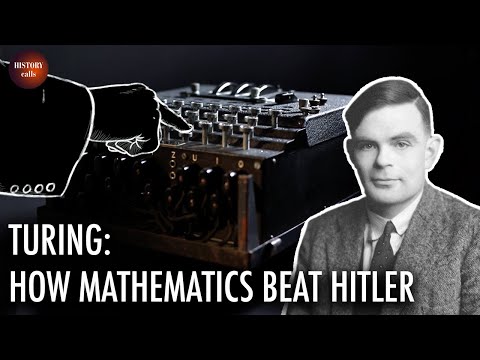
To understand Turing’s impact, we must first go back to the battlefields—not of Normandy, but of the North Atlantic. Here, German U-boats prowled the icy waters, sinking Allied supply ships at an alarming rate. The wolf packs, as they were called, threatened to starve Britain into submission. The key to stopping them lay in breaking the Enigma code, a cipher so complex that it seemed unbreakable.
Enigma was a machine that could scramble messages in a staggering number of ways—one thousand million million million, to be precise. Even with a captured machine, the Allies were stuck. That is, until Turing arrived at Bletchley Park, a Victorian mansion turned code-breaking factory. Here, among a motley crew of linguists, chess champions, and crossword fanatics, Turing would face the greatest puzzle of his life.
Turing was not like the others. He wore a gas mask to ward off hay fever, chained his mug to a radiator, and ran marathons at an Olympic level. But his eccentricities hid a brilliant mind. Convinced that machines could think, he designed a device called the Bombe—an electromechanical machine that could test thousands of Enigma settings in hours. It was a machine to fight a machine, and it worked.
By 1941, the Bombe was decrypting tens of thousands of German messages, giving the Allies unprecedented insight into enemy plans. But the naval Enigma, used by U-boats, remained stubbornly secure. Turing, ever the lone wolf, locked himself in Hut 8 and worked day and night. Then, one night, he cracked it. He broke the naval Enigma and invented a statistical method called Banburismus, a double breakthrough that would turn the tide of the Atlantic.
With U-boat positions now known, Allied convoys could slip past the wolf packs. In the 23 days after the first naval decryption, no German submarine spotted an Allied convoy. The Battle of the Atlantic was far from over, but the balance had shifted. And Turing was just getting started.
As the war raged on, Bletchley Park grew into an industrial code-breaking operation, and Turing tackled new challenges—including the even more complex Lorenz cipher. His work would lead to Colossus, the world’s first electronic computer, and help deceive Hitler about the true location of the D-Day landings. But despite his contributions, Turing’s story would take a tragic turn. In 1952, he was convicted of homosexuality and subjected to chemical castration. His life ended in mystery, but his legacy would endure.
This is the story of a man who thought machines could think—and in doing so, changed the world. But how exactly did he crack the unbreakable code? And what price did he pay for his genius? The answers lie ahead.
To understand how Turing cracked the naval Enigma, you have to understand the machine itself. Enigma was not a single device but a family of them, each network with its own keys and procedures. The U-boat version, code-named Dolphin at Bletchley, was the most stubborn of all. Its operators were disciplined, its settings changed daily, and its messages were short and clipped—giving the codebreakers almost nothing to grip.
Turing moved into Hut 8 and made it his fortress. He worked alone through the night, surrounded by stacks of intercepted messages that looked like gibberish. Colleagues remembered him cycling in at odd hours, sometimes with a tea mug chained to his belt, sometimes arguing with himself about probability. He was not waiting for inspiration. He was hunting for patterns.
The breakthrough came in two parts. First, Turing realized that the naval Enigma had a flaw in its indicator system—the way operators encoded the starting position of the rotors. That flaw gave him a wedge. Second, he developed a statistical technique called Banburismus, which compared the frequency of letters across two messages to find where they aligned. In a language, some letters appear more often than others, and Turing used that human weakness to crack a machine’s logic.
But the real turning point was not a mathematical insight alone. It was a stroke of luck. In the spring of 1941, the British captured German trawlers and, soon after, a damaged U-boat. From these prizes came Enigma machines, codebooks, and, most precious of all, the keys for months of naval traffic. Turing and his team now had the missing pieces.
With the Bombe machines grinding through possibilities and the captured keys filling in the gaps, Hut 8 began reading U-boat messages daily. The Admiralty could now plot the positions of the wolf packs in near real time. Convoys were rerouted around ambushes. In the 23 days after the first naval decryption, not a single Allied convoy was spotted by a German submarine.
The impact was immediate and measurable. Post-war analysis showed that roughly 30 percent of convoy tonnage that would have been sunk was saved. The Battle of the Atlantic did not end overnight—the U-boats would return with new tactics and new technology—but the Allies had seized the initiative. And the man behind it was a mathematician who had never set foot on a ship.
Yet Turing did not stop there. As the war expanded, so did the code-breaking challenge. The Germans introduced a new cipher machine, the Lorenz, used by Hitler’s high command. Unlike Enigma, it did not use Morse code but a digital teletype signal—a strange, burbling music in the headphones. Turing was called in again, and within weeks he devised a method to break it. His work would lead to Colossus, the first electronic computer, and help the Allies read the most secret communications of the German general staff.
By 1944, the intelligence flowing out of Bletchley Park was shaping the largest invasion in history. Operation Fortitude, the grand deception that convinced Hitler the landings would come at Calais, was fine-tuned by reading German reactions in real time. When the first waves hit Normandy on June 6, the German reserves were held back, waiting for an attack that would never come. Turing heard the news like everyone else—but few knew how much of it was his doing.
Victory in Europe came in May 1945, and the crowds celebrated. Turing was not among the heroes paraded before the cameras. Instead, he slipped back into civilian life, his wartime work sealed under the Official Secrets Act. The world moved on, and the man who had helped save it was left to face a quieter, crueler battle—one that would end in a locked bedroom in Manchester, with a half-eaten apple on the nightstand.
But that dark ending was still years away. In the summer of 1945, Turing was already thinking about the next war—the Cold War—and the strange new machines it would require. The Germans had surrendered, but their cipher machines did not vanish. As Soviet forces pushed west, they captured Lorenz and Enigma equipment by the thousands. Within months, Russian engineers had reconditioned them, changed their wiring, and put them back into service. The same machines Turing had broken were now encoding Soviet secrets.
At Bletchley Park, the staff shrank but did not disappear. The codebreakers who remained turned their attention eastward, and Turing briefly joined them. Yet his mind was drifting elsewhere—toward a question that had haunted him since Cambridge: could a machine think? The war had proven that machines could out-calculate humans, out-search humans, even out-guess humans. But could they reason?
In 1945, he drafted a detailed plan for an electronic computer—the Automatic Computing Engine, or ACE. It would have been the first modern stored-program computer, a machine that kept both data and instructions in its memory. It was, by any measure, decades ahead of its time. He submitted the design to the National Physical Laboratory and waited.
The wait was painful. The NPL bureaucracy moved slowly, and rival projects—some of them far less ambitious—received funding first. Turing’s ACE was shelved, then watered down, then quietly abandoned in its original form. A smaller version was eventually built, but by then the world’s first stored-program computer had been completed elsewhere. Turing’s vision had been correct; the timing had not.
Frustrated, he left for Manchester in 1948, joining a team building one of Britain’s first practical computers. There he wrote software—real programs, running on real hardware—and began to think seriously about artificial intelligence. In 1950, he published a paper that opened with a deceptively simple question: “Can machines think?” To answer it, he proposed a game. A human judge would exchange text messages with two hidden entities—one a person, one a machine. If the judge could not reliably tell them apart, the machine had passed. The test would later bear his name.
His colleagues were not impressed. One director dismissed his work as “a schoolboy’s essay.” Another called his chess program—the first ever written—a waste of time. Turing ignored them. He was used to being underestimated.
By 1950 he had also turned to a new obsession: the mathematics of life itself. He began studying how patterns form in nature—the stripes of a zebra, the spots of a leopard, the whorls of a sunflower. He proposed that simple chemical reactions, governed by simple equations, could spontaneously produce complex shapes. It was a radical idea, and it would take biologists another thirty years to catch up.
In his spare time, he ran. Not casually, but competitively. He clocked a marathon in just under two hours and forty-six minutes—a time that would have placed him near the top of the 1948 Olympic field, had he been selected. He ran to think, he said. The rhythm of his feet loosened the knots in his mind.
But the war had left him with secrets he could not share, and peacetime left him with a freedom he did not know how to handle. He was famous in a small circle, anonymous in the wider world, and increasingly alone. Then, in December 1951, he met a young man named Arnold Murray outside a cinema in Manchester. What began as a casual encounter would end in a courtroom—and change everything.
The arrest came in early 1952. A burglary at Turing’s home led police to question his relationship with Murray, and Turing, with characteristic honesty, made no attempt to hide it. He was charged with “gross indecency” under a Victorian law that criminalized homosexuality. He stood trial, was convicted, and was offered a choice: prison, or a course of hormone injections designed to suppress his desires.
He chose the injections. He believed he could endure them. He was wrong.
The treatment lasted a year. His body changed—weight gain, breast growth—and his mind, already prone to dark spirals, grew heavier. “I am not in a state in which I am able to concentrate well,” he wrote to a friend. “No doubt I shall emerge from it all a different man, but quite who I’ve not found out.”
He kept working, kept running, kept thinking about machines and minds. But the joy had gone out of it. On June 8, 1954, his housekeeper found him dead in bed. A half-eaten apple sat on the nightstand, laced with cyanide. The verdict: suicide. The truth, like so much of his life, remains locked away.
In 2013, the Queen granted him a royal pardon. It was too late, of course—but it was something. Turing’s story is now told in museums and movies, his face on banknotes. Yet the question he asked in 1950 still hangs in the air, unanswered and urgent: Can machines think? And if they can—what then?
What do you think Turing would make of today’s AI? Would he be proud, or terrified? Tell us in the comments.






