You’ve seen the dazzling smiles, the perfect poses, the carefully crafted public images. But what about the moments between the flashbulbs? The unguarded glances, the quiet dinners, the private joys and sorrows that Hollywood’s biggest stars fought to keep out of the spotlight? For decades, these rare photographs have been locked away in studio vaults, private collections, and forgotten archives, deemed too revealing, too intimate, or simply too real for public consumption. Now, for the first time, we’re pulling back the curtain on a century of secrets.
From the 1930s to the 1970s, Tinseltown was a factory of dreams, but also a fortress of secrets. Studio bosses controlled every aspect of their stars’ lives, from who they dated to what they wore, and especially what the public was allowed to see. Any image that threatened the carefully constructed illusion was swiftly suppressed. But some photos slipped through the cracks, saved by chance or by those who believed the world deserved to see the truth behind the legend.
Take Cary Grant, the epitome of suave sophistication. On screen, he was the ultimate leading man, but off screen, he cherished quiet dinners and private moments with those he loved most—far from the paparazzi’s lens. “He would often slip away to a small beach house in Santa Monica, where he could just be himself,” recalls a close friend. “No tuxedos, no autographs. Just Cary, barefoot and laughing.” Those moments were never meant to be shared, but a handful of candid snapshots survived, offering a glimpse of the man behind the myth.
Then there’s Sophia Loren, the Italian goddess whose beauty and talent captivated the world. Despite her international fame, she remained fiercely devoted to her family, shielding her children from the relentless glare of publicity. “Sophia would wake up at dawn to make breakfast for her sons before any interview or photo shoot,” a longtime assistant reveals. “She said those quiet mornings were her real red-carpet moments.” The photos that capture these tender scenes are among the rarest, hidden for decades to protect her family’s privacy.
But the secrets don’t stop there. From the clandestine romances that studios forbade to the political activism that could ruin careers, each photo tells a story of rebellion and resilience. Some images were destroyed, others buried in vaults so deep that even the stars themselves forgot they existed. Until now.
As we delve into this treasure trove of forgotten moments, you’ll see a side of Hollywood you’ve never imagined. The laughter, the tears, the quiet acts of defiance—all captured in fleeting frames that were never meant for our eyes. But perhaps that’s what makes them so compelling: they remind us that behind the glitter, these icons were human, just like us.
So dim the lights, silence your phone, and prepare to travel back in time. What you’re about to see will change the way you think about the golden age of Hollywood forever. And who knows? You might just recognize a familiar face in a way you never have before.
Consider the photographs that never should have survived. In the 1940s, a young studio archivist named Margaret Holloway was tasked with cataloging and, in some cases, destroying thousands of negatives deemed unsuitable for public release. “She kept a locked drawer in her desk,” her granddaughter later recalled. “When she passed away, we found it filled with envelopes labeled only with dates and initials. No names. No context. Just faces.” Among those envelopes was a single frame of Katharine Hepburn, seated alone on the steps of a soundstage, her expression unreadable, the glamour stripped away. It was never published. It was never meant to be.
What makes these images so powerful isn’t their rarity—it’s their honesty. In an era when every public appearance was choreographed, a candid photograph was an act of rebellion. Some stars fought to reclaim their own images; others simply gave up, surrendering their private lives to the machinery of fame. But a few found ways to outsmart the system entirely.
Clark Gable, for instance, famously detested the studio’s grip on his personal life. “He once drove three hours in the middle of the night just to visit a friend in the hospital without anyone knowing,” a biographer notes. “No press, no photographers. He said that was the only way he could feel like a real person.” The handful of photos from that visit, taken by a nurse with a hidden camera, show a side of Gable the world rarely saw: tired, unguarded, and deeply human.
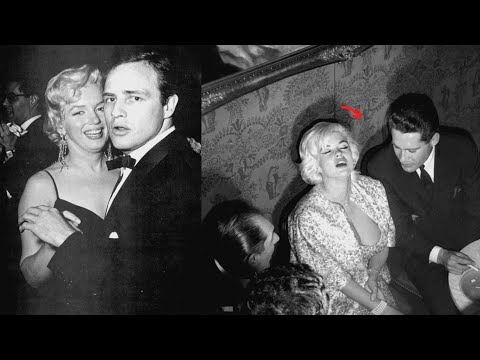
And then there are the photographs that tell a darker story. The ones that reveal the toll of fame—the exhaustion, the loneliness, the quiet struggles that no press release could conceal. Marilyn Monroe’s final years are well documented, but some of the most haunting images remain hidden, too painful for public display. “She would sit for hours in front of the mirror, not saying a word,” a makeup artist remembered. “Just looking at herself, like she was searching for someone she’d lost.” Those moments were captured by a friend, not a photographer. They were never sold, never published. They simply exist, a silent testament to a woman who gave everything to an industry that never truly knew her.
These are the stories that the studio system tried to erase. But photographs have a way of surviving. They hide in shoeboxes, in forgotten filing cabinets, in the hands of those who understood their value long before the world did. And now, they’re finally seeing the light of day.
But perhaps the most astonishing discovery came from a dusty attic in Pasadena, where a retired prop master’s estate yielded a battered metal box labeled simply “Do Not Open — 1954.” Inside were dozens of contact sheets from a long-forgotten studio party, the kind of glittering affair where cameras were strictly forbidden. Yet there they were: candid frames of Audrey Hepburn mid-laugh, Grace Kelly sneaking a cigarette on a balcony, and a young James Dean leaning against a wall, utterly alone in a room full of people.
What makes these images extraordinary isn’t just who they show—it’s what they reveal about the machinery of fame. Every frame was marked with a small red X in the corner, the studio’s shorthand for “destroy on sight.” Someone had defied orders. Someone had risked their career to preserve a fleeting truth.
And that someone, it turns out, wasn’t alone. Across Hollywood, a quiet network of photographers, assistants, and archivists operated in the shadows, smuggling negatives out in coat linings and lunch boxes. “They called themselves the ‘Tuesday Club,'” a film historian explains. “They met in the back room of a diner on Melrose. No minutes, no membership list. Just a shared belief that the public deserved to see the real people behind the posters.”
Their efforts came at a cost. Some were fired. Others were blacklisted. One photographer, whose name has been lost to time, reportedly had his entire life’s work confiscated by studio security and burned in a backlot incinerator. But he kept one negative hidden in the lining of his fedora—a single shot of Frank Sinatra, eyes closed, singing softly to himself in an empty rehearsal hall. It survived. It always survives.
Today, these images feel less like relics and more like messages in a bottle. They remind us that the golden age of Hollywood wasn’t just about glamour—it was about people fighting to hold onto something real in a world designed to manufacture illusion. And as we continue to unearth these forgotten frames, one thing becomes clear: the story of Hollywood’s secrets is still being written, one hidden photograph at a time.
The Tuesday Club’s greatest triumph, however, was never a single photograph. It was a ritual. “Every time they saved a negative, they’d raise a glass of cheap bourbon and whisper, ‘For the ones who came after,’” the historian says. They knew they might never see the results. They did it anyway.
That spirit lives on today. When a cache of 300 never-before-seen negatives surfaced at a flea market in 2019, collectors and archivists raced to identify the faces. Among them was a young, unknown actress named Norma Jeane—years before she became Marilyn—laughing with her first husband in a cramped apartment kitchen. “It’s the only photo we have of her truly carefree,” a curator notes. “No pose. No performance. Just joy.”
These discoveries remind us that the past isn’t fixed. Every attic, every shoebox, every locked drawer might hold another piece of the puzzle. The golden age of Hollywood didn’t end—it’s still being revealed, frame by frame, by those who refuse to let the truth fade.
So the next time you watch a classic film, look closely at the background. The extras, the crew, the fleeting shadows. Somewhere in those frames, a hidden story waits. And thanks to a quiet network of rebels, it might just find its way to you.
Which forgotten star’s private moment would you most want to see uncovered next—and why? Tell us in the comments below.






