Northern Italy, early 1960s. A wealthy industrialist’s Ferrari breaks down again—clutch slipping, burning out, another expensive trip back to Maranello. Frustrated, he has it opened up and finds a part he recognizes: a clutch much like the ones in his own tractors. Ferrari charges a fortune for it. His name? Ferruccio Lamborghini. He builds tractors. And when he complains to Enzo Ferrari himself, the most powerful name in Italian motoring, he is told, more or less, to go back to his farm machines.
That insult would spark one of the most legendary rivalries in automotive history. But the story is far stranger than the feud. By 1974, Ferruccio owned not a single share of the car company bearing his name. In 2024, one of his cars sold at auction for $4.9 million. The tractor fortune that gave him the power to challenge Ferrari was the same fortune whose collapse took the bull away from him.
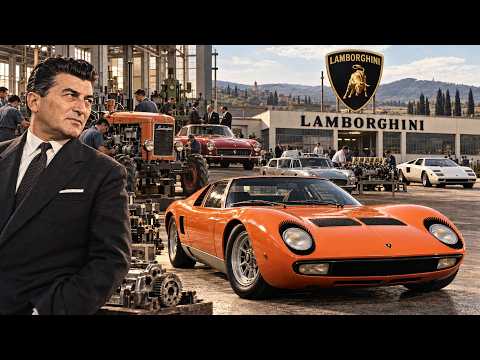
This is the story of a farmer’s son who built the most outrageous cars on Earth to settle a score—and then lost them just as the wildest one was coming to life. The feud everyone remembers is not the thing that beat him.
The village of Renazzo does not look like the birthplace of a legend. Flat farm country in Emilia-Romagna, northern Italy, rows of vines, dirt roads that turn to mud every spring. On April 28, 1916, Ferruccio Elio Arturo Lamborghini was born into that world. His parents were grape farmers. They were not poor, but not comfortable either. Italy was in the middle of the First World War. Money was tight, labor was hard, and the future of a farm family was supposed to be simple: the oldest son grows up, takes over the vines.
Ferruccio had other ideas. The boy showed little interest in the soil and enormous interest in the machines that worked it. Plows, pumps, anything with gears. He wanted to know how things moved, why they broke, and how to make them run again. His parents did not force him to stay on the land. Instead, he went to study mechanics at a technical institute near Bologna. For a farm boy from Renazzo, it was a real opportunity.
He learned fast. Engines, gearboxes, electrical systems. And he learned something that would shape the rest of his career: A machine is not magic. It is a set of parts. If you understand the parts, you can fix almost anything.
Then the war came for him. In 1940, Italy entered the Second World War. Ferruccio, now in his mid-20s, was drafted into the Regia Aeronautica, the Italian Royal Air Force. The military did not send him to fly—it sent him to fix. His posting was the island of Rhodes, in the Aegean Sea. Planes, trucks, and supply vehicles all depended on a handful of mechanics working far from home. Ferruccio was assigned to the vehicle maintenance unit.
Rhodes was an island at war. Supply ships did not always arrive. Spare parts ran short, and then they ran out. When a truck broke down, there was often no replacement waiting in a crate. A mechanic had two choices: leave the vehicle dead or improvise. Ferruccio improvised. He pulled usable pieces from wrecks. He adapted parts from one machine to fit another. He kept engines alive long after they should have quit.
The skill he built on that island was not elegance. It was survival. Make it work with what you have because nothing else is coming. He did not know it yet, but that would become his entire business model.
The war turned against Italy. In September 1943, the Italian government signed an armistice with the Allies, and German forces moved quickly to seize control of Italian-held territory. Rhodes fell under German command. Ferruccio stayed on the island through all of it. When the war in Europe ended in 1945, the island passed into British hands, and Ferruccio became a prisoner of war. He had left Italy as a young mechanic. He would not set foot on home soil again until 1946. He was 30 years old.
He came back to a country in ruins. Bridges were down. Factories were bombed out. Farms across northern Italy had lost their horses, their equipment, and in many cases the men who used to run them. Food production had collapsed, and the nation needed to feed itself before it could rebuild anything else. Most returning soldiers saw that wreckage and felt despair. Ferruccio saw something else.
All across Italy the armies had left their machines behind. Trucks, engines, transmissions. Whole vehicles abandoned in fields and depots, rusting where they stopped. To a farmer it was junk. To a man who had spent five years keeping dead machines alive on an island with no spare parts, it looked like raw material.
He had no factory. He had no workers. He had no money to speak of. What he had was an idea—and it would make him one of the richest men in Italy.
He started in a small workshop in Pieve di Cento, a town a few miles from the farm where he was born. At first it was ordinary work: fixing cars, repairing engines, keeping the few machines that survived the war running a little longer. In 1946 that was enough to earn a living. Northern Italy was full of broken equipment and very short on people who knew how to bring it back.
But Ferruccio was watching the farms. Italian agriculture was in desperate shape. Horses and oxen had been lost to the war. The tractors that existed were old, scarce, or imported at prices ordinary farmers could never pay. The country needed to grow food fast, and it needed machines to do it. Meanwhile the military surplus sat everywhere. Most people saw scrap. Ferruccio saw a supply chain.
The idea was simple and it came straight out of Rhodes. Take the leftover machinery of the war, strip it down to its useful parts, rebuild those parts into something a farmer could afford—a tractor. He bought surplus vehicles. He took them apart. He reworked the engines and drive trains and rebuilt them into working farm machines. They were not elegant. They were not pretty. But they ran, they pulled, and they cost far less than anything new.
Then came the tragedy that almost no one remembers. In 1947, Ferruccio’s young wife, Clelia, died shortly after giving birth to their son, Tonino. Ferruccio was a widower with a newborn and a business that barely existed yet. He did not stop. He threw himself into the work. And in 1948, he formally founded Lamborghini Trattori.
His first real model was called the Carioca. It was built largely from surplus military components, and it carried a clever piece of practical engineering: the engine started on gasoline, then switched over to a cheaper fuel once it was warm. For a farmer counting every lira, that mattered more than horsepower. The machine was cheap to buy and cheap to run. The farmers bought them, then they bought more.
As the surplus supply began to dry up, Ferruccio did what every serious manufacturer eventually does. He stopped relying on scrap. He started building his own engines and his own components. The workshop became a factory. The factory grew. Through the 1950s, Lamborghini tractors rolled out across Italy, and the name on the hood became familiar on farms from Emilia-Romagna to the south. The farm boy who did not want to work the land was now selling the machines that worked it.
He kept going. In 1959, Ferruccio launched a second company, Lamborghini Bruciatori, building oil burners and heating systems. It later moved into air conditioning. Post-war Italy was rebuilding its homes, offices, and factories, and all of them needed heat. Once again, Ferruccio had read the market before anyone else. By the early 1960s, he was one of the wealthiest industrialists in Italy.
And he spent his money the way a mechanic would. He bought cars—fast ones, the best that European engineering could offer. Over the years, his garage reportedly held names like Alfa Romeo, Lancia, Mercedes-Benz, Jaguar, Maserati, and Ferrari. To most rich men of that era, a Ferrari was the finish line. The final proof that you had made it. You bought one, you parked it in front of your villa, and you let the neighbors look.
Ferruccio did not see it that way. To him, a Ferrari was just another machine. A beautiful one, an expensive one, but still a set of parts. And when parts fail, a mechanic wants to know why. His Ferraris, by his own account, failed more than they should have. The car was fast, the car was stunning, and the car kept going back to the shop. For a man who had built an empire on machines that simply would not quit, that was not a small annoyance. It was an insult to everything he believed about engineering.
So, one day he decided to look inside. What he claimed he found there would launch one of the most famous rivalries in automotive history.
Here is the story the way Ferruccio told it. His Ferrari had a clutch problem—not once, but again and again. The car would go back to Maranello, come back fixed, then the clutch would wear out again. Eventually, Ferruccio had his own mechanics take it apart. And according to his telling, when they opened it up, they found something he recognized. The clutch inside the most exclusive sports car in Italy was, in his words, similar to the kind he was already buying for his tractors. The difference was the price. Ferrari charged a fortune for the replacement. Ferruccio paid a fraction of that for comparable parts in his own factory.
For a man who knew exactly what parts cost, that was hard to swallow. So he went to see Enzo Ferrari. This is the moment the legend turns on, and it is worth being careful here. There is no recording. No transcript. No account from Ferrari’s side. Everything we know comes from Ferruccio himself, in interviews he gave years later, and from his son Tonino, who repeated the story long after his father was gone.
In that version, Ferruccio made his complaint, and Enzo—proud, famously difficult, used to being treated like royalty—brushed him off. The message, as Ferruccio remembered it, was that the problem was not the car. It was the driver. And a man who built tractors should leave sports cars to the people who understood them. That was the insult. Whether those were Enzo’s real words, or whether time and retelling sharpened them, we cannot know. What we do know is what Ferruccio did next.
It is also worth noting that Ferruccio himself gave a second reason, a far less dramatic one. He said he could see that cars like Ferraris carried huge profit margins. Parts that cost a little sold for a lot. A businessman who already had the factories, the engineers, and the money could build a better grand touring car and sell it at a healthy profit. Pride and profit. Both stories can be true at the same time. And for the rest of this story, keep both in mind—because they will pull in opposite directions when the trouble comes.
Now, here is where the tale gets strange. In the spring of 1963, Ferrari was in talks with another very powerful man who wanted a piece of Maranello. Henry Ford II, of Ford Motor Company, was negotiating to buy Ferrari outright to gain instant credibility in European racing. The deal came close. Then in May 1963, Enzo Ferrari walked away from it, unwilling to give up control of his racing program. Henry Ford II did not take the rejection quietly. He decided to beat Ferrari on the track—and that decision would lead straight to the Ford GT40 and the 24 Hours of Le Mans.
That same year, a tractor maker in Emilia-Romagna decided to beat Ferrari on the road. Two very different men. Two very different fortunes. Both rejected by Enzo Ferrari, at least in their own minds. Both determined to prove him wrong.
In 1963, Ferruccio founded Automobili Ferruccio Lamborghini. He chose a site in Sant’Agata Bolognese, a small farming town between Bologna and Modena. It was not a random choice. It placed his new factory in the same corner of Italy where Ferrari and Maserati already built their cars, inside the region that had become Italy’s high-performance heartland. The message was not subtle. He wanted to compete in Ferrari’s backyard.
For the badge, he did not choose a horse. He chose a bull. Ferruccio was born in late April under the sign of Taurus, and he was drawn to the raw power of the fighting bull—a charging animal against a prancing one. Again, the message was not subtle.
Now, look closely at how this was paid for. The new car company did not raise money from investors. It did not take loans from a bank betting on a startup. It was funded by Ferruccio’s existing businesses—by the burners and heating systems, and above all, by the tractors. Every new building in Sant’Agata, every machine tool, every engineer’s salary was backed by the money flowing in from Italian farms. That was the great advantage he had over almost every small sports car maker in Europe. Most of them lived from one race to the next, one season to the next, one sale to the next. Ferruccio did not have to. If the car company lost money for a while, the tractors could carry it.
That was the strength. It was also the weakness. Because a company built on one fortune stands only as long as that fortune does. But in 1963, nobody was thinking about that.
Ferruccio had a factory site, a bull for a badge, and an enormous point to prove. What he still needed was an engine. And to build it, he went looking for a man who had already built some of the most famous engines and cars in Ferrari’s history—a man Ferrari had fired.
Giotto Bizzarrini knew Ferrari from the inside. He was an engineer from Tuscany, trained at the University of Pisa, and during the late 1950s and early 1960s he had been one of the most important technical minds at Maranello. He worked on the development of the Ferrari 250 GTO, the car that would become one of the most valuable automobiles ever sold. Then, in late 1961, Bizzarrini and several of Ferrari’s senior staff were pushed out of the company in a bitter internal dispute. It was one of the great shakeups in Ferrari’s history.
Enzo Ferrari’s loss was available for hire. Ferruccio hired him to design a V12 engine—not a six, not a V8, a V12, the same layout that defined Ferrari’s road cars. If Ferruccio was going to fight Enzo, he was going to fight him with the same weapon. Bizzarrini delivered. His engine displaced about 3.5 liters, roughly 213 cubic inches. It had four overhead camshafts, two per cylinder bank, at a time when many Ferrari road engines still used just one per bank. It revved high. It made big power. In its first form, it was closer to a racing engine than a road engine.
And that was exactly the problem. Ferruccio did not want a race car. He was not building a company to win at Le Mans. He wanted a refined grand tourer—a car a wealthy man could drive across Europe in comfort, fast, quiet, and reliable. Everything his Ferraris were supposed to be, and in his opinion, were not. Bizzarrini had built an engine for the track. The two men did not see eye to eye. Bizzarrini soon moved on to other projects and eventually to cars bearing his own name. But his engine stayed behind. And versions of that same basic V12 architecture would power Lamborghini’s flagship cars for decades to come.
Before the engine could be tamed, though, the company had to show the world something. In October 1963, at the Turin Motor Show, Automobili Ferruccio Lamborghini unveiled its first car. It was called the 350 GTV. The body was designed by Franco Scaglione and built by a small coachbuilding shop called Sargiotto. It was supposed to be the moment the bull announced itself. It was not.
The styling divided opinion, and much of the reaction was lukewarm at best. The proportions looked awkward to many critics. And the car carried a story that has followed it ever since. As it is commonly told, the engine did not properly fit under the hood. So the car was displayed with the hood closed—and the engine not installed at all. Whether every detail of that tale is exact, the larger point is not in dispute. The first Lamborghini was not ready.
Ferruccio was a businessman. He knew a dead end when he saw one. The 350 GTV would never go into production as shown. He needed a new team. What he assembled next was one of the most unusual engineering groups in automotive history. It was young—shockingly young.
Gian Paolo Dallara was in his mid-20s. He had already worked at Ferrari and at Maserati, and he understood chassis design at a level few engineers his age could match. Ferruccio made him the technical lead. Alongside him was Paolo Stanzani, another young engineer from the region who would become one of the most important figures in the company’s history. And then there was Bob Wallace. Wallace was a New Zealander, a mechanic and test driver who had worked around the Italian racing scene, including time near Ferrari and Maserati. He did not have the title of chief engineer. He had something more valuable. He could drive a car hard, feel what was wrong with it, and tell the engineers exactly what to fix.
Three young men, one furious tractor maker, and an engine nobody had yet made civilized. They went to work. Dallara and Stanzani reworked Bizzarrini’s V12 for road use. They brought the power down to a more manageable level and made the engine more practical to build and to live with. Dallara reworked the chassis. Wallace drove the prototypes for mile after mile, testing, reporting, and testing again. The body was redesigned, too. This time the job went to Carrozzeria Touring of Milan, one of the most respected coachbuilders in Italy, famous for its lightweight construction methods. Meanwhile, in Sant’Agata Bolognese, the factory rose out of the farmland. A modern plant built from scratch, paid for by tractors.
In March 1964, at the Geneva Motor Show, Lamborghini tried again. The car was called the 350 GT. This time the reaction was very different. The styling was smoother, more balanced, more mature. The engine produced about 270 horsepower. The car was fast, comfortable, and built with the kind of quality Ferruccio had demanded from the start. It was not a sensation, but it was serious. People began to take the tractor maker seriously, too.
Between 1964 and 1966, Lamborghini built around 120 examples of the 350 GT. For a car maker, that is tiny. For a company that had not existed two years earlier, it was proof of life. The 350 GT was followed by the larger-engine 400 GT, with the V12 enlarged to about 4 liters. The car sold. The factory worked. The bull had arrived.
But inside the company, something else was happening. Ferruccio had built exactly what he wanted: a refined front-engine grand tourer. Fast, comfortable, civilized. A businessman’s car. His young engineers wanted something else entirely. They wanted to build a car that would make the whole world stop and stare. And they were about to start building it without asking permission.
The project had a code name: P400. The letter P stood for posteriore—Italian for rear. The number 400 pointed to the engine size, roughly 4 liters. And the idea behind it broke almost every rule Ferruccio had set for his company. Dallara, Stanzani, and Wallace wanted to put the engine behind the driver.
Here is why that mattered. In almost every road car of the era, the engine sat up front under the hood. It was the standard layout. It was easy to build, easy to service, and it left room for passengers and luggage. But it had a cost. All that weight up front made a car less balanced. The front tires carried too much of the load. In hard corners, a front-engine car wanted to push wide.
Race cars had already solved that problem. By the mid-1960s, the fastest racing machines in the world put the engine in the middle of the car, between the driver and the rear wheels. Weight sat close to the center. The car turned more sharply. It felt lighter, more agile, more alive. The young engineers asked a simple question: why not do that on the road?
There was one big obstacle. A V12 is long. Put it in the middle of a car pointing front to back, and the car grows too long to be practical. So they turned it sideways. The engine was mounted transversely across the car, right behind the seats. The gearbox and the differential were packed in with it as a single unit. It is often said the inspiration came from an unlikely place: the tiny British Mini of 1959, which had used a sideways engine to save space in a car for ordinary families. The same trick applied to a 12-cylinder supercar was radical.
Now, the crucial detail. The three men largely worked on this in their own time, after hours. Ferruccio was not against them experimenting, but he did not share their passion for it. He had built his company on refined front-engine grand tourers. He had no interest in racing, and a mid-engine car looked to him like exactly the sort of race-bred machine he had told everyone he was not going to build. By most accounts, he let them continue believing it might be a useful attention-grabber that would sell in small numbers at best. He did not think it would change anything.
In November 1965, Lamborghini brought the P400 to the Turin Motor Show. There was no body. It was a bare rolling chassis. A steel frame drilled full of holes to save weight, suspension, wheels, and that transverse V12 sitting right behind where the driver’s seat would go. It should have been a footnote. Instead, it drew crowds. People stood around a car with no body and talked about it like it was finished. Coachbuilders started asking who would get to dress it. Some potential buyers reportedly wanted to place orders on the spot for a car they had never actually seen.
The job of designing the body went to Carrozzeria Bertone in Turin. At Bertone, the work fell to a young designer named Marcello Gandini, still in his 20s. Some historians have also pointed to early work at Bertone by Giorgetto Giugiaro, who left the firm around that time. The question of exactly who did what has been debated. But the finished shape is overwhelmingly credited to Gandini. And what a shape it was. Low—impossibly low—long and smooth, with a short nose and the engine visible through slats behind the cabin. Headlights that folded flat, black louvers around them that people called eyelashes. It looked less like a car than a living creature caught mid-leap.
In March 1966, at the Geneva Motor Show, Lamborghini revealed it to the world. It needed a name. Ferruccio, who loved bulls in the Spanish tradition of the bullfight, chose Miura. The name came from a famous Spanish ranch that bred some of the fiercest fighting bulls in the world. The Miura line was legendary for its strength and its danger. It was the perfect name for a car that had been born almost by accident.
Because here is the irony at the heart of this chapter. Ferruccio Lamborghini built his company to make polite, reliable, refined grand tourers—to prove he could do Ferrari’s job better. The car that would make his name immortal was the one he had never asked for. His engineers built it on their own time. He allowed it as a curiosity. And the curiosity was about to become the most talked-about car on the planet.
The question was whether it could actually deliver on the promise of its shape. To answer that, you have to look at the numbers. And when you stack them up against the best that America and Ferrari had to offer, the gap is staggering. On paper, the Miura was a monster. The production P400 used a version of the V12 enlarged to 3,929 cubic centimeters—about 240 cubic inches. It was rated at 350 horsepower. Lamborghini claimed a top speed of about 171 miles per hour. In 1966, those were not road car numbers. Those were race car numbers. And it delivered them in a body that stood only about 41 inches tall. Shorter than the hood of many American sedans of the day.
Now put it next to America’s best. In 1966, the king of American performance was the Chevrolet Corvette Stingray. Ordered with the big-block 427 V8, the top engine choice was rated at 425 horsepower. That is more horsepower than the Miura—from a far bigger engine. The Corvette’s 427 cubic inches came close to doubling the Miura’s 240. Two completely different philosophies. The American answer to speed was displacement. Build a big engine, give it room to breathe, and let torque do the work. It was cheap to make, easy to fix, and devastating in a straight line. The Italian answer was precision. A smaller engine, 12 cylinders, four camshafts, spinning higher and harder. Then put it in the middle of the car for balance.
The Corvette was a front-engine car. The weight sat up front like nearly every road car on Earth. The Miura carried its engine right behind the driver, the way a race car did. And then there was the price. A 1967 Corvette coupe started at about $4,400 before options. A Miura in America cost around $20,000. Several Corvettes for the price of one Italian bull. That was not a weakness. That was the point. The Corvette was a sports car for the American middle class. The Miura was a statement for the richest drivers in the world. It was never meant to beat the Corvette in a showroom. It was meant to beat everyone in the imagination.
The closest American rival in spirit was not a Chevrolet at all. It was the Ford GT40. Remember Henry Ford II and his feud with Enzo Ferrari. The GT40 was the result. It was mid-engine, low, and built to win at Le Mans. And in June 1966, just months after the Miura’s debut, Ford finished first, second, and third at the 24 Hours of Le Mans. Ford had beaten Ferrari on the racetrack. But the GT40 was a racing machine first. Road-going versions existed, but they were rare, loud, raw, and never meant to be a regular showroom model.
What Lamborghini did with the Miura was take the race car idea—mid-engine, low body, enormous speed—and sell it as a road car to customers who would drive it on public streets. That is why so many people consider the Miura the first true supercar. In fact, motoring legend often credits the British writer L.J.K. Setright with being among the first to use the word supercar in print to describe it.
There was a price for all that ambition. Early Miuras were not perfect. At very high speeds, drivers reported that the front end could get light, making the steering feel vague just when you needed it most. The cabin could get hot with a big V12 sitting inches behind your head. And the car demanded skill. It rewarded a good driver. It punished a careless one. Remember that if you have ever been behind the wheel of one. We will come back to it.
But none of those flaws slowed demand. Lamborghini had planned on a small run. Instead, orders came pouring in. The P400 alone would reach 275 examples—far more than anyone at the factory had expected. The tractor maker who had promised to build quiet, polite grand tourers now had the most famous car in the world. And he was about to do something that no car maker had ever dared. He was going to park it outside the most exclusive event in motorsport and let the world come to him.
Monaco, May 1966. The Grand Prix weekend. There was no more glamorous event in motorsport. A Formula 1 race run not on a purpose-built circuit, but through the narrow streets of a tiny principality on the French Riviera. Past the harbor full of yachts, through the tunnel, up the hill to the square in front of the famous Monte Carlo Casino. Every year the richest people in Europe came to watch. Bankers, royalty, film stars, industrialists—exactly the kind of buyers who might spend a small fortune on a car. And every serious manufacturer wanted to be seen there.
Ferrari belonged at Monaco. Ferrari was racing. Lamborghini was not. Ferruccio had made that clear from the start. No racing, no factory team, no money burned on the track. So how do you make an entrance at a race you are not competing in? As the story is usually told, you drive in. A Miura painted a bright, impossible-to-miss orange made its way to Monaco. Bob Wallace, the New Zealand test driver who knew the car better than anyone, was closely involved. And the car was brought right into the heart of the action and parked where it could not be ignored—in the area around the casino and the Hotel de Paris. It was a prototype. The production run had not even properly begun. It did not matter.
Picture the scene. The streets are packed with the most expensive cars in Europe. Mercedes, Rolls-Royce, Aston Martin, Ferrari. All of them tall, upright, front-engine machines. All of them familiar. And then there is this. Barely higher than a man’s waist, long, smooth, bright orange, headlights folded back flat with black louvers around them like eyelashes, slats over the engine behind the cabin. People stop. Then more people stop. A crowd forms around the car. Then the crowd grows. Spectators who came for a Formula 1 race are suddenly gathered around a parked road car asking what it is, who built it, how fast it goes.
And then, the story goes, the engine starts. 12 cylinders right behind the seats barking through the square. No muffled rumble from under a hood. The sound comes from the middle of the car, raw and mechanical, bouncing off the stone walls of Monte Carlo. The crowd pushes in closer. Traffic slows. Then it stops.
The race was won that day by a young Scotsman named Jackie Stewart, driving for BRM. He would go on to become one of the greatest drivers in history. But for many people who were there, the image that stuck was not on the track. It was a bright orange Lamborghini. The tractor maker who refused to race had stolen attention from Formula 1 without turning a single lap.
The orders kept coming. Production of the Miura began in earnest, and the car found its way into the garages of the famous. The American jazz legend Miles Davis owned one. Frank Sinatra was reported to have had one, too. The Miura became the car you bought when you wanted the world to know you had arrived.
Lamborghini did not stand still. In 1968, the Miura was refined into the P400S with more power and improvements to the cabin. That same year, Lamborghini launched the Espada, a four-seat grand tourer with a front-mounted V12. It was exactly the kind of car Ferruccio had always wanted to build. Fast, but practical. Luxurious, but usable. A car for a businessman who wanted to bring his family along. The Espada sold well. Over its life, more than 1,200 were built, making it Lamborghini’s best-selling model of that era.
For a few golden years, everything worked. The factory at Sant’Agata was humming. In 1970, the company built around 400 cars. For the first time, the car business itself was profitable. It no longer needed the tractors to carry it. In 1971, the Miura reached its final form, the P400 SV. More power, wider rear wheels, refinements to the chassis. Only 150 were built. Today, those 150 cars are among the most coveted Lamborghinis in existence.
And then came the moment that would define the brand for the next half century. March 1971, the Geneva Motor Show. Under the lights, Lamborghini rolled out a prototype called the LP500. If the Miura had looked like a living creature, this looked like something from another planet. Gandini, again working at Bertone, had abandoned curves almost entirely. The new car was a wedge. Sharp angles, flat planes, a nose that seemed to cut the air. Doors that did not swing out, but rose upward, scissoring toward the sky. It was so extreme that it seemed absurd anyone would ever let it on the road.
It needed a name that matched. It got one from a word in the Piedmontese dialect of northwestern Italy—an exclamation of astonishment. The kind of thing a man might blurt out when he sees something so outrageous he cannot believe his eyes. Countach.
Lamborghini had gone from a lukewarm debut in Turin in 1963 to a flagship that stopped the crowds at Monaco, and now a concept that rewrote what a sports car could look like—in less than a decade, paid for by tractors. Ferruccio was in his mid-50s. He had beaten the odds. He had made the world take him seriously. Whatever had really been said in Enzo Ferrari’s office, the answer had been delivered in steel, glass, and 12 cylinders.
The bull was at the top of its game. And far from Sant’Agata—in a country most of his customers could not have found on a map—the ground was about to shift beneath him.
To understand what went wrong, you have to look at Italy at the end of the 1960s. From the outside, Lamborghini looked unstoppable. The Miura was a legend. The Espada was selling. The Countach prototype had stunned Geneva. The factory in Sant’Agata was finally making money. But the ground under Italian industry was moving. In the autumn of 1969, northern Italy exploded in a wave of strikes and labor protests so intense that Italians gave it a name: the Hot Autumn. Workers in factories across the industrial north walked out demanding higher wages, better conditions, and more control over their working lives. The protest did not end with that season. Labor unrest would shape Italian manufacturing for years.
For a giant like Fiat, it was a serious problem. For a small, hand-built car maker like Lamborghini, it could be a crisis. A company that builds a few hundred cars a year has almost no margin for disruption. A strike that slows production for weeks means cars do not leave the factory, money does not come in, and fixed costs keep piling up. Wages were rising, parts were getting more expensive, and every delay hit harder.
At the same time, the most important export market in the world was changing. America. Wealthy American buyers had always been critical to the Italian exotic car business. But the US government was now writing new rules. Federal safety standards had arrived in the late 1960s. Then came the Clean Air Act of 1970, setting the country on a path toward much tighter limits on what came out of a car’s tailpipe. For Detroit, compliance was expensive but manageable. The giants could spread the costs across millions of cars. For a company building a few hundred cars a year, every new rule meant engineering work, testing, and money that had to be recovered from a tiny number of sales. The big, thirsty, hand-built supercar was moving into a hostile world.
And it was in that moment that Lamborghini made a big bet. At the Turin Motor Show in 1970, the company had unveiled a new kind of Lamborghini. Smaller, cheaper, built for volume. It was called the Urraco. The plan made sense on paper. The Miura and the Espada sold to a tiny slice of the world’s richest buyers. But just below them sat a much larger market. The Porsche 911. Ferrari’s smaller Dino. Cars for people who were wealthy, but not that wealthy. If Lamborghini could capture that market, it would no longer depend on a handful of expensive sales each year. It would have a real, steady business.
The Urraco used a new V8 instead of a V12. It had a 2+2 seating layout. It was designed to be built in much larger numbers than anything Lamborghini had made before. That meant investment. New tooling, new production methods, factory capacity. And development dragged on. The car was shown in 1970, but production was delayed, and serious deliveries did not begin until years later. All that time, money was going out the door, and no Urracos were coming back in.
Meanwhile, the Countach prototype from Geneva still had to be turned into a car that could actually be built, sold, and driven. That meant even more engineering, more testing, and more money. So the car company was spending heavily on two major projects at once. And who was backing the car company? The tractors.
Which brings us to the second front—and to a country most of Lamborghini’s car customers had never thought about. Bolivia. In the early 1970s, Lamborghini Trattori landed what was reportedly an enormous order from Bolivia. Some accounts put it at 5,000 tractors. Whatever the exact figure, it was a contract big enough to transform the tractor business. To fill it, Ferruccio did what a confident industrialist does. He invested ahead of the deal. Accounts describe him expanding the factory’s capacity, buying raw materials, and building tractors before the payment had been secured. It was not reckless by the standards of the time. It was ambition. A huge customer, a huge order, and a businessman who had always been right before.
But Bolivia was politically unstable. In August 1971, the country was shaken by a military coup. The government changed hands, and the deal that had seemed so solid collapsed. The great Bolivian tractor order was canceled. Ferruccio was left with the investment, the capacity, and the machines—without the buyer.
Let that sink in. The tractor company was the foundation under everything. It had paid for the Sant’Agata factory. It had funded the 350 GT, the Miura, the Espada, the Countach. It was the safety net that let Ferruccio build supercars without begging investors for money. And now the safety net had a hole torn straight through it—at the exact moment the car company was spending more than ever.
This is the paradox from the start of the story coming into focus. The strength that allowed Ferruccio to challenge Ferrari—a car business carried on the back of a tractor fortune—was now the very thing pulling him under.
Ferruccio was a practical man. He knew numbers, and he knew something had to give. What he chose to give up would shock almost everyone who knew him.
The first thing to go was the tractor company. It must have been a strange decision to make. Lamborghini Trattori was where it all began. The surplus military vehicles, the Carioca, the farmers who had trusted his name long before any millionaire did. It was the business that had made him rich. And in the early 1970s, Ferruccio sold it. The buyer was SAME, a rival Italian tractor maker based in Treviglio, near Milan. The Lamborghini name would stay on the tractors. The factories would keep running. But they were no longer his. The man who had built an empire from tractors no longer owned a tractor company.
Then came the car business. In 1972, Ferruccio sold 51% of Automobili Lamborghini to a Swiss businessman named Georges-Henri Rossetti. 51% control. It was not a full exit. Ferruccio kept the remaining 49% and remained involved. On paper, he could still help guide the company. His name was still on every car. The engineers still knew him as the boss who walked the factory floor. But the man who had built Lamborghini to answer to no one now had a partner with the majority vote.
And then the world changed again. October 1973. War broke out in the Middle East. In response to Western support for Israel, Arab oil producers imposed an embargo. Oil prices exploded. Within months, the price of crude had roughly quadrupled. In the United States, drivers waited in lines that stretched around the block just to buy gasoline. Some stations ran dry. Others limited how much a customer could buy. In early 1974, Washington imposed a national speed limit of 55 mph.
Think about what that meant for a company like Lamborghini. Its entire reason to exist was speed. Big engines, 12 cylinders, cars that could run well past 150 mph. Now the most important export market in the world was telling drivers to slow down and save fuel. Europe was hit just as hard. In Italy, the government restricted driving on Sundays to save fuel. Highways that had once been playgrounds for Miuras and Espadas sat eerily empty. Who buys a 12-cylinder supercar in a fuel crisis? Very few people.
For Ferruccio, it was the last blow. In 1974, he sold his remaining 49% of Automobili Lamborghini to another Swiss businessman, René Leimer, a friend of Rossetti. It was over. A little more than 10 years after he founded the company to prove a point to Enzo Ferrari, Ferruccio Lamborghini walked away from it. He owned no tractor company. He owned no share of the car company. The bull on the badge was still his star sign. The name on the cars was still his family name. But none of it belonged to him anymore.
He retired to a large estate in Umbria, near Lake Trasimeno, and turned to the land. Grapes. Wine. The farmer’s son who had fled the vineyards as a boy went back to them as an old man.
You can read the sale two ways. Maybe Ferruccio was trapped. A canceled order on the other side of the world tore a hole in his finances, and then a global oil crisis destroyed the market for the cars he built. A man with a lifetime of hard work behind him had no choice but to sell before he lost everything. The forces were bigger than he was. Or maybe Ferruccio simply stopped caring. He had built the cars. He had answered Enzo Ferrari in steel and in headlines. And once the point was proven, the businessman in him looked at the numbers and decided that supercars were no longer worth the risk. He cut his losses, cashed out, and moved on, the way a hard-headed industrialist always would. Honest history holds both readings at once. He was pushed by forces he could not control, and he chose not to fight them.
There is one more detail that makes this chapter hurt. In 1974, the same year Ferruccio sold his final shares, the production version of the Countach began reaching customers. The car that had stunned Geneva in 1971 was finally real. The wildest car ever to wear his name went into production just as Ferruccio walked out the door. He had built the stage. He would watch the show from the audience.
And the company he left behind was about to discover how hard it is to survive without the man and the money that built it.
The new owners inherited a legend. They also inherited a problem. Lamborghini in the mid-1970s was a small company with enormous ambitions and very little money. The Countach was in production, and it was turning heads around the world. But it was hand-built, expensive, and sold in tiny numbers. The Urraco—the car meant to bring volume—had arrived late and never sold in the numbers the company needed. The fuel crisis lingered. Labor costs kept climbing. And there was no longer a tractor fortune behind the factory to absorb the losses. The safety net was gone.
So Lamborghini went looking for outside work. Contracts. Anything that could bring money through the door. Two of those contracts would help finish the company off.
The first came from America. In 1977, at the Geneva Motor Show, Lamborghini unveiled something nobody expected from a supercar maker: a boxy, brutal off-road vehicle called the Cheetah. It was developed in partnership with an American firm, and aimed at a potential military contract in the United States. It even used an American engine—a Chrysler V8 mounted in the rear. The idea was bold. Win a deal to supply the US military, and Lamborghini would have the kind of steady income that supercars could never provide. It did not work out. The Cheetah failed to win the contract. The project was surrounded by disputes and setbacks, and it drained money the company did not have. The military vehicle that eventually filled that role would come from American industry, not from Sant’Agata.
The second contract came from Germany. BMW wanted to build a mid-engine sports car—a road car that could also become the basis for a racing program. It did not have the experience to do it alone. So it turned to the company that had essentially invented the modern mid-engine supercar. Lamborghini agreed to help develop and build the car that would become the BMW M1. For a struggling company, it was a lifeline. A respected German partner, real engineering work, real money.
But Lamborghini was in no condition to deliver. The company’s finances were so unstable that the project stalled. BMW, unwilling to wait, pulled the program out of Sant’Agata and finished the car elsewhere. The lifeline was cut.
In 1978, the end came. Automobili Lamborghini was declared bankrupt by an Italian court and placed under court-appointed administration. Fifteen years earlier, it had been founded by one of the richest industrialists in Italy, backed by a tractor empire, determined to beat Ferrari at its own game. Now it belonged to the receivers. The factory did not close. A small workforce kept building Countachs in tiny numbers, holding the company together on almost nothing.
In 1980, the court handed management to the Mimran brothers, a pair of wealthy young entrepreneurs from a family food business, who had a passion for fast cars. They would eventually buy the company outright and keep it alive through the early 1980s. The bull survived—barely.
And where was Ferruccio? Far from Sant’Agata, on his estate in Umbria, among the hills near Lake Trasimeno. He had built a new life there. He grew grapes. He made wine. And it is said that one of his reds carried a name that tied him straight back to his past—a name that called it the blood of the Miura. He did not try to buy the company back. He did not launch a rival. He did not return to the fight. The man who had once argued with Enzo Ferrari about a clutch was now spending his days in a vineyard.
Picture it. Rows of vines running across the hillside. An older man walking between them, hands rough from a lifetime of machinery. And somewhere in the field, a tractor working the soil. The same kind of machine he once built from the scraps of a war. The same kind of machine whose fortune had carried him to the top of the automotive world. The same kind of machine whose collapse had taken it all away.
At the start of this story, Ferruccio opened up a car to look for the part that had failed him. Now the cars were gone. The factories were gone. What was left was the land he had tried so hard to escape. The farmer’s son had come home.
But the story of the bull was not finished. Because the company he had walked away from was about to be rescued by the very country whose car industry had always seen Italian supercars as distant, impossible dreams. America.
In April 1987, the Chrysler Corporation of Detroit bought Lamborghini. It sounds impossible. The Motor City—home of the minivan and the K-car—taking over the most outrageous supercar maker in Italy. But Chrysler’s chairman at the time was Lee Iacocca, the man who had helped create the Ford Mustang and then pulled Chrysler back from the brink of collapse. Iacocca understood the power of an image. And few images in the car world were stronger than a bull charging across a badge.
For Lamborghini, the American money meant something it had not had since Ferruccio walked away: stability. Chrysler funded new development. It even backed a Lamborghini V12 engine program in Formula 1—the very kind of racing Ferruccio had always refused to touch. And in 1990, the company launched the successor to the Countach: the Diablo. It was faster than anything Lamborghini had built before. Low, wide, and wild, with a V12 behind the seats and the scissor doors rising toward the sky. Exactly the formula the young engineers had invented with the Miura a quarter century earlier.
Ferruccio lived long enough to see it. On February 20, 1993, Ferruccio Lamborghini died. He was 76 years old. He had been born on a grape farm in Renazzo. He had kept military trucks alive on a besieged island. He had turned the scrap of a war into a tractor empire. He had built a car company to prove a point to the most famous man in Italian motoring. And he had lost it all and gone back to the vines.
The company outlived him, but its troubles were not over. In 1994, Chrysler sold Lamborghini to a group of investors from Indonesia. Asia’s financial crisis hit a few years later, and the bull was on the move again. Then in 1998, the final rescue came. Audi, part of the Volkswagen Group, bought Lamborghini. This time, it stuck.
With German money, German engineering discipline, and German production methods behind it, Lamborghini was transformed. The Murciélago replaced the Diablo. The smaller Gallardo—a V10 car built in large numbers—finally gave Lamborghini what the Urraco had been meant to provide back in the 1970s: a volume model that actually worked. Then came the Aventador, the Huracán, and the Urus—an SUV, the kind of practical, money-making machine Ferruccio the businessman might have understood better than anyone. In 2021, Lamborghini even brought back the name that stunned Geneva 50 years earlier: a limited run of 112 cars called the Countach LPI 800-4, built to honor the original.
Today, Lamborghini delivers more than 10,000 cars a year—a company that once struggled to build 400. And the old cars? They have become some of the most valuable machines on Earth. At RM Sotheby’s Dare to Dream auction in 2024, a 1972 Miura P400 SV, one of only 150 ever built, sold for $4,900,000. At the time, it was the most expensive Miura ever sold at auction. In 2026, at Gooding & Company in Amelia Island, Florida, a 1969 Miura P400 S sold for $2,590,000. The car Ferruccio’s engineers built after hours—the car he allowed as a curiosity—now worth millions.
Today, Lamborghini’s own heritage department, Polo Storico, restores and certifies classic cars, tracing each one back to the factory records. Owners gather through groups like Lamborghini Club America, keeping the old V12s running. And in the town of Funo, near Bologna, the Lamborghini family runs a museum dedicated to Ferruccio himself. His cars. His tractors. His story. Because the tractors never disappeared either. Lamborghini Trattori still exists today, part of the same Deutz-Fahr Group. Somewhere in Italy right now, a farmer is driving a tractor with Ferruccio’s name on the hood. Just like it was in 1948.
So what is the lesson of Ferruccio Lamborghini? Maybe it is this. Spite can start a company. It cannot sustain one. Ferruccio built the bull with a tractor fortune. That fortune gave him the freedom to take on Ferrari without asking permission from anyone. And when that fortune cracked—in a canceled order and a coup on the other side of the world—the freedom went with it. The same money that gave him the power to challenge Ferrari was the money whose collapse took the bull away from him. He did not lose to Enzo Ferrari. He lost to the ground beneath his own feet.
And yet the bull kept running. Through bankruptcy, through receivers, through Detroit, Jakarta, and Ingolstadt. Long after the man who built it had gone home to the vines, Lamborghini outlived the tractors, the fortune, and the farmer who built it.
If you have ever owned a Lamborghini, driven one, or wrenched on one, tell us below: what model, what year—and did the front end ever go light on you at high speed?






