He was the only top Nazi to stand at Nuremberg and admit guilt—the architect of Hitler’s grandest visions, the armaments minister who kept the war machine running, the man historians would later call ‘the good Nazi.’ But behind the carefully rehearsed apologies and bestselling memoirs, Albert Speer was a father who could not hug his own children. His daughter Hilde watched the performance for decades, and what she uncovered would shatter the myth more completely than any verdict.
“His remorse was intellectual and rehearsed,” she would later say. “The people who knew him best saw right through it.” This is the story of the man behind the apology—and the daughter who refused to let him write his own ending.
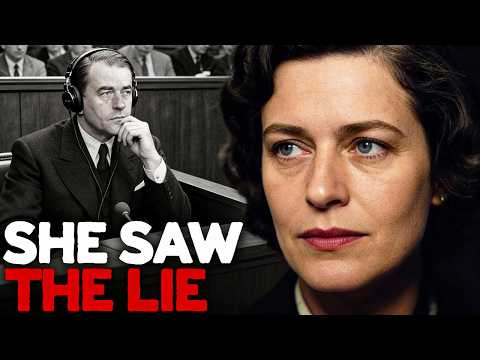
Before the trials, before the prison walls, Speer was consumed by Hitler’s inner circle. His wife Margareta once joked she’d have to telephone him to announce that Frau Speer wished to speak to Herr Speer. It wasn’t a joke. It was the truth dressed up to hurt less. Between 1934 and 1942, they had six children, and Speer was absent for almost all of it—not physically deployed, but emotionally unreachable. Present in the house, absent in every way that mattered.
His children grew up with a ghost for a father. They just didn’t know it yet.
The Speer family lived in one of the strangest places in Nazi Germany: Hitler’s restricted zone at the Berghof, high in the Bavarian Alps. While bombs fell on German cities and millions died across Europe, these children watched American cartoons with Eva Braun. They played in mountain meadows, blissfully unaware of what their father actually did. This privilege came with a price they didn’t yet understand—a carefully constructed illusion that depended entirely on the Reich’s survival.
And in the spring of 1945, that illusion shattered completely.
Germany surrendered. Hilde was nine years old. Her youngest brother, Ernst, was barely two. They expected their father to come home now that the war was over. Instead, he was arrested, put on trial at Nuremberg, and sentenced to twenty years in Spandau Prison. Twenty years. Hilde would be nearly thirty before her father walked free. Ernst wouldn’t remember him at all.
But Speer’s imprisonment created something unexpected: a relationship built entirely on paper. During those two decades, he wrote hundreds of letters to his children—articulate, thoughtful, carefully constructed arguments about responsibility and moral failure. He could explain his guilt in perfectly reasoned paragraphs, analyze his own complicity with the detachment of a historian examining someone else’s life. But something was missing. His words had no heat in them, no genuine anguish. Reading his letters was like reading a legal brief about his own soul: technically correct, emotionally empty.
In 1953, when Hilde was seventeen, she did something remarkable. She wrote to her imprisoned father and asked him to explain his guilt—not to comfort her, but to account for what he had done. “How could such a sensitive, basically kind person like my father… find his place in this regime?” she later asked. It was a confrontation, and Speer’s response revealed everything. He could explain Nazi Germany, the psychology of obedience, the seduction of power—but he could never explain himself. Not in a way that reached the human level where understanding actually lives.
Hilde kept those letters. She kept writing. But somewhere in that exchange, she began to understand something troubling: his remorse wasn’t transformation. It was performance.
October 1st, 1966. After serving his full twenty-year sentence, Albert Speer walked out of Spandau Prison. Cameras flashed. Reporters shouted questions. His children were waiting—adults now, the oldest in their thirties, the youngest barely remembering a time before prison. This should have been the moment of reconciliation. But the reunion failed completely.
Speer discovered something devastating: he couldn’t connect with his own children. Not emotionally. Not in any real way. The letters had created an illusion of relationship, but face-to-face, there was nothing. “I cannot break through emotionally to my children,” he admitted later. His son Ernst, who had been two years old when Speer went to prison, couldn’t speak during visits—just sat there in silence. And Speer confessed, “I, too, had nothing to say, and it’s sad. I still don’t think about that.”
The man who wrote bestselling memoirs about Nazi guilt, who gave interviews explaining the psychology of evil, couldn’t have a real conversation with his own son. The walls he’d built around himself weren’t just for the public. They went all the way down.
In 1978, journalist Gitta Sereny visited the Speer home and described an intense aura of loneliness hanging over the household. Five of the six children had scattered across Germany, rarely visiting. The family home felt like a mausoleum—beautiful, cold, empty of real life. But the most revealing detail came during a dinner. Sereny watched as the adult children arrived: formal handshakes, no embraces, polite, distant conversation while Speer sat at the head of the table. The atmosphere was suffocating.
Then Speer left the room, and suddenly Sereny heard something she hadn’t heard all evening: peals of laughter. The children relaxed. They joked with each other. They became warm, open, alive. Speer’s wife, Margarete, lit up, becoming girlish and gay in a way that seemed impossible moments before. The family functioned better without him.
Speer noticed it, too. He once asked Sereny with something like bewilderment, “Do you see how she lights up when they come? How she changes when I’m not around?” He could see it. He could even articulate it, but he couldn’t change it. The emotional walls were permanent.
Whatever capacity for genuine human connection he might once have had, he traded it away—first for Hitler’s approval, then for survival, then for the carefully managed image of the repentant Nazi. By the time he wanted it back, it was gone.
But one daughter refused to let the story end there. Hilde had spent decades watching her father perform remorse without feeling it. She had one question that haunted her more than any other: “How could such a person find his place in this regime?” She never got a satisfying answer. So she decided to provide her own—not through words, but through action.
When Albert Speer died in 1981, Hilde inherited something troubling: artwork she suspected came from murdered Jews—paintings looted during the very crimes her father claimed not to know about. She could have kept them. Many children of Nazi officials did exactly that, hung the art on their walls, told themselves it was just family property now, let time blur the origins. She could have quietly sold them, taken the money, and moved on. No one would have blamed her. No one would have even known.
But Hilde did something extraordinary. She sold the paintings and used every penny to found Zurückgeben—the name means “give back” in German—a foundation supporting Jewish women artists. The daughter of Hitler’s architect spent the rest of her life funding the very community her father’s work had helped destroy.
She didn’t stop there. In 2004, she received the Moses Mendelssohn Award for her work promoting Jewish-German reconciliation. In 2015, at seventy-nine years old, she opened her Berlin home to Syrian refugees—people fleeing a war zone, welcomed by the daughter of a man who once designed buildings for the most murderous regime in history.
Hilde Schramm—she took her husband’s name, distancing herself from Speer—never publicly forgave her father. She didn’t write memoirs defending him. She didn’t argue that he was secretly a good man who made terrible mistakes. She simply moved beyond him. And that may be the most damning verdict of all.
Albert Speer spent his final decades trying to control his legacy. He wrote books explaining himself. He gave interviews shaping how history would remember him. He worked tirelessly to be seen as the Nazi who understood his guilt, who took responsibility, who proved that even participants in great evil could find redemption. But his own daughter—the person who knew him longest, who wrote him those letters, who watched him fail to connect with his own family—she didn’t buy it. She didn’t argue with him. She didn’t try to expose him. She just quietly built something that mattered more than his performed remorse ever could.
While Speer wrote about guilt, Hilde did something about it. While he explained his failures in bestselling books, she transformed inherited shame into action. The Nazi who said sorry left behind memoirs and interviews and carefully crafted explanations. His daughter left behind a foundation, refugees welcomed into her home, a lifetime of work that actually helped the people her father’s regime tried to destroy.
History may remember Albert Speer as the repentant Nazi, but Hilde Schramm showed what real accountability looks like—not words about guilt, but a life spent making things right. Not explaining evil, but actively working against its legacy. The daughter didn’t forgive him. She didn’t redeem his name. She simply became more historically significant than his performed remorse ever was. And that says more about Albert Speer than anything he ever wrote about himself.
Yet the story doesn’t end with Hilde’s quiet defiance. There is one more chapter—one that Speer himself never anticipated, and that his family only discovered after his death. Among his private papers, tucked away in a folder he had labeled “unfinished,” was a letter addressed to no one. It was dated 1979, two years before his death, and in it, Speer wrote something that contradicted everything he had ever said publicly.
“I have spent my life explaining a man I never truly knew,” the letter began. “And I am beginning to suspect that man was me.” For the first time, there was heat in his words—a raw, unpolished confession that no publisher ever saw. He admitted he had rehearsed his remorse so often that he no longer knew where the performance ended and the man began. He wrote of waking in Spandau and feeling nothing, then panicking because he knew he should feel something. He wrote of his children’s faces at the reunion, and how he wanted to reach for them but his arms would not move.
Hilde read the letter alone. She did not cry. She had waited too long for a sentence that arrived only after the author could no longer revise it. “He finally told the truth,” she said later, “but only to a piece of paper, and only when no one could ask him a question.” The letter changed nothing about her work, nothing about the foundation, nothing about the refugees who still came through her door. But it confirmed what she had always suspected: her father had known. He had known all along.
She filed the letter away with the others—the teenage confrontation, the legal briefs about his soul, the final unaddressed confession. Then she went back to her life. The paintings were long gone. The foundation was still growing. The family home remained a mausoleum, but she had built something warmer elsewhere.
Albert Speer died still believing he could control how history saw him. He was wrong. History sees him now through the daughter who gave back what he took, who welcomed whom he would have excluded, who answered the question he spent his life dodging. Her answer was never a paragraph. It was a life.
So here is the question that remains: when the apology is perfect but the heart is empty, which one does history remember—the words, or the life lived in response? Tell us in the comments below.






