When Hitler declared war on the United States in December 1941, Nazi leaders sneered at Americans as a mongrel race, incapable of producing real soldiers. They called them soft, dollar-obsessed, and racially impure. Yet by May 1945, entire German armies were racing west, desperate to surrender to Americans rather than face the Soviets. How did that contempt turn into terror?
The transformation was not just a military shift—it was a psychological earthquake. German soldiers had to abandon everything they believed about Americans in order to survive fighting them. Their letters, diaries, and interrogation transcripts reveal a journey from propaganda fantasy to devastating reality.
Hitler’s contempt was an article of faith. In his private table talk, he called America a “decayed country” with a racial problem, half “Judaized” and half “Negrofied.” He genuinely believed racial mixing fatally weakened a nation’s fighting capacity. Göring mocked that Americans “cannot build airplanes and are only good at refrigerators and razor blades.” When Rommel complained about American armor-piercing shells, Göring sneered that Americans only know how to make razor blades. Rommel’s reply cut back: “They could do with some of those razor blades, Herr Reichsmarschall.”
Nazi propaganda reinforced these delusions. Leaflets targeting black soldiers cynically promised they could go to any church in Germany and that there had never been lynchings there. The press mocked American soldiers as soft products of jazz and Hollywood. But not all Germans were blind. Some who had fought Americans in World War I remembered them differently—as “the most honorable of all enemies and the bravest.” Yet these voices were drowned out by ideological certainty.
When American and German ground forces first clashed at Kasserine Pass in February 1943, the result seemed to vindicate every Nazi assumption. Rommel targeted the Americans as the weak link. Major General Lloyd Fredendall commanded from a bunker 70 miles behind the lines, rarely visiting the front. Replacements arrived without basic training, some without rifles. Many soldiers fired a bazooka for the first time at an approaching German tank. Within two days, the U.S. Second Corps lost 1,600 men, nearly 100 tanks, and 57 half-tracks. German tank crews began calling American armor “sardine cans.”
But even amid this debacle, Rommel noticed something that gave him pause. He recorded that the tactical conduct of the enemy’s defense had been “first class.” They recovered quickly, damming up the advance at passes and other key points. At Thala, a devastating artillery barrage from the freshly arrived Ninth Infantry Division stopped the 10th Panzer Division dead. The German offensive was over. A crack in German certainty had appeared—small at first, but it would widen into a chasm.
The speed of American self-correction stunned the Germans who paid attention. Patton replaced Fredendall and enforced discipline ruthlessly, fining soldiers $50 for not wearing helmets. Just 17 days later, at El Guettar, the same German units that had crushed the Americans at Kasserine ran into a wall. The Big Red One destroyed approximately 30 German tanks in a single morning. It was the first time American forces decisively defeated experienced German armor. Rommel acknowledged that the Americans “had to pay a stiff price for their experience, but it brought rich dividends.”
By the time Tunisia fell in May 1943, some 250,000 Axis soldiers surrendered—80 times the number of Americans captured at Kasserine. The learning curve had been steep, but devastatingly effective. In Sicily, at Gela and Troina, Americans proved they could not only fight but win campaigns. The Italian campaign was grinding and bloody, but through it all, two things increasingly dominated German soldiers’ experience of fighting Americans—and both changed how they saw their enemy forever.
The first was American artillery. By the latter part of the war, the American artillery arm was clearly superior to the Germans. The Fire Direction Center system could coordinate time-on-target shoots, where shells from multiple batteries all arrived at the same instant—a capability no other artillery in the world possessed. The psychological effect was devastating, as defending troops had no warning before the full weight of the bombardment struck. American divisions had lavish artillery support and near-unlimited ammunition. A German soldier might fire 30 shells on a good day; his American counterpart could call in hundreds on a single target.
The second was air superiority. The German word Jabos—short for fighter-bombers—became a term of terror. P-47 Thunderbolts and P-51 Mustangs raked German columns at 400 mph with cannons, machine guns, and 500-lb bombs. German forces planned their movements around avoiding the Jabos, moving primarily at night or in bad weather. A Panzer commander reported advancing more than 10 miles with only three losses, then “all of a sudden the Jabos dropped out of the sky firing deadly rockets and strafing, spreading terror throughout his formation.” Rommel articulated the existential despair: “Anyone who has to fight against an enemy in complete command of the air fights like a savage against modern European troops.”
By 1944, German units in France learned to dread daylight. Any vehicle that moved on a road during clear weather was a potential target. The amount of artillery the Americans rained down ceased to shock the Germans. A German veteran of the 276th Volksgrenadier Division offered a vivid comparative analysis: the Russians were capable soldiers, the British competent but slow, but Americans were “enthusiastic amateurs with a disposition to aggression he had never seen in any other nation’s sons.” He explained that Americans would immediately return fire, bring a punishing rain of artillery or air power, and move to counterattack as soon as the rain of death ended. They more than compensated for any lack of individual skill with sheer, unadulterated, unapologetic combat aggression.
Nothing shattered German assumptions more completely than June 6, 1944. The sheer scale of the invasion fleet emerging from weather that German commanders had assumed made an attack impossible stunned defenders. Paul Gols, a 19-year-old machine gunner, watched thousands of ships and landing boats and knew the war was lost. At Omaha Beach, Heinrich Severloh fired thousands of rounds from his MG 42 but could not throw the Americans back. German assessments of American paratroopers were particularly striking. Field Marshal von Rundstedt’s official report acknowledged that enemy airborne tactics were “highly developed” and these soldiers “proven to be powerful fighters.” At Pointe du Hoc, captured Germans complained that the Rangers came down the road instead of through the fields—an inadvertently complimentary complaint. German Fallschirmjäger developed outright fear, describing Americans as “madmen with Indian heads where there were no rules and everyone had their knives drawn.”
The most devastating testimony came after Operation Cobra, when 1,500 heavy bombers dropped 3,300 tons on the Panzer Lehr Division. Lieutenant General Fritz Bayerlein called it “hell.” His front lines looked like “a landscape of the moon,” with at least 70% of personnel dead, wounded, crazed, or numbed. When ordered to hold, Bayerlein erupted: “Out in front everyone is holding out. They are lying silent in their foxholes, for they are dead.” The division was annihilated. Von Rundstedt, the most senior German commander in the West, reached his conclusion early. When asked what should be done, he gave the most honest strategic assessment of the war: “Make peace, you fools. What else can you do?” He was dismissed within days.
By the time the Falaise Pocket closed in August 1944, the destruction was beyond description. Eisenhower wrote that it was “literally possible to walk for hundreds of yards at a time stepping on nothing but dead and decaying flesh.” Rommel, who had concluded within three days of D-Day that the war was lost, was himself critically wounded when Allied Spitfires caught his staff car. After Normandy, Bayerlein offered what may be the most sweeping German assessment: “No campaign in history can approach the Battle of Annihilation in France in 1944 in the magnitude of planning, the logic of execution, the collaboration of sea, air, and ground forces.”
By December 1944, Hitler’s final gamble in the Ardennes reflected persistent contempt for American soldiers, even after 18 months of evidence to the contrary. Field Marshal von Rundstedt privately assessed that if they reached the Meuse River, they should get down on their knees and thank God. Field Marshal Model called the plan “flatly, this plan does not have a leg to stand on.” But Hitler would hear no objections. On December 16, some 410,000 German troops struck the American lines. At Lanzerath Ridge, 18 American soldiers delayed 500 German paratroopers for nearly a day. At Elsenborn Ridge, the 99th and 2nd Infantry Divisions held the Schwerpunkt of the entire offensive and never broke. Kampfgruppe Peiper, supposed to spearhead the drive to the Meuse, found itself trapped in a nightmare of blown bridges and stubborn resistance. Peiper complained that “these roads were not for tanks, but for bicycles.” The same advance that had taken 9 hours in 1940 now took 36. By December 24, he was surrounded and out of fuel, leading 770 survivors back on foot.
At Bastogne, the 101st Airborne held the vital crossroads against forces outnumbering them five to one. When German General von Lüttwitz demanded surrender, Brigadier General Anthony McAuliffe replied with a single word: “Nuts.” The German officers were baffled. Colonel Joseph Harper translated: “If you do not understand what ‘nuts’ means, in plain English, it is the same as ‘go to hell.’” General Kokott noted dryly that the American commander rejected the ultimatum with “remarkable brevity.” Von Manteuffel was furious that von Lüttwitz had allowed the Americans to make such a fool of them all. The Christmas Day assault briefly penetrated the perimeter, but three tanks were destroyed by tank destroyers, three by bazookas, and the attack was contained.
Perhaps the most revealing German reaction came during post-war interrogations. When Lieutenant Colonel Harry Kinnard, the 101st Airborne’s operations officer, attended the session, the meeting was a visible shock to the German commanders. It seemed incredible to them that this boyish-faced soldier had been one of their principal antagonists. Von Lüttwitz asked repeatedly if Kinnard was certain he was chief of operations, wondering if it was possible he was only the chief for one regiment. The Battle of the Bulge cost the Americans dearly—approximately 81,000 to 89,000 casualties—but German losses were irreplaceable. The offensive consumed Germany’s last strategic reserve of 200,000 troops.
Behind every American trigger pull stood an industrial machine that German leadership had dismissed as fantasy. When Roosevelt announced ambitious production targets, Hitler’s advisers told him it was American propaganda. They were wrong. The United States produced approximately 300,000 aircraft versus Germany’s 95,000, 88,000 armored fighting vehicles against 26,000 German tanks, and 2,400,000 trucks to Germany’s 166,000. Ford’s Willow Run Plant produced one B-24 Liberator every 63 minutes. General Motors alone manufactured 119,562,000 artillery shells, 206,000 aircraft engines, and 854,000 trucks. In 1944, the United States built more planes than Japan produced during the entire war. The Liberty ship program epitomized this miracle: 2,710 cargo ships built between 1941 and 1945, averaging three ships every two days. The SS Robert E. Peary was built in a record 4 days, 15 hours, and 29 minutes. A single Liberty ship could carry 2,840 Jeeps, 440 tanks, or 230 million rounds of rifle ammunition.
German soldiers experienced this avalanche in deeply personal terms. They were amazed by the absence of horses in American formations—everything was mechanized. They saw Americans who, if something broke, simply discarded it and got a replacement. German troops called Americans Amis—a relatively neutral term—but also Kaugummisoldaten, “chewing gum soldiers,” struck by Americans’ constant gum chewing, a small symbol of alien abundance. Military analyst Trevor Dupuy’s landmark studies found that on a man-for-man basis, German ground soldiers consistently inflicted casualties at about a 50% higher rate than they incurred. This was the uncomfortable kernel of truth beneath German contempt. At the squad and platoon level, German tactical proficiency was genuinely superior for most of the war. But this statistic is deeply misleading in isolation. It measures only direct tactical combat and ignores strategy, logistics, and intelligence—factors that actually determined the war’s outcome. Research on the Fourth Infantry Division shows that in Normandy, Germans fought with clear tactical superiority. After the Falaise Pocket, Americans matched or exceeded them. After the Battle of the Bulge, Americans were clearly superior at every level.
Many German soldiers framed American tactics as unfair, softening positions with overwhelming bombardment before advancing. This framing—calling overwhelming firepower “cheating” rather than admitting it was devastatingly effective—represented the psychological gap between propaganda and reality. As one analysis noted, committed Nazi officers would surely have found it easier to blame defeat on raw industrial might than to acknowledge American fighting skills. The Third Fallschirmjäger Division, defending Saint-Lô, had 930 light machine guns—far more than the American 29th Division opposing it. At the squad level, German paratroopers had two MG 42s and three submachine guns versus a single BAR for the Americans. Yet the Americans took Saint-Lô, grinding through “hedgerow hell” with tactical adaptation, coordinated combined arms, and relentless firepower that no German advantage in small-unit skills could overcome.
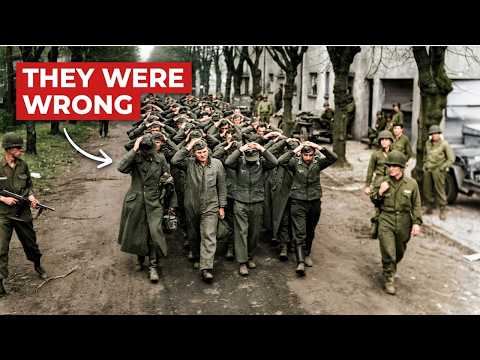
By the war’s final months, the most telling measure of German opinion was where German soldiers chose to surrender. The answer was overwhelmingly, desperately clear: to the Americans at almost any cost. Grand Admiral Dönitz pursued a deliberate policy of partial capitulations in the west to save as many as possible from Soviet captivity. General Admiral Hans Georg von Friedeburg told Field Marshal Montgomery that to surrender to the Soviets was “unthinkable” and that the “red savages” would put them all in labor camps. The numbers justified the terror: of approximately 3,060,000 German military personnel captured by the USSR, roughly 1 million to 1,094,000 died in captivity. At the Battle of Slivice on May 11–12, 1945, German troops fought Czech partisans and the Red Army specifically to break through and surrender to nearby American forces. A German teenager, Gerda Drews, watched soldiers stream past her farm. “They were trying to break through to the north of Berlin. There was a rumor that there was an opening there where they could escape from the Russians and surrender to the Americans instead.”
At the Ruhr Pocket, 317,000 German soldiers surrendered to American forces—twice the U.S. intelligence estimate. This was the largest German mass surrender of the war, exceeding even the number captured at Stalingrad. Prisoners asked simply, “What was the point in this?” saying they had wives and children. Among those captured were 30 generals and one admiral. Field Marshal Walter Model, who had commanded the trapped forces, refused to surrender and shot himself rather than face captivity. The capture of the Ludendorff Bridge at Remagen on March 7, 1945, produced reactions that captured German despair. Karin Loeff, a civilian on the east bank, watched retreating German soldiers. “She could not help comparing it to Napoleon’s retreat. The older ones could hardly march on. Their eyes were cast down onto the ground. They seemed to simply stumble on without any hope.” Within a week, seven U.S. divisions and 125,000 troops had crossed.
The German veteran of the 276th Volksgrenadier Division spoke for many when he noted simply that he was glad he was able to surrender to the Americans instead of the Russians. When asked about American rations, former prisoners recalled they were happy when it was the turn of the Americans because they had the most to give. The arc of German opinion about American soldiers is ultimately a story about the cost of ideological blindness. Nazi racial theory predicted that a mongrelized democracy could never produce effective soldiers. That prediction was tested against reality across North Africa, Sicily, Italy, France, Belgium, and into the heart of Germany itself—and it failed catastrophically. The transformation was not instantaneous. Kasserine Pass seemed to confirm every German assumption, but within weeks, the same German units that had routed Americans were being destroyed by them at El Guettar. By Normandy, German defenders were writing home about bombardments that made them think the world was ending. By the Bulge, German commanders were staring in disbelief at the youthful American officers who had orchestrated their defeat. By spring 1945, entire German armies were racing to reach American lines before the Soviets caught them.
Three insights emerge from this history that the German record makes vivid. First, the Americans’ greatest military asset was not any single weapon or tactic, but their capacity for rapid institutional learning—the ability to absorb a disaster like Kasserine and within weeks transform into a force that could destroy the units that had just beaten them. Second, the combination of overwhelming industrial production and aggressive tactical application created a form of warfare that German tactical superiority at the individual level simply could not overcome—a lesson German veterans often acknowledged through the backhanded compliment of calling American methods “unfair.” Third, the German soldiers who actually fought Americans consistently developed more nuanced and respectful views than the leadership that sent them into battle—a gap between propaganda and reality that widened with every engagement until the Third Reich itself collapsed into it. Göring’s razor blades, it turned out, could cut through anything. The German soldiers who survived discovered this truth the hard way on battlefields from Tunisia to the heart of the Reich itself.
By May 1945, the transformation was complete. The same soldiers who had sneered at “chewing gum soldiers” now scrambled to surrender to them. Göring’s razor blades had cut through the thousand-year Reich in under four years.
What the German record reveals is not a story of American invincibility, but of adaptability. The U.S. Army learned faster than any enemy could exploit its mistakes. Kasserine’s humiliation produced El Guettar’s triumph in seventeen days. Normandy’s hedgerows produced the breakout at Saint-Lô. The Bulge’s surprise produced the collapse of the West Wall.
German veterans, writing decades later, rarely described Americans as natural warriors. They described them as relentless ones—men who brought artillery, air power, and replacements in quantities that made tactical brilliance irrelevant. “They fought like amateurs,” one admitted, “but they won like professionals.”
That was the final verdict from the men who learned it the hardest way possible. The Führer’s racial theories had predicted a hollow enemy. The battlefield delivered an avalanche instead.
So here is the question that lingers over every German diary and interrogation transcript: Was it American fighting spirit that defeated the Wehrmacht—or was it the simple, crushing fact that the United States could replace its losses while Germany could not? What do you think tipped the balance?






