In the early 1900s, the American government stripped Native Americans of their land, dividing it among white settlers. But what they didn’t realize was that beneath the rocky, undesirable plots given to Black children of the Creek Nation lay a vast ocean of crude oil. One of those children was Sarah Rector, a young Black girl who would become the richest Black girl in America—and a target for exploitation.
Born in 1902 in Muskogee, Oklahoma, Sarah was the daughter of formerly enslaved parents. Her family was poor, barely able to afford the $30 annual property tax on the 160 acres she had been allotted as a descendant of Creek freedmen. Her father, Joseph, even petitioned the court to sell the land, but the request was denied. He had no idea that the land was sitting on a fortune.
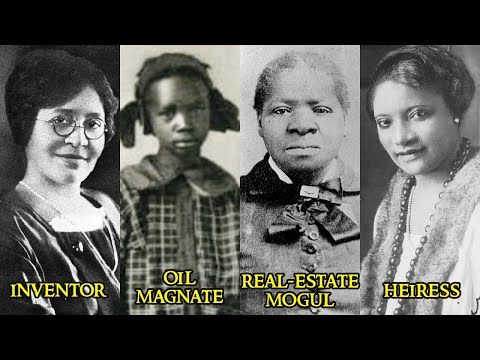
In 1911, Joseph leased the land to Standard Oil. Two years later, an independent driller struck a gusher. Within months, tens of thousands of barrels of oil were being pulled from beneath Sarah’s land each day. At just 11 years old, she was earning thousands of dollars a month—more than the President of the United States.
But because she was a minor and a citizen of Indian Territory, the law required that a “well-respected white guardian” be appointed to manage her wealth. A local white man named T.J. Porter was given control of Sarah’s financial affairs. Despite her massive income, rumors spread that Sarah was still living in a two-room shack with her family, uneducated and impoverished.
The Chicago Defender, a prominent African-American newspaper, published an article claiming that Sarah’s wealth was being mismanaged. The story caught the attention of the NAACP, and soon an investigation was launched. W.E.B. Du Bois himself received a memo detailing that Sarah received no education, wore cheap dresses, and went without shoes while her guardian profited. The case became a national scandal, highlighting the widespread corruption of white guardianship over Black children’s oil wealth.
Under pressure, the court revealed that Sarah and her family had moved into a five-room cottage and that she was attending school. But the damage was done—the NAACP’s investigation exposed a system that robbed countless Black children of their fortunes. Sarah’s story became a symbol of resilience and a catalyst for reform.
But her wealth also made her a target. While attending the Tuskegee Institute, a group of criminals plotted to kidnap her for ransom. Fortunately, students intervened. Sarah later retreated from the public eye, but her legacy as the richest Black girl in America—and a symbol of the fight against exploitation—endures.
Yet Sarah’s story did not end with her retreat from the headlines. By the time she was eighteen, she was a bona fide millionaire, owning stocks, a boarding house, and vast tracts of land. Her mother, Rose, managed her finances until Sarah turned twenty, ensuring that the family’s newfound wealth was handled with care.
In 1920, Sarah married Kenneth Campbell, a local businessman. The wedding was a private affair, attended only by close relatives. The couple went on to have three sons, but the marriage eventually ended in divorce in 1930. By then, Sarah had already weathered the Wall Street Crash of 1929, which wiped out a significant portion of her fortune—particularly after she and Kenneth had sunk money into a car dealership that went bust.
Still, Sarah remained comfortable. She was known for her love of fine clothing and fast cars—Cadillacs, Lincolns, and Rolls-Royces. She and her mother would race around Kansas City, with Sarah racking up speeding tickets that only added to her notoriety. Designer stores that typically admitted only white customers would close their doors to allow the Rectors to shop in private, a small but significant reversal of the racial hierarchy of the time.
In 1934, Sarah married William Crawford, a restaurant owner, and settled into a quieter life. She threw grand parties for leading members of the African-American community—jazz celebrities, intellectuals, and activists—but as the years passed, she withdrew from public view. Details of her later life are scarce, as she deliberately avoided the press that had once hounded her.
Sarah Rector died on July 22, 1967, at the age of 65, from a cerebral hemorrhage. She was buried in Taft Cemetery, her hometown. Her life had been a remarkable journey from a two-room shack to a mansion, from poverty to unimaginable wealth—all because of the oil beneath land the government had deemed worthless.
But Sarah’s story was not unique. Across Oklahoma, hundreds of Black children from the Creek Nation had been allotted similar plots, and many of them struck oil too. Like Sarah, they were assigned white guardians who often mismanaged or outright stole their fortunes. The NAACP’s investigation into Sarah’s case had exposed a systemic injustice, but the damage to countless other children had already been done.
Her legacy, however, was not merely one of exploitation. Sarah’s case had forced the nation to confront the corruption of the guardianship system, and it had empowered the NAACP to establish a Children’s Department dedicated to protecting Black children’s wealth. In the decades that followed, fewer children would be neglected and exploited because of the spotlight Sarah’s story had shone on the problem.
Today, Sarah Rector is remembered as a symbol of both the promise and the peril of sudden wealth. Her life was a testament to the resilience of Black Americans in the face of a system designed to keep them down—and a reminder that even the most unlikely fortunes can be found in the most unlikely places.
From the oil fields of Oklahoma, the story shifts eastward to the antebellum South—and to a woman whose name would become synonymous with grit, generosity, and an almost impossible rise from bondage. Biddy Mason was born into slavery in Hancock County, Georgia, on August 15, 1818. She was called Bridget at birth, but the name Biddy stuck with her through a life that would span nearly three-quarters of a century and cross half a continent.
In her youth, Biddy was separated from her parents and sold to a Georgia plantation owner named Robert Smithson. Those early years were brutal, spent in the fields and the big house alike. Yet they were not wasted. On Smithson’s plantation, Biddy learned about agriculture, absorbed the folk medicine passed down from Africa, and trained as a midwife. These skills—the ability to heal, to deliver babies, to read the body’s quiet signals—would one day make her indispensable.
In 1836, Biddy was either given away as a wedding present or sold outright to Robert and Rebecca Smith, a young couple with a plantation in Mississippi. She spent the next decade there, and during that time she bore three daughters: Ellen in 1838, Ann in 1844, and Harriet in 1847. It has been speculated that the enslaved Robert Smith fathered these children, though no definitive evidence survives to confirm it.
Then came the missionaries. In 1847, a group of Mormons arrived in Mississippi to convert the locals to the Church of Jesus Christ of Latter-day Saints. Robert Smith converted, and soon he decided to move his family—and the people he enslaved, including Biddy and her three daughters—to Utah, where Brigham Young was building a new Zion in the Salt Lake Valley.
The journey was punishing. The Smith party crossed through Colorado in 1848 and finally arrived in Utah, where they settled in the town of Cottonwood, not far from Salt Lake City. Along the way, Biddy’s medical skills proved invaluable, and she became an integral member of the convoy. She delivered babies, treated fevers, and dressed wounds—all while still legally enslaved.
Slavery was permitted in Utah, and Brigham Young himself held views that were anything but abolitionist. Yet in 1851, a decision by Young seemed to crack open a door. That year, the church dispatched a mission southwest to San Bernardino, California. California had entered the Union in 1850 as a free state, and Young instructed the missionaries that anyone who brought enslaved people with them would be effectively granting them their freedom.
When Robert Smith announced he would join the mission, Biddy must have dared to hope. But Smith had no intention of setting his slaves free. He brought Biddy and her daughters to California and kept them in bondage, exploiting the reluctance of local authorities to prosecute slave owners who crossed the border with human property.
Freedom, when it came, arrived through a back door—and through the courage of a young man in love. In 1855, Biddy’s daughter Ellen began courting a free Black man named Charles Owens. It was from Owens that Biddy learned the truth: California law banned slavery, and she had the right to petition the courts for her freedom and her daughters’.
Owens helped her file the petition in Los Angeles County Court. Biddy was not permitted to speak on her own behalf, but it hardly mattered. Robert Smith failed to appear, and the court granted Biddy and her three daughters their freedom in January 1856. She was about thirty-eight years old. At that moment, she chose a surname for herself: Mason, borrowed from a Mormon man in San Bernardino for whom she had worked and whom she respected.
With her daughters free alongside her, Biddy Mason wasted no time. She found work as a nurse, and when smallpox swept through California in the late 1850s, her training in folk medicine made her indispensable. She delivered babies, nursed the sick, and saved every dollar she could. By 1866, she had scraped together $250 to buy a house on Spring Street—making her one of the first Black women to own property in California.
That modest purchase became the foundation of an empire. As Los Angeles grew, Spring Street became prime real estate. Biddy bought cheap land on the city’s edges and sold it years later for a handsome profit. By the 1880s, she was erecting commercial buildings and renting them out as office space. By the late 1880s, her fortune was estimated at $300,000—roughly $10 million today.
But Biddy’s wealth never hardened her heart. In 1872, she and her son-in-law Charles Owens co-founded the first African Methodist Episcopal Church in Los Angeles, with the planning meetings held in her own home. She helped establish the city’s first elementary school for Black children and paid for flood victims’ groceries for weeks. She visited jail inmates, opened her home to orphans and the destitute, and became known simply as Grandma Mason.
Biddy Mason died on January 15, 1891, at seventy-three. She was buried in an unmarked grave at Evergreen Cemetery—a final indignity for a woman who had given so much. Nearly a century later, in 1988, a large tombstone was finally erected over her grave, and November 16, 1989 was declared Biddy Mason Day in California. Today, Biddy Mason Memorial Park in Los Angeles bears her name.
Her story is one of the most remarkable in American history: a woman born into slavery who learned to heal, walked halfway across a continent in chains, petitioned a court for her own freedom, and then built a fortune that she poured back into her community. She proved that freedom is not merely the absence of chains—it is the presence of purpose.
What would you have done with Biddy Mason’s fortune—built an empire, or given it all away?






