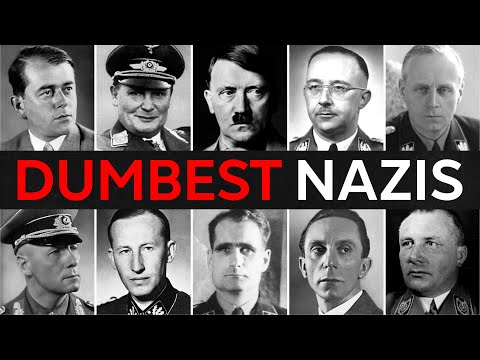
What happens when the most evil regime in history is catastrophically stupid? This is not a story of geniuses. It is a list of errors, blunders, and ridiculous bureaucratic collapses that make satire look realistic. From drug-addled air marshals to chicken-farming occultists, these are the 53 Nazis who were not just evil—they were dumb by nature. And as the Reich crumbled, it wasn’t justice that was approaching. It was the truth. Welcome to the collapse of a system that never stopped sabotaging itself. Because sometimes the villain doesn’t need a hero to be defeated—he just needs his own stupidity.
Before we dive into this catastrophic display of failure, make sure to subscribe to the channel, where history isn’t just dark—it’s stunningly stupid. Hit the bell so you don’t miss a moment of this masterfully documented disaster. And together, where in the world are you watching from? Write your location and time in the comments. Midnight in Berlin? Lunch break in Texas? Can’t sleep in Manila? Let’s see how far stupidity travels.
One. Adolf Hitler. He thought himself a military genius, yet refused to listen to actual generals. Hitler managed battles from hundreds of miles away, rejected tactical retreats, and planned invasions based on emotions and astrology. He delayed Operation Barbarossa by invading Greece at the wrong time, letting the Russian winter shatter his dreams. His greatest enemy wasn’t Stalin—it was logistics, but he never learned.
In the end, his vision led Germany straight into a holocaust of his own making, while he clung to maps as if they were lottery tickets. The only thing worse than a dictator, it turns out, is a dictator who thinks he’s Napoleon.
Two. Hermann Göring. He wore velvet suits, stuffed himself with stolen art, and promised Hitler air superiority over Stalingrad without checking if his planes could fly in snow. His Luftwaffe collapsed under the weight of his ego and drug-addled optimism. He declared he would supply the Sixth Army by air. He dropped starvation instead.
When Berlin burned, Göring fled like a peacock without feathers, insisting he was still in control. He even tried to declare himself Hitler’s successor. Hitler responded by ordering his arrest. If power corrupts, Göring proved it also bloats, bluffs, and crashes into the Volga. And that was Hermann Göring—proof that confidence without competence can crash worse than any planned air mission.
If you’re still here marveling at this madness, don’t forget to subscribe for more history that defies fiction in its weirdness and stupidity. Hit the bell so you don’t miss the next easily avoidable disaster. Also, where are you watching from? And what time is it there? Tell us in the comments. This channel runs on global numbers and questionable life choices.
Three. Heinrich Himmler. A chicken farmer turned occult-obsessed bureaucrat, Himmler believed in magic stones, Nordic ancestors, and negotiating with the British in 1945. He ran the SS like a spiritual cult, then tried to switch loyalties as if World War II were a failed date. After decades of ruthless loyalty, he thought the Allies might forgive genocide if he offered a handshake.
Hitler found out and was furious. The Allies didn’t care. And Himmler, the man who thought discipline was everything, died proving he lacked it entirely. But if you think that’s delusional, wait until you meet the man who flew to Scotland alone.
Four. Joseph Goebbels. Goebbels was Minister of Propaganda, but his greatest delusion was his belief in his own genius. He spent years crafting Hitler’s image while ignoring reality. When he called for total war, Berlin was already surrounded. His speeches thundered with rage, but the Reich’s factories were collapsing, and the only thing multiplying was despair. He built illusions while the ground vanished beneath his feet, convinced words could still win wars.
Yet somehow, Goebbels looked sane compared to the man who flew himself to Scotland with a peace plan and no coordination.
Five. Rudolf Hess. He boarded a plane in 1941 and flew alone to Scotland to negotiate peace with the British without telling Hitler, the Luftwaffe, or anyone with a map. He believed he could end World War II single-handedly through ‘feelings’ and aristocratic magic. His plane crashed, he was arrested, and the British assumed it was a Nazi plot so dumb it had to be fake. In Germany, Hitler called him mentally unstable and erased him from history.
But don’t worry, Hitler found another follower who confidently assured him Britain would never intervene. Spoiler: they did.
Six. Joachim von Ribbentrop. A failed champagne salesman turned Foreign Minister, Ribbentrop had a talent for saying exactly the wrong thing at the worst possible time. He promised Hitler that Britain would never enter the war over Poland. Hours later, they did. His treaties were disasters in formal wear, and his diplomatic instincts were so bad that his fellow Nazis mocked him. He once tried to lecture Churchill on honor. It went exactly as you’d expect.
And speaking of things going off the rails, wait until you meet the Nazi economist who treated war like a Ponzi scheme.
Seven. Hjalmar Schacht. Schacht styled himself the financial wizard of the Reich, but his creative accounting was just a pile of IOUs glued together with fake confidence. He hid debt behind more debt, then acted shocked when the economy collapsed like a house of cards. His schemes bought time, not stability, and when the bills came due, Germany was walking straight into ruin. He insisted everything was under control until the moment he lost control entirely.
And if Schacht built the financial maze, the next man tried to solve defeat with promises of wonder weapons that bordered on cheap alchemy.
Eight. Albert Speer. Speer sold himself as a brilliant technocrat, a modernist genius who could turn rubble into rockets. In reality, he exaggerated promises of wonder weapons that never changed the war’s course, and spent resources on vanity projects while cities crumbled. He told Hitler salvation was one super-cannon away, as if physics cared about propaganda. His grand plans looked elegant on paper but were catastrophic in practice. Efficiency meant organized collapse.
But even Speer’s shiny delusions seemed modest compared to the man who controlled Hitler’s mail and used it to sabotage everyone around him.
Nine. Martin Bormann. Bormann was the shadow man, controlling access to Hitler like a jealous bouncer. He buried memos, rewrote decisions, and stirred chaos by pitting rivals against each other. His talent wasn’t strategy—it was creating confusion so dense that even Hitler found it hard to navigate. Policies contradicted daily, but Bormann loved it. Chaos kept him powerful. And unfortunately for the Reich, it kept everything else broken.
And the official next turned that administrative chaos into legal chaos on a grand scale.
Ten. Wilhelm Frick. Frick tried to build a legal empire but mostly produced a bureaucratic maze where laws contradicted each other before lunch. He churned out legislation faster than anyone could read, turning governance into a labyrinth with no exits. Corruption flourished, departments overlapped, and no one knew who was actually in charge. His system was so chaotic that Nazi officials themselves complained they couldn’t keep track of what was illegal anymore.
And if Frick drowned the system in paper, the next man managed to drown himself in something more fermented.
Eleven. Robert Ley. Ley ran the German Labor Front like a personal playground, fueled by arrogance and a love of excess. Under his watch, resources vanished, records disappeared, and dysfunction flourished. His management style was a blend of bluster and denial, wrapped in overconfidence. He claimed everything was improving while factories struggled and workers grumbled. His administration became a monument to mismanagement.
But Ley’s chaos was nothing compared to the official who rubber-stamped every contradictory order that crossed his desk.
Twelve. Hans Lammers. Lammers treated governance like a stamp-collecting hobby. If someone handed him a decree, no matter how contradictory, he approved it. This created an administrative landscape where multiple versions of reality operated simultaneously, and no one knew which orders were real. Instead of coordinating leadership, he inadvertently turned the Reich Chancellery into a bottleneck of confusion. His passivity amplified every crisis.
Thirteen. Karl Dönitz. Dönitz believed U-boats could still win the war long after Allied sonar, depth charges, and codebreaking turned the Atlantic into a graveyard. He kept sending submarines on missions that went from risky to suicidal, insisting victory was one breakthrough away. When he briefly succeeded Hitler, his leadership lasted as long as his strategies at sea. His loyalty to failure was absolute.
But while Dönitz sank ships, the next man sank the economy and called it strategy.
Fourteen. Walther Funk. As Economics Minister, Funk was supposed to manage wartime finance. Instead, he inflated the currency, misallocated resources, and sat helplessly as the economy deteriorated. He had no real plan, just blind optimism and vague promises. Industrial production became erratic, price controls failed, and his solutions often made things worse. Funk talked like a technocrat but operated like a gambler betting his last chips.
Yet even Funk’s economic collapse looked orderly compared to the general who signed every disastrous order like a loyalty card.
Fifteen. Wilhelm Keitel. Keitel was so obedient that other generals nicknamed him ‘Lakeitel’—a play on words meaning lackey. His talent wasn’t strategy but agreeing to whatever Hitler demanded, no matter how illogical. He approved invasions that couldn’t be supplied and suppression campaigns that fueled resistance. Instead of leading, he nodded. When someone needed a scapegoat for a terrible plan, Keitel was always available with a pen.
And if Keitel was the signature, the next man was the spreadsheet—utterly confident and utterly wrong.
Sixteen. Alfred Jodl. Jodl’s maps always looked great until reality intervened. As Chief of Operations, he signed off on schedules that ignored terrain, weather, and basic physics. He treated war like a scheduling problem, convinced troops could march faster than bullets. When plans failed, he doubled down. His blind faith in Hitler’s intuition turned coordination into chaos, yet he kept approving disasters as if they were routine paperwork.
And if Jodl was the war planner who forgot about mud, the next man was the prophet who helped pave the way for it.
Seventeen. Erich Ludendorff. Long before World War II, Ludendorff helped build the myth that Germany didn’t lose World War I—it was betrayed. That lie became Nazi dogma. He later supported Hitler’s first coup attempt, then disowned him like a losing stock. Ludendorff believed in total war but lacked any political sense. He blamed shadowy conspiracies and once claimed Christianity weakened Germany. Even his fellow authoritarians found him unsettling.
But in battlefield delusion, Ludendorff was rivaled by the general who kept proposing fantasy counterattacks while the front collapsed.
Eighteen. Erich von Manstein. Manstein was hailed as a tactical genius, but by 1944, he was drafting counteroffensives that required armies he didn’t have and time that no longer existed. He proposed elegant maneuvers on paper while the Eastern Front burned in reality. His solutions were often brilliant in theory and utterly useless in practice. He blamed others for failures, never admitting he was strategizing in a vacuum.
And when theories ran out, the next general turned to brutality, hoping cruelty could substitute for competence.
Nineteen. Walter von Reichenau. Reichenau thought terror would win hearts and minds. He demanded the infamous ‘Severity Order’ for brutal suppression, believing fear was more efficient than strategy. Instead, it backfired spectacularly. Resistance movements grew stronger, fueled by rage, and his troops were bogged down by the chaos he unleashed. He confused cruelty with control, making occupation harder, bloodier, and counterproductive. His orders didn’t secure territory—they turned it to ash.
And if Reichenau thought holding Stalingrad was a matter of will, the next commander confused loyalty with logic and paid the full price.
Twenty. Friedrich Paulus. Paulus was sent to take Stalingrad but ended up trapped there by Soviet forces, begging for permission to retreat. Hitler refused. So Paulus waited. Supplies ran out, reinforcements never came, and surrender became inevitable. Yet he refused to act without orders, clinging to hierarchy over survival. He was promoted to Field Marshal hours before capture, becoming the first German officer of that rank to surrender. Even his promotion was a trap.
And if Paulus collapsed under pressure, the next Field Marshal was so indecisive it’s hard to tell which side he was on.
Twenty-one. Gerd von Rundstedt. Rundstedt was a professional officer who acted like a commander but couldn’t decide what his role was. One week he endorsed withdrawal, the next he ordered pointless counterattacks. He resigned, was reinstated, then contradicted himself again. His strategy on the Western Front was a pendulum of hesitation. He criticized Hitler’s decisions, then followed them anyway. The only constant was his inconsistency.
But while Rundstedt wavered, the next general tried to negotiate peace behind Hitler’s back before everything exploded.
Twenty-two. Günther von Kluge. Kluge had a talent for doubting himself at the worst possible moment. While commanding in France, he quietly explored peace talks with the Allies just as the Gestapo tightened its grip on internal opposition. Caught between loyalty and survival, he froze, malfunctioned, and achieved nothing. His diplomatic attempts came too late to matter and too early to be forgiven. His name became synonymous with indecision, a man who saw the abyss and couldn’t decide whether to stop or jump.
And what about the next man? He failed so often that Hitler kept reappointing him like clockwork.
Twenty-three. Ernst Busch. Busch was the military equivalent of a bad investment—consistent underperformance, constant reappointment. Every time he was given responsibility, disaster followed. From the Eastern Front to the Ardennes, he oversaw defeats with a kind of grim enthusiasm, convinced that obedience alone would change outcomes. Even after repeated collapses, Hitler kept giving him new commands, perhaps out of habit. Busch didn’t adapt; he repeated his mistakes.
But while Busch kept failing upward, the next officer failed sideways by partying his way out of Berlin.
Twenty-four. Hermann Fegelein. Fegelein was a soldier less and a social climber in uniform. After marrying into Hitler’s inner circle, he treated the war as an inconvenience between parties. When Berlin was under siege, he was caught trying to escape, disguised, drunk, and dressed for a night out. He misjudged the situation by several kilometers. His charm couldn’t save him when things got real, and his end was as chaotic as his career.
Yet for some reason, the next commander thought launching a major offensive without fuel would be easier.
Twenty-five. Sepp Dietrich. Dietrich was loyal, loud, and logistically blind. He led elite SS divisions with flair as a scapegoat, but in the Ardennes Offensive, he ignored one key detail: fuel. His tanks ran dry before the battle even started, turning a surprise attack into a traffic jam in the snow. When questioned, he blamed everyone—the weather, the maps, even the terrain. But no excuse could fuel a tank. Dietrich wanted glory, but he forgot the gasoline.
And if Dietrich couldn’t plan a drive through Belgium, the next man couldn’t even cover up a plot without botching the whole thing.
Twenty-six. Friedrich Fromm. Fromm was a master of self-preservation until he wasn’t. When the July 20 plot to overthrow Hitler failed, Fromm panicked. To cover his own involvement, he hastily executed the conspirators without trial, hoping it would clear him of suspicion. It didn’t. The Nazis saw the cleanup for what it was and sidelined him immediately. In trying to save himself, Fromm confirmed exactly what he feared others suspected. His loyalty was for sale, but there were no buyers.
The next officer, by contrast, specialized in daring missions with results ranging from cinematic to useless.
Twenty-seven. Otto Skorzeny. Skorzeny made a name for himself by rescuing Mussolini and proposing Hollywood-style sabotage missions. But behind the theatrics, his operations often lacked substance. His plan to infiltrate the Ardennes with Germans dressed as Allied troops confused everyone, including his own side. Most of his schemes ended in chaos or fizzled out before they began. He was more myth than method, thriving on dramatic press rather than strategic results.
Yet even Skorzeny’s exaggerations seemed realistic compared to the Luftwaffe chief of staff who tried to build an air force that existed only on paper.
Twenty-eight. Hans Jeschonnek. Jeschonnek was supposed to keep the Luftwaffe flying. Instead, he crippled it with unrealistic production targets and aircraft designs that barely worked. He approved bomber programs that couldn’t deliver bombs and insisted Germany could fight a multi-front war with half the planes it needed. His loyalty to Göring’s delusions of air superiority turned into air confusion. Every time reality intruded, he doubled down on impossible numbers.
And while Jeschonnek wrecked the skies, the next official tried to control entire countries through terror but sparked revolts instead.
Twenty-nine. Reinhard Heydrich. Heydrich believed terror was a shortcut to control. In Prague, he crushed opposition so brutally that it united his enemies. His policies backfired, inspiring resistance where there had been hesitation. His iron fist squeezed until the system cracked. Even Nazis feared him, but not because he was wise. He played a long game with short-sighted brutality, turning the system into a mess in record time. His legend was built on fear, not foresight.
And when replacing a man everyone feared? Naturally, they chose someone obsessed with power but lacking any competence.
Thirty. Ernst Kaltenbrunner. Kaltenbrunner inherited Heydrich’s position but not his effectiveness. He barked orders, craved influence, and embroiled himself in bureaucratic wars that made everything worse. He lacked finesse and saw conspiracies in every corner, chasing ghosts while real threats slipped by. His leadership turned fear into farce, and the system he ran collapsed under its own weight. He wasn’t so much ruthless as reckless, with a touch of paranoia for decoration.
The next man, however, made mass murder so haphazard that even the Nazis called it a financial disaster.
Thirty-one. Odilo Globocnik. Globocnik took over one of the regime’s most murderous operations and turned it into a black hole of corruption fueled by chaos. As head of Operation Reinhard, he wasted money, materials, and even personnel, while embezzling stolen assets for personal gain. His methods were so sloppy that the SS had to audit his accounts, and the audit found so much theft it was almost impressive. He wasn’t just brutal—he was disastrously inefficient.
And if Globocnik’s incompetence was matched by greed, the next man handed out rifles to volunteers who didn’t know how to use them.
Thirty-two. Gottlob Berger. Berger dreamed of a vast SS empire and achieved it by recruiting anyone who would wear a uniform, regardless of training, loyalty, or logic. Under his watch, the SS ballooned into a chaotic mess of foreign volunteers who barely spoke German and couldn’t hold a position. His divisions collapsed in combat, often retreating before the battle began. Quantity replaced quality, and the results were obvious. In multiple languages, they all said: ‘This was a bad idea.’
And while Berger was busy building an army of confusion, the next man was running death squads by day and plotting treason by night.
Thirty-three. Arthur Nebe. Nebe lived in two worlds—one as a bureaucratic killer leading death squad operations, the other as a secret conspirator in anti-Hitler circles. He thought he could walk both paths, executing orders while quietly communicating with plotters. But his oscillation between opposites made him sloppy. His role in the July 20 plot was haphazard. His loyalties were unintelligible. And when things fell apart, his web of lies fell with him. His idea of strategy was betting on all sides until everyone turned on him.
The next man didn’t hide his incompetence—he made it national policy.
Thirty-four. Emil Hácha. Hácha was not a Nazi originally, but he played their puppet in occupied Czechoslovakia with a passivity that made it devastating. As a figurehead leader, he acquiesced to German demands while his administration slid into dysfunction. His leadership style could be described as absent-present, allowing chaotic policies and deep collapse of Czech governance. Even the Nazis were frustrated by his lack of control.
But Hácha’s quiet failure paled next to the man who ran concentration camps like poorly managed warehouses of suffering and disease.
Thirty-five. Richard Glücks. Glücks oversaw the concentration camp system and couldn’t even keep it running according to its own brutal rules. Disease spread, supply chains disintegrated, and his administrative failures led to thousands of deaths that the regime itself considered wasteful. His obsession with target numbers conflicted with his inability to enforce basic logistics. He wasn’t just brutal—he was incompetent. Glücks turned industrial horror into administrative collapse.
Yet somehow, the next man taught his division to substitute structure with rage and called it discipline.
Thirty-six. Theodor Eicke. Eicke stamped his personal style on the SS Totenkopf division: violent, unpredictable, and barely controllable. He used brutality as a shortcut to morale, hollowing out discipline in favor of intimidation. His troops operated more like a gang in uniform than a military unit. In battle, they were reckless. In occupation, they were worse. Eicke believed chaos was loyalty, and when chaos wasn’t enough, the next official added corruption so excessive that his fellow Nazis asked him to stop.
Thirty-seven. Friedrich Jeckeln. Jeckeln ran occupied territories with a brutality and corruption so reckless that other Nazis panicked. His operations were disorganized, filled with theft, sadism, and waste, to the point that the SS dismissed him—not for moral reasons, but because he was bad for workflow. Jeckeln didn’t just abuse power; he burned through competence, strategy, and long-term control. His rule created more enemies than he could count.
But in instability, Jeckeln couldn’t match the thug whose rise ended with a bullet from his own system.
Thirty-eight. Ernst Röhm. Röhm helped build the Nazi Party’s paramilitary force but turned it into an uncontrollable mess. His SA grew so unruly that Hitler himself saw it as a threat. Röhm demanded the SA be merged with the army and cast himself as a revolutionary within the revolution. It backfired. His ambition outgrew his usefulness, and the regime responded as authoritarian regimes always do: with a purge. Röhm was too loud, too bold, and too wrong about his own importance.
Meanwhile, the next man ran a newspaper so vile that his fellow Nazis wanted to cancel him before cancellation became a thing.
Thirty-nine. Julius Streicher. Streicher’s role was propaganda, but his paper Der Stürmer was so hysterically hateful and absurdly crude that it became an embarrassment to the regime. Even hardcore Nazis found his rhetoric cartoonish. He wasn’t clever, just loud, obsessive, and incapable of coherent strategy. He was sidelined from power not for moral reasons, but because he was a public relations liability. Streicher turned propaganda into self-parody and made himself irrelevant with constant ranting.
And while he fumed on paper, the next official turned an entire country into a failed experiment in rule by repression.
Forty. Hans Frank. As Governor-General of occupied Poland, Hans Frank ruled with a mix of theatrical cruelty and administrative chaos. He fancied himself a cultured intellectual while overseeing atrocities and logistical breakdowns. His policies sparked fierce resistance, and his inability to curb corruption within his own administration made Poland a mess even by Nazi standards. He gave speeches about law and order while presiding over disorder.
But if Frank wrecked Poland with mismanagement, the next regional governor tried to Germanize entire populations with a plan so confused it canceled itself out.
Forty-one. Albert Forster. Forster was tasked with Germanizing the region of West Prussia in Poland and quickly turned it into a bureaucratic disaster. His policies on racial classification changed weekly, leading to contradictory orders that left even SS officials baffled. Some locals were Germanized, others deported, then some Germanized again, all depending on who filled out the forms. His plan had no consistency, and he buried the ideological purity he claimed to enforce under piles of paperwork and favoritism.
Yet Forster’s chaos seemed mild compared to the brutality of the man who tried to rule Ukraine with an iron fist and sparked an uprising instead.
Forty-two. Erich Koch. Koch treated Ukraine as his personal empire, ruling with such brutality that it united nationalists, peasants, and even former collaborators against him. He viewed the local population as subhuman labor and imposed policies so violent and exploitative that entire regions became ungovernable. Resistance grew under his watch, not in spite of his rule but because of it. He crushed loyalty with arrogance and turned a potential asset into a battlefield.
And when the Nazis finally began retreating, the next official’s grand idea was to destroy everything, including his own credibility.
Forty-three. Arthur Seyss-Inquart. Seyss-Inquart’s main contribution during the German retreat from the Netherlands was to destroy as much infrastructure as possible—bridges, ports, railways—crippling the country long after the war ended. His obsession with scorched-earth tactics didn’t slow the Allies; it only increased civilian suffering and economic collapse. Even other Nazis questioned the wisdom of his destruction. He wasn’t delaying defeat; he was accelerating dysfunction.
But while Seyss-Inquart demolished bridges, the next Nazi was busy demolishing youth programs through sheer mismanagement.
Forty-four. Baldur von Schirach. Von Schirach led the Hitler Youth, but instead of producing a unified generation of ideologues, he delivered a logistical nightmare. Supplies vanished, training was inconsistent, and his organizational plans were so disjointed that entire regions had no effective leadership. He promised strength and order, then delivered paper shortages and complaints about food. His version of future leadership looked more like a failed summer camp with armbands.
And if von Schirach corrupted indoctrination, the next man corrupted Nazi politics from within like a gangster in a tailored suit.
Forty-five. Christian Weber. Weber was a former bouncer turned Nazi enforcer who used his connections to accumulate wealth, power, and enemies in equal measure. Ensconced in Munich, he turned the city into his personal fiefdom of bribery, extortion, and petty rivalries. Even senior Nazis were embarrassed by his open corruption. His antics didn’t just undermine the regime’s image—they turned local governance into a farce.
But Weber’s localized chaos was nothing compared to the official who managed to turn Belarus into a giant resistance movement.
Forty-six. Wilhelm Kube. Kube oversaw Nazi rule in Belarus, where his excessive brutality didn’t crush opposition—it multiplied it. His policies of scorched earth and indiscriminate violence made collaboration impossible and turned the countryside into a hotbed of partisan warfare. He couldn’t distinguish between control and chaos, so he created both. Even his fellow Nazis saw his tactics as strategically counterproductive. Kube ruled through fear and was shocked when fear came back to bite him.
And while Kube burned Belarus, the next fanatic was busy defending a doomed city as if it were Rome itself.
Forty-seven. Karl Hanke. Appointed Gauleiter of Breslau in the final months of the war, Hanke ordered a desperate defense that reduced the city to rubble. Civilians were conscripted, supplies ran out, and surrender was forbidden even when defeat was certain. Hanke’s orders weren’t just stubborn—they were theatrical. He wanted to appear as the last man standing, even if the city wasn’t standing anymore. And when the moment of fall came, he vanished.
And if Hanke was the architect of absurd last stands, the next official tried to make all of Norway collapse with him.
Forty-eight. Josef Terboven. Terboven ruled Norway like a villain in a bad opera—inflated, erratic, and disconnected from reality. As the Allies advanced, he proposed blowing up everything—ports, cities, entire regions. His scorched-earth fantasies were so excessive that even the Nazi leadership told him to stop. He turned occupation into obsession, believing destruction was a form of victory. When denied his final act, he faded into nothing.
Yet despite his delusions of grandeur, the next official kept things simple—he just made every problem worse.
Forty-nine. Paul Giesler. Giesler was a textbook example of promotion through rage. As Gauleiter of Munich near the war’s end, he responded to the collapsing front by lashing out—ordering executions, purges, and repression with no tactical purpose. His version of defense involved massacres that only destabilized the region further. He didn’t lead; he attacked everyone. Giesler saw retreat as betrayal and loyalty as a license to destroy. His tenure created fear, not coordination, and turned Munich into a pressure cooker with no release valve.
But if Giesler failed by betting on violence, the next man failed by betting everything on a concrete wall and promises he could never keep.
Fifty. Fritz Todt. Todt was hailed as the Reich’s master builder, but his real specialty was overpromising. The Atlantic Wall? Impressive in theory, mostly decorative in practice. His schedules were fantasy, his budgets evaporated, and his logistics often collapsed under their own weight. Todt treated military engineering like stage design—grand illusions lacking any structural integrity. Behind the glossy propaganda, fortifications remained incomplete, supplies ran short, and defenses were riddled with gaps.
Yet Todt’s projects seemed almost practical next to the rocket man who prioritized spectacle over aim.
Fifty-one. Wernher von Braun. Von Braun was a brilliant engineer who prioritized headlines over battlefield results. His V-2 rocket was a technical marvel—fast, expensive, and utterly ineffective. It consumed more resources than it destroyed and never affected the war’s outcome. But to von Braun, that didn’t matter. What mattered was the show. He marketed the V-2 as a wonder weapon while privately admitting it was just a symbolic terror tool. Strategic impact? Minimal. Scientific vanity? Maximum. He wasn’t building victory; he was building his resume.
Yet for all von Braun’s ambition, the next man went further into biology, pseudoscience, and utter failure.
Fifty-two. Kurt Blome. Blome thought he was the future of biological warfare, but his research produced more fiction than function. Obsessed with disease weapons, he poured resources into projects with no results, chasing catastrophic ideas with medieval methods. He spoke confidently about plagues that never happened and viruses he never isolated. His experiments were scattered, poorly documented, and scientifically unsound, often overlapping with other programs in bureaucratic chaos. In the end, he promised the Reich bioweapons that never left the lab—if they existed at all.
Yet the jewel in the crown of Nazi scientific failure belongs to the next man, who tried to manage all wonder weapons at once and mastered the art of promising everyone everything while delivering chaos.
Fifty-three. Hans Kammler. Kammler was given control of Nazi ‘wonder weapon’ projects—jet fighters, rockets, secret bases—and promptly buried them under incompetence. He shuffled between programs, made sweeping announcements, and reorganized everything constantly, leaving engineers bewildered and timelines in tatters. His management style was a blend of paranoia and ambition, hoarding authority, relocating facilities, and then denying responsibility when deadlines slipped. Instead of delivering war-changing technology, he delivered missed targets and internal feuds. The V-2 project, the jet fighters, the underground factories—all faltered under his chaos.
Kammler promised Hitler the future and inadvertently helped guarantee defeat. But the real mystery isn’t how he failed—it’s how he vanished and why no one ever found him.
So there you have it—fifty-three Nazis whose incompetence was as monumental as their cruelty. And as their Reich crumbled, it wasn’t heroes who brought them down; it was their own staggering stupidity. Which of these catastrophic failures surprised you the most? Let us know in the comments below!






