History books rarely whisper about the intimate lives of America’s presidents. Behind the solemn portraits and formal addresses lie secrets that could rewrite everything we thought we knew. From lifelong bachelors to passionate letters, the private lives of these leaders have long been shrouded in mystery—until now.
What if the most powerful men in the world harbored desires that dared not speak their names? The evidence is scattered across letters, shared beds, and whispered rumors. And some of it is hiding in plain sight.
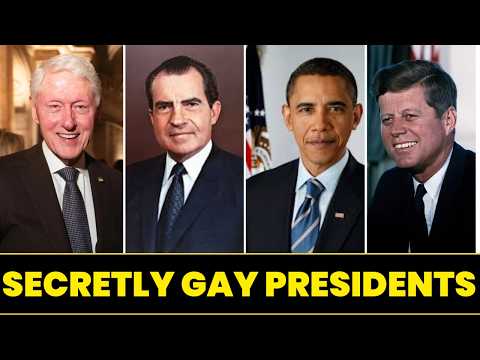
James Buchanan, the only lifelong bachelor to serve as president, shared an unusually close bond with Senator William Rufus King. They lived together for over a decade, and their affectionate letters reveal an emotional depth that went far beyond ordinary friendship. Andrew Jackson teasingly called them “Miss Nancy” and “Aunt Fancy.” When King was appointed minister to France, Buchanan wrote of feeling “solitary and alone,” and later expressed feelings of “wooing several gentlemen.” His choice of words has led some scholars to believe he harbored unrequited romantic interests in other men.
Abraham Lincoln’s relationship with Joshua Speed is equally intriguing. They shared a bed for several years in Springfield, Illinois—a common practice at the time, yet their deep and lasting friendship has sparked speculation. Lincoln also shared a bed with Billy Green, who later provided detailed recollections of their time together. While mainstream historians caution against reading too much into these friendships, the questions linger.
George Washington’s military career brought him into contact with Baron Friedrich von Steuben, a Prussian officer who faced persecution in Europe over rumors about his sexuality. Von Steuben transformed the Continental Army with rigorous training, and Washington valued him deeply. Another key figure was General Casimir Pulaski, whose remains in 2019 suggested he may have been intersex. Washington’s readiness to embrace such individuals highlights a commitment to talent over prejudice.
Thomas Jefferson’s love for French culture and his close friendships have also raised eyebrows, though his documented relationship with Sally Hemings complicates any simple narrative. Bill Clinton’s scandals were strictly heterosexual, but conspiracy theorists have speculated otherwise—without evidence. Martin Van Buren’s meticulous appearance and bachelorhood after his wife’s death led to occasional remarks about his dandyism, but little more.
John F. Kennedy’s friendship with Kirk LeMoyne Billings was lifelong and deeply affectionate. Billings, openly gay in his social circles, had his own room at the White House. Their bond defies easy categorization, illustrating how close friendships can profoundly shape a life without fitting conventional labels.
Barack Obama’s advocacy for LGBTQ rights sparked unfounded rumors, while Chester A. Arthur’s refined tastes and widowed status have led some historians to believe he was closeted. William Henry Harrison may have explored a same-sex relationship, and rumors suggest he helped a same-sex couple escape persecution.
But not all presidents were allies. Eisenhower’s Executive Order 10450 banned LGBTQ individuals from federal jobs, launching the Lavender Scare. Johnson, Nixon, Reagan, and Trump all enforced or endorsed discriminatory policies. Reagan’s slow response to the AIDS crisis and Trump’s transgender military ban stand as stark reminders of institutionalized prejudice.
These stories are just the beginning. The full truth of presidential intimacy remains buried in archives and letters, waiting to be unearthed. What we uncover may challenge everything we thought we knew about the men who led America.
Take Chester A. Arthur, for instance. The twenty-first president was famously widowed, yet his White House years were marked by an almost theatrical elegance. He owned over eighty pairs of trousers and redecorated the executive mansion with the help of Louis Comfort Tiffany. Some historians now suspect that Arthur’s obsessive refinement was less about vanity and more about camouflage—a carefully constructed public persona designed to deflect scrutiny from a private life he dared not reveal.
William Henry Harrison’s story is even more elusive. The ninth president served only thirty-one days before succumbing to illness, leaving little time for historians to examine his personal life. Yet rumors persist that Harrison once intervened on behalf of Peter Hand and Morning Guard, a same-sex interracial couple facing severe persecution. If true, his empathy may have been born from personal experience—an understanding of what it meant to love against the grain of society.
But the deeper we dig, the more we must confront a troubling truth: the absence of evidence is not the evidence of absence. In an era when same-sex desire was criminalized and pathologized, discretion was survival. Men burned letters. They married. They performed heterosexuality with the precision of trained actors. What we find in the archives is only what slipped through the cracks.
Consider the case of Franklin Pierce, Buchanan’s predecessor and King’s former running mate. Pierce and his wife Jane were devastated by the death of their young son in a train accident, and their marriage never recovered. Some scholars have noted that Pierce’s closest emotional relationships were with men—particularly Nathaniel Hawthorne, whose death Pierce mourned with a grief that bordered on the romantic. Was it friendship, or something more? The letters suggest a bond so intense that it eclipsed his marriage.
Then there is the curious case of Grover Cleveland, who was a bachelor when he entered the White House and reportedly shared quarters with a male friend for years. His letters reveal a warmth that historians have struggled to categorize. When Cleveland finally married Frances Folsom in 1886, he was forty-nine; she was twenty-one. The marriage silenced rumors, but did it resolve them?
And what of Woodrow Wilson? His devotion to his advisor Edward House was so consuming that his second wife, Edith, grew openly jealous. House and Wilson exchanged hundreds of letters, some of which House later burned—a decision that has only fueled speculation. What was in those pages that House felt compelled to destroy?
The pattern repeats across generations: intense male friendships, shared quarters, letters that blur the line between affection and romance. In the nineteenth century, such bonds were permitted—even encouraged—because society could not imagine what it refused to name. But as the twentieth century dawned and the language of sexuality sharpened, the space for ambiguity narrowed.
By the time J. Edgar Hoover became director of the FBI, the closet had become a fortress. Hoover’s own relationship with Clyde Tolson—his constant companion, his associate director, his heir—was the subject of whispered rumors for decades. Hoover denied everything, and Tolson was buried within yards of him in Congressional Cemetery. Yet the FBI that Hoover built would destroy countless lives for the very desires he may have harbored himself.
The contradictions grow sharper the closer we look. Hoover’s FBI compiled dossiers on suspected homosexuals while its director dined nightly with Clyde Tolson at the Mayflower Hotel. The hypocrisy was not lost on insiders, but fear kept the silence intact. And that silence, carefully maintained, became a kind of architecture—one that every subsequent president would have to navigate.
Franklin Delano Roosevelt’s administration brought a different kind of ambiguity. His relationship with his wife Eleanor was famously complicated, marked by separate residences and mutual tolerance of outside attachments. Eleanor’s own deep friendship with reporter Lorena Hickok produced thousands of letters, some of which Eleanor later tried to destroy. The first lady’s bond with Hickok was so intimate that historians still debate its nature—and Eleanor was not the only Roosevelt whose private life invited scrutiny.
FDR’s longtime aide Louis Howe was fiercely devoted to him, and the two men worked in such close quarters that their partnership bordered on the domestic. When Howe died in 1936, Roosevelt was inconsolable. Yet the historical record offers no confession, no smoking gun—only the ache of absence where certainty should be.
Harry Truman’s presidency marked a turning point in the other direction. His Executive Order 9835 in 1947, which established loyalty reviews for federal employees, laid the groundwork for the purges that would follow. Truman himself was reportedly uncomfortable with homosexuality—a discomfort that hardened into policy. Under his watch, the machinery of dismissal began to turn, and it would not stop for decades.
Dwight Eisenhower then turned that machinery into an industry. Executive Order 10450 in 1953 explicitly listed “sexual perversion” as grounds for termination, and the Lavender Scare swept through Washington like a cold front. Thousands of careers ended in quiet resignations and ruined reputations. Some men chose suicide over exposure. Others married hastily, burying their lives beneath the weight of respectable façades.
Yet even as the government purged, the culture began to shift. The Stonewall uprising in 1969 cracked the silence open, and by the 1980s the AIDS crisis forced a reckoning that no administration could ignore. Ronald Reagan’s silence during those years remains one of the darkest chapters of presidential indifference. He did not utter the word “AIDS” publicly until 1985—by which time thousands had already died.
Against this backdrop, the question of presidential intimacy becomes more than gossip. It becomes a story about power, fear, and the lengths to which men will go to protect a secret. Some presidents destroyed letters. Some married strategically. Some, like Buchanan, simply refused to perform the expected script at all.
And that refusal—quiet, stubborn, lifelong—may be the closest thing to a confession we will ever have.
Yet the question of presidential intimacy is not merely historical curiosity. It is a mirror held up to power itself. What does it mean that so many of America’s leaders lived within the shadow of a secret? The answer may lie not in what they did, but in what they feared would be known.
Consider the weight of the closet in the Oval Office. A man who could order armies into battle, veto legislation, or shape the fate of millions could still tremble at the thought of a letter falling into the wrong hands. Buchanan’s lifelong bachelorhood, Lincoln’s bed-sharing, Hoover’s constant companion—each invites us to ask what the historical record can never fully answer.
Perhaps that is the point. The truth of presidential sexuality may be less important than the silence that surrounded it. In a nation that preached freedom while policing desire, the private lives of its leaders became a battleground for the country’s deepest contradictions. The same men who signed laws liberating some Americans signed orders persecuting others.
But the story is not over. As archives open and scholarship evolves, new questions emerge. What might we learn if we stopped demanding proof and started listening to the silences? The letters that survive, the friendships that endured, the marriages that masked—all of it forms a hidden history of American power.
And what of the presidents yet to be scrutinized? The ones whose stories remain sealed in private collections, whose loves were never named? History is not a closed book but a living conversation, and every generation reads it anew.
So we are left with the ache of uncertainty. We cannot know for certain what Buchanan felt in King’s absence or what Hoover whispered to Tolson in the dark. But we can know this: the closet has always been a room with a view of the White House.
Perhaps the most radical act is to hold these stories without demanding resolution. To let the ambiguity stand. To accept that the men who led America were as complicated as the country itself—capable of courage and cowardice, love and cruelty, honesty and deception.
What do you think—should we keep digging for definitive answers, or is the mystery itself the most honest truth we can offer?






