It is February 1942, and the temperature has plummeted far below freezing. The snow is so deep a man can vanish into it up to his chest, and the wind carries ice that cuts skin like glass. Somewhere south of Leningrad, in a wilderness of frozen swamp and black pine forest, roughly 100,000 German soldiers are about to be trapped. Among them is the most feared division in Heinrich Himmler’s army: the SS Totenkopf, the Death’s Head Division.
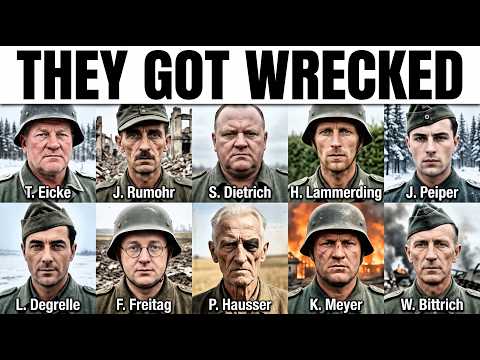
This was no ordinary fighting unit. It had been built from the guards of concentration camps, its first soldiers drawn from the men who had run Dachau. Its commander, Theodor Eicke, had organized the camp system and personally murdered a rival of Hitler’s before the war. Eicke told his officers that the coming war would be a death struggle and that they were to be fanatical and merciless. The Totenkopf carried that message into Russia, leaving a trail of massacres behind it. These were among the most committed, most brutal, and most ideologically loyal soldiers Hitler possessed. And in the winter of 1942, the Red Army was about to wrap a noose around all of them.
The Soviet plan came out of the great counterattack that had thrown the Germans back from the gates of Moscow. In January, General Pavel Kurochkin launched an offensive south of Lake Ilmen. His soldiers pushed through gaps in the thin German line, through forest and snow the Germans believed no army could move through, and began to close in behind the German 16th Army’s Second Corps. On the 8th of February 1942, the ring snapped shut. Six German divisions were sealed inside, about 90,000 fighting men and another 10,000 support troops. Among them, holding the western and northeastern edges of the pocket, was the Totenkopf.
Now, Hitler made the decision that would define the rest of this story, and that he would make again and again until it destroyed his armies. He refused to let them retreat. Field Marshal von Leeb, commander of Army Group North, asked permission to pull some men back before they were cut off. Hitler said no. Leeb was removed from command for even asking. The men in the pocket were ordered to hold their ground and wait to be rescued, no matter the cost.
But how do you supply 100,000 men who are completely surrounded in the dead of a Russian winter with no road and no railway reaching them? The answer came from Hermann Göring, head of the Luftwaffe. Göring promised Hitler that his transport planes could carry everything the trapped army needed: 300 tons of supplies every single day, flown in over enemy lines and landed on two small airfields inside the pocket. This was something the world had never seen before—an entire encircled army kept alive entirely from the air.
The transport planes, the lumbering three-engined Junkers, flew in waves through Soviet anti-aircraft fire and Soviet fighters. Over the months of the siege, the Luftwaffe flew more than 32,000 sorties into Demyansk. They brought in tens of thousands of tons of food, ammunition, and fuel. They flew in over 30,000 fresh soldiers to replace the dead. They carried out tens of thousands of wounded men. It was an astonishing feat of flying, and it cost the Germans hundreds of aircraft and hundreds of irreplaceable air crew—losses they would feel for the rest of the war.
But here is the part the planners did not understand at the time. The airlift never actually delivered the 300 tons a day it had promised. Not even close. The men inside the pocket were always hungry. Always short of shells. Always cold. And every single day the Red Army attacked.
For the Totenkopf, the pocket became a slaughterhouse that never ended. The division was given the role of what the Germans called the fire brigade. Wherever the Soviet attack threatened to break through, the Totenkopf was rushed to plug the hole. Day after day, week after week, month after month, Eicke’s men fought in the snow, in the swamp, in positions that were little more than holes scraped out of frozen ground. There was a saying about the division at Demyansk: No Totenkopf position was taken by the Soviets until every Totenkopf soldier in it was dead. That was not propaganda. That was simply how they fought. And it was why they died in such enormous numbers.
The men lived in conditions that are almost impossible to describe. The wounded could not always be evacuated. Frostbite took fingers, toes, whole feet. Disease spread through the cramped, filthy positions. The spring thaw turned the frozen swamp into a sea of mud that swallowed men and machines alike. There is a photograph of Totenkopf soldiers, many of them wounded, dragging themselves through that mud toward the rear. They look less like an elite division and more like the survivors of some terrible shipwreck.
Eicke himself was nearly killed several times. He sent desperate messages to Himmler begging for replacements, begging for more supplies, begging for the Luftwaffe to fly more missions, warning that without help his division would simply cease to exist. The replacements that did arrive were poured into the line and chewed up almost as fast as they came.
The relief operation finally began in March. German forces outside the pocket attacked toward it, trying to punch a corridor through the Soviet ring. The fighting was savage. Across rivers and swamps, the Soviets defended every step of the way. It was not until the 21st of April 1942 that a battle group with the Totenkopf at its core finally broke through and reopened a thin land link to the outside world. They called it the Ramushevo Corridor, a narrow blood-soaked strip of ground that the Germans would have to defend for another year.
The siege was lifted. But for the Death’s Head Division, the victory was meaningless. Look at what was left of it. The division had gone into the east as a powerful formation. By the time it staggered out of Demyansk, it had been reduced to around 6,700 men. And the histories record that almost none of them were truly fit for duty. Around 80% of the division’s strength had been killed, wounded, or lost. Four out of every five men. An entire elite division had been ground down to a battered remnant of frostbitten, exhausted survivors.
The Totenkopf was so completely wrecked that it could not be patched up at the front. It had to be pulled out of the line entirely, taken off the Eastern Front, shipped first to Germany and then to France, and rebuilt almost from scratch. When it returned to battle nearly a year later, it was effectively a different division wearing the same name.
And there is a darker legacy to Demyansk, one that reached far beyond this one pocket. The airlift had appeared to work. The men had been kept supplied from the air and they had survived. Göring and Hitler looked at this and drew exactly the wrong lesson. When a far larger German army was surrounded at Stalingrad less than a year later, Göring promised Hitler that the Luftwaffe could supply them from the air just as it had at Demyansk. He pointed to this very battle as proof. But Stalingrad was many times larger, the weather was worse, and the Soviet Air Force was far stronger. The airlift failed completely, and an entire German army of around 300,000 men was destroyed. The false lesson of Demyansk helped lead Germany into one of the greatest military disasters in history.
So, the destruction of the Totenkopf in the Demyansk pocket sits at number 10 on our list. One of the most fanatical SS divisions ever raised reduced to a fraction of its strength in a frozen swamp, and a battle whose hollow success would help doom an entire army the following winter.
Number nine takes us forward almost three years, to the very end of the war, and to a beautiful old European capital that was about to be turned into a graveyard. By the winter of 1944, the war was clearly lost for Germany. The Red Army had pushed the Germans out of the Soviet Union, out of most of Poland, and was now driving deep into Hungary, Germany’s last major ally. The great prize in Hungary was its capital, Budapest, the elegant city that straddles the Danube River. On the eastern bank lay the flat district called Pest. On the western bank rose the hills of Buda, crowned by an ancient castle.
Hitler declared Budapest a fortress. It was to be held to the last man and the last bullet. No retreat, no surrender. And among the troops trapped inside when the Red Army closed the ring on the 26th of December 1944 were two divisions of Heinrich Himmler’s Waffen SS, both of them cavalry divisions. The 8th SS Cavalry Division, named Florian Geyer after a German nobleman who had led peasant rebels centuries before, and the 22nd SS Cavalry Division, named Maria Theresia after the old Habsburg Empress who had once ruled Hungary.
These two divisions had a grim history behind them. The Florian Geyer Division had spent much of the war not in open battle, but in what the Germans called bandit fighting, hunting partisans behind the lines in the Soviet Union. In practice, this meant the killing of huge numbers of civilians. In one set of operations alone, the division and units alongside it killed an estimated 3,000 people, the great majority of them unarmed, while recovering only a few hundred weapons. The numbers tell the story of what kind of fighting it really was.
The Maria Theresia Division had been built up from a core of Florian Geyer veterans, filled out mostly with ethnic German conscripts from Hungary, many of them taken into the SS whether they wanted to go or not. Now both divisions were sealed inside a dying city along with other German units and the Hungarian troops who fought beside them. In total, the trapped garrison numbered tens of thousands of soldiers, and behind them, packed into cellars and ruined buildings, were around 800,000 terrified civilians.
The Siege of Budapest was one of the most horrific urban battles of the entire war. Some historians have called it a second Stalingrad. The Red Army did not try to storm the whole city at once. Instead, it ground forward street by street, house by house, room by room. The fighting moved up through buildings and down into the sewers. Soviet assault teams and German defenders fought each other underground in the dark, in the filth of the tunnels beneath the streets. At one point, a handful of Soviet Marines made it all the way to Castle Hill through the sewers, grabbed a German officer, and dragged him back through the tunnels to their own lines.
Supply collapsed almost immediately. The main airport was lost at the very start of the siege. After that, the only way in was by transport plane landing on improvised strips and on a park beside the castle, all under constant Soviet shellfire, or by glider. Food ran out. The defenders began to starve. Soldiers ate their own horses. The cavalry divisions, which depended on those horses, watched them slaughtered for meat. The cold was merciless. The wounded lay in cellars with no proper care.
The Germans tried three times to break in from the outside and rescue the garrison. In a series of attacks code-named Operation Konrad, powerful SS panzer forces from outside the city hammered at the Soviet ring, trying to punch a corridor through to the trapped men. Each time they were stopped. The city was simply too far inside Soviet-held territory, and the Red Army was too strong. The garrison was on its own.
By February of 1945, the situation inside Budapest was beyond hopeless. The defenders had been compressed into a shrinking pocket in the hills of Buda. They were out of food, nearly out of ammunition, surrounded on all sides. The German commander, an SS general named Karl Pfeffer-Wildenbruch, faced a terrible choice: surrender against Hitler’s orders, or attempt to break out through the Soviet lines.
On the night of the 11th of February 1945, the garrison tried to break out. What followed was a massacre. Tens of thousands of soldiers and civilians poured out of the German positions and tried to fight their way through the Soviet encirclement toward the German lines many miles to the west. The Soviets were ready. They knew the breakout was coming. They had set up their machine guns and their artillery to cover every escape route.
As the columns of desperate men surged forward through the darkness and the snow, the Soviet guns opened fire into the packed masses. The streets and the hillsides of Buda were turned into killing grounds. The breakout shattered into thousands of small groups, each trying to slip through the gaps. Most of them were cut down or captured. The numbers are staggering. Of the tens of thousands who tried to break out, only a few hundred ever reached German lines.
For the two SS cavalry divisions, the result was annihilation. The histories of the Florian Geyer division record that of around 30,000 men in the wider SS corps, only about 800 made it out. For the Maria Theresia division, the figure was even worse. Only around 170 men escaped the encirclement. 170 out of an entire division. The commander of the Florian Geyer division, Joachim Rumohr, was wounded in the breakout and took his own life rather than be captured.
The two SS divisions did not retreat, did not regroup, did not rebuild. They simply ceased to exist. They were struck from the German order of battle. The handful of survivors and the men who had been left out of the city were eventually swept into the formation of yet another doomed unit.
And the city itself was destroyed. More than 80% of Budapest’s buildings were damaged or wrecked. All five bridges across the Danube lay in the river, blown up by the retreating Germans. Tens of thousands of civilians had died in the siege from starvation, from the fighting, and from massacres carried out by the Hungarian fascist Arrow Cross gangs who used the chaos to murder thousands of the city’s Jews.
The siege of Budapest takes number nine. Two SS cavalry divisions with a record of brutality behind the lines, trapped in a beautiful city, and then wiped out almost to the last man in a single night of slaughter when they tried to escape. From the frozen swamp of Demyansk to the burning streets of Buda, the pattern repeats: fanaticism that promised invincibility delivered only annihilation.
Which of these two stories shocked you more — the frostbitten remnant of the Totenkopf, or the 170 survivors of an entire SS division? Tell us in the comments below.






