You know him as the bumbling, bayonet-wielding butcher of Walmington-on-Sea, the man whose catchphrase “Don’t panic!” became a national treasure. But behind Lance Corporal Jack Jones’s trembling hands and wild-eyed tales lies a military career so richly detailed, it could fill a history book. And here’s the kicker: it’s all based on real campaigns, real regiments, and real medals.
For decades, fans of Dad’s Army have chuckled at Jonesy’s anecdotes about General Kitchener, the Fuzzy-Wuzzies, and his beloved bayonet. But few realise that the BBC crafted a meticulously accurate backstory for the character—one that mirrors the actual service of the Royal Warwickshire Regiment. From the sands of the Sudan to the trenches of the Western Front, Jones’s fictional life is a window into Britain’s imperial wars.
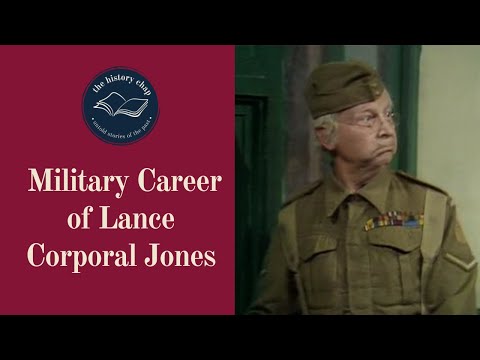
So, let’s dig into the archives and follow the journey of a man who, though fictional, wore his medals with genuine pride. Because those ribbons on his Home Guard uniform? They tell a story of courage, chaos, and a career that spanned over three decades.
Jack Jones was born in 1870 in Walmington-on-Sea, the son of George and Mildred Jones. At just fourteen, he joined the Royal Warwickshire Regiment as a drummer boy—a real regiment with a storied past dating back to the 1670s. The BBC’s writers didn’t pick this unit at random; they chose one that would place Jones at the heart of some of the British Army’s most iconic battles.
His first taste of action came in 1884, when the 1st Battalion was sent to Egypt for General Wolseley’s Nile Expedition. The mission was to rescue General Gordon in Khartoum—and though it failed, Jones returned with two campaign medals: the Egypt Medal and the Khedive’s Star. Those very ribbons would later adorn his Home Guard uniform, over fifty years later.
But Jones’s thirst for adventure was far from quenched. By the late 1890s, he found himself back in Sudan under General Kitchener, fighting in the Anglo-Egyptian reconquest. The 1st Battalion saw action at the Battle of Atbara and the climactic Battle of Omdurman, where a young Winston Churchill took part in one of the last great cavalry charges. Jones added the Queen’s Sudan Medal and the Khedive’s Sudan Medal to his collection—medals that spoke of desert dust and dervish spears.
Yet, as with any good story, there’s a twist. Jones also wears the Queen’s South Africa Medal and the King’s South Africa Medal, issued for the Boer War. But the 1st Battalion spent that war in India. So how did a butcher from Walmington-on-Sea end up in South Africa? Did he transfer to the 2nd Battalion? Or perhaps he volunteered for a mounted infantry unit, seeking even more action? The BBC’s trail goes cold, but Jones’s own tales—of being “mad with grenades” in the trenches—suggest a man who never shied away from a fight.
We do know that by 1908, he was back with the 1st Battalion on the North-West Frontier of India, earning the Indian General Service Medal for campaigns against the Pathan tribesmen. His stories of fighting the Patans weren’t just barrack-room boasts—they were grounded in real history.
When the First World War broke out in 1914, Jones was 44 and had served for thirty years. He was awarded the Army Long Service and Good Conduct Medal, but that didn’t stop him from joining the British Expeditionary Force in France. His battalion fought at Mons, took part in the retreat to the Marne, and even witnessed the Christmas Truce of 1914. Jones wore the 1914 Star—nicknamed the Mons Star—along with the British War Medal and the Allied Victory Medal, affectionately known as “Pip, Squeak, and Wilfred.”
Invalided out in 1915 due to poor eyesight, he returned to Walmington-on-Sea and opened a butcher’s shop. But when Britain faced its gravest peril in 1940, Jones didn’t hesitate. He lied about his age—claiming to be 60 instead of 70—and enlisted in the Home Guard, armed with a dervish spear from his Sudan days.
And so, the legend of Lance Corporal Jones was born. But his story doesn’t end there. The medals on his chest, the tales he told, and the man behind the catchphrase—all of it is a testament to the real men who served, and to the writers who honoured them with such meticulous detail. Because sometimes, the best fiction is the kind that’s almost true.
But let’s pause on that mystery for a moment, because it reveals something fascinating about how the BBC constructed Jones’s backstory. The writers didn’t just slap medals on a costume—they mapped them to actual campaign histories, then left deliberate gaps that let viewers fill in the blanks. Those two Boer War ribbons are the perfect example: they don’t quite fit the 1st Battalion’s timeline, which means Jones’s story invites us to imagine a young soldier so eager for action that he’d volunteer for a transfer or a mounted infantry unit just to get to the front.
And that’s exactly the kind of man Jones was. In Walmington-on-Sea, he’s the first to volunteer for the dangerous patrol, the one who suggests fixing bayonets when the situation looks grim. His eagerness isn’t just comic relief—it’s a character trait rooted in a lifetime of colonial warfare.
Consider his catchphrase: “They don’t like it up ’em!” It’s played for laughs, but it references the bayonet charges that were a brutal reality of the Sudanese campaigns. At Omdurman, British and Egyptian forces faced tens of thousands of Mahdist warriors; the fighting was close, desperate, and bloody. Jones’s fixation on the bayonet isn’t senile nostalgia—it’s the muscle memory of a soldier who survived some of the Victorian army’s fiercest battles.
Then there’s his relationship with General Kitchener. Jones mentions him constantly, almost reverently. “Kitchener? I knew him well,” he’ll say, before launching into another tale. The real Kitchener was a towering figure of the era—the man who avenged Gordon, conquered Sudan, and later became the face of the First World War recruitment drive. For a young soldier in the 1890s, serving under Kitchener would have been a defining experience, and Jones clings to that memory like a medal.
What makes Jones’s fictional career so compelling is how it mirrors the real trajectory of the British Army in the late Victorian and Edwardian eras. From Egypt to Sudan, India to South Africa, and finally the mud of Flanders—Jones was there for all of it, at least on paper. The BBC’s researchers clearly combed through regimental histories, because the 1st Battalion Royal Warwickshires really did serve in all those theatres.
And then came the First World War, the great rupture. Jones was 44 in 1914, a veteran of thirty years’ service. He could have retired. Instead, he marched to Mons with the British Expeditionary Force, fought in the retreat from Mons, and was there for the Christmas Truce. His eyesight—so comically bad in the show that he signs the table instead of the enlistment papers—was what eventually invalided him out in 1915.
But here’s a poignant detail: the 1914 Star, which Jones wears with such pride, was only issued to those who served in France or Belgium between August and November 1914. It marks him as one of the original “Old Contemptibles,” the small professional army that bore the brunt of the German advance. By the time Jones returned to Walmington-on-Sea, that army was virtually gone—and the war would grind on for three more years.
So when we see Jones in 1940, chest glittering with ribbons, spear in hand, we’re not just looking at a comedy character. We’re looking at a living archive—a man who carries the memory of a vanished world. And when he tells his Home Guard comrades about the Sudan or the Boer War, he’s doing what thousands of real veterans did: passing on the stories of an age that was already slipping away.
But let’s not forget the man who brought Jones to life. Clive Dunn was only 48 when he took the role—younger than many of his co-stars—yet he imbued the character with a warmth and vigour that made Jones utterly believable. Dunn’s own wartime experiences added a layer of authenticity to his performance. He served with the 4th Queen’s Own Hussars in Greece, was captured, and spent four years in a German POW camp in Austria. That firsthand knowledge of soldiering, of fear and camaraderie, must have informed every tremor of Jones’s hands and every eager volunteer for a dangerous mission.
After the war, Dunn resumed his acting career, but it was Jones that made him a household name. The character’s catchphrases—”Don’t panic!” and “Permission to speak, sir!”—became part of the national lexicon. And yet, behind the comedy, there was always a hint of the real veteran: the man who had seen too much, who coped with the terror of war through a kind of manic cheerfulness.
In many ways, Jones represents the thousands of real Home Guard members who had served in the earlier conflicts. By 1940, they were in their fifties, sixties, and seventies—too old for active service, but determined to do their bit. They drilled with broomsticks and antique rifles, patrolled the coastline, and scanned the skies for parachutists. They were the last line of defence against a German invasion that never came.
And like Jones, many of them carried stories of distant campaigns. They had fought in the Sudan, in South Africa, in India, and on the Western Front. Their medals, like Jones’s, were a tangible link to a world that was rapidly disappearing. When they spoke of Kitchener or the Fuzzy-Wuzzies, they were not just boasting—they were remembering fallen comrades and a sense of duty that had defined their lives.
So the next time you watch Dad’s Army and chuckle at Jones’s frantic cries of “Don’t panic!”, spare a thought for the real men he represented. They may not have had a BBC research team crafting their backstories, but their service was just as real—and their stories just as extraordinary.
Jones’s fictional career, meticulously mapped to the Royal Warwickshires’ real campaigns, is a tribute to them all. And it’s a reminder that sometimes, comedy can be the most respectful form of remembrance.
And what of the medals he might have earned but never wore? If Jones had survived the war—and let’s assume he did, because characters like him never truly fade—he would have qualified for the Defence Medal, issued to those who served in Britain during the conflict. That final ribbon would have completed a collection spanning nearly six decades of British military history.
But Jones’s story isn’t really about medals. It’s about the men who wore them. The Home Guard veterans who drilled in church halls and scanned the skies for parachutists were living links to an age of empire that was already crumbling. When Jones shouted “Don’t panic!” he was speaking for a generation that had faced far worse and somehow kept smiling.
Clive Dunn understood that. His own wartime service—captured in Greece, four years in a POW camp—gave Jones a depth that pure comedy could never achieve. Behind every trembling hand and wild-eyed tale was a quiet dignity, a refusal to let age or fear define him.
So the next time you watch Dad’s Army, look closely at those ribbons. They’re not just costume decoration—they’re a life story, meticulously researched, lovingly worn. And they remind us that the line between fiction and history is thinner than we think.
What’s your favourite Jonesy moment—and did you ever spot a medal we missed? Let us know in the comments below!






