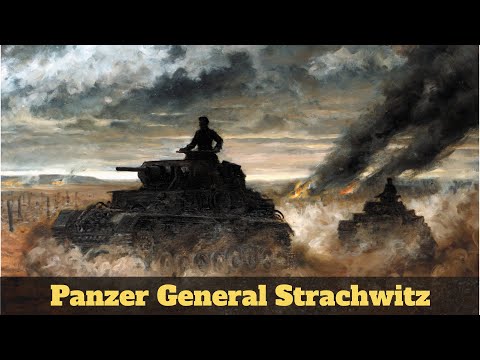
The night was shattered by the roar of cannons, and the snow-covered village of Belgorod became a graveyard for Soviet armor. In a matter of minutes, the quiet darkness erupted into a hellscape of fire and steel. The Soviet tank crews, confident and relentless, had no idea they were walking into a trap set by the most feared panzer commander of the Eastern Front. “The Russians have recognized us. They’re broadcasting. Watch out. It’s Strachwitz,” crackled the radio, but it was already too late. The trap had sprung.
Count Hyazinth von Strachwitz, known as the Panzer Count, was a legend even among his enemies. His name alone could send shivers down the spines of Soviet commanders. On this fateful night in March 1943, his cunning and audacity would add another chapter to his storied career. But how did a nobleman from Silesia become the scourge of the Soviet tank corps? The answer lies in a lifetime of daring, resilience, and an unyielding will to fight.
Born on July 30, 1893, in Groß Stein, Upper Silesia, Hyazinth von Strachwitz was the firstborn son of a wealthy and noble family. His early life was one of privilege, but it was also steeped in a tradition of military service. From a young age, he was groomed for greatness. He excelled at sports, horsemanship, and academics, and his path seemed set for a life of honor and distinction. But the world had other plans. The outbreak of World War I in 1914 would thrust him into the cauldron of combat, where he would quickly make a name for himself.
As a young cavalry officer, Strachwitz led daring reconnaissance missions deep behind enemy lines. His bravery was undeniable, and his exploits became the stuff of legend. He was awarded the Iron Cross for his daring, but his war was far from over. Captured by the French, he endured years of hardship and multiple escape attempts. His resilience in the face of adversity would forge the steel that would later drive his panzers into the heart of Russia.
After the war, Strachwitz returned to a Germany in turmoil. He joined the Freikorps, fighting against communist uprisings and Polish insurgents in his beloved Silesia. His leadership in these chaotic times further honed his skills. When the Nazis rose to power, Strachwitz, like many aristocrats, joined the party, seeing it as a means to protect his homeland. But his true loyalty was always to his soldiers and his country, not to any political ideology.
When World War II erupted, Strachwitz was a reserve officer, but he quickly proved his worth. During the invasion of France, he famously bluffed an entire French garrison into surrendering with nothing but a cigarette and a bold claim. “Strachwitz, that devil!” exclaimed General Friedrich Kirchner upon learning of the feat. It was a prelude to the audacious tactics he would employ on the Eastern Front.
Operation Barbarossa was where Strachwitz truly came into his own. Leading the 1st Battalion of Panzer Regiment 2, he faced the might of the Soviet T-34 and KV-1 tanks. The German panzers were outgunned, but Strachwitz’s tactical brilliance compensated. He used captured Soviet tactics against them, ambushing and outmaneuvering the enemy at every turn. His panzers became a phantom force, striking from unexpected directions and vanishing into the vast steppe.
By the time of the Battle of Stalingrad, Strachwitz was a household name among the German troops. His regiment claimed 270 enemy tanks destroyed, and his leadership was instrumental in the drive to the Volga. “Watch out for Strachwitz,” became a common warning among Soviet tank crews. His reputation was such that even Hitler sought to exploit it for propaganda.
But it was in March 1943, during the Third Battle of Kharkov, that Strachwitz executed one of his most brilliant maneuvers. Facing three Soviet tank corps west of Belgorod, he hid his panzers, including three Tiger tanks, in a deserted village. The trap was set. As the Soviet tanks rumbled into the village, the Tigers and Panzer IVs unleashed hell. In a matter of minutes, 18 Soviet tanks were reduced to burning wrecks. It was a devastating blow, and it was just the beginning.
The night battle that followed was a masterclass in armored warfare. Strachwitz’s panzers, camouflaged and dug in, waited until the Soviet column was fully committed. Then, they struck. The Soviet tanks were caught in a deadly crossfire, unable to maneuver in the narrow village streets. Panic spread among the Soviet crews as their comrades’ tanks exploded around them. The inferno lit up the night sky, and the snow was stained with oil and blood.
Strachwitz climbed atop his turret, watching the destruction with a mix of satisfaction and grim determination. He knew that this victory, while significant, was only a temporary reprieve. The Soviet juggernaut was relentless, and the German army was stretched thin. But for now, he had bought his men another day.
As the flames died down and the surviving Soviet tanks retreated, Strachwitz’s men cheered. They had destroyed over 300 Soviet tanks in just a few days, a feat that would earn Strachwitz the Swords to his Knight’s Cross. But the war was far from over. The count’s greatest challenges were yet to come, and the price of victory would be higher than he could ever imagine.
The victory at Kharkov bought the German army a fleeting respite, but Strachwitz knew better than to mistake a tactical triumph for a strategic turning point. The spring thaw was already turning the Ukrainian steppe into a sea of mud, and the Soviets were massing for something far larger. The count used the lull to refit his regiment, personally inspecting every Panther and Tiger that rolled into the depot. He drove his mechanics relentlessly, and he drove himself harder still.
In late March, he was summoned to the Wolf’s Lair to receive the Swords to his Knight’s Cross from Hitler himself. The Führer, pale and trembling, gripped the count’s hand and spoke of destiny and wonder weapons. Strachwitz nodded politely, but his mind was on the mud and the mines and the endless Russian columns. He left the bunker convinced that Germany was being led by a man who had lost his grip on reality.
He took two weeks of leave with his wife Alda in Berchtesgaden, the mountains a world away from the burning villages of the east. They walked the alpine trails and spoke little of the war. But Strachwitz could not sit still. He returned to his regiment early, arriving just as the final preparations for Operation Citadel were underway.
The summer offensive of 1943 was to be the greatest armored thrust in history, and Großdeutschland was to be its spearhead. On the morning of July 5th, a heavy rain fell as thousands of guns opened fire. Strachwitz’s panzers rolled forward into the dense Soviet defenses north of Belgorod, and the earth itself seemed to shake. Minefields, anti-tank guns, and dug-in tanks awaited them at every turn.
For days the fighting raged with a ferocity that defied description. On July 7th alone, his men destroyed 62 Soviet tanks and 55 anti-tank guns. But the Soviets did not break. They bent, withdrew, and counterattacked, trading ground for time and blood. Strachwitz’s Panthers, plagued by mechanical failures, broke down in the mud and the dust, and the count raged at the engineers who could not keep them running.
Then came the news that his eldest son had been seriously wounded at the front. Strachwitz received the message in his command tank, read it twice, and folded it into his pocket without a word. The next day, as he rested his arm on the breech lock, a premature shot from his own gunner smashed his forearm. He had the arm set in a plaster cast and returned to the line within hours. General Hörnlein, outraged at the count’s refusal to evacuate, ordered him to the field hospital personally.
By the time Strachwitz returned to combat in August, the Battle of Kursk had ended in German defeat. The initiative on the Eastern Front had passed to the Soviets, and it would never return. The German army was now in full retreat, and Strachwitz’s regiment, reduced to a single operational panzer by the end of September, was fighting for its very survival.
Through the autumn and winter, the retreat continued. Across the Dnieper at Kirovograd, Strachwitz took another serious wound, this time in the left arm. He was sent to Breslau Hospital, then home to convalesce. But the war would not wait for him, and neither would the Soviets.
By early 1944, Strachwitz was back in action, promoted to Higher Panzer Commander of Army Group North. The northern front had collapsed to the Narva River, and the count was given the task of eliminating the Soviet bridgeheads one by one. He spearheaded the attack in one of the first Panther tanks, walking stick in hand and his trademark sheepskin jacket on his back. The fighting was brutal, often at night in swampy, claustrophobic woods, but Strachwitz was always at the front, handing out cognac and Iron Crosses in equal measure.
In April, Hitler awarded him the Diamonds to his Knight’s Cross, but when the Führer demanded the elimination of the last Soviet bridgehead, Strachwitz refused. “Panzers can’t drive in the swamp,” he told Hitler bluntly. It was a rare act of defiance from a man who cared more for his soldiers’ lives than for medals or political favor.
That summer, the Soviets launched Operation Bagration, and the Eastern Front collapsed. Strachwitz was part of the relief attempt for Vilnius, and later, in August, he led a small battle group to break through to the encircled German forces at Riga. With only a handful of Panthers and a few thousand men, he routed the Soviet 51st Army, capturing 18,000 prisoners and destroying dozens of tanks. “Herr Leutnant, you have busted the cauldron,” an officer exclaimed as Strachwitz emerged from his tank, covered in oil and dirt. “I am a full-fledged general,” he replied with a grin.
But the end was near. In January 1945, Strachwitz, still on crutches from a near-fatal car accident, appeared at Field Marshal Schörner’s headquarters and volunteered to defend his Silesian homeland. He organized 8,000 men into a tank-hunter force, many of them teenagers and wounded veterans. Among them was his youngest son, Hubertus, who had lost a leg but insisted on returning to the front. He was killed on March 25th, 1945. Strachwitz never spoke of it publicly, but those who knew him saw the light in his eyes dim.
After Germany’s surrender, Strachwitz ensured most of his men surrendered to the Americans. He spent two years in captivity, during which he learned that his wife Alda had been killed by a US military truck. His ancestral lands were gone, handed over to Poland. He had nothing left but his tattered uniform and his medals.
Yet the count rebuilt his life. He married again, founded a refugee foundation for displaced Silesians, and became a knight of devotion of the Order of St. John. On April 25th, 1968, at the age of 75, Hyazinth von Strachwitz succumbed to lung cancer. At his funeral, General Hans-Georg Lemm of the Bundeswehr said, “It was because of his bravery, which served as an example to all officers and soldiers, that he carried the highest decorations of the Knight’s Cross.” Unlike most senior commanders of the Third Reich, the Panzer Count was buried with full military honors.
His motto was simple: “Panzers should not be standing around. They should be rolling along, either shooting at the enemy or attacking and pursuing with speed and daring.” He was wounded fourteen times, yet he proved as tough as the wild boar on his family crest. Guderian rightly considered him one of the greatest panzer leaders. And on that snowy night in Belgorod, the Soviets learned why. Was Strachwitz the finest tank commander of the war, or was he simply a relic of a dying age of chivalry? Share your thoughts below.






