In the early hours of December 23, 1948, while Tokyo slept, seven men were led one by one to the gallows inside Sugamo Prison. They had once ruled an empire—now they faced the silence of the executioner. No reporters, no families, no public announcement. Just the cold precision of military justice. This is the story of the Tokyo Trial and the untold executions that closed a dark chapter in Japan’s history.
But how did it come to this? In August 1945, after years of war and destruction, Emperor Hirohito announced Japan’s unconditional surrender. For the military elite, it was a nightmare. Chaos engulfed the government as secret documents were burned and officials tried to flee or hide. General Douglas MacArthur arrived in Tokyo with a mission: to reshape the country and bring war criminals to justice.
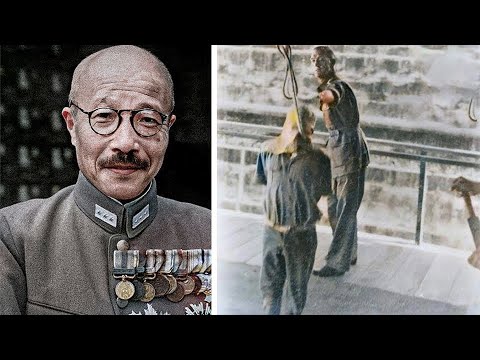
The International Military Tribunal for the Far East was born, inspired by Nuremberg. Eleven nations sent judges and prosecutors to try Japan’s leaders for crimes against peace, war crimes, and crimes against humanity. The world watched as the architects of Pearl Harbor and the brutal occupations of Asia faced judgment.
Among the first arrested was Hideki Tojo, former prime minister and mastermind of the war. He did not deny his role. “I accept full responsibility,” he said, but he claimed he acted on the emperor’s will—a claim that would shake the courtroom.
As the trial began on May 3, 1946, the courtroom filled with judges, prosecutors, and journalists. The defendants sat silently, showing little emotion. The legal process was slow, hampered by language barriers and differing legal systems. Yet, the prosecution presented overwhelming evidence: forced labor, massacres, and the horrific treatment of prisoners of war.
More than 400 witnesses testified, including survivors of the Nanjing Massacre and the Burma-Thailand Railway. The world heard stories of unimaginable cruelty. “We were treated like animals,” one survivor recalled. The evidence was damning.
After two years, the verdict came. Seven men were sentenced to death. Sixteen received life imprisonment. Two got shorter terms. The condemned were returned to Sugamo Prison to await their fate. Appeals were rejected. Justice would be swift.
On the night of December 23, 1948, the executions were carried out in secret. The bodies were cremated, and the ashes scattered over Tokyo Bay to prevent any monument from being built. The message was clear: there would be no glorification of war criminals.
But the story doesn’t end there. While the Tokyo Trial focused on the top leaders, regional trials across Asia prosecuted thousands more. And as the Cold War began, Japan’s war criminals would soon find unexpected allies—and their release would spark new controversies.
In Manila, the trial of General Tomoyuki Yamashita had already set a legal precedent that would echo through history. He was hanged in February 1946, not for ordering atrocities, but for failing to stop them. Command responsibility became a doctrine that would haunt military leaders for generations.
In China, the trials in Nanjing and Shanghai moved quickly. Hisao Tani, a lieutenant general who had marched through the devastated city in 1937, was found guilty of the massacre and executed in 1947. The Chinese proceedings revealed horrors that had been buried for years—forced labor, human experimentation, and the systematic destruction of villages.
In Singapore, British prosecutors focused on the Death Railway. Thousands of Allied prisoners had been worked to death under brutal conditions. Guards who had beaten, starved, and executed prisoners were brought to justice. Many were hanged.
By 1951, more than 5,700 Japanese individuals had been charged. About 984 were executed. It was one of the largest efforts in history to hold individuals accountable for wartime atrocities.
But as Japan’s surrender became certain in August 1945, a wave of suicides swept through the military elite. General Korechika Anami, the Minister of War, committed seppuku hours after the emperor’s announcement. He left a note expressing loyalty to the throne and regret over the war’s outcome.
General Toshizo Nishio, who had commanded forces in China, also chose death over trial. In occupied territories, entire units committed collective suicide, encouraged by commanders to avoid dishonor. These deaths left gaps in investigations and made it harder to uncover the full truth.
Meanwhile, the remaining war criminals were held at Sugamo Prison. The men who had once commanded armies now spent their days behind concrete walls. The routines were rigid, the silence heavy. They waited.
With the San Francisco Treaty in 1951, Japan regained its sovereignty. The occupation ended, but the legacy of the war remained. Calls for the release of the remaining prisoners grew louder. Politicians argued that the men had already paid for their actions. Families pleaded for mercy. Some claimed the sentences were political, not just.
From 1952 to 1958, under Japanese pressure and American approval, releases began. Many were freed quietly under the label of clemency, justified by old age or poor health. The last group of Class A war criminals walked out of Sugamo Prison in 1958. No ceremony. No public statements. They simply disappeared into private life.
But the releases sparked outrage across Asia. For survivors of massacres and forced labor, the early release of convicted war criminals felt like a denial of justice. The wounds were still fresh.
And through it all, one figure remained untouchable: Emperor Hirohito. He had been the symbolic head of Japan throughout the war. His name appeared on military orders. His image inspired soldiers to fight and die. Yet he was never charged.
General MacArthur made the decision early: putting Hirohito on trial would trigger chaos. The emperor was allowed to remain on the throne, stripped of political and divine authority. In January 1946, he declared he was not a living god. The announcement marked a turning point in Japan’s cultural and political structure.
But the decision to shield him remains controversial. Critics argue that justice was not fully served. Survivors in China, Korea, and the Philippines saw his protection as a political compromise that denied them full accountability.
As the last of the released men faded into obscurity, a quieter reckoning was taking place in the streets of Tokyo and across the former empire. The trials had ended, but the memory of what had been done—and what had been left unpunished—refused to stay buried.
In the decades that followed, historians, journalists, and survivors began to piece together a different picture of the Tokyo Trial. They noted that the tribunal had been shaped by the politics of the Cold War as much as by the pursuit of justice. “The trial was a victor’s court,” some critics argued, pointing out that Allied atrocities—such as the firebombing of Tokyo or the atomic bombings of Hiroshima and Nagasaki—were never examined.
Others defended the proceedings as a necessary first step. For the first time in history, a coalition of nations had held leaders accountable for crimes against peace. The precedent mattered, even if the process was imperfect.
Yet the most painful legacy was not in the courtroom but in the memories of those who had suffered. In Nanjing, survivors gathered each December to light candles for the dead. In Seoul, former comfort women demanded recognition. In Manila, families of massacre victims still searched for answers.
And in Japan itself, the war remained a subject of deep division. Some saw the executed men as martyrs who had acted for the nation. Others saw them as criminals who had brought ruin upon the country. The Yasukuni Shrine became a flashpoint, especially after it enshrined fourteen Class A war criminals alongside millions of ordinary soldiers.
When Emperor Hirohito died in 1989, the world watched as Japan mourned a man who had become a symbol of both continuity and silence. He never publicly apologized for the war. He never explained his role. “The emperor’s silence,” one historian wrote, “was the loudest statement of all.”
But the story of the Tokyo Trial was not only about guilt and punishment. It was also about the birth of modern international law. The tribunal’s definitions of crimes against humanity and command responsibility would later be used in courts from The Hague to Rwanda.
In 2001, a new generation of lawyers gathered in Tokyo for a conference on the legacy of the IMTFE. They debated the fairness of the verdicts, the handling of evidence, and the decision to spare the emperor. Yet they also acknowledged that the trial had opened a door—one that could never be fully closed again.
The men who were hanged on that cold December morning in 1948 had believed they were serving their emperor and their nation. History judged them differently. And as the years passed, the question remained: had justice been done, or had it merely been declared?
The answer depends on who is asked. For the families of the victims in Nanjing, Manila, and the Death Railway, the hangings were a necessary reckoning—a formal acknowledgment that their suffering had been seen. For the men who died, it was a victor’s justice, swift and final.
What remains undeniable is the precedent. The Tokyo Trial, for all its flaws, established that leaders could not hide behind sovereignty or orders. “The tribunal did not end war crimes,” one legal scholar noted, “but it made denial impossible.”
Today, Sugamo Prison is gone—replaced by a high-rise complex in Ikebukuro. Tokyo Bay holds the ashes of seven men with no graves. And the Yasukuni Shrine still enshrines them, a quiet provocation that refuses to fade.
The last surviving prosecutor of the IMTFE died in 2019, taking with him memories of a courtroom where empires were judged and silence was the loudest defense. His final interview ended with a single sentence: “We did what we could. The rest is for history.”
But history is never finished. The questions linger—about Hirohito’s immunity, about the Cold War’s shadow, about whether justice can ever be complete when the most powerful are spared. The Tokyo Trial closed a chapter, but the book remains open.
What do you think—was the Tokyo Trial a foundation for international justice, or a victor’s compromise that left the deepest wounds unhealed? Share your thoughts below.






