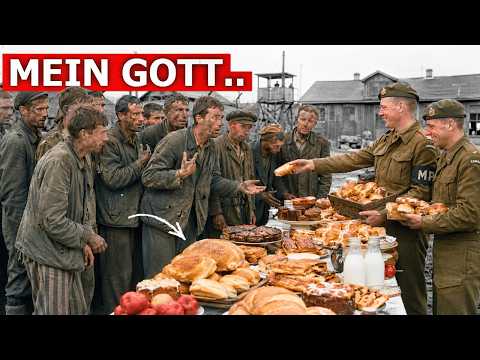
The room was completely silent. Twenty-three German soldiers sat on wooden benches, backs straight despite the exhaustion pulling at every muscle, all staring at the door. They had been told food was coming. From experience, that meant thin soup, watery broth with maybe a few potato peels floating on top, hard bread that could break your teeth. If you were lucky, a single boiled potato, small and gray.
Sergeant Hans Weber sat fifth from the left, hands resting on his knees to keep them from shaking. He was 35 years old. Two years on the Eastern Front had aged him a decade. The lines around his eyes ran deep, carved by cold and fear and things he tried not to remember when he closed his eyes at night.
Three days ago, he had surrendered. Not in some grand last stand, not with honor or glory, just quietly in a ruined farmhouse outside a town whose name he never learned. An American patrol had surrounded his position. He had no ammunition left and no will to fight even if he did.
His unit had been retreating for six months, always moving west, always running—from the Soviets, from reality, from the inevitable end everyone could see coming but no one dared speak aloud. When the American corporal pointed his rifle at Weber’s chest and shouted in English, Weber simply raised his hands. His men did the same. Twelve of them, boys mostly, teenagers in uniforms too big for their shrinking frames. They dropped their weapons and waited to die.
But the Americans hadn’t shot them. That was the first shock. The first moment when Weber’s understanding of how the world worked began to crack. The corporal searched them for weapons—professional and quick—then pointed to a truck and said something Weber didn’t understand but whose meaning was clear. Get in. No beating, no screaming, no bullets. Just orders, calm and matter-of-fact, as if taking prisoners was routine business and not the culmination of years of hatred and bloodshed.
The truck brought them here, a holding center. It used to be a German barracks before the Americans took it. They were searched again, more thoroughly this time. Names written down, photographs taken, each man given a number. Everything done by the book, precise and organized the way Weber himself had been trained to handle prisoners back when he believed Germany would win this war.
Then they were brought to this room and told to sit, told to wait, told food was coming. Weber didn’t believe it. He had learned not to believe anything anymore. The war had beaten that out of him. Belief was dangerous. Hope was worse. Better to expect nothing and be surprised if something good happened than to hope and be crushed when it didn’t.
So he sat on the hard wooden bench and prepared himself to wait. Hours, maybe. A day, perhaps. That’s how these things worked. Prisoners didn’t matter. Feeding them was never urgent.
That’s why the silence felt so heavy when the door opened thirty minutes later. Thirty minutes. Weber’s stomach was still growling from the thin soup they’d been given two days ago at the last checkpoint. His body had learned to exist on almost nothing—a few hundred calories a day, maybe less, just enough to keep moving, just enough to keep the heart beating. The Wehrmacht supply system had collapsed months ago. Rations had dwindled to scraps. Near the end, they were eating whatever they could find—tree bark sometimes, grass when there was nothing else.
Every man in the room expected nothing when that door swung open. But what walked through changed everything.
Three American soldiers entered carrying trays. Not small trays, not the kind you might use to serve soup to a few men—big metal trays, the kind meant to feed a whole unit, industrial-sized serving platters that required both hands to carry. The smell hit Weber first. Meat. Real cooked meat. Not the ersatz rations made from sawdust and chemicals they’d been choking down for a year, not the mystery tins of paste that claimed to be food but tasted like despair. This was actual meat, roasted, seasoned. The smell of it filled the room like a memory from another life, from before the war, from a time when food was normal and hunger wasn’t a constant companion gnawing at your insides.
The soldiers set the trays on a long table at the front of the room. Nobody moved. Weber stared. They all stared. Twenty-three men frozen in place, eyes locked on those trays like they were looking at something impossible, something their minds couldn’t quite accept as real.
On the trays: large pieces of roasted meat, dark and glistening; big piles of mashed potatoes with real butter melting on top, golden and thick; cooked vegetables—carrots and peas bright with color, steaming; several loaves of bread already sliced, the kind of soft white bread Weber hadn’t seen in years.
This can’t be one meal. The thought ran through Weber’s mind on an endless loop. This can’t be for us. This is a mistake. They brought the wrong trays. This is for the guards. This is for officers. This is for anyone but us.
One of the American soldiers, a sergeant with tired eyes and three stripes on his sleeve, said something in English. Another soldier, younger, stepped forward and spoke in halting German. His accent was terrible, but the words were clear enough.
“This is your meal. There is enough for everyone. Form a line. Take what you want. Eat until you are full.”
Still, nobody moved. Take what you want. Eat until you are full. Those words didn’t make sense. They belonged to a different world, a world where prisoners had choices, a world where anyone cared if you were full.
Weber looked at the man sitting next to him. Ernst Adler, 42 years old, a Nazi Party member since 1932, a true believer who still thought Germany would somehow turn this around even now, even here. Adler’s face was twisted in confusion, suspicion radiating from every line. On Weber’s other side sat a boy, Private Johann Keller, 19 years old, Hitler Youth before they conscripted him. Still had that fanatical light in his eyes, though it was dimmer now, dulled by hunger and defeat.
The American sergeant seemed to understand why they weren’t moving. He spoke again. The translator repeated it. “This is not a trick. This is normal. This is the same food we give our own soldiers. You are prisoners, yes, but you are still human beings. Now, eat.”
Slowly, like men waking from a dream or walking under water, one prisoner stood. Then another. A line formed. Muscle memory. Even defeated, starving soldiers understand how to form a line.
Weber was fifth. He watched the first four men approach the table, watched them hesitate, watched them take plates with hands that shook, watched them serve themselves like they expected someone to slap the food away at any moment. The first man took a piece of meat—just one, small portions, careful, trying not to be greedy, trying not to take too much, operating on the logic of scarcity that governed their lives. The American sergeant watched and said something to the translator. The translator called out, “You can take more. Take as much as you want. There is plenty.”
The second man took more—a larger piece of meat, a big scoop of potatoes. His hands were shaking so badly he almost dropped the serving spoon.
Then it was Weber’s turn. He stepped up to the table. The smells were overwhelming up close. His stomach cramped. His mouth filled with saliva so quickly he had to swallow. He hadn’t produced this much saliva in months. His body had forgotten what real food smelled like. Now it remembered, and every cell screamed hunger.
He picked up a plate. The ceramic was clean, warm. Someone had washed these plates. Someone had cared enough to serve this meal properly. Weber looked at the meat—large cuts roasted until the outside was crisp and dark. He could see the grain of the meat, could see the herbs and seasoning crusted on the surface. His hand reached out, stopped, reached out again. He took a piece. It was heavy on the serving fork, substantial, real. He placed it on his plate, and the plate actually tilted from the weight.
The mashed potatoes came next. Creamy and smooth, butter pooled on top, melting into yellow rivers through the white peaks. He scooped a portion. It was more food than he’d eaten in a single meal in six months, maybe longer. Vegetables—carrots cooked until they were tender, peas that were actually green, not the gray-green of canned rations that had been sitting in warehouses for years. He added them to his plate. Bread—soft, fresh bread. He took two slices. The bread compressed slightly under his fingers. Fresh. This bread had been baked today, maybe this morning. Someone had baked fresh bread to feed prisoners.
His plate was full, overflowing. He stared at it. His hands were shaking. He tried to steady them, tried to maintain some dignity, some remnant of the soldier he used to be. But hunger is a powerful thing. It strips away pretense. It reveals what you really are underneath all the training and ideology and pride. He was just a starving man looking at food.
Weber carried his plate to the bench and sat down. Around the room, other men were doing the same. All of them moving slowly, carefully, like they were handling something fragile and precious. All of them wearing the same expression of disbelief.
For a moment, nobody ate. Twenty-three men sat with full plates just looking, staring at portions they couldn’t quite believe were real. Then someone started. Weber never saw who, but the sound of a fork on a plate broke the spell, and suddenly everyone was eating.
Weber cut a piece of meat, put it in his mouth. The taste exploded across his tongue. It was seasoned—actually seasoned with salt and herbs and care. The meat was tender. It had been cooked slowly, properly, with attention and skill. The flavor was so intense after months of bland, tasteless rations that Weber’s eyes watered. He chewed slowly, trying to make it last, trying to process the fact that this was happening, that he was eating real food, that someone had cooked this meal with care and was serving it to him—a defeated enemy, a prisoner, a man who hours ago had been trying to kill soldiers from this same army.
He swallowed. The meat went down and his stomach cramped again, shocked by the richness after so long with nothing. He took another bite and another. The mashed potatoes were creamy and rich, the butter adding a smoothness he’d forgotten food could have. The vegetables were cooked perfectly—still firm enough to have texture, seasoned with something, pepper maybe or garlic. The bread was soft and fresh and tasted like bread was supposed to taste before the war, before everything.
Halfway through the meal, Weber started crying. He couldn’t help it. The tears just came, rolling down his face as he continued to eat, unable to stop either the crying or the eating. His whole body shook with silent sobs while he chewed and swallowed and tasted food that was better than anything he’d eaten in years—maybe better than anything he’d eaten in his entire life.
He wasn’t alone. Around the room, other men were crying, too—not sobbing, not breaking down, just silent tears streaming down dirty faces while they ate. Tears of relief, tears of confusion, tears of something they couldn’t name, something that happened when your enemy feeds you better than your own side ever did.
Weber looked up through blurred vision and saw Ernst Adler crying. The Nazi true believer, the man who still defended the party even now, had tears running down his weathered face and into his mashed potatoes. He was eating mechanically, fork to mouth, fork to mouth, like if he stopped eating, this would all disappear. Young Johann Keller was crying, too. His thin shoulders shaking, his face buried in his hands between bites.
The American soldiers watched all of this in silence. They didn’t comment, didn’t mock, didn’t say anything. They just stood at attention, maintaining a respectful distance, making sure there was enough food ready to bring more if needed.
When Weber finished his plate, he sat back. His stomach was fuller than it had been in a year—actually full, not just temporarily less empty, full. The sensation was almost painful. His body didn’t know what to do with it. He looked at the trays. There was still food remaining—quite a bit, actually. He looked at the American sergeant, then at the other prisoners. Several men were looking at the trays, too, that same question in their eyes.
The sergeant noticed. He said something to the translator. The words came out in broken German. “If you are still hungry, you can have more. There is plenty.”
The room went silent again—different than before. This silence was disbelief of a different kind. More. There was more. They could go back.
One man stood, walked to the table like he was approaching something sacred, got another portion—smaller this time, but still substantial. He returned to his seat and ate more slowly, savoring it now that the desperate edge of starvation was blunted. Others followed. Not everyone, but several. Men whose bodies needed more after months of starvation, men who couldn’t quite believe this opportunity would come again. Men who had learned the hard way to eat when food was available, because you never knew when the next meal might come.
Young Johann Keller went back, got another full plate, ate all of it. The Americans watched him put away enough food for three men and didn’t say a word. They just made sure the trays stayed full.
By the time everyone had eaten their fill—truly full for the first time in months—the afternoon sun was slanting through the high windows. The room had changed. The men had changed. Not physically, not yet, but something fundamental had shifted.
The American sergeant spoke one final time. The translator rendered it into German. “Tomorrow, you will be moved to a permanent prisoner of war camp. The food there will be the same as what you ate today. Three meals a day, full portions. This is how we do things. This is what you can expect for the duration of your imprisonment.”
Weber sat very still, absorbing these words. Three meals a day, like this, every day. This wasn’t special. This wasn’t a one-time gesture. This was standard. This was normal.
The Americans left, taking the trays with them. The door closed. The prisoners sat in silence again, but it was a different silence now—heavy with thought, thick with implications none of them quite knew how to process.
Ernst Adler was the first to speak. His voice was rough, defensive. “It’s propaganda. They’re softening us up. They’ll photograph us tomorrow, use it for newspapers. Then the real treatment starts.”
No one responded. The words hung in the air, hollow and desperate.
Weber looked at his hands. They’d stopped shaking. His stomach was full—actually full. He could still taste the butter from the potatoes, still smell the roasted meat on his fingers.
“Maybe,” someone said. Weber thought it might have been young Keller. “Or maybe this is just who they are.”
Ernst’s face darkened. “Don’t be naive. This is weakness—democratic softness. It’ll be their downfall.”
“If this is weakness,” Weber heard himself say, his voice quiet but steady, “then why are we the ones sitting here as prisoners?”
The question landed like a stone in still water. Ripples spread through the room. Ernst opened his mouth, closed it, had no answer.
That night, sleep didn’t come for any of them. They lay on cots—actual cots with thin mattresses and wool blankets—and talked. Quiet conversations in the darkness, men trying to make sense of what had happened.
Weber lay on his back, staring at the ceiling, one hand resting on his full stomach. The sensation was alien, wrong almost. How could he be full when his family back home was starving? How could he be lying here comfortable and fed when his wife and daughters were trapped in the Soviet zone with barely enough to survive? The guilt was crushing.
But underneath the guilt was something else, something he was afraid to name. Hope. Not hope that the war would end differently—that ship had sailed. Not hope that Germany would somehow win—that was impossible now, obvious to anyone with eyes to see. Hope that maybe, just maybe, the world wasn’t entirely made of cruelty. Hope that humanity could survive even the worst humans did to each other. Hope that some people somewhere still believed in treating others with basic dignity, even when those others were enemies who’d spent years trying to kill them.
The American sergeant’s words echoed in Weber’s mind. “You are prisoners, yes, but you are still human beings.” When had that stopped being obvious? When had Weber stopped seeing himself as human and started seeing himself as just a number, a unit, a resource to be expended? When had the party convinced him that some people were human and others weren’t—that humanity was something you earned through racial purity and ideological commitment, rather than something you had by virtue of being born?
Lying in the dark, stomach full for the first time in a year, Weber felt the first real crack in the foundation of everything he’d been taught to believe. Tomorrow, they would go to a permanent camp. Tomorrow, the food would come again. Three meals, full portions—the same as what American soldiers ate. Tomorrow would test whether this was real or just a beautiful lie.
But tonight, for the first time in longer than he could remember, Hans Weber allowed himself to hope.
The train rattled south through the American countryside, and Hans Weber watched a world he’d never imagined roll past the window. Fields stretched to the horizon without a single bomb crater. Children played in yards. This was what a country looked like when the war hadn’t touched it.
Camp Aliceville appeared on the third day—a sprawling compound of barracks surrounded by wire fencing. The barracks had real beds, mattresses, two wool blankets each. Weber pressed down on the mattress. It gave under his weight.
That evening they learned the routine. The mess hall doors opened and the smell hit them again. Meatloaf, mashed potatoes with gravy, green beans, white bread, an apple. This wasn’t survival rations. This was abundance.
May 8th, the loudspeakers crackled. Germany had surrendered. Weber felt nothing but a darker fear—now they’ll stop. But the next morning the portions were exactly the same. A week passed, a month. The food never changed.
In late June, a prisoner named Hartmann tried to escape and was caught. Weber waited for the beatings. Instead, word came through the walls: three meals a day, medical checks, treatment by the letter of the Geneva Convention. They followed the law even when no one was watching.
That evening Weber found himself in the camp garden beside a young guard, Private Nathaniel Thorne. “Why?” Weber asked in broken English. “Why good we enemy?”
Thorne was quiet a long moment. “My brother died at the Battle of the Bulge. Killed by German soldiers. Maybe soldiers like you.” Weber went still. “If I starve you, if I let this war turn me into someone who tortures prisoners for revenge, then David died for nothing.”
The words hit Weber like a physical blow. “You’re still a human being, and that means something. It has to mean something. Because if it doesn’t, then all of this was for nothing.”
Weber felt something break open inside his chest. He’d been taught that strength meant dominance, that mercy was weakness. But standing in this Alabama garden, he was learning a different definition. Strength was feeding your enemy when you could starve him.
“I am sorry,” Weber said. “Your brother, I am sorry.” Thorne nodded once. Something in his expression softened.
By summer’s end, Weber looked in a mirror and saw a different man. Not just healthier—fundamentally changed. A man learning that his enemies had been more honest than his leaders.
January 1947. Weber stood on a train platform in Hamburg, breathing air that smelled like ash and defeat. The address led him through the Soviet sector to a door marked with a handwritten number. The woman who answered wore his wife’s face, transformed by hunger into someone skeletal and ancient.
Two girls sat at a bare table, thin, pale, huge-eyed. “The ration is 1,100 calories a day,” Margaret said. “When we can get it. Often we can’t.”
Weber opened his duffel. Canned goods the Americans had given him for the journey. Margaret’s hands shook as she took them. “They gave you this? The Americans?” He nodded. “They fed you?”
“Yes. Three meals a day. Full portions.” The silence was crushing. “You got fat,” she whispered. “You were a prisoner and you got fat while we starved.”
“Your mother died last October. Starved to death. She gave her rations to the girls.” The room tilted. Weber sat down hard. His mother, dead, while he ate meatloaf and fresh bread.
He watched his daughters eat food the Americans had given him and understood with brutal clarity: he had eaten better as an American prisoner than his family had eaten as free Germans.
Over the following months, Weber told his story to neighbors. “They fed us the same rations they gave their own soldiers.” Always disbelief. “Why?” “Because they believed we were still human.”
In 1955, the Webers boarded a ship for New York. Weber became a citizen in 1960, swearing an oath to a country that had once been his enemy. He opened a restaurant in 1962. German food, American portions. No one left his tables hungry.
On a Tuesday afternoon in 1965, a gray-haired man walked in. Weber nearly dropped his tray. Nathaniel Thorne. They stood facing each other—two men in their fifties, their war long past but never entirely gone.
“I got your letter, the one from ’56,” Thorne said. “Meant to visit sooner.”
Weber brought coffee, then a full meal. Sauerbraten with red cabbage and potato dumplings. Thorne ate while Weber sat across from him. The moment felt circular. Complete.
“You made it,” Thorne said. “Built a life.” “Because of what you taught me.” “We just followed the rules.” “No. You followed them when it was hard.”
Thorne’s eyes were wet. “I’ve wondered sometimes if it mattered.” “It mattered,” Weber said, his voice rough. “That first meal when we all froze because we couldn’t believe it was real. It proved your values weren’t just words. They were real.”
When Thorne stood to leave, they didn’t just shake hands. They embraced. Two old men who’d met as enemies and found something better. Not just peace. Understanding.
In the late 1970s, Weber’s granddaughter Sarah asked him about the war for a school project. “Why couldn’t you believe it?” she asked.
“Because we’d been taught our enemies were weak. That democracy made people soft. And then they proved us wrong in the simplest way possible. They fed us. Not just adequately. Generously. Like we mattered.”
“What did that teach you?”
“That I’d been lied to about everything. That strength isn’t cruelty or dominance. It’s choosing to be human when you have every excuse not to be. Your country defeated our weapons with force. But it defeated our ideology with kindness. And that second victory—that’s the one that lasted.”
He stood, knees creaking, age catching up. “Hate is easy. Revenge is easy. What’s hard is maintaining your humanity when everything pushes you to abandon it. The Americans did the hard thing. And they won a victory that outlasted any battlefield triumph.”
That night, closing the restaurant, Weber paused by the photographs on the wall. Aliceville 1945. Prisoners in formation. He was there. Fifth from the left. Young and thin and just beginning to understand. Next to it, Nathaniel Thorne and Hans Weber, 1965. Arms around each other’s shoulders. Smiling like the friends they’d become.
He thought about that frozen moment forty-five years ago. The door opening. The smell of real food. The taste of meat seasoned with care. The tears that fell while they ate. That moment had taught him more about strength than four years of war ever did.
Some lessons are written in hunger and satisfied with abundance. Those lessons, once learned, never fade. He carried it with him still—in every meal he served, in every kindness he chose, in every moment he decided to be better than his worst impulses. Because enemies had fed him like a brother, and that simple act of human decency had changed everything.
What would you have done, standing on the other side of that door—would you have carried the trays?






