The desert night was shattered by the roar of engines and the stutter of machine guns. Small teams of British commandos, the newly formed Special Air Service, raced across the airfield at Sidi Hanish, their Jeeps bristling with heavy weapons. Behind enemy lines, they had one goal: destroy as many Axis aircraft as possible before vanishing into the darkness. This was a new kind of war, and it demanded a new kind of arsenal.
But how did these raiders choose their weapons? What made a gun suitable for the SAS? The answer lay in the nature of their missions: stealth, speed, and devastating firepower.
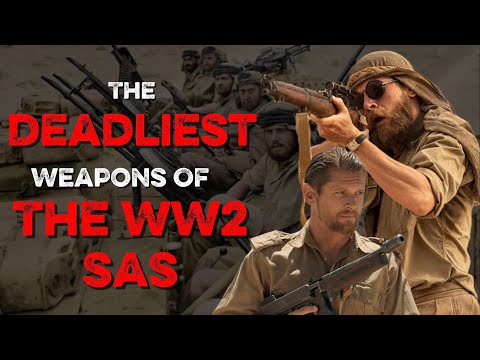
The SAS was never designed to hold ground or fight prolonged battles. Their job was to infiltrate deep behind enemy lines, strike at airfields, fuel depots, and communication lines, then withdraw before the enemy could respond. This required weapons that were reliable, compact, and lethal at close range. Some were standard British Army issue, but many were captured, adapted, or invented.
One of the most iconic weapons of the early SAS was the Fairbairn-Sykes fighting knife. Developed for commandos, it became a symbol of British raiding forces. Its slim, double-edged blade was designed for silent sentry elimination, and it was standard issue for most SAS men. In the darkness, it was a silent and deadly tool.
For close-quarters firepower, the Thompson submachine gun was a favorite. It was heavy, especially when loaded, but it was powerful and reliable. In night raids and ambushes, where enemies were close and reactions had to be fast, the Thompson delivered a torrent of .45 caliber rounds. In an airfield at night, with tents, vehicles, and aircraft packed together, the Thompson was often more useful than a rifle.
Later, the Sten gun became more common. It was lighter, cheaper, and easier to produce than the Thompson. The Mk II version could be broken down and hidden, making it invaluable for airborne operations and resistance work. It was crude and not loved by all, but it was simple and available in huge numbers—qualities that mattered in occupied Europe.
The Owen gun, an Australian 9mm submachine gun, also earned a strong reputation. It was simple, robust, and reliable in mud, rain, and rough handling. Its top-mounted magazine looked odd but fed reliably, and many Australian troops preferred it to the Sten for its durability. The SAS used it in limited numbers, mostly in the early North African desert campaign.
Many SAS men also appreciated the captured German MP40. It was compact, easy to control, and well-made. It fired 9mm ammunition that could sometimes be found in captured German stocks. Compared to the Sten and Thompson, the MP40 felt more solid and lighter, and it was often trusted more by those who could get one. This fit perfectly with the SAS culture: if a weapon worked, they used it.
The SAS also used standard British rifles, including the Lee-Enfield and later the No. 4 rifle. Rifles, though longer and slower to fire, still had a role. They provided range and accuracy that submachine guns couldn’t match in certain situations—useful for sentries, observation posts, and general combat. They also conserved ammunition better than automatic weapons. A number of SAS men were equipped with the sniper version of the Lee-Enfield, giving them even greater reach.
The Bren gun gave small SAS teams a portable source of automatic fire. It was the standard light machine gun of Commonwealth forces and widely respected for its accuracy. For the SAS, it was useful in ambushes, defensive positions, and withdrawals. A patrol armed only with rifles and submachine guns could quickly be pinned down; the Bren gave them staying power and helped them break contact.
Hand grenades were also part of the basic raiding kit. The Mills bomb, especially the No. 36, was used to clear positions, attack trenches, and deal with entrenched enemy troops. In the desert, they could be used in camps and airfield buildings. In Sicily, Italy, and Northwest Europe, they became more useful in villages, woods, and defensive positions.
The most important sabotage weapon in the early SAS was the Lewis bomb. Developed by Lieutenant Jock Lewis, a key figure in L Detachment, it was designed to destroy aircraft on the ground. The raider could place the charge on or near an aircraft, set the fuse, and withdraw before it exploded. The Lewis bomb combined explosive effect with incendiary action. This was crucial because aircraft were vulnerable to fire—fuel, oil, fabric, rubber, and light metal structures made them ideal targets for incendiary charges. A small patrol could destroy aircraft that had taken weeks or months to build and deliver to the front. In this sense, the Lewis bomb was one of the weapons that proved the SAS’s value.
As SAS tactics evolved in 1942, vehicle-mounted weapons became central. The most important was the Vickers K gun. Originally an aircraft machine gun, it had a high rate of fire and was perfect for surprise attacks. Mounted on SAS Jeeps, sometimes singly and sometimes in twin mounts, it gave small patrols a huge amount of firepower. The Vickers K was particularly useful in airfield raids. SAS Jeeps could drive across an airfield, strafing parked aircraft. This tactic was used in major desert raids, such as the Sidi Hanish airfield raid in July 1942, when armed Jeeps swept through the airfield and destroyed aircraft on the ground.
Some SAS Jeeps also carried the .50 caliber Browning machine gun. It provided heavier fire against vehicles, aircraft, and defensive positions. It was larger and heavier than the Vickers K but more powerful. Not every Jeep had one, but where available, it gave the patrol extra punch.
The Breda gun, a captured Italian weapon, also became useful in the desert. A 20mm cannon, it was originally an anti-aircraft gun and was heavier than the Vickers K, but it also provided much greater destructive power. The Long Range Desert Group made good use of captured Breda guns on Chevrolet trucks, where they could be used against aircraft, light vehicles, enemy positions, and convoys. The SAS also used captured Breda guns on some Jeeps and trucks when available.
The Jeep itself became part of the SAS weapon system. It carried rifles, ammunition, fuel, water, explosives, grenades, and personal weapons. Unnecessary fittings were removed to save weight, and then the vehicle was loaded for deep raids. It became a mobile firing platform.
When the war moved to Sicily and Italy, the SAS was reorganized for a time as the Special Raiding Squadron under Blair Mayne. At this stage, weapons like the Bren, Thompson, and M1 carbine remained important. The M1 carbine was a very light, semi-automatic rifle designed primarily for paratroopers and other units needing a light rifle. It was ideal for SAS warfare, combining some rifle range with a faster rate of fire.
In France in 1944, the SAS returned to airborne operations behind enemy lines. Here too, weapons like the Sten and M1 carbine were very important. The PIAT became more important in Europe as well. It was the main British infantry anti-tank weapon of the war. It was heavy and awkward, but it gave small patrols a means to attack armored vehicles, buildings, and strongpoints. The SAS didn’t use it extensively, but it remained in use when patrols encountered vehicles or fortified positions.
SAS men also carried sidearms. The Webley and Enfield revolvers were standard British options, while Colt M1911 pistols were also used when available. Pistols were useful for officers, drivers, radio operators, and men carrying heavy equipment. They were a compact backup for close encounters and emergencies.
So, these were some of the most notable weapons used by the SAS during World War II. If I missed any, please mention them in the comments below. If you enjoyed this video overview of SAS weapons in WWII, please like, subscribe, and hit the notification bell. Share this video with your friends. And most importantly, leave me a comment. Tell me who or what I should talk about next time. Because sometimes history doesn’t need to be rewritten. It just needs to be told correctly.
Yet for all the firepower, the most dangerous weapon in an SAS patrol was often the one nobody could see. Silence, timing, and surprise were the true arsenal, and every gun, bomb, and blade served those three masters. A raid that began with a noisy Thompson burst had already failed half its purpose; the ideal strike was over before the enemy understood it had begun.
Consider the patrol’s loadout on a typical deep desert operation. Each Jeep carried a driver, a gunner, and often a navigator, all crammed among fuel cans, water tins, and ammunition boxes. Weight was the enemy. Every extra pound of steel meant less fuel, less water, and fewer miles before the next rendezvous. So the men learned to strip their kit to the bone, choosing weapons that earned their place through performance rather than reputation.
This is why the Vickers K, with its fearsome rate of fire, was so prized. It could empty its pan in seconds, but those seconds were enough to shred parked aircraft and panic a garrison. The sound alone was a weapon, a ripping roar that told the defenders they were already too late.
Communication gear deserves its own mention, though it fired no bullets. Without reliable wireless sets, a patrol was blind and alone. Radio operators carried heavy, fragile equipment and guarded it with their lives, because a single message could summon an airstrike, redirect a convoy, or call off a mission gone wrong. The wireless was the patrol’s lifeline, and the man who carried it was often the most protected soldier in the group.
Navigation tools were equally vital. In the featureless desert, a compass and a set of sun compasses kept the raiders from vanishing into the sand. In Europe, maps, silva compasses, and local guides from the resistance filled the same role. A weapon that misfired was a nuisance; a patrol that lost its way was a disaster.
Then there was the equipment the men wore and carried. Boots, webbing, and water bottles were part of the weapon system too. A raider who ran out of water in the desert was as dead as one who ran out of ammunition. The SAS learned to treat supplies as ammunition: rationed, guarded, and never wasted.
Sabotage charges beyond the Lewis bomb also grew in sophistication. Plastic explosives, time pencils, and pressure switches allowed small teams to cripple rail lines, bridges, and fuel dumps. A handful of men with the right charges could do the work of a battalion, then slip away before the dust settled. This was the logic of the entire unit: maximum damage, minimum exposure.
Captured weapons remained a constant theme. In Italy and Northwest Europe, SAS patrols picked up German Schmeissers, Italian Berettas, and whatever else lay abandoned on the battlefield. If it worked, it was carried. The men had no time for sentiment about where a gun was made; they cared only that it fired when needed.
As the war entered its final year, the emphasis shifted once more. Armored Jeeps gave way to heavier vehicles, and patrols operating in France and Germany faced better-armed opponents. The Bren and the PIAT became more valuable than ever, giving small teams a fighting chance against armor and fortified positions. The arsenal was never fixed; it evolved with every new front and every new threat.
What remained constant was the philosophy behind it. The SAS did not win battles through sheer weight of fire. They won by appearing where they were least expected, striking hard, and disappearing before the enemy could organize a response. Every weapon in their hands was chosen to serve that single, brutal logic.
And as the raids grew bolder and the fronts multiplied, one question lingered over every patrol: what would the next mission demand, and what new tool would they need to survive it?
By 1945, the men who had started with knives and improvised bombs had become masters of mechanized raiding. The Jeep, the Vickers K, and the wireless had transformed a small band of raiders into a mobile strike force. Yet the desert veterans still carried their Fairbairn-Sykes knives, a quiet reminder of where they began.
When the war ended, the unit was disbanded, then reborn. Its weapons changed, but the doctrine remained: strike hard, vanish fast, and never fight a battle you cannot win. The arsenal was always a means, never an end. The men, the training, and the audacity mattered more than any single gun.
Looking back, the SAS of World War II proved that small, well-armed teams could change the course of a campaign. Their legacy lives in every special forces unit that followed. But which of their weapons would you have trusted with your life on a night raid?






