In the rolling fields of Normandy, where 21,000 German soldiers lie buried, one grave stands apart—always adorned with fresh flowers. It belongs to Michael Wittmann, the most feared tank commander of the Third Reich. His name is whispered with awe and dread, a legend forged in fire and steel. But behind the myth lies a story of ruthless ambition, unwavering loyalty, and a deadly skill that would change the course of battles.
Wittmann was not a typical soldier. Quiet, likable, yet fiercely aggressive, he embodied the panzer spirit. Decorated personally by Hitler, he accumulated kills with a methodical precision that stunned both allies and enemies. “He was the ace of aces,” historians say. But his path to glory began in the fields of Bavaria, far from the carnage of war.
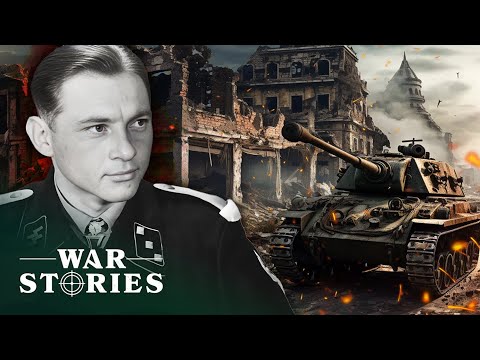
Born in 1914 on a farm south of Nuremberg, Wittmann was a country boy with a healthy outdoor life. At 19, he was drafted into the army, and by 1937, he volunteered for Hitler’s personal bodyguard, the Leibstandarte SS Adolf Hitler. “It was an elite unit, hand-picked for height and physical fitness,” recalls a historian. Wittmann embraced absolute loyalty, swearing an oath of obedience unto death. The parades and black uniforms appealed to his youthful idealism, but soon the fighting would begin.
With the invasion of Poland in 1939, Wittmann’s generation of young Nazis faced the reality of war. His excellence as a driver earned him command of a reconnaissance vehicle. By 1941, he was part of Operation Barbarossa, the massive invasion of the Soviet Union. “The whole mentality of the tank force was always keep moving,” says an expert. Wittmann’s unit raced over the Soviet frontier, spearheading the advance.
On July 12, 1941, near the city of Zhitomir, Wittmann faced his first major test. Soviet T-34 tanks, superior to anything the Germans had, bore down on his position. Outnumbered and outgunned, Wittmann disobeyed orders and attacked. “He spotted two groups of Soviet T-34s—18 tanks against his single assault gun,” recounts a military historian. With daring maneuvers, he destroyed the Soviet column, earning the Iron Cross. His career was on the rise.
Sent back to Germany for officer training, Wittmann graduated as an SS second lieutenant and soon trained on the Tiger tank—Hitler’s answer to the T-34. “The Tiger was virtually impregnable, with an 88mm gun that could cut through a T-34 at over two kilometers,” says a tank expert. In February 1943, Wittmann returned to the Russian front, commanding a platoon of five Tigers.
By summer, the tide had turned. The Soviets had created a massive bulge near Kursk, and Hitler planned Operation Citadel to cut it off. “It was the greatest tank battle in history,” notes a historian. Wittmann’s Tigers spearheaded the southern attack. On the first day, he knocked out eight tanks and twelve anti-tank guns. “We thought we were superior to the Russian tanks,” a comrade recalls. But the Soviets threw wave after wave of tanks, and despite Wittmann’s success, the offensive failed.
From then on, Wittmann fought for survival. In December 1943, near Brusselove, he used his Tiger as bait to destroy Soviet anti-tank guns, then single-handedly attacked a supply convoy. “He knocked out the lead and rear tanks, trapping the convoy,” says a historian. His kill count soared to 117, earning him the Knight’s Cross with Oak Leaves. In February 1944, Hitler personally decorated him.
But the war was turning. Wittmann was called back to Germany, where he witnessed the destruction of German cities. “The sight of such senseless destruction made one’s heart bleed,” he wrote. He married Hildegard Burmester, and Hitler gave them a Mercedes as a wedding gift. Soon, he was posted to Normandy, just as the Allies landed on June 6, 1944.
Wittmann’s Tigers took five harrowing days to reach the front, harried by Allied fighter-bombers. By June 13, he had only six tanks left. Near the town of Villers-Bocage, he spotted a British armored column—138 tanks and vehicles—moving through the streets. “I had no time to assemble my company; I set off with one tank,” Wittmann later recalled. In a 15-minute rampage, he destroyed 21 tanks and vehicles, halting the British advance. “It kept the Allies from taking the area around Caen for two months,” says a historian. The feat made him a propaganda icon.
But Wittmann’s luck would not hold. On August 8, 1944, during Operation Totalize, he led a counter-attack against 300 Allied tanks. “It was almost suicidal,” admits a fellow officer. Wittmann’s Tiger was ambushed by British and Canadian tanks hidden on either side of the road. “A tremendous explosion—the turret hit the ground,” remembers a witness. Michael Wittmann was dead.
His legend, however, endures. Some see him as a hero; others as a Nazi. “He might have been a hero to the Germans, but not to me,” says a British veteran. Yet the flowers on his grave remain fresh, a testament to the mystique of the Black Baron.
The flowers on Wittmann’s grave are not placed by accident. Every year, on the anniversary of his death, a small group of veterans and enthusiasts makes the pilgrimage to La Cambe. “They come quietly, almost reverently,” says the cemetery’s caretaker. “They stand for a few minutes, then they leave.” For the locals, the ritual is both puzzling and unsettling—a quiet tribute to a man who fought for a regime that brought ruin to their land.
But the fascination with Wittmann extends far beyond Normandy. In the decades after the war, his name appeared in military journals, on the lips of tank enthusiasts, and eventually on the internet. “Wittmann became a brand,” notes one historian. Model kits, biographies, and documentaries all bear his name. His tactics are still studied in military academies, though often with caveats about the cause he served.
Yet for those who survived the war, the memory is far more raw. “I lost friends to his guns,” says a British tank veteran, now in his nineties. “I can’t celebrate him. I can only remember.” The tension between admiration for his skill and revulsion at his ideology remains unresolved, a wound that time has not fully healed.
In the quiet of the cemetery, the rows of gravestones stretch out like a grim ledger. Each name tells a story, but Wittmann’s stands apart—not because of the flowers, but because of what he represents. “He was a soldier’s soldier,” says a former comrade. “But he was also a Nazi.” That duality is the heart of the Wittmann myth: a man of extraordinary ability who chose to serve an evil cause.
Historians continue to debate his legacy. Some argue that his tactical brilliance should be studied separately from his politics. Others insist that his willing participation in Hitler’s war makes any admiration dangerous. “You can’t separate the tank commander from the uniform,” says one scholar. “He swore an oath to Hitler, and he kept it.”
The debate is unlikely to end soon. Wittmann’s story is a reminder that war produces men of great skill, but skill alone does not make a hero. “He was a legend in his own time,” reflects a Normandy resident. “But legends can be dangerous.” As the years pass and the last veterans fade, the flowers on his grave will keep appearing—a symbol of a mystique that refuses to die.
The caretaker’s words linger in the air, heavy with the weight of history. “They come quietly, almost reverently,” he repeats, as if trying to understand it himself. But the pilgrims who visit La Cambe are not the only ones drawn to Wittmann’s story. In the decades after the war, his name spread far beyond military circles, into the realm of popular culture.
In the 1970s, a wave of memoirs and biographies emerged, many of them glorifying the Waffen-SS. Wittmann became a central figure in this literature, portrayed as a knight of the battlefield. “He was a soldier’s soldier,” one former comrade wrote, “but he was also a Nazi.” That duality—the skilled warrior and the loyal party man—became the core of his myth.
Military academies around the world still study his tactics. His use of the Tiger’s long-range gun, his ability to fire on the move, and his instinct for ambush are taught as textbook examples. “Wittmann’s techniques were brilliant,” a modern tank commander admits. “But we must never forget what he fought for.” The caveat is always there, a shadow that refuses to lift.
For the veterans who faced him, the memory is different. “I lost friends to his guns,” says a British tank veteran, now in his nineties. “I can’t celebrate him. I can only remember.” His voice trembles, not with anger, but with a deep, unshakeable sorrow. He recalls the day at Villers-Bocage, the sudden roar of the Tiger’s 88mm gun, the flames that consumed his comrades.
Yet even among the Allied veterans, there is a grudging respect. “He was the best we ever faced,” another veteran concedes. “And that’s what makes it so hard.” The admiration for skill and the revulsion at ideology collide, leaving a legacy that resists easy judgment.
In Germany, the debate is even more fraught. For decades, Wittmann’s name was taboo, his story buried alongside the millions of other soldiers. But in recent years, a new generation of historians has begun to examine his life with fresh eyes. “We must confront the past, not glorify it,” says one German scholar. “Wittmann is a case study in how ordinary men can be seduced by evil.”
The internet has only amplified the controversy. Online forums are filled with heated arguments, some praising Wittmann’s prowess, others condemning his ideology. “He became a brand,” notes a historian. Model kits, documentaries, and even video games feature his name. But the commercialization of his myth often obscures the grim reality of the war he fought.
At La Cambe, the flowers keep appearing. The caretaker shrugs. “It is not my place to judge,” he says. “But I wonder if they truly understand what he stood for.” The visitors leave as quietly as they came, their footsteps fading into the Normandy soil.
Wittmann’s wife, Hildegard, never remarried. She lived a quiet life in Germany, rarely speaking of her husband. In a rare interview years later, she said only, “He was a good man, but the war took him.” Her words echo the denial that many Germans felt after the war—a refusal to confront the full truth of the Nazi regime.
The last veterans of the Normandy campaign are now in their late nineties, their voices fading. Soon, the memory of Wittmann will be carried only by historians and enthusiasts. “That’s when the myth becomes most dangerous,” warns a scholar. “When the witnesses are gone, the legend can be shaped by anyone.”
In the end, Wittmann’s story is not just about a tank commander. It is about the seduction of power, the allure of skill, and the moral choices that define a life. “He could have been a hero in a just cause,” reflects a Normandy resident. “But he chose the wrong side.” The flowers on his grave remain, a silent testament to a legacy that refuses to be resolved.
Decades later, a young German officer visits La Cambe with his unit. He stands before the grave, the fresh flowers at his feet. “We study his tactics, but we do not honor his cause,” he says quietly. His voice is steady, but his eyes betray the weight of history.
The caretaker watches from a distance. “Every generation asks the same question,” he murmurs. “Can a man be brilliant and monstrous at once?” The wind stirs the leaves, and the answer seems to scatter with them.
Perhaps that is the true legacy of Michael Wittmann: not a hero to be celebrated, nor a villain to be dismissed, but a mirror in which each generation must confront its own capacity for both.
What do you see when you look into that mirror?






