Classic Hollywood sold the world perfect smiles, bright lights, and happy endings. But behind some of those famous names were parents carrying losses no camera could hide. Lou Costello lost his little boy in a backyard accident and went on the radio the same day. Red Skelton watched his young son fade from illness. Veronica Lake lost her newborn baby after a premature birth, and others faced tragedies that never truly left them. These are the classic stars who lost their children in the most heartbreaking ways.
In 1943, Veronica Lake was the face of the moment—the famous peekaboo hairstyle, magazine covers, starring roles. And in that same year, something happened in her private life that newspapers reported in short, cold lines. She tripped over a lighting cable on set, and soon after, she went into premature labor. Her baby boy, William Anthony Detley, was born too early and placed in an incubator. Newspapers reported that he died on July 15th, 1943, at just 7 days old. Some accounts noted simply that she took it very hard. The child’s father was serving in the military at the time, one more detail that fixes the era in place. Even in the middle of a family tragedy, war and distance could split a home in two.
And then life began to fracture fast. By August 1943, the marriage had broken apart. By December, the divorce was final. The loss didn’t explain everything, but it accelerated what was already under strain. Her career continued in public, but privately, the ground never felt stable again, because no amount of glamour can erase an empty crib or a date that burns itself into memory.
In the early hours of September 23rd, 1965, Charles Boyer’s only son, Michael Boyer, died at home from a gunshot wound. He was 21 years old. Press reports at the time described the wound as self-inflicted. After that, the story immediately attracted noise and speculation. But for the family, there was only one reality. Their only child was gone. After a loss like that, a family doesn’t stay the same, even if the outside world still sees a respectable life. Boyer had the classic picture—a long marriage, a controlled public image, no constant scandals. And then the one thing you assume will outlive you, your child, is gone. When it’s your only child, it isn’t just losing a part of your life. It feels like losing the entire continuation of it.
And then comes the second wave. The world tries to explain it for you. People build versions, motives, rumors—anything to turn the unbearable into a story that sounds tidy. But parents are left with one hard fact. Their son is gone, and no explanation changes the outcome. In Boyer’s own timeline, this became a black mark you can’t move past. From that point on, life isn’t about returning to normal. It’s about endurance and keeping your face steady while everything inside is scorched.
In 1930, Stan Laurel and his wife welcomed a baby boy named Stanley. He arrived about two months early and lived for only nine days. In the records, it’s written almost without detail, because in that era, there often weren’t many details to give. Medicine could reach a hard limit, and families were left with nothing but the date. After a loss like that, a house doesn’t return to normal. Grief doesn’t move at the same speed for two people, and a marriage can start splitting quietly through blame, silence, exhaustion, and the kind of tension you can’t explain to anyone outside the room. Laurel’s divorce came later in the 1930s, but the death of a child is the kind of mark that never disappears from a family timeline.
Publicly, Laurel kept doing what the world demanded. Comedy, timing, pantomime—the precision of a gag that has to land. Privately, he lived with a fact that has no punchline and no fix. And in the studio era, that private reality was rarely allowed to surface. The machine needed the smile on schedule, while the home carried the loss for the rest of the year and the rest of the life.
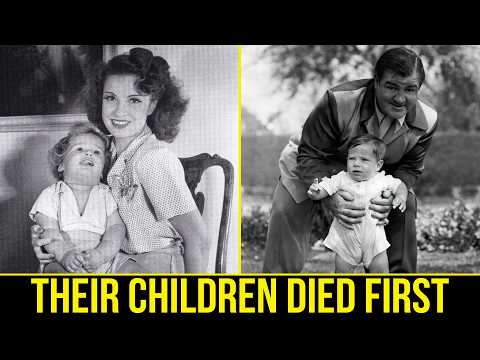
On November 4th, 1943, Lou Costello’s one-year-old son, Louis Francis Costello Jr., known in the family as Butch, died after falling into the backyard pool at their home in Van Nuys. Contemporary reports described it plainly as a tragic accident. No crime, no mystery—just an everyday moment that turned fatal. What happened next is the part people still struggle to process. That same day, Costello had a scheduled radio broadcast with his partner. He refused to cancel. Just hours after losing his son, he went on the air anyway. Later accounts of that broadcast say his partner spoke about the tragedy only after the program ended, as if the comedy had finished and reality finally caught up.
The aftermath in situations like this is brutal in the most ordinary way. The house becomes a place where everything reminds you of what’s missing. Work turns into a frame you cling to so you don’t collapse in public. Costello remained a working comedian with applause, contracts, and a relentless schedule. But privately, the life behind the laughter was no longer the same. The loss didn’t end; it simply became a part of him, a shadow that followed every step, every joke, every bow.
John Garfield was the kind of actor who carried raw nerves on screen—never a polished studio statue, always a man pushed to the edge. In 1945, his private life was hit by a sudden, brutal loss. His daughter, Katherine—called Kathy—died on March 18th, 1945. The cause is recorded plainly: a severe allergic reaction. It happened fast. One moment, she was simply a child coming home, and the next, her body was fighting for air. There was no long illness, no time to prepare, no “We’ll try another treatment tomorrow.” The house flipped from ordinary to emergency in minutes, and then to silence.
After something like that, parents don’t just grieve. They replay the last normal moment again and again, hunting for the point where it could have been different. In short biographies of Garfield, you’ll often see the same conclusion. He never truly recovered from the loss. He kept moving, working, speaking, showing up, but something inside collapsed. And with everything else pressing on him in that era—public scrutiny, conflict, the political climate—his daughter’s death became the blow that broke the feeling that life could ever be safe again.
To the public, Roy Rogers and Dale Evans looked almost perfect. Bright image, faith, smiles, family-friendly shows. In real life, they lived through two devastating losses. Their biological daughter, Robin, was born with Down syndrome and serious heart problems. Not long before her second birthday, she came down with mumps. Her condition worsened rapidly, and she died—described in sources as complications of the illness on top of her congenital health issues.
After Robin’s death, Dale Evans wrote the book Angel Unaware. It wasn’t a publicity move; it was a way to survive the loss and to put into words something many families were pressured to hide in that era—that this child was loved and her life mattered. Then came 1964 and a different kind of tragedy. Their adopted daughter Debbie was killed in a church bus accident in California near San Clemente. Reports described a bus returning from a charitable trip, carrying dozens of children, losing control and colliding with multiple vehicles. Debbie was 12 years old.
At the time, Roy Rogers was in the hospital recovering from neck surgery. Dale Evans later recalled her first reaction in one stunned sentence: “I hear it, but I can’t accept it.” After Debbie’s death, the family moved, because sometimes the road, the house, and the familiar roots become permanent triggers, and staying in the same place feels impossible.
On screen, Red Skelton felt calm, warm, and steady—the kind of man whose world seemed safe. Off camera, his family lived by hospital schedules. His son Richard, only nine years old, was diagnosed with leukemia, and doctors gave a grim prognosis. Skelton was told to take all the time he needed, disappear from television, wait it out. He chose the opposite. He went back to the show because he believed work was the only way to keep himself from falling apart—and the only way to remain steady beside his child.
After the diagnosis, the family took a long trip through Europe. Not as a vacation, but as an attempt to let Richard see the world while there was still time. Contemporary accounts of that period mention a meeting with Pope Pius XII in the summer of 1957 as one of the defining moments of the journey. The trip ended earlier than planned; London’s press became intrusive and aggressive, and the family returned home. Richard died on May 10th, 1958, just ten days before his tenth birthday.
After that, even small things changed. For years, Skelton had spoken about family life naturally on the air; then it became almost impossible. People close to him also recalled a harsh chain of blows to Skelton himself—an injury, then a serious episode and hospitalization, as if his body couldn’t carry the strain any longer. From the outside, it still looked like broadcasts and career. Inside, everything narrowed to one fixed point: the day they buried his son.
In December 1928, Irving Berlin and his wife welcomed a baby boy, Irving Berlin Jr. Less than a month later, on Christmas Day, the child died at just 24 days old. After that, Christmas was never just a holiday inside their home again. Year after year, Berlin and his wife marked the date by going to their son’s grave. It wasn’t symbolism or a public gesture. It became a routine, a private ritual—the one thing that stayed fixed when everything else moved on.
The contrast is almost unbearable. The man whose songs filled living rooms with warmth spent that same day living with a family shaped by absence. The reason wasn’t scandal or mystery; it was the era itself. In the late 1920s, even wealthy families could lose a newborn suddenly, without warning, without an explanation that felt like an answer. Money could buy comfort, doctors, the best care available—just not certainty. And then the calendar does what it always does: it returns to the same date every year and asks you to survive it again.
This isn’t always the death of a child in the crib. Sometimes it’s the loss of a grown son, and that can feel even colder. Charles Chaplin Jr. died on March 20th, 1968, in Santa Monica. The cause was a pulmonary embolism—a blood clot that suddenly blocked an artery in the lungs. He wasn’t simply the son of a legend. Chaplin Jr. acted, tried to carve out his own career, and in 1960 published a memoir, My Father, Charlie Chaplin, where he tried to explain himself, his father, and what it was like to live inside a famous name.
When a parent loses an adult child, it isn’t only grief—it’s the sense that a whole line of after you has been cut off, the part of the future that was supposed to continue without you. Deaths like this are often cruel in a specific way. You can’t tell yourself he was fragile or too young, or that the odds were always against him. He was grown. He was living. And then, in one day, he’s not. What follows is a list of practical things that hurt like knives: papers to sign, a funeral to arrange, personal belongings to sort through, a phone that will never ring with that voice again—and the blunt realization that status doesn’t soften any of it.
These are the classic stars who lost their children in the most heartbreaking ways—and whose stories remind us that behind the brightest smiles, there can be an unimaginable ache. Which of these stories moved you the most, and why? Share your thoughts in the comments below.






