On August 23rd, 1944, six American soldiers stood waist-deep in a warm Pacific lagoon on Pigan Island, firing backward into a tree line full of Japanese riflemen. Arisaka rounds snapped over the water from three directions. The garrison on this island numbered close to 200 men. The American patrol numbered six.
Private First Class Harry Whalen braced his Browning automatic rifle against his hip and raked the jungle in controlled bursts. Sergeant Lawrence Coleman swept the left flank with an M3 grease gun. Lieutenant Robert Sumner stood on the exposed dune line, back-to-back with Private Edward Reynolds, drawing fire so the rest of the team could reach the rubber boat.
Then an Australian bow fighter screamed overhead at 30 yards off the ground. Six .50 caliber machine guns and two 20-mm cannons hammering the shore. The PT boats behind them opened up with 20-mm, 40-mm, and 3-in guns. Not one of those six Americans was hit. They boarded a PT boat, the Coast Guard frigate shelled the island, and the team vanished back across the Pacific.
A few nights later, Tokyo Rose announced on Radio Tokyo that Imperial Marines had repulsed an Allied attack on the Mapia Islands with losses. She was half right. There were losses. They were all Japanese.
Those six men belonged to a unit so secret that the Japanese never identified it, never captured a member, and never recovered a body. Across 106 verified missions behind enemy lines, this unit killed over 500 Japanese troops, captured 84 more for interrogation, and liberated over 700 Allied prisoners of war. And they did all of it without losing a single man in combat during the entire war. They were called the Alamo Scouts, and on Pigan Island, Japan learned the hard way what happened when you tried to hunt them.
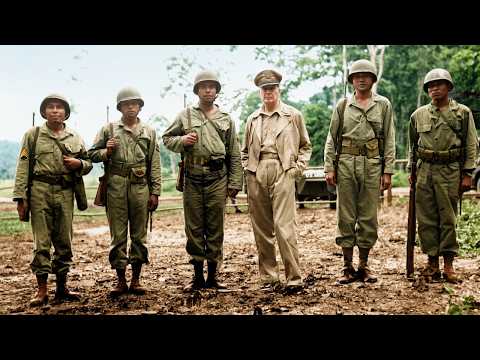
It was late November 1943, and Lieutenant General Walter Krueger had a problem he could no longer ignore. Krueger commanded the Sixth Army in the Southwest Pacific, the force General Douglas MacArthur designated Alamo Force. The Sixth Army was tasked with island hopping across New Guinea and into the Philippines. Every landing required intelligence about what was waiting on the beach, and that intelligence kept failing.
At Kiska in the Aleutians that August, the Allies had launched a full-scale invasion of an island the Japanese had already abandoned. Thousands of troops stormed empty beaches because nobody confirmed the enemy was still there. At Cape Gloucester on New Britain, inadequate reconnaissance preceded the landings again, and the Navy’s amphibious scouts had returned 11 days late from one mission and then been held another four days by Navy intelligence officers for debriefing.
Krueger needed his own people, men who answered to him, moved on his timeline, and reported directly to Sixth Army G-2. On November 28th, 1943, he signed General Order 353B and created the Alamo Scouts Training Center on Ferguson Island, a remote jungle outpost in the D’Entrecasteaux Group off eastern New Guinea.
The concept was radical for 1943. Six to seven-man teams, named after their team leader, inserted by PT boat or submarine up to 14 days before a major landing. Their job was to observe enemy positions, count troops, map beaches, and radio everything back. If they were compromised, there would be no reinforcement. No rescue helicopter because those didn’t exist yet. No extraction unless the PT boats could reach them.
Every detail of the selection process was designed around that reality. Roughly 700 men volunteered across the war. Only about 138 became operational scouts. 40% of trainees washed out in the first 2 weeks of a 6-week course that included jungle navigation, rubber boat handling in heavy surf, hand-to-hand combat, demolitions, radio operation, and long-range reconnaissance techniques.
The men who survived the course then did something no other military unit did. They voted on who they wanted beside them. Every trainee secretly listed the officers and enlisted men he most wanted to deploy with. The teams that formed were built on trust that already existed before the first mission.
The scouts were not, as Krueger himself put it, “cutthroats and toughs.” They were chosen because they could think, move silently, and stay invisible for days at a time on islands crawling with Japanese soldiers.
The first test of that doctrine came on February 27th, 1944, at Los Negros Island in the Admiralties. Lieutenant John McGowan’s six-man team was inserted by PBY Catalina flying boat 48 hours before the planned first Cavalry Division reconnaissance in force. The planners believed the Japanese might have already evacuated. McGowan’s team crept to within 15 ft of Japanese positions in the dark and radioed back a message that became legend inside Sixth Army headquarters. The area southwest of Momote airstrip, they reported, was lousy with Japs.
The garrison was an estimated 4 to 5,000 troops, not evacuated, waiting. That single radio transmission changed the invasion plan. The landing shifted to lightly defended Hyane Bay instead of the original target. The Alamo Scouts had proven their concept with one mission.
Over the following months, teams fanned out across New Guinea and the surrounding islands, inserting by PT boat under cover of darkness, paddling rubber rafts through surf, and spending days hidden in jungle so thick you couldn’t see your hand in front of your face. They carried M1 carbines with 75 rounds, two fragmentation grenades, four smoke grenades split among the team, an SCR-300 radio, and two days of K-rations. Light, fast, and quiet. That was the doctrine.
Now, the Scouts could gather intelligence. Los Negros proved that. The question became whether they could fight when the mission demanded it. On October 4th, 1944, two scout teams got their answer at Cape Oransbari on the Vogelkop Peninsula of New Guinea.
Nellis’ team and Roundsville team had learned from a Dutch liaison officer that a governor and his family were being held by the Japanese at a small coastal village. Both teams, plus Lieutenant Jack Dove, inserted by PT boat under a full moon, and began a 6 and 1/2 hour night march through jungle so dark they taped flashlights to the ends of their weapons just to see. Behind enemy lines using flashlights. That was the kind of calculated risk these men lived inside.
At 0410, Lieutenant Roundsville opened fire on the main Japanese barracks hut. Phosphorous grenades went through the windows. The assault on the village lasted 3 minutes. At least 10 Japanese were killed in the barracks. Sergeants Andy Smith and Sabas Asis hit a second hut housing five Kempetai military police officers and freed a native chief. Nellis’ team neutralized a guard post 2 and 1/2 miles east, killing four sentries and capturing a British and a Japanese machine gun. 66 Dutch and Javanese civilians, plus a French family with 10 children, were extracted to safety. 18 Japanese dead. Zero American casualties. The scouts had just pulled off the first hostage rescue in their history.
And then, there was the moment that cracked things open. Private First Class Rufo Vacular walked into one of the smoldering huts where Andy Smith had found a captured gramophone and was playing a Bing Crosby record. Behind Smith, a Japanese soldier with a fixed bayonet was creeping forward in the dark. Vacular raised his weapon and fired past Smith’s head, less than a foot from his ear, and killed the Japanese soldier behind him. That’s who these men were. The kind of calm that doesn’t come from training alone.
O’Hare’s body proved the scouts could execute offensive operations. Three months later, they would be asked to do something far more dangerous and far more consequential. In late January, 1945, the Japanese were retreating across Luzon in the Philippines. Behind their lines at a prisoner of war camp near the town of Cabanatuan, over 500 Allied POWs, many of them survivors of the Bataan Death March, were starving and dying. American intelligence feared the Japanese would execute the prisoners before they could be liberated. It had happened before.
Sixth Army tasked two Alamo Scout teams to reconnoiter the camp and guide a Ranger assault force in. On January 27th, Lieutenant Bill Nellist and Private First Class Rufo Vacular, the same man who had saved Andy Smith’s life at O’Hare’s body, disguised themselves as Filipino rice farmers. Straw hats, farmers clothing. They walked to a nipa hut 200 yards north of the prison gate, within direct line of sight of the Japanese guard towers, and stayed there for over two hours. Plotting Japanese positions on an aerial photograph, counting guards, marking machine gun emplacements. Three more scouts later crawled to the same hut to serve as runners. Lieutenant Dove carried the marked photograph by native pony to Lieutenant Colonel Henry Mucci’s Sixth Ranger Battalion at Platero.
On the night of January 30th, the raid went in. Two five-man scout teams, C and F companies of the Sixth Ranger Battalion, and roughly 280 Filipino guerrillas under Captains Juan Pajota and Eduardo Joson. A P-61 Black Widow night fighter buzzed the camp as a distraction. The raid lasted under 30 minutes. 516 Allied prisoners of war walked out of Cabanatuan alive that night. An estimated 530 or more Japanese were killed. Two Rangers were killed in action. Lieutenant Rounsaville took mortar shrapnel in his backside and reportedly told Nellist with characteristic humor that he needed Bill to come look at his injury. Technical Sergeant Alfonso was hit in the abdomen. Zero Scouts killed.
Sixth Army’s weekly G2 report called it an almost perfect example of prior reconnaissance and planning. The publicity from Cabanatuan finally blew the Scouts’ cover. For the first time, the American public learned that a small, unnamed unit had been operating deep behind Japanese lines across the entire Pacific Theater.
The numbers, when you line them up, are almost hard to believe. 106 verified reconnaissance missions behind Japanese lines. 1,482 total days spent in the field. Over 500 Japanese killed directly by Scout teams. 84 enemy soldiers captured and brought back for interrogation. 713 Allied prisoners of war and civilians liberated. 118 combat decorations, including 44 Silver Stars, 33 Bronze Stars, and two Presidential Unit Citations. And through all of it, across every island, every jungle, every lagoon where the enemy tried to find them, zero Alamo Scouts killed in action. Zero captured.
To understand how extraordinary that is, consider the comparison. Merrill’s Marauders in Burma suffered over 80% casualties. The First Special Service Force lost 134% of its combat strength in 251 days. The Alamo Scouts operated for nearly 500 days in the field, deep behind Japanese lines, in six-man teams with no extraction guarantee, and brought every single man home alive.
The Japanese never even figured out what they were. No scout body was ever recovered by the enemy. No scout sat across a Japanese interrogation table. Tokyo couldn’t connect the dots between the small parties landing on their islands because there was nothing to connect. The scouts left behind intelligence reports, not evidence.
The unit was disbanded in November 1945 in Kyoto, Japan, without ceremony or parade. The men went home to farms in Iowa, law practices in Mississippi, and civilian lives that never mentioned what they had done. But the legacy didn’t end there.
In 1950, Lieutenant Rafael Ileto, a Filipino American who had led his own Alamo Scout team, founded the Philippine Army’s first Scout Ranger Regiment. In Vietnam, long-range surveillance units modeled themselves directly on the Scout concept. The peer evaluation selection methods the Scouts pioneered became the backbone of US Army Special Forces qualification.
And in 1988, surviving Alamo Scouts, most of them in their 70s by then, were called to Fort Bragg. The John F. Kennedy Special Warfare Center awarded them the Special Forces tab, formally recognizing what those men had always been, the ancestors of the Green Berets.
One man among them connected that thread across two wars. Galen Kittleson was a 19-year-old Iowa farm boy when he earned a Silver Star with the 503rd Parachute Infantry Regiment. He volunteered for the Alamo Scouts. He went into Cabanatuan. After the war, he joined Special Forces. In 1970, at the age of 46, he beat out Green Berets half his age to serve as assault element leader on the Son Tay prison camp raid in North Vietnam. The only American soldier to participate in four prisoner of war rescue attempts across two wars.
Sometimes the right six men in the right place with the right training and the right discipline matter more than a division. The Alamo Scouts understood that before anyone had a name for special operations.
And somewhere in the archives of Radio Tokyo, there is a broadcast from August 1944 where a woman with a silky voice told the Pacific Fleet that Imperial Marines had repulsed an Allied attack on the Mapia Islands. She never mentioned the six Americans who walked away clean.
What unit in military history do you think deserves more recognition than it ever received? Let us know in the comments.






