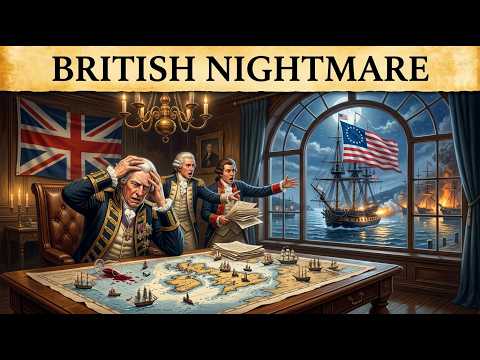
The cliffs of Flamborough Head were crowded with hundreds of spectators, their breath fogging in the September night air. Below them, two warships were locked in a deadly embrace, hull grinding against hull, cannons roaring at point-blank range. The smaller ship—an old merchant vessel flying the American flag—was already taking on water, its deck a chaos of splintered wood and screaming men. Through the smoke, the British captain shouted across the gap, demanding surrender.
The American captain, a burly Scot with a sharp jaw and a sharper temper, gave an answer that would echo through history: “I have not yet begun to fight.” His name was John Paul Jones, and his journey to that blood-soaked night was as improbable as it was relentless.
Born plain John Paul in 1747, the son of a gardener on a Scottish estate, he grew up watching Royal Navy frigates glide past the Irish Sea. The sea called to him early. By thirteen, he was apprenticed on a merchant ship; by his early twenties, he was a captain in the West Indies trade—competent, ambitious, and notoriously hard to handle. In 1770, he had a carpenter flogged so severely the man later died. A court cleared him, but the stain lingered. Three years later, a dispute over wages ended with Jones running a mutinous crewman through with a sword. He didn’t wait for trial—he fled to America and vanished.
When he resurfaced, he had added “Jones” to his name and a new purpose to his life. The American Revolution was igniting, and the Continental Navy was desperate for experienced officers. Jones signed on as a first lieutenant in December 1775, but from day one, he wanted more than defense. While other commanders hugged the coastline, he dreamed of carrying the war across the Atlantic—to England’s own shores.
His first command, the sloop Providence, proved him right. In six weeks, he captured sixteen British ships and outran a Royal Navy frigate by sailing into shallows too dangerous for the larger vessel. No American captain had done more damage to British commerce. But Jones wanted a real warship, a real squadron, and a mission that would shake the empire. Benjamin Franklin, America’s envoy in Paris, saw in him the audacity the revolution needed.
In 1779, Franklin helped secure him command of the Bonhomme Richard, an aging East Indiaman refitted with forty-two guns—many of them unreliable. Its crew was a polyglot rabble of Americans, French, Irish, Portuguese, and Malays, some of them former prisoners of war. Jones drilled them mercilessly, forging a fighting force out of chaos. His squadron was no better: a French frigate whose captain openly despised him, another that ignored his signals, and a small escort that proved useless.
On August 14, 1779, the squadron sailed around the British Isles, seizing merchant ships and spreading panic. Coastal towns from Scotland to Wales feared they were next. Jones even attempted to raid the port of Leith near Edinburgh for ransom, but a sudden storm scattered his ships. The Royal Navy was humiliated, and London’s patience was wearing thin.
Then, on September 23, off Flamborough Head, Jones spotted a convoy of over forty British merchant ships, loaded with timber and naval supplies, guarded by two warships: the twenty-gun Countess of Scarborough and the brand-new, fifty-gun frigate HMS Serapis, commanded by Captain Richard Pearson. The Serapis was faster, better-armed, and crewed by over three hundred trained sailors. Pearson knew the Americans were coming and was confident. He had every reason to expect an easy victory.
But Jones attacked anyway.
The battle began around seven in the evening, the sun dipping below the Yorkshire coast while a half-moon rose in the east. The two ships closed on each other and opened fire. Almost immediately, the Bonhomme Richard ran into trouble. Two of her old eighteen-pounders burst on the lower deck in the first broadside, killing their crews and blowing holes through the hull from the inside. Jones ordered the entire lower gun deck abandoned. He had lost his heaviest weapons before the fight had truly begun.
The Serapis hammered the Bonhomme Richard with broadside after broadside. Cannonballs punched through her hull below the waterline. Water poured in. Fires broke out across the deck. The American ship was being systematically destroyed, and Pearson knew it. At some point in the slaughter, Pearson hailed Jones and asked the question that would decide the entire battle: had the American struck his colors? Was he surrendering?
Jones shouted back: “I have not yet begun to fight.” Historians still argue over the exact wording—some say he phrased it differently, others insist the line was polished for the history books—but the intent was never in doubt. Jones had no intention of surrendering, even as his ship collapsed beneath him.
What Jones did next was either genius or madness, and frankly, it may have been both. He ordered the Bonhomme Richard to close on the Serapis until the two ships were literally touching. In the confusion of wind and current, the Serapis’s jib boom tangled in the Bonhomme Richard’s rigging. Jones personally helped lash the ships together with grappling hooks and rope. The two vessels were now locked side by side, their gun ports almost overlapping.
This changed everything. At long range, the Serapis held every advantage—better guns, stronger hull, superior maneuverability. But at grappling distance, the fight became a brawl, and Jones was a brawler. For the next two and a half hours, the crews fought from point-blank range. Cannons fired directly into the opposing hull from a few feet away. Marines shot down from the rigging. Sailors hurled hand grenades across the gap. The decks grew slick with blood. Fires spread.
At one point, an American sailor crawling along the Bonhomme Richard’s yardarm dropped a grenade through an open hatch on the Serapis. It fell into a pile of powder cartridges the British had stacked near their guns. The explosion tore through the Serapis’s lower deck, killing or maiming dozens of men in an instant.
Meanwhile, the Bonhomme Richard was sinking, water pouring through holes below the waterline. The ship’s carpenter ran to Jones and told him she would go down. One of Jones’s officers, apparently convinced all was lost, tried to lower the American flag in surrender. Jones reportedly knocked him down with a pistol and ordered the flag raised again. The Alliance, the American-French frigate that was supposed to support him, spent most of the battle sailing on the periphery. Her captain, the Frenchman Pierre Landais—possibly unhinged—fired broadsides into both sides of the fight, hitting the Bonhomme Richard instead of the Serapis more than once. Jones was taking fire from his ally while fighting the enemy and keeping his ship from sinking.
It is hard to imagine a worse tactical position. And yet, somehow, it was Captain Pearson on the Serapis who broke first. The explosion below decks had been devastating. Her mainmast was damaged and about to fall. American sharpshooters had cleared her upper deck, and still the Bonhomme Richard kept fighting. After more than three hours of combat, Pearson himself lowered the British flag and surrendered the Serapis.
The cheers for the American ship likely did not last long. Jones rushed to transfer his surviving crew and wounded to the captured Serapis, because the Bonhomme Richard was finished. They tried to save her. Pumps worked through the night. Repair crews did their best. But on the morning of September 25, two days after the battle, the Bonhomme Richard finally slipped beneath the waves of the North Sea and sank. Jones watched her go from the deck of the Serapis, which now flew the American flag.
Flamborough Head was a catastrophe by every material measure. Jones had lost his flagship. His crew had suffered grievous losses. His supporting frigate had been worse than useless. But by every other measure that mattered, it was one of the most important naval victories of the American Revolution.
Word of the battle reached London within days, and the reaction was not merely anger—it was disbelief. The Royal Navy, the pride of the empire, had been defeated in sight of the English coast by a converted merchantman. Newspapers demanded answers. The Admiralty demanded a court-martial for Pearson, though the king himself intervened, praising the captain’s courage and knighting him for his conduct. Jones, hearing of this, reportedly joked that if he ever met Pearson again, he would give him a lord’s title himself.
For America and France, the news was electric. Jones sailed the captured Serapis into the Dutch port of Texel, and what followed was an international diplomatic disaster. Britain demanded the Dutch hand over Jones and his prizes, calling him a pirate. The Dutch, theoretically neutral, wanted to offend neither side. Jones was stranded in Texel for weeks while diplomats argued over his fate.
Franklin worked quietly to free him, and eventually the French arranged for Jones to slip away on another ship. When he finally reached Paris, the reception was extraordinary. Franklin called him the most daring man in the American cause. King Louis XVI personally presented him with a gold-hilted sword inscribed with praise for his courage and made him a knight of the Order of Military Merit. Songs were written about him in both French and English. His portrait was painted. He became one of the most famous men in Europe.
Returning to America, Congress thanked him and awarded him the only gold medal ever given to a Continental Navy officer during the entire revolution. He was assigned to command the America, a massive seventy-four-gun ship of the line under construction in Portsmouth—destined to be the most powerful warship in the American fleet. Then Congress gave the ship to France. Jones was left standing on the docks with nothing.
Fame is a strange currency, and for Jones, it did not buy lasting happiness. After the war, the Continental Navy was dissolved. America had no need for a fleet in peacetime, and Jones found himself without a command, without a country to serve, and without a clear purpose. He drifted for years, writing letters, pressing for a new navy, growing more anxious by the day.
Then, in 1788, he accepted a commission from Empress Catherine the Great of Russia and traveled to St. Petersburg to serve as a rear admiral in the Black Sea Fleet during Russia’s war against the Ottoman Turks. It was a poor fit from the start. Russian naval politics were vicious, riddled with jealousy and betrayal among the foreign officers Catherine hired. Jones, never skilled at diplomacy or patience, made enemies at every turn. A rival admiral named Nassau-Siegen claimed credit for victories Jones had won. Russian courtiers spread rumors about him. He was recalled from service under a cloud of false accusations and left Russia bitter and disillusioned, stripped of a command he had earned and denied the recognition he deserved.
He returned to Paris, the city that had celebrated him a decade earlier. But Paris in 1790 was a different place entirely. The French Revolution was tearing the country apart, and no one had time for an aging American naval hero. Jones spent his final years in a small apartment on the Rue de Tournon, increasingly isolated, his health failing. He was only forty-five years old.
On July 18, 1792, John Paul Jones was found dead in his apartment, his face buried in his bed. The cause was likely a kidney ailment, possibly worsened by pneumonia. His body was preserved in alcohol and placed in a lead coffin, then buried in a small cemetery in Paris that was later built over and forgotten.
For over a century, no one knew exactly where his remains lay. The small Protestant cemetery where he was buried was sold and developed. Buildings rose over the graves. The man who had once been America’s most famous naval officer was literally lost beneath the streets of a foreign city.
The coffin was not found until 1905, thanks to a dogged search led by the American ambassador to France, Horace Porter. Porter spent six years and a considerable sum of his own money on the project, tunneling under buildings and sifting through old burial records. He finally located the lead coffin beneath what had become a laundry on one side and a grocery store on the other. When opened, the body was remarkably well preserved. The alcohol had kept him intact for more than a century. An autopsy confirmed the identity of John Paul Jones by comparing it to a bust sculpted during his lifetime.
President Theodore Roosevelt dispatched a squadron of American warships to France to escort the coffin home. A solemn funeral procession crossed the Atlantic to the United States Naval Academy in Annapolis, Maryland, where Jones rests today in an ornate marble and bronze crypt beneath the Academy chapel.
The irony is almost perfect. The man who spent his life fighting for recognition, who begged for ships, who battled jealousy and bureaucracy at every turn, finally received the honor he craved—but only 113 years after his death.
What endures about John Paul Jones is not just his famous line or his single battle, but what he represented in a moment when America was a fragile experiment with no army to speak of and no navy at all. He carried the fight to the enemy’s doorstep, proving that audacity could compensate for a lack of resources.
One man, one rotting ship, and enough courage to embarrass the greatest navy in the world. Which moment in this story stunned you the most—the grenade through the hatch, the flag shot down and raised again, or the lost grave beneath a Paris laundry? Tell us in the comments below.






