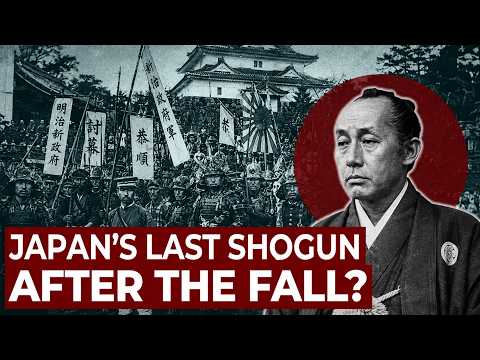
For more than 260 years, the Tokugawa family ruled Japan with an iron grip, dictating every aspect of life from trade to worship. Their capital, Edo, was a sprawling metropolis of over a million souls, and their feudal system was so airtight that Japan remained isolated from the world for two centuries. But by the mid-19th century, that world came knocking—and the empire began to crumble.
Tokugawa Yoshinobu, the 15th and final shogun, inherited this crumbling edifice. He was sharp, composed, and born into the heart of power, yet he would preside over the most dramatic transformation in Japanese history. Unlike most rulers who lose everything, Yoshinobu didn’t meet his end at the executioner’s block or vanish into exile. Instead, he picked up a camera, bought a bicycle, and lived for another 45 years. But how did a man who lost an empire find a new life?
The seeds of the shogunate’s destruction were planted centuries before Yoshinobu’s birth. In 1603, Tokugawa Ieyasu established a system of control so brilliant it was almost suffocating. The Sankin Kotai policy forced daimyo to spend alternate years in Edo, leaving their families behind as hostages. It kept them broke and obedient for 260 years. But isolation came at a cost: while the West industrialized, Japan remained frozen in a pre-industrial age.
Then, on July 8th, 1853, four American warships under Commodore Matthew Perry steamed into Edo Bay. The Japanese had never seen steamships—they called them “black ships” for their dark iron hulls and belching smoke. Perry carried a letter from President Fillmore demanding trade, backed by 73 heavy guns. The shogunate was paralyzed. “Open up or we’ll open you up ourselves,” the message was clear. The humiliation cut deep, and the shogunate’s credibility never recovered.
Yoshinobu was born in 1837, the seventh son of the daimyo of Mito, a branch of the Tokugawa clan eligible to produce a shogun. His mother was of imperial blood, giving him a unique dual heritage. From a young age, he impressed tutors with his sharpness and composure. His father, Nariaki, championed the sonno joi philosophy—”Revere the emperor, expel the barbarians”—which placed the emperor, not the shogun, at the nation’s moral center. Yoshinobu grew up in a household that questioned the very institution he would one day lead.
In the 1850s, Yoshinobu was adopted into the Hitotsubashi branch to position him as a potential heir. But when Shogun Iesada died in 1858, political infighting pushed him aside in favor of a boy, Iemochi. The powerful regent Ii Naosuke launched the Ansei Purge, arresting and executing Yoshinobu’s supporters. Yoshinobu himself was placed under house arrest. But in 1860, disaffected samurai assassinated Ii outside Edo Castle, and Yoshinobu’s star rose again. By 1862, he was guardian to the young shogun, introducing military reforms with French assistance and trying to create a more consultative government.
Yet the situation deteriorated faster than any reform could address. In the south, the Satsuma and Choshu domains formed a secret alliance to topple the shogunate. They had quietly modernized with British support, acquiring Chassepot rifles and Armstrong cannons that made the shogunate’s matchlocks look like museum pieces. When Shogun Iemochi died in 1866, Yoshinobu finally accepted the title he had been groomed for—but by then, it was a poisoned chalice.
On November 9th, 1867, Yoshinobu did something extraordinary: he formally resigned his powers to Emperor Meiji, expecting to retain a prominent role in the new government. He was wrong. On January 3rd, 1868, samurai from Satsuma and Choshu seized the Imperial Palace and declared full restoration of imperial rule. Yoshinobu was stripped of his lands and titles, declared an enemy of the court. His advisers were furious, and 15,000 shogunate troops marched toward Kyoto. The Boshin War had begun.
At the Battle of Toba-Fushimi, Yoshinobu’s forces outnumbered the imperial troops three to one. But the imperial side had modern weapons—Chassepot rifles and Armstrong cannons—that cut through ranks at distances traditional weapons couldn’t reach. Then, the imperial brocade banner appeared on the battlefield, the symbol of the emperor himself. Daimyo began defecting, desperate to prove their loyalty. And Yoshinobu? He fled. Under cover of darkness, he slipped away from Osaka Castle, abandoning his troops. The shogunate army disintegrated.
Most stories end here. But Yoshinobu’s story was far from over.
He returned to Edo and confined himself to Kaneiji Temple, a prisoner of his own making. The imperial army marched east under Saigo Takamori, intent on taking Edo Castle by force. With 1.5 million civilians in the crossfire, the city faced catastrophe. Then came one of history’s most remarkable negotiations.
Katsu Kaishu, the shogunate’s army minister, met Saigo for two grueling days. The terms were extraordinary: Yoshinobu would surrender, and Edo Castle—the seat of Tokugawa power for 265 years—would be handed over without a single shot. On May 3rd, 1868, the gates swung open. A city of millions was saved.
Pardoned in 1869, Yoshinobu moved to Shizuoka, where thousands of his former retainers blamed him for their ruin. Fearing assassination, he even redesigned his sleeping arrangements. Yet instead of bitterness, he adapted. He took up photography, submitting work to a magazine that never published him. He rode a penny-farthing in Western dress, once crashing into a signboard while distracted by a beautiful woman. He practiced archery, oil painting, Noh theater, and learned to cook rice in a military mess tin.
In 1902, Emperor Meiji granted him the rank of prince, welcoming the former enemy back into the fold. Yoshinobu died in 1913 at 76, outliving the emperor himself. He lost an empire and found a life.
So here’s the question: If you lost everything tomorrow, could you reinvent yourself as gracefully—or would you fight a war you knew you’d lose? Let us know in the comments below.






