The sea was calm off the northwest coast of Ireland on the morning of October 27, 1914, but beneath the waves lurked a deadly secret. HMS Audacious, a mighty King George V-class dreadnought, was conducting routine gunnery practice with the Second Battle Squadron. No one aboard suspected that they were sailing straight into a minefield laid just days earlier by a German auxiliary cruiser. At 8:45 AM, a massive explosion tore through the hull, plunging over 800 sailors into a desperate fight for survival.
The blast, muffled by the water, initially seemed like a misfire, but the rapidly flooding engine rooms told a different story. Captain Cecil Dampier, realizing his ship was crippled, hoped to beach the battleship on the Irish coast, 25 miles away. But the sea had other plans. As the dreadnought began to list and settle, help arrived from an unexpected source: the RMS Olympic, sister ship of the ill-fated Titanic, was steaming toward the scene, her captain ready to attempt a daring rescue.
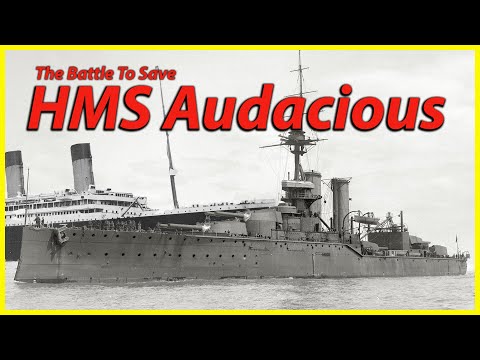
The Olympic, on her final transatlantic crossing before being pressed into wartime service, had intercepted the distress calls. Her captain, Herbert Haddock, maneuvered the massive liner close to the stricken battleship, while lifeboats from both vessels plucked sailors from the freezing water. The operation was fraught with tension—the threat of submarines still loomed, and every moment counted. As the crew of the Audacious fought to save their ship, a secret was already being born: the Admiralty, fearing a blow to morale, would soon order a cover-up that would keep the loss hidden for years.
But for now, the focus was on survival. With the Audacious dead in the water and towing attempts failing, the order was given to abandon ship. As the last men left the doomed dreadnought, they could only watch as the sea claimed one of Britain’s most powerful warships. The story of the Audacious, however, was far from over—and the truth would not stay buried forever.
As the last of the crew scrambled aboard the Olympic and the Liverpool, Captain Dampier stood at the rail, watching his ship wallow deeper into the Atlantic swell. The Audacious had been his command for barely a year, and now she was a corpse in the water, her decks awash and her guns pointing uselessly at the grey sky. He had done everything by the book, yet the sea had won.
The Olympic’s passengers—153 Americans mostly, many of them curious tourists—crowded the liner’s promenade deck with cameras in hand. They had expected a routine crossing to Glasgow; instead, they were witnessing the death of a dreadnought. Some snapped photographs openly, ignoring the frantic gestures of British officers who had been ordered to confiscate any film. “You can’t touch our cameras,” one American drawled. “We’re neutral, and this is history.” The officers could only fume.
By late afternoon, the tow lines had snapped three times, and the Audacious was listing heavily to port. Vice Admiral Sir Lewis Bayly, who had arrived to take charge, conferred with Dampier and Haddock. The decision was grim but inevitable: the ship could not be saved. As the sun dipped toward the horizon, the remaining 250 men were ordered off. They climbed down rope ladders into lifeboats, leaving behind the great steel hull that had been their home.
At 8:45 PM, the end came. From the deck of the Liverpool, sailors watched in silence as the Audacious heeled sharply, paused as if in defiance, and then capsized. For fifteen minutes her bow jutted skyward, a grotesque monument to British naval power. Then, with a thunderous roar, her magazines detonated. A column of flame and debris shot hundreds of feet into the air, and a piece of armor plating, flung like shrapnel, struck a petty officer aboard the Liverpool, killing him instantly. He was the only fatality of the sinking—a cruel twist of fate for a man who had survived the initial explosion.
When the smoke cleared, the Audacious was gone. Admiral Jellicoe, informed by signal, understood immediately what this meant. The Grand Fleet’s invincibility was a myth; if the Germans learned that a modern dreadnought had been sunk by a single mine, the propaganda victory would be immense. He ordered the news suppressed, and the government agreed. The Olympic, meanwhile, steamed for Lough Swilly with the Audacious’s crew aboard, her American passengers confined to their cabins and their cameras under guard.
But secrets at sea are hard to keep. Within days, rumors were swirling in neutral ports, and German intelligence was already piecing together the truth. The Admiralty’s wall of silence was about to crack—and when it did, the scandal would embarrass the Royal Navy for years to come.
At Lough Swilly, the Olympic dropped anchor under a grey, drizzling sky. British officials swarmed aboard, polite but firm, demanding the passengers surrender their cameras and film. Most complied with grumbling; a few, sensing a story worth more than any souvenir, had already hidden rolls of film in coat linings and luggage compartments. The Americans were beyond British jurisdiction, and they knew it. One enterprising tourist from Chicago reportedly mailed his photographs to a friend in New York before the ship even docked, ensuring the images would survive any confiscation attempt.
The crew of the Audacious were kept aboard the Olympic for several days, their letters home censored, their movements watched. Captain Dampier, exhausted and hollow-eyed, filed his official report and then waited in silence. No public word came. No announcement, no acknowledgment, no thanks. The Admiralty had decided that the sinking had never happened, and the men who had lived through it were expected to act accordingly.
But the sea has a way of giving up its secrets. In Berlin, the German naval attaché received a coded message from an agent in neutral Holland: a British dreadnought had struck a mine off Ireland and gone down. The Kaiser’s navy, starved of good news since the war began, seized on the report with delight. Within weeks, German newspapers were printing triumphant headlines, complete with sketches of the Audacious capsizing. The British public, kept in the dark, read the claims with disbelief—surely the Royal Navy would not hide such a thing?
In London, the Admiralty’s press office issued flat denials. The Audacious was on patrol, they said; rumors of her loss were enemy propaganda. The lie held through the winter, through the spring, through the grinding battles of 1915. Families of the crew received letters postmarked from ships that no longer existed, their sons and husbands writing cheerful notes dictated by censors. One mother in Portsmouth, told her boy was ‘serving with the fleet,’ wrote back asking why his letters smelled faintly of the Olympic’s engine oil. The reply never came.
Meanwhile, the Olympic herself was transformed. Stripped of her civilian finery, painted in dazzle camouflage, she became a troop transport, ferrying Canadian soldiers to the mud of Flanders. Her captain, Herbert Haddock, was commended for his role in the rescue—quietly, in private, with no medal and no public mention. The men who had watched the Audacious die carried the memory with them: the flash, the roar, the slow terrible roll of a great ship going under.
By 1916, the cover-up was becoming untenable. Too many men knew the truth, too many letters had slipped through, too many neutral sailors had seen the wreck marked on their charts. The Admiralty began to soften its line, hinting at ‘a serious mishap’ without confirming details. But the full admission would not come until the guns fell silent—and by then, the war had claimed so much that one sunken battleship seemed almost a minor loss.
Yet for the men of the Audacious, the secret had never been a secret at all. They had been there. They had seen their ship turn turtle and explode. And they would remember, long after the Admiralty’s silence finally broke, the morning the sea swallowed a dreadnought and the truth went down with it.
The war ended on November 11, 1918, and with the armistice came a strange kind of reckoning. The Admiralty, no longer able to hide behind wartime necessity, finally prepared the announcement it had delayed for four years. On November 14, 1918, the Secretary of the Admiralty released a brief, clinical statement: HMS Audacious had sunk after striking a mine off the north Irish coast on October 27, 1914. No apology, no explanation for the silence—just the bare facts, four years late.
The families who had waited in vain for news read the announcement with a mixture of grief and bitter anger. Some had suspected the truth for years; others had clung to the Admiralty’s lies until the very end. One widow in Devon, upon reading the notice, reportedly folded the newspaper and said only, ‘Four years. They gave me four years of nothing.’ The press, which had loyally suppressed the story at Jellicoe’s request, now published retrospectives full of quiet reproach.
The Olympic returned to civilian service after the war, her dazzle paint scraped away and her brass polished bright again. She carried passengers across the Atlantic until 1935, when she was sold for scrap—her long career overshadowed by her famous sister, but forever linked to the morning she raced to save a sinking dreadnought. Captain Haddock never spoke publicly of the rescue, though his log recorded the events with the same meticulous care he gave to everything else.
Today, the wreck of HMS Audacious lies upside down in about 200 feet of water, northwest of Tory Island. Divers first reached her in the 1960s, finding her hull intact, her guns still pointing at the seabed. The ship that the Admiralty insisted had never sunk became a quiet monument to the men who survived her—and to the one petty officer who did not. The fragments of armor plating that killed him were gathered up and buried at sea, unmarked and unremembered.
What remains is a lesson in the cost of silence. The Admiralty saved face in 1914, but lost something harder to measure: the trust of the families who deserved the truth. The sea kept the Audacious for four years, but the lie kept her longer still.
Was the cover-up justified to protect wartime morale—or did it betray the very people the Navy swore to serve? Share your thoughts in the comments below.






