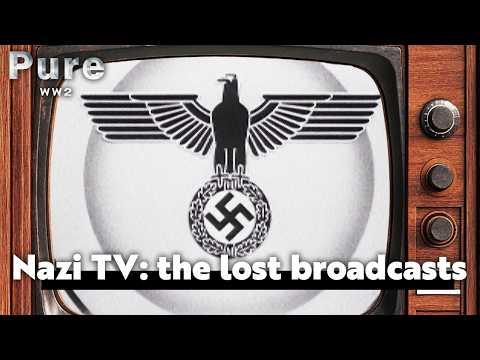
In the heart of Berlin, 1935, a small, unassuming building near the radio tower became the unlikely birthplace of a propaganda tool that would both fascinate and frustrate the Nazi elite. On March 22, Reich Broadcasting Director Eugen Hadamovsky rushed to announce the birth of the first German television station, a preemptive strike against feared competition from England and the US. But behind the fanfare, the technology was crude, the audience tiny, and the results far from impressive.
The studio, barely two square meters, was soundproof and pitch black. Announcers and performers squeezed into the claustrophobic scanning cell, their faces caked with heavy makeup to provide contrast for the fuzzy images that flickered on makeshift screens. “The picture quality still left much to be desired,” admitted one technician, as the mechanical transmission system struggled to produce anything beyond a blurry bust.
Propaganda Minister Joseph Goebbels, who had prophesied a bright future for the medium, was reportedly more appalled than enchanted when he first saw himself on screen. The Nazi elite remained reserved, and the station aired only three times a week. To compensate for the technical limitations, producers pre-recorded some programming on film, like the entertainment show Roof Garden, which premiered on June 19, 1935. It was a series of vaudeville acts, seemingly innocuous, but laced with subtle propaganda.
As the 1936 Berlin Olympics approached, the regime saw an opportunity to showcase the new medium. The television service, named after Paul Nipkow, the inventor of the scanning disk, promised to bring the games to those who couldn’t get tickets. “100,000 find space in the stadium, and for the many others, the television service offers the chance to participate with eye and ear,” boasted a reporter. But the reality was far from glorious. Cameras struggled with outdoor lighting, and the broadcasts were often marred by empty footage and spinning images.
Behind the scenes, the Nazis were using television for more than just sports. The party congress reports revealed the limited value television held for the propaganda machine, but they persisted. A special television room was even set up in the Olympic Village, where athletes could watch the games. “The international athletes enjoy watching this television,” a soldier explained, though the novelty was likely lost on those used to better technology.
By 1937, live telecasts had improved, but television remained a marginal medium, reserved for the political elite and special demonstrations. “The medium was actually used very rarely,” recalled one insider. “If you wanted to stay informed, you listened to the radio.” As war loomed, mass production of receivers became unrealistic, and the Nazi television experiment faded into the background, a curious footnote in the history of propaganda.
Yet the flickering screens did not go dark entirely. In occupied Paris, the old French facilities atop the Eiffel Tower were repurposed, and the Paris station became the largest television operator in the world at the time. Military commanders were delighted to have a source of entertainment for soldiers stationed in the city, and broadcasts were beamed into hospitals to distract the wounded from the war.
Back in Berlin, the programming grew stranger as the conflict dragged on. A 1943 report from Alexanderplatz showed trams and lorries hauling war-essential goods, while the camera lingered on a surprise: “That’s not lawn, it’s vegetables — turnips, to be exact, growing right in the middle of the square.” The reporter’s cheerful tone masked the growing scarcity that had turned public spaces into makeshift gardens.
Even the wounded were drafted into the propaganda effort. At a rehabilitation center, amputees ran a hundred-meter obstacle course, leaping and weaving like weasels. One man, who had lost both legs in Russia, confessed he had never danced before his injury. “The life is beautiful,” he said, smiling for the cameras. It was a perfect image of resilience — and exactly the kind of story the regime wanted the nation to see.
But the medium’s reach remained painfully limited. Receivers were scarce, and the broadcasts were still largely demonstrations for visiting dignitaries. The mass production that might have made television a true weapon of propaganda never materialized. As the war consumed every resource, the Paul Nipkow station faded further into obscurity, its signal flickering like a candle in a blackout.
Still, the experiment left its mark. The men and women who worked in the tiny scanning cell, their faces ghostly with makeup, had glimpsed a future where images traveled through the air. They could not have known that this crude, temperamental technology would one day reshape the world. For now, it was enough that the picture appeared — however fuzzy, however brief.
And as the bombs began to fall on Berlin, the cameras kept rolling, capturing a regime determined to project its vision to the very end.
The end came not with a grand finale but with a whimper of static. In the autumn of 1944, the Paul Nipkow station broadcast its final program to a handful of receivers in Berlin hospitals. The signal simply stopped, swallowed by the advancing Soviet armies. The tiny studio near the radio tower was dismantled, its equipment packed away or destroyed, and the files that documented a decade of experimentation were scattered to the winds.
What remained were fragments. A reel of Roof Garden, preserved by chance in a television troop archive. A few photographs of announcers in their heavy makeup, their faces pale as ghosts. And the memories of those who had worked in the pitch-black scanning cell, squinting into the glare of arc lamps while the world outside crumbled.
After the war, the Allies confiscated what was left of the German television operation. The Americans, who had their own fledgling networks, were reportedly unimpressed by the Nazi technology — the mechanical scanners were obsolete, the cameras crude, the whole enterprise a dead end. But they took the files anyway, and the reels, and the testimony of the engineers who had built it all.
It would be decades before historians began to piece the story together. “It was a propaganda tool that never quite worked,” one scholar would later write. The Nazis had dreamed of beaming the Führer into every German living room, but they had been undone by the limits of the technology — and by their own impatience with anything that didn’t immediately serve their purposes.
Yet the experiment was not entirely in vain. The engineers who had worked on the Nipkow station carried their knowledge into the postwar era, some of them helping to build the television networks of a divided Germany. The flickering images of the 1930s had been a beginning, however troubled, of something that would one day become ubiquitous.
And in the archives, the old reels still turn. A chanteuse warbles a tune about Strength Through Joy. A boxer knocks out his opponent in seventy-one seconds. A reporter stands in the Olympic Village, gesturing at the camera with practiced cheer. The images are grainy, the sound is poor, but they are there — ghosts of a regime that tried to conquer the airwaves and failed.
The men and women who made those broadcasts are mostly gone now. But their work remains, a strange and unsettling legacy. They had glimpsed the future, and it had looked back at them through a lens smeared with greasepaint and ambition. The picture was never clear — but it was enough to see what was coming.
The last reel from the Paul Nipkow station was never meant to survive. It was found in a damp cellar in 1946, its tin canister rusted shut, the film inside warped but still legible. A British signals officer catalogued it as “German television, miscellaneous” and shipped it to London, where it sat forgotten for half a century.
When the archivists finally threaded it onto a modern projector, they saw what the Nazis had never intended for mass consumption: a test broadcast from the autumn of 1944, recorded in the ruins of the old studio. The announcer’s face was gaunt, her makeup smeared, her voice flat as she read the evening’s program.
“And now, a word from the Führer,” she said, and the screen went white. The speech that followed was never delivered — the film breaks mid-sentence, the leader’s face dissolving into a blur of chemical decay. The last image is of a technician’s hand reaching toward the camera, as if to switch it off.
Historians still argue about that final frame. Was it a gesture of defiance, a simple act of exhaustion, or something else entirely? “We will never know,” one curator said. “But it is fitting, somehow. The regime that tried to control every image ended with one it could not control at all.”
The reel now sits in a climate-controlled vault in Berlin, catalogued and preserved for a future that the men and women of the Nipkow station could scarcely have imagined. Sometimes, on quiet afternoons, a researcher will request it, and the old images will flicker to life once more.
The chanteuse still warbles her tune. The boxer still throws his punch. The reporter still smiles his practiced smile. And the hand still reaches for the camera, frozen forever in the act of turning away.
What do you think that hand was trying to say — and does it change how we remember the flickering ghosts of Hitler’s television?






