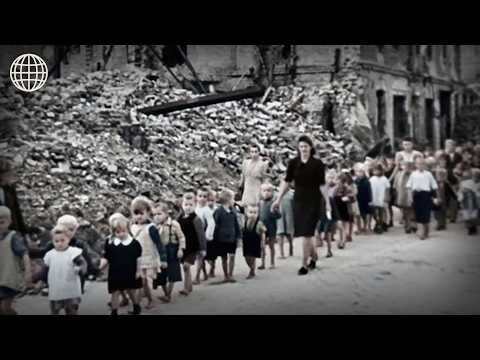
The war ended, but for the children of Europe, the nightmare was just beginning. On May 8, 1945, the world erupted in celebration. Confetti rained down on New York, London, Moscow, and Paris as the Allies declared victory over Nazi Germany. But amid the jubilation, a chilling silence settled over the heart of Europe—a landscape reduced to rubble, where hundreds of thousands of children wandered alone, their futures stolen.
These were the lost children of the Reich: some orphaned by bombs, others torn from their families by Nazi racial policies, and many more kidnapped for forced Germanization. Their stories, buried for decades, reveal one of the darkest and least-known chapters of World War II.
For twelve-year-old Roman Hoffmann, survival meant knocking on strangers’ doors, begging for bread. “I had no food. I had nothing. So I went into town and started knocking on doors. Can you give me a little food? I’m hungry.” Some gave him bread; others slammed the door in his face. Roman was one of countless Jewish children hunted by the Nazis’ Einsatzgruppen—mobile killing squads responsible for the “Holocaust by bullets” across Eastern Europe.
Ania, a young Polish girl, spent nine months hiding in an attic, forbidden to speak, just to stay alive. “Once I was separated from my family, I had to sit for nine months in an attic, not talking to anyone, just to survive Hitler.” Thousands of Jewish children were hunted as part of the Nazi regime’s criminal madness to exterminate all Jews in Europe.
In Hungary, twelve-year-old George Renitz’s life was shattered when he and his family were arrested and deported to Auschwitz-Birkenau in spring 1944. “I remember it exactly. I was told to get out of the wagon. The women there went that way.” A Polish prisoner on the arrival ramp saved George by advising him to lie about his age. “How old is he?” the prisoner asked, pointing at George. “You must say he’s seventeen.” George was twelve but tall for his age. His mother asked about his nine-year-old sister. The prisoner simply walked away. That advice saved George’s life, but not his mother’s or sister’s—they were sent immediately to the gas chambers.
George and his father endured nine months of hard labor in Auschwitz, where many died from exhaustion or starvation. “People starve for a day, two days, three days. They don’t realize what it means to be hungry for months.” George was among the few liberated by Russian soldiers in January 1945. “We saw the Russians coming from the East. Within ten minutes there were a thousand Russian soldiers inside, and we kissed them and hugged them and thanked them.”
But while some children were hunted for being Jewish, others across Eastern Europe were torn from their families by the Nazis for conscription. American soldiers were stunned to encounter a regiment of child soldiers in a barracks in Bavaria—a twelve-year-old Hungarian with three years of military training. Janusz Bogaricki, just ten years old, was one of hundreds of thousands kidnapped and thrust into the heart of the chaos. “The war destroyed our childhood. It stole our happiness. I was ten when the Gestapo came to take me. My mother said she wanted to come with me, but they refused and left her there.”
Janusz was sent from his hometown of Wałcz, Poland, to Austria, 800 kilometers away. “They gave me a number. After that, I was no longer allowed to use my first name, only my number. Every word we said in Polish meant three days without food, or three days without sleep, or three days of marching.” Like thousands of others, Janusz joined the massive refugee tide sweeping Europe at war’s end. How could they travel, stay warm, and most importantly, eat after losing everything?
Hunger became the daily torment for millions of European survivors. Urgent action was needed, and the Allied forces launched the largest humanitarian operation in history. The United Nations Relief and Rehabilitation Administration (UNRRA), comprising 47 nations, became responsible for protecting, feeding, and repatriating millions of displaced persons. Twelve thousand doctors, nurses, and social workers were rushed to over 700 camps across central Europe. It was a daunting mission unlike any before.
American UNRRA volunteer Aletta Brownley, responsible for all lost children in a vast area of Austria, recounted a rescue operation far more complex than expected. “No one was prepared for the reality we faced. There are very young children as well as teenagers. Most are dressed in dirty clothes and shuffle in old shoes full of holes. The most frustrating part is that the army brings us more of them every day. It’s an extremely difficult task.”
This was the reality for Janusz, the former child soldier who found himself near Salzburg, Austria, where he and a small group of Polish children faced a daily struggle for survival. There he met American soldiers. “We went to steal food from the Americans because we were hungry. We were four. We approached an American soldier standing there, but he spoke to us in Polish. We were really shocked. We hugged him with all our strength. He said, ‘What do you want?’ We all answered: ‘Bread.'”
The American soldiers took the group of Polish children to the nearest UNRRA camp in Salzburg. “The first time they gave us breakfast, we stuffed everything in our pockets. As soon as we left, it all disappeared in minutes. Then the camp director told us: ‘Look, you don’t need to steal bread. You’ll get all the food you need.’ And that’s where our new life began.”
Humanitarian workers now faced the arduous task of searching for and identifying thousands of children who often provided only fragmentary information about their past. Sometimes finding solutions was like searching for a miracle—like a little girl found in an abandoned house, barely four years old, with no documents at all. Through UNRRA’s work, thousands of children were reunited with their families. “I swear it’s impossible to describe. It’s truly incredible. Not only were my friends and I saved from the war, but we and all the others finally made it home.”
Janusz was one of the lucky ones whose family UNRRA found. But the hardest part was still ahead. Thousands of children remained unidentified. Booklets were published. Appeals for witnesses appeared in newspapers. German cinemas even showed footage of missing children’s faces when no other means existed to find their families.
But as they tried to piece together these chaotic journeys, social workers began asking a crucial question: Why were there so many of these children in Germany and Austria? Certainly there were orphans, those who fled bombs and persecution, and others forced to become child soldiers. But that still didn’t explain the sheer number.
The first mystery UNRRA social workers encountered was the puzzle of children under two, left in strange nurseries across Germany, whose identity papers revealed some weren’t even born in Germany. What they discovered when they tried to understand how these infants ended up there was horrifying.
In a photograph, a small girl sits at the feet of her caretaker, a sad expression on her face. “I look sad, as if I’m wondering where I am.” This was two-year-old Gisela Majola, found by UNRRA in a Munich orphanage in 1945. The only document they found revealed she was born in 1943 in Vimont, Belgium—in a very special kind of nursery. These were the Lebensborn homes, maternity wards established by the Nazis across Europe to breed the future elite of the pure Aryan race. Women sympathetic to Nazism were impregnated by SS soldiers, viewed as the ideal of masculinity and power. At birth, babies like Gisela were raised in these homes and became exclusive property of the German state.
“When I discovered that, I thought I would die. It contradicts everything I believe in. I couldn’t believe it. I was born into this. It was really hard to accept.” As the war neared its end, defeated German forces hastily evacuated Lebensborn children back to the heart of the Reich. Gisela was taken from Belgium and ended up near Munich. When UNRRA found her in Germany, she had no parents and no nationality. The decision was made to return her to her birthplace, Vimont. But the humanitarian organization made a mistake that would change the course of her destiny.
“I found my registration records in UNRRA. So, Majola Gisela was born on October 11, 1943 in Vimont, France. But in reality, there is no Vimont in France. An error occurred and I don’t know why, but they registered me as French.” The French authorities didn’t notice the error, but reconstruction was the priority, and the child was welcomed. So little Gisela found herself on a train with dozens of other war orphans. They left Germany and headed to France. A call went out to towns across France, including Commercy in the Meuse region, which was among the first to receive war children.
“My mother told me: ‘When I went to pick you up from the Commercy hospital, people were already choosing their children, and you held out your arms to me, and we met.'” France gave the little girl a family and didn’t hesitate to erase all trace of her German past. Gisela Majola was born in Bar-le-Duc. This court ruling constitutes the birth certificate above. Gisela Majola officially became Giselle Paty, born in Bar-le-Duc. This sudden change of identity was supposed to protect the children and their new parents, but in reality, it would haunt Giselle her whole life.
“In fact, when my mother died, I was sixty-one and I started searching for my identity. Because for me, it’s necessary to know your real story, not the story that was imposed on you. In the end, we all need to understand our origins. Your father, your mother, your siblings. You can’t live without that.” After many trips to Germany and Belgium and countless letters, Giselle finally tracked down her late mother and found a few mysterious photos among her belongings. “During my search, I found a photo of a German soldier. There’s nothing on the back except that you can see the name has been torn off. Just that. So, is this the father? My father or not?” Giselle Paty found the courage to confront the story of little Gisela Majola. But throughout her life, doubts about the identity of her German father—who made her a victim of Nazi madness—continued to haunt her. One among many others.
The Lebensborn, which UNRRA came to understand in detail, was just a small cog in a much larger machine. To their horror, investigators discovered in Nazi records that a huge number of children, this time stolen from the East, were certainly hidden across the country. So it became urgent for UNRRA to find these missing children that Germany was trying to hide. This was the task of Susan Pettis, a twenty-five-year-old American social worker stationed in the south of the country.
“Despite the ill will of local authorities, I found a group of Hungarian children in a care home. And I found more children in shelters, hospitals, and even monasteries. In Kalbaron, Bavaria, the director told me the place was empty, while in reality she had hidden a group of Polish children before we arrived. There seem to be countless such situations.” In just three months, UNRRA counted thousands of children from Eastern European countries. But why had the Nazis brought so many of them to Germany? Susan and her team dug deeper into the archives, and what they uncovered was horrifying.
In pursuit of strengthening the Reich and weakening the peoples of Eastern Europe, especially the Poles, the Nazis developed a vast operation called Germanization of Children. To achieve this, they organized mass kidnappings of children under six whom they considered “racially pure.” These children were forcibly taken from their parents or snatched from parks or as they left school. Most were handed over to German or Austrian families to be raised according to the principles of the Reich.
“I am now responsible for many Polish children. With their new foster families, they have been able to completely forget their origins, and most of them seem very happy.” Anna Pieragowska was likely taken from Poland at birth and placed with a family in Austria, where she grew up feeling loved. “I lived in a small wooden house high in the mountains, hidden in the forest. There was a boy a little older than me who helped take care of me. I thought he was my brother. My happiest moments were when I came home and my mother was waiting with open arms. Mama Rosa took good care of me. She hugged me, told me stories, and sang me lullabies. That was the happy childhood I had.”
Anna was one of thousands of children found by UNRRA—far more than social workers could have imagined. The affected countries estimated that around 300,000 children had disappeared in this way. But what was to be done? Should these children be torn from their new homes and returned to their countries of origin, or allowed to stay with their German foster families? International negotiations took place and a decision was made. UNRRA was ordered to take the children from the families they were living with and return them to their birth countries. It was a difficult task for the organization’s social workers, who were torn between many conflicting emotions.
“We worked on the principle that there was no other choice but to return these children to their homes. But in reality, with each child we tore from their family, we felt increasingly uneasy about what we were doing.” Anna remembers the night she was taken. “I was pulled from my bed in the middle of the night. There were two men in green uniforms. I was still half asleep. I didn’t understand the noise around me. I remember my mother dressing me in very warm clothes. All that mattered to her was that I wouldn’t be sad. So she gave me my teddy bear and then turned and gave me my doll. It must have been horrifying for her. She stood at the door watching me leave, wringing her hands and tears streaming down her face.”
For Anna, this meant being sent by train to Poland, the country she was now told was her homeland. But while people celebrated on the platforms of Warsaw station at the return of these young survivors, there was no one waiting for this little girl whose biological parents UNRRA had been unable to find. “I woke up in an orphanage. There were so many children around me. The beds were too small for us, and our feet dangled off the ends. The adults beat us when we wet the bed. I remember trying to escape every night because I knew I had to get back home to my mother who was waiting for me, and she must have been so worried that I hadn’t returned. Once I broke the glass door windows. Another time I hid in a haystack. I reached a sawmill once, and even a train station. I bit and hit and spat. I did everything I could to try to get back to Mama Rosa.”
Anna never saw her Austrian mother again. Like thousands of children returned to their countries of origin, she had to build her future in a country completely foreign to her, to which she ultimately felt no real connection. As time passed, the situations faced by post-war social workers became more and more complex. How could they confront the suffering of these children shattered by war, for whom solutions seemed to dwindle day by day?
The task was extremely difficult when it came to Jewish children rescued from the Nazis’ extermination program—children who had often lost their parents or even their entire families. UNRRA humanitarian workers were at a loss, having to deal with children who no longer acted like children, barely spoke, expressed no emotions, and often became aggressive when any adult tried to approach them. An old monastery in the German town of Indersdorf was converted into a center for these deeply traumatized children. Their care relied primarily on conversation, fostering a sense of autonomy, and creating a community spirit. This true sanctuary was run by a Czech social worker named Greta Fischer.
“Many children develop deep feelings of guilt for still being alive while their families were exterminated. But their strength and will to live are exceptional. I try to provide them with a reassuring and stimulating environment to create a relationship based on trust that can turn into affection. We represent everything to these children. A nurse, and a mother.” Arna, the orphan who miraculously survived the “Holocaust by bullets” in Poland, was struggling to survive when a Jewish association dedicated to helping the persecuted smuggled her to Germany to the Indersdorf camp.
“Everyone had their own stories. We never talked about anything that happened to us. How we got there, or what our lives were like before. No one talked about anything. That was part of our existence.” The goal at Indersdorf was to instill new hope in these children who would have to try to find a place in a world that had treated them so harshly. “At Indersdorf, there was a feeling that we were all together, and we all had peers of roughly the same age. And for the first time, in fact, I started to feel like a teenager.”
In Arna’s case, the future she built for herself was in the United States, where she managed to find a lost uncle who was willing to take her in. “I had no one. I was free in my decisions. I could go anywhere I wanted. So I said, ‘What do I have to lose? Let me go see America.'” Arna boarded a ship to New York and never looked back. She became Bonnie, an American citizen married to another survivor she met in Germany.
For over a year, UNRRA volunteers worked tirelessly to achieve success in a mission of epic dimensions. Many goals had already been achieved. Stolen children were returned to their countries of origin. Others who had been missing were reunited with their families. But from the beginning of 1947, their task became much harder to implement. International cooperation was rapidly deteriorating. While in the aftermath of the war the victorious nations celebrated their alliance in the face of all challenges, they now found themselves at odds. The first theater of this confrontation was Germany, which at the end of the war was divided into four zones controlled by the former Allied powers: the Americans, British, French, and Russians. And in these zones, children saw their future shaken once again by the whims of states whose only priority now was to strengthen their power.
The Soviets were the first to put an end to UNRRA’s activities in their zone. It was inconceivable that they would tolerate a humanitarian organization whose actions they considered, more than anything else, American interference. The Soviets believed they should bear responsibility for the unaccompanied children in their zone. This new Soviet policy alarmed its former allies, as shown by these warning messages sent by the French zone authorities. “The Russians are transferring thousands of children of unknown parents to their country and making them Soviet citizens.” Soviet leader Joseph Stalin needed to strengthen his country, which had paid a heavy price in the war with over 20 million dead. To achieve this, Stalin had a vision—a vision of the New Man, who would resurrect the Soviet Union, a project whose cornerstone was youth. Therefore, it was necessary to make as many children as possible conform to this new communist ideal across the territories of the Soviet Union, from Moscow to Berlin.
So, in the zone they occupied in eastern Germany during the many years their influence lasted in that part of the country, the Soviets demanded that Germans declare their faith in the Russian Revolution. The same methods were used in other countries that were becoming the Soviet bloc: Poland, Czechoslovakia, Romania, Hungary. This was what George discovered. George, the boy who escaped Auschwitz and returned to his village in Hungary. “In my mind, I never believed that my mother and father wouldn’t be there, because we agreed that no matter what happened, we would meet in my village.” George waited for his parents and watched his country transform from the moment the Soviets began imposing their worldview. The communist system was trying to brainwash people that Comrade Stalin was our savior and our god, and he had to go participate in the march. “On the first of May I was the tallest child there. I carried the flag, but I didn’t want to stay there. I just wanted to get out of that place.”
George was now nearly sixteen and had just received the terrible news he feared most: his parents and sister had not survived. He now had only one idea—to leave Hungary. A Jewish association told him that Canada was accepting orphans who had survived the Holocaust. “Canada brought some orphans under eighteen. So I fell into that category. I didn’t realize it until I boarded the boat, on the ship, and I said to myself: ‘Where am I going? I don’t know anyone.’ I said if I survived Auschwitz, whatever I face along the way, I will stay alive.” When he disembarked, he had one box that he threw into the sea. “I arrived with my hand in my pocket and they asked me: ‘What would you like to do?’ I said: ‘I want a job where there’s food.’ So they put me on a night shift at a bakery immediately, and I ate bread and cakes all night. It was paradise.” George Renitz, a Hungarian Jew who miraculously survived, became a Canadian citizen and turned his back forever on the Europe that had nearly devoured him alive.
Europe was now splitting into two blocs, separated by what Winston Churchill called the Iron Curtain. From 1947, these blocs engaged in what soon became known as the Cold War. A new balance of power took hold and divided Germany in two. Once again, children found themselves at the heart of negotiations, especially regarding the painful file of those kidnapped by the Nazis in Eastern Europe and still in Germany, particularly in the British zone.
Initially, there was international consensus that they should be returned to their countries of origin. But soon the British refused to send children to the East. “Every child we return to the East will be against us in the future,” explained Colonel Gray. This policy change condemned many of these children to a very long wait before they could hope to discover their true identity.
My name is Hermann Ludaking, but my real name is actually Roman Rasatovsky. For a long time, Hermann believed he was German. He discovered his true identity only years later, on the day he buried his adoptive father. “I was always curious. I searched my adoptive father’s closet and found all these documents in the back. I flipped through them quickly, but it was enough to know that my parents were not my real parents.” Later, he investigated to try to understand what really happened. It was a journey of discovery into his past. When he went to Poland, he visited at least 15 archive centers. He needed to find answers.
Despite all his efforts, Hermann never succeeded in finding his biological family. But during his investigations, he was able to reconstruct the chain of events when he was still with his parents in Lem, in the British zone. It all began from the moment the Polish Red Cross found him. “There is no doubt that Roman Rusidovski is a Polish child stolen by the SS. We request the child be removed without delay from Mrs. Ludaking’s house to be prepared for return to his homeland.” The British authorities were obliged to open an investigation into Hermann’s adoptive family, who turned out to be Nazis. His adoptive mother was a director of the League of German Girls (BDM). “My adoptive mother was very enthusiastic about Adolf Hitler. Frankly, she remained a loyal Nazi until the bitter end.”
So what was to be done with little Hermann? The British sent social worker Nelly Braun to meet him at home. But in reality, the decision had already been made. The new British policy was clear. As Colonel Gray explained, “Every child we return to the East will be against us in the future.” Hermann remembers this strange visit very clearly. “What happened was that Miss Nelly Braun came to see me with a translator who tried to speak to me in Polish. But I didn’t understand a single word. I never spoke Polish. I only remember the translator saying: ‘Well, this child cannot be Polish. He doesn’t understand a word I say.'” Despite his adoptive family’s Nazi past, the child would not return to Poland. “Dear Mrs. Ludaking, I am very pleased to inform you that the military government has decided that Hermann will stay with you.”
Hermann, victim of the Germanization of children, felt as if his identity had been stolen when he was left with his German family. Conversely, Anna, the girl torn from her Austrian foster family and returned to Poland, suffered for years from rejection in her new country. “How many times did I hear: ‘Look, that [__] Kraut.’ ‘We should send her back where she came from.’ ‘So we don’t have to feed her.’ In school, I answered questions in German. Every time, the teacher ordered me to hold out my hand like this, and hit me on the knuckles with a ruler. They beat me so much that they drove German out of me, and I never spoke it again.”
Two fates, two contradictory decisions, but the same pain. The pain of the victims of the Germanization of children. Those the Nazis sought so desperately, a crime that can never be atoned for. In this Germany, divided into different sectors, children became a precious asset fought over secretly by states. And one country in particular was watching these lost children closely. After the war, France desperately needed to increase its population. A million and a half children were not born due to the conflict. Faced with this painful reality, General de Gaulle himself issued a very clear and rapid order. “I ask you to consider the arrival of children of all nationalities in France, orphans or unaccompanied, currently in Germany.”
Later, in the German zone occupied by the French, the army implemented this order to the letter. Successive governments continued this approach. Little concern was shown for the methods used to achieve this goal, as unpublished archives of the French command show. “Our interests seek to remove all healthy children of good development, whom there is no hope of claiming, from the control of UNRRA.” When it came to seizing these unaccompanied children, anything was permissible. As happened in 1947 when the French discovered that Denmark was sheltering thousands of German refugees. “Subject: Children of Denmark. The attention of the Ministry of Population was drawn to the presence of between 2,000 and 3,000 German children in Denmark whose fathers are unknown.”
France went on to propose to Denmark that these refugees be returned to the zone it occupied in Germany, promising to place them under UNRRA care. Their intentions seemed good, but in reality, the French authorities had a hidden motive. The true and secret goal of the French authorities was to absorb a large proportion of these crowds of children. To avoid arousing Danish sentiment, it was advisable not to reveal this goal. To achieve this, the French military command devised a plan that showed a lack of moral scruple. They gathered the selected children into a train in four separate cars. The train left Denmark heading toward Germany and Offenburg in the French-occupied zone. But during the journey, the cars carrying the children mysteriously disappeared.
The French thought the secret kidnapping operation had gone unnoticed. But when the train arrived, the Red Cross, responsible for refugees, noticed that children were missing. They conducted an investigation, and three weeks later when they realized what had really happened, they immediately sent a strongly worded complaint to the French military command. “General, 217 children who were in the Danish convoy never arrived in Offenburg. This convoy of four train cars was detached at Koblenz station on orders from the French authorities.” The plan devised by the French was to divert the four cars of children at Koblenz to take them elsewhere in the French zone, to Travenant in the Black Forest, where the children were placed in a center under French military control. The Red Cross discovered that French families were being sent to the center to adopt these children. For the organization, this was nothing less than evidence of kidnapping, and thus a crime against the children and their families.
The case seemed about to turn into an international scandal until the French backed down, and the 217 children were eventually secretly returned to the German authorities. The French military command covered up the case with a deceptive style and denied the Red Cross accusations. “The rumor that a decision was made to send these children to French families for adoption is nothing but fantasy.” The French authorities realized they needed to change tactics. From then on, they would prioritize reclaiming children whom no one could object to. Within months, the solution was put into effect, and thousands of children born from relationships between French soldiers and young German women began to be transferred to France.
In the French zone, as in all zones occupied by the Soviets, Americans, and British, there were hundreds of thousands of young soldiers in their prime, drunk with victory, often believing German women, in defeat, were part of the spoils of war. Many German women were raped, while others were forced into prostitution to survive. But some were simply seduced by these young men far from home. Like on the banks of Lake Tegel in Berlin or in the jazz clubs of the former Reich capital. These encounters often turned into real love stories. And all these relationships, whether fleeting or sincere, led to the birth of a large number of children. Such was the case in the French occupation zone, where 20,000 children were born to German mothers and French soldiers. These were an incredible blessing for the French authorities, who did their utmost to obtain these newborns. “National interest requires that the recovery of children of French blood be carried out with the highest possible success rate.”
General Koenig, commander-in-chief of the French zone, launched a major deportation operation. First, he ordered German authorities to immediately report any birth of a child with a French father. For Koenig, there was no doubt that these children belonged to France. “I knew I was adopted. It was never hidden from me, and I knew I was born in Germany in Walden. But I didn’t know more than that. I knew nothing else. We only decided to go see the village where I was born in 2018. And in Walden I discovered the truth.” There was an address on his birth certificate. He wanted to see the house where he was born. When he arrived, he met an old man. He only later learned it was his uncle. When he saw him, he said several times: “I have been waiting to see you for 70 years.” That meant since the days he held him on his knees, when he was three or four months old, when they discovered a large file about him.
Sebastian Driebach discovered that he was in fact Hans Peter Springmann, born to a German mother and a French soldier. “The child was baptized here. I was his godfather. We loved that boy. To this day it still saddens me.” He discovered a family. He could barely speak because he was paralyzed with emotion and anticipation. “I must say it was a great shock. I also felt very resentful about what I discovered about French policy in Germany at that time. It somewhat diminished my admiration for General Koenig.”
The recovery procedures were perfectly polished. As soon as a child was born to a French father, an officer would go to the mother’s house with the aim of making her sign an official document relinquishing her child. “I hereby acknowledge that I renounce all my rights to this child and entrust him to the French state.” These young single mothers were easy prey. With the rationing system still in place in Germany, feeding a newborn was no easy task. And often, these women, ostracized by society, succumbed to pressure from the French authorities. “Since I have a two-and-a-half-year-old daughter to raise, I am unable to feed my son, Robert. I hereby declare that I renounce all my rights forever.” Thousands of relinquishment letters can be found in the French National Archives. Sebastian wanted to know the truth at any cost and managed to find the relinquishment document signed by his German mother. This document changed the little boy’s life. “I, the undersigned Springmann, declare on my honor that I have a child by a French father and wish, for personal reasons, to relinquish him to the care of the French authorities.” Everything was typed, except his mother’s signature, Ernstmann. “I have no reason to doubt that she was forced to give me up. The story my family tells is that she was threatened with prison if she did not comply. We Germans were the losing side and had to comply.”
They received an official letter demanding they return the child on a specific day. Full stop. They were not allowed to keep him. They didn’t know if they would ever see him again. They wanted at least a picture of the little one. She took it. The child, then called Hans Peter, was sent to a nursery taken over by the French army. The management of this main site in the child recovery apparatus was assigned to Dr. Marie Hellmann, a highly enthusiastic government employee. “I was tasked by the ministry with organizing the workflow of this nursery. It is a very difficult job, but very exciting. The abandoned children who come to us are in rather poor health. I actually call them ‘my little ones who barely walk.'”
In fact, Dr. Hellmann’s brief was to select children. France dreamed of healthy, strong, genetically ideal inhabitants. To achieve this, they did not hesitate to pick and choose among these newborns. Only those capable of fulfilling their role as French citizens could be sent to France. “And I reject anyone I believe should be rejected. Simone, I managed to return everyone I considered deficient. They were sent back to the Germans under various pretexts. Among them, doubts about their French origins.” When Dr. Hellmann picked up little Hans Peter Springmann, she wrote a very precise note about his health condition. “A very fat child, in good condition, though somewhat sluggish due to his weight, which far exceeds what is normal for his age. He was placed on a strict diet under supervision. Previously, the boy ate at all times and whatever he wanted. In the two months between my arrival and my departure, I lost 600 grams. So, the diet worked. After two months in the nursery, our little living dead became almost normal children. I now have a rather large convoy to send to France, and I hope they all become good French citizens.”
Dr. Hellmer declared young Hans Peter fit. He was transferred to France with other selected children. Before his arrival, the French authorities changed his identity. He became Hans Peter Sebastian for a new family in Paris who was already waiting for him. “I was extremely lucky because I had a very loving adoptive family. Only now do I think I am living a life that very well might not have been mine.” After that, they never heard anything about him again. They didn’t know what name he was given or where he was. They went to the French consulate in Offenburg. They wrote letters, but in vain. For over 70 years, no news of Sebastian reached his German family. Hundreds like him were torn from their German families and transferred to France. All for the supreme interest of the nation.
In the West, as in the East, these children were the embodiment of hope for a new world, a world that could only be better. These children became symbols of a new society characterized by peace and harmony. But in reality, the demon of racism was still raging in countries that did not hesitate to reject anyone whose origins were not correct in their eyes. Many were those who could not find a place for themselves anywhere on the continent. This was the case of Jewish children rescued from the Holocaust who found themselves once again forced to flee to survive in Eastern Europe.
In Poland, as in Czechoslovakia, anti-Semitic hatred had not disappeared with the Nazis. “In Poland, the atmosphere was very bad for us. The Poles hate us and say so and call us ‘Jew.’ For us, the war was not over.” Eliahu Yaker was ten years old. He spent the war hiding in a Russian orphanage. He had lost everything—his family and his home. When he ended up in the town of W in Poland, he was directed to a house run by a young Jewish woman of 24 named Haska Palichka. “The door opened and I saw a beautiful woman, she was like a character from fairy tales to me. On the table was a large basket full of bread. I think it was the first time since I can remember that I saw so much bread placed like that, and no one taking it.”
The secret Jewish organization Bricha entrusted Haska Palichka with the mission of saving all Jewish children at risk who were wandering the streets of Poland. Children at twelve who had survived only by hiding in the forest for months. Osta, eight years old, who was sold to a Ukrainian farmer who abused him and forced him to sleep with animals, and Eliahu Hoyaka who lost the ability to speak after a violent bombing during the war. “I came, I think there were about 27 or 28 children. And over time, the number of children in the place grew until we reached 73 children.”
In her private diaries, Haska recounts how she suddenly found herself, despite her lack of experience, responsible for caring for dozens of traumatized children, doing her utmost to give them a new chance at life. “I had no idea how to care for these children who had survived such horrors. I felt they needed a welcoming environment. That was the only way to gain their trust. I held them in my arms, showered them with affection. I got up at any hour of the night if they needed me. I did it so that each child would feel that I belonged to them. I received love. I received a hug. I received a kiss. It was the first time since the end of the war that I felt I belonged to something I wanted to be part of.”
But the haven Haska provided unfortunately proved unsafe. In the summer of 1946, a wave of pogroms against Jews swept through Poland. Dozens of Jewish men, women, and children were killed in those massacres. The Jewish organizations trying to save these children realized their safety was no longer guaranteed. “The night after dinner, I told the children that we had to leave at midnight. And I wanted each one of you to say goodbye to Poland out loud.” The children had lived in this house for three months and were very sad to leave. But how to escape from these lands that had become extremely dangerous?
The Bricha organization devised a plan that exploited the influx of thousands of German-speaking refugees at the time, who were also trying to flee from Poland to Germany. The plan was for the Jewish children to pretend to be German refugees and blend in with the traveling crowds. They were sent to the station in small groups so as not to attract attention. Once on the train, Haska placed the children in the care of childless couples to look like real families. As if by magic, the first obstacle was overcome. “I looked out the window and felt the cold breeze on my face. I said to myself: ‘We have really left Poland, and our lives are no longer in danger.'” They reached the German border. Then they left the train. They had no personal belongings. Almost nothing, except the clothes they wore.
Eliahu and all of Haska’s children fleeing Poland were actually at the beginning of their long journey. The secret destination chosen for them by the Jewish organizations was Palestine. In the Middle East, over 4,000 kilometers away. Their first stop was Lübeck in Germany, in the British-occupied zone, because the British at that time held the mandate over Palestine. Faced with this sudden influx, the British authorities, exhausted, refused to grant permits to these refugees who arrived in the thousands in their zone, and even prevented them from entering the camps. Haska and her lost children were trapped, and soon tens of thousands of other destitute Jews joined them. It was a very difficult time for the young woman who began to doubt herself.
“One of the girls was suffering from a high fever and great pain. I couldn’t call a nurse or a doctor. I had no medicine. I was afraid she would die. How could I have been so reckless and left alone with 70 children on that journey?” This extremely fragile situation required an urgent solution. And here the Jewish associations intervened, most notably the largest at the time, the American Jewish Joint Distribution Committee (JDC). Their first decision was to return 250,000 refugees to the American zone and negotiate with the military authorities and UNRRA to establish new camps specifically for Eastern European Jews. The goal was to leave Germany as soon as possible. And more than ever, Palestine seemed the only viable option for these survivors of Nazi brutality, who had returned to fear for their lives again.
Everything was put in place to prepare these refugees for a life in a world they knew nothing about. The Jewish Agency began teaching us Hebrew. “So I never attended any lesson because I couldn’t concentrate or even think about going, and I never learned to read or write.” For months, the associations pressured the British authorities to provide those precious permits. But the British, facing conflicts between Jewish and Arab communities in Palestine, were not prepared to grant permission to everyone who asked. There was only one solution: to work secretly again and try to reach Palestine illegally.
“In the middle of the night, they woke us and put us in trucks. The trucks were covered. They put empty gasoline barrels. So we sat inside, forbidden to speak, forbidden to do anything, to stay quiet until we arrived after hours of driving to a place in France. We sat in the port of Sète.” Eliahu boarded the ship Theodor Herzl with 3,600 other survivors, including over 500 children. Destination: Haifa. Their arduous journey began in August 1947 and it took over a year for Eliahu and his seventy-two companions to escape from Europe, which had become extremely dangerous for them. They would all begin a new life in what a few months later became the state of Israel. Haska Palichka’s mission was finally accomplished. “I saw in Haska a mother. What she did, no one did. She was a hero.”
The Europe that these thousands of persecuted Jews left forever was now in the midst of reconstruction. In Germany, people dreamed that their children would live in a country capable of deciding its own fate again soon, with the hope after years of chaos of erasing the last stigma of war. But some scars would never disappear. In a German society still dominated by racism and the desire to finally turn the page on defeat, it was now the turn of another category of children to be rejected. Over 5,000 mixed-race children were born from relationships between German women and African-American soldiers. These children were rejected by the racist United States, which strictly prohibited sexual relations between black men and white women—a rule they wanted to impose in Europe as well. “Any marriage between a black man and a white woman is considered contrary to the interests of the army, as it could cause social problems when soldiers return to America.” Whenever the American military command learned that a black soldier had fathered a child, in order to put an end to the relationship, the soldier was immediately transferred from his unit or sent directly home.
This is what happened to the father of a little girl born in 1947. Eica Hou, whom the United States preferred to ignore, grew up alone with her mother in Bavaria in a German society that violently rejected her. “We, the children of African-American soldiers, stood out clearly. At that time, my mother and other mothers like her were called, and I don’t like to say it, ‘nigger whores.’ [__].” Eica’s fate did not improve when the Federal Republic of Germany was founded in 1949. This new democracy in the West, supported by the Western powers, assigned a very special fate to these troublesome children. Child protection services decided that remaining at home would harm her development, and that it would be better to separate her from her family. What they really wanted was to get rid of all children of color. The existence of these mixed-race children was just another reminder that Germany had lost the war. To make them invisible.
Eica was six years old when she was separated from her mother and taken 500 kilometers away to a home where she was kept for about nine years. “It was a very shocking experience that many others like me went through. My mother suddenly disappeared from my life. I didn’t realize I was different from other children until I arrived there. And it caused me a lot of suffering. Like the time one of them rubbed my face with a rough brush to prove I wasn’t made of chocolate.” In this home, usually intended for children with mental disabilities, Eica was treated with particular violence. “Well, of course, that reinforced my feeling of inferiority. I was told I had a demon inside me and it had to be driven out. One day, I was taken to a place I didn’t know, and locked in a room where I was ordered to kneel on my knees to drive the demon out of me. All of that contributed to, how can I say it, destroying my spirit a little more.”
Eica returned home when she was fifteen. The young woman then began a long journey to discover her identity and try to rebuild herself, after being rejected by both Germany and the United States. When she turned eighteen, she found the strength to write to her missing father after a long and arduous search for his address. “Unfortunately, I don’t know if you are alive or dead. Do you know you have an eighteen-year-old daughter? I hope if you are alive, you will write me a letter please.” That was in 1965. The address was wrong and the letter was returned to sender. It took many more years until the young woman dared to cross the Atlantic and search for a father she knew nothing about. In the mid-1990s, her determination led her to a suburb of Chicago. “Yes. It took a long time to find him, but I am really very happy. So, when you wait your whole life to see your father and you finally find yourself in front of him. Yes. At first, you can’t even think clearly. We just looked at each other, contemplating each other. We weren’t ready to talk about our feelings. What was striking was that I inherited some of his personality traits and facial expressions, even though I never lived with him. That made it clear there was no room for error. He really was my father.”
After years of searching, Eica is still striving to overcome the trauma of her childhood. Today, she has managed to add her father’s name, Marshall, to her mother’s name, Hou. She even obtained American citizenship. Eica’s long and painful journey to reclaim her past is the same journey carried by other lost war children whose stories we have just heard. Each one had to find their own way to survive and rebuild themselves.
Like George Renitz, the child rescued from Auschwitz who ended up in Canada. “I was an angry child. I was hunted. In those days, Jews never fought. And I said: ‘My God, I will not run anymore. I will stand my ground.’ And that’s what drove me to take up wrestling.” Ten years after his arrival, the Hungarian orphan became Canada’s wrestling champion, a country whose national symbol he tattooed over his Auschwitz deportation number. “I am Peruska, the child the Nazis stole, adopted by a couple in Austria, then returned to Poland. She had no choice but to rebuild herself without knowing her true identity. Unfortunately, I will never know who my real parents were. I never found out. All the information in my identity documents is fabricated. That is something I have to live with.”
Hermann Ludaking became obsessed with the idea of uncovering the truth, but his investigation negatively affected his relationship with his German adoptive mother, who could not bear her son’s quest. “My adoptive mother said she didn’t want me to attend her funeral. She was afraid I would cause a scandal because of the documents I found. That was her wish. So I didn’t go.” When Sebastian Driebach finally discovered his identity and found his biological mother, it was too late. When the French left Germany, they took with them all the archives relating to the thousands of children forcibly taken to France. It was vital to prevent the Germans from one day investigating the fate of these children and demanding their return. Sebastian’s mother and uncle were never able to find him. Only a desperate hope for an unlikely miracle remained. “I always said that one day a car would appear and someone like Hana would step out. And that’s exactly what happened.”
When Sebastian found his German family in Waldum, he learned that his real German mother had started a new life for herself in France. But the old lady died a few days later before Sebastian could meet her. He arrived just in time to attend her funeral. “I have one regret: that I arrived too late. Perhaps if I had discovered my story earlier, I could have met my mother. I think she went through something really painful. She kept pictures of me in my German grandmother’s arms until the day she died. My mother signed a relinquishment document, but keeping those pictures until the end shows how much it mattered to her.”
Sebastian was keen to learn German, a gesture to try to repair the threads of his severed past. “Move away. Yes. It took more than a year until Sebastian finally discovered the identity that had been stolen from him 70 years ago. The French archive that hid so many secrets is now a path to uncovering all these individual journeys. Perhaps one day, other war children whose fates were turned upside down may try to discover their true stories.”
What would you have done in their place—would you have searched for the truth at any cost, or chosen to live in peace with the identity you were given? Share your thoughts in the comments.






