Albert Blithe was supposed to die in 1948. That’s what millions of viewers believe after watching Band of Brothers, the acclaimed miniseries that chronicled the harrowing journey of Easy Company during World War II. In the episode “Carentan,” a young paratrooper is shot in the neck, and a somber title card informs us that he never recovered, passing away just four years later. It’s a tragic, tidy ending to a soldier’s story—one that fits the narrative of war’s random cruelty.
But it’s a lie. Albert Blithe didn’t die in 1948. He didn’t even die from that wound. In reality, he survived Normandy, recovered from his injuries, went on to fight in the Korean War, and lived until 1967. So why did Tom Hanks and Steven Spielberg kill him off? And what does that mistake say about how we remember our heroes?
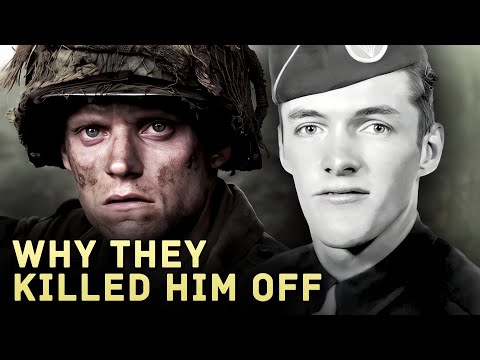
The answer begins not on the battlefields of France, but in a small town in Pennsylvania, where a troubled young man named Albert Blithe decided he needed to escape his past. Born on June 25, 1923, in Philadelphia, Blithe grew up on the wrong side of the tracks. His son Gordon later described him bluntly: “My dad was a thug.” He ran with a rough crowd, and after high school, he took a job at a Westinghouse Electric plant—but he knew he had to get out.
So on August 18, 1942, he volunteered for the paratroopers. It was a fresh start, a chance to become someone else. He was sent to Camp Toccoa, Georgia, where he joined Easy Company, 2nd Battalion, 506th Parachute Infantry Regiment, 101st Airborne Division. There, under the brutal training of Captain Herbert Sobel, Blithe became a rifleman in the first platoon. He earned his jump wings at Fort Benning and, by June 6, 1944, found himself hurtling toward Normandy as part of the D-Day invasion.
In the chaos of the drop, Blithe landed far from his target and, exhausted—perhaps affected by airsickness medication—he fell asleep in a ditch. He was eventually found by other lost paratroopers, and together they made their way to Sainte-Marie-du-Mont, where the famous photo of Easy Company holding a captured German flag was taken. Blithe stands on the far right, a quiet presence in a iconic image.
But it was near the town of Carentan that Blithe’s story took a dramatic turn. During the attack on June 12, 1944, he suffered what was then called “hysterical blindness”—a psychological reaction to the overwhelming stress of combat. “I can’t see, sir, I can’t see,” he told Lieutenant Dick Winters at the aid station. Winters reassured him, told him to relax, and suddenly Blithe snapped out of it. “I can see! I can see you!” he exclaimed. Winters later recalled, “All he needed was somebody to talk to him for a minute and calm him down.”
Blithe rejoined the fight, and in the fields outside Carentan, he overcame his fear. He began firing at the enemy, and one of his bullets struck a German paratrooper. After the fighting, he knelt beside the man he had killed and took a white edelweiss flower from the soldier’s jacket—a symbol of courage that only grew at high altitudes. He placed it on his own uniform. Finally, he had found his courage.
But on his 21st birthday, June 25, 1944, Blithe volunteered for a patrol outside Carentan. He and several other men were moving along a hedgerow when a German sniper hidden in a tree shot him in the collarbone. The bullet shattered the bone, and a piece of it protruded from his back. “The hole was so big in the back of his upper right shoulder,” recalled Joe Lesniewski, who stuffed a spare shirt into the wound to stop the bleeding. As they carried him back, bullets whizzed past their ears, but nobody else was hit.
In the series, this wound is depicted as a neck injury, and the title card claims it killed him in 1948. But the real story is different. Blithe’s hospital admission card states he was shot in the clavicle—the collarbone—resulting in a compound fracture. He was discharged from a hospital in England in October 1944, sent home, and fully recovered by October 1945. He even waived his disability payments to return to the Army.
So where did the false death claim come from? It originated with Easy Company veterans Edward “Babe” Heffron and Bill Guarnere. In 1948, they attended the funeral of a soldier from Pennsylvania named Albert Blithe and mistakenly believed it was their old war buddy. The error was compounded when author Stephen Ambrose interviewed the veterans and took their word as gospel. He wrote in his book that Blithe never recovered and died in 1948—a claim that made its way into the miniseries.
After the series aired, the Blithe family refuted the death claim and received an apology from Tom Hanks and Steven Spielberg. Corrections were made to subsequent editions of Ambrose’s book, but the series itself was never revised. It still displays the false death claim, and the book still incorrectly states that a German sniper put a bullet in his neck.
But Albert Blithe’s heroism didn’t end with World War II. After recovering, he served in the Korean War with the 187th Airborne Regimental Combat Team—the same regiment as Ronald Speirs, another Easy Company legend. During one mission, Blithe jumped behind enemy lines and landed in the middle of a Chinese division. For that, he was awarded the Silver Star. He also received the Bronze Star.
Dick Winters later said, “The way Blithe’s story is presented in Band of Brothers is unfair to the man. Falsely depicting him as being mortally wounded and dying from those injuries dishonors his service.” He noted that Blithe’s Purple Heart, Silver Star, and Bronze Star “speaks for itself.”
Blithe rose to the rank of master sergeant and became a master parachutist with over 600 jumps. He was stationed in Germany in 1967 when he traveled to Bastogne, Belgium, for a weekend ceremony commemorating Easy Company’s role in the Battle of the Bulge.
But the war had taken its toll. According to his son Gordon, Blithe was a chronic alcoholic. “He drank himself to death,” Gordon said. “My dad drank every day after work. He went to the NCO Club until it closed at 2 in the morning.” On December 10, 1967, Blithe returned to Germany feeling nauseated. He was diagnosed with a perforated ulcer and underwent emergency surgery. Complications led to kidney failure, and on December 17, 1967, Master Sergeant Albert Blithe died in the intensive care unit. He was just 44 years old.
He was buried with full military honors at Arlington National Cemetery. His commanding officer wrote to his wife, “Albert was an efficient and highly dedicated professional soldier. He was liked by everyone who had the opportunity to meet or work with him.”
But the story doesn’t end there. Blithe’s struggle with alcoholism, his gambling, and the destruction of his family life—these are the hidden costs of war that Band of Brothers never showed. His son Gordon said, “My dad went through hell during the war and loved the army so much. He was a true American paratrooper who put his life on the line for this country and thousands of other people in this world. I’m proud of him—so proud. That’s how I want people to remember Albert Blithe.”
Yet the series buried him in 1948, erasing his later heroism and his long, painful struggle. Why did Hanks and Spielberg choose to kill him off? Was it simply a mistake, or did it serve a narrative purpose? And what does it mean for the way we tell the stories of real soldiers?
The answer, in part, lies in the demands of storytelling. Band of Brothers is not a documentary; it is a dramatization based on Ambrose’s book, which itself relied on the imperfect memories of aging veterans. The miniseries needed to convey the brutal randomness of war, and Blithe’s arc—from fear to courage to death—provided a neat, tragic closure. As one of the show’s writers later admitted, “We had to make choices. We couldn’t follow every soldier’s full life.” But those choices have consequences.
For the Blithe family, the consequences were personal. Gordon Blithe recalled watching the episode with his mother, Kay. “She was furious,” he said. “She yelled at the TV, ‘That’s not what happened! He didn’t die then!’” The family had long known the truth, but the series’ global reach meant strangers suddenly believed a false version of their father’s life. The apology from Hanks and Spielberg helped, but the damage was done.
More troubling is what the error reveals about how we remember veterans. By killing Blithe in 1948, the series erased his Korean War service—the Silver Star, the Bronze Star, the 600 jumps. It also erased his struggle with alcoholism, the slow unraveling that his son described. “The war messed up his mind,” Gordon said. That truth is messier than a heroic death, but it is also more honest.
Historians have noted that Blithe’s case is not unique. Band of Brothers also simplified or altered other soldiers’ stories—sometimes for clarity, sometimes for drama. But Blithe’s false death stands out because it was so easily verifiable. “A simple check of military records would have shown he was alive,” said one researcher. “But no one checked.”
The veterans themselves were not entirely to blame. Heffron and Guarnere genuinely believed they had attended Blithe’s funeral. “They weren’t lying,” said another Easy Company veteran. “They were mistaken. It happens.” Ambrose, however, was the historian—he should have verified. But he was known for trusting his subjects’ memories over documents, a practice that has drawn criticism from other historians.
So what should we take from this? Perhaps that war stories are never simple, and that the men who fought them deserve more than a tidy narrative. Albert Blithe lived a life of courage and pain, of service and addiction, of love and loss. He was not a footnote to be killed off for dramatic effect. He was a master sergeant, a paratrooper, a father, a husband—and a man who, in his son’s words, “put his life on the line for people he didn’t even know.”
That is the truth the series missed. And it is a truth worth remembering.
So the next time you watch Band of Brothers and see that title card claiming Albert Blithe died in 1948, remember the real man. Remember the soldier who overcame hysterical blindness, who killed an enemy paratrooper and took his edelweiss, who jumped into Korea and earned a Silver Star, and who died at 44 from the slow wounds of war that no medal could heal.
His son Gordon put it best: “He fought for people he didn’t even know. I’m proud of him—so proud.” That is the legacy the series erased, and the one we should carry forward.
But this raises a question we all must face: when we dramatize real lives for entertainment, where is the line between artistic license and dishonoring the truth? And who gets to decide which version of a hero’s story survives?
What do you think—should Band of Brothers be re-edited to correct Blithe’s story, or does the error stand as a cautionary tale about trusting memory over fact? Share your thoughts below.






