Major Dick Winters returned home a hero. The war was over, victory declared, and the world celebrated. But for Winters, the battlefield had followed him back to Lancaster, Pennsylvania. In the quiet streets of his hometown, the echoes of combat were far from silenced. One ordinary walk would reveal just how deep the scars of war ran.
He had wanted solitude, a simple walk alone to escape the suffocating embrace of family and the weight of civilian life. The pavement stretched ahead, peaceful and unassuming. Then, a child appeared, dragging a stick along a picket fence. The sound—a rapid, rattling clatter—shattered the calm.
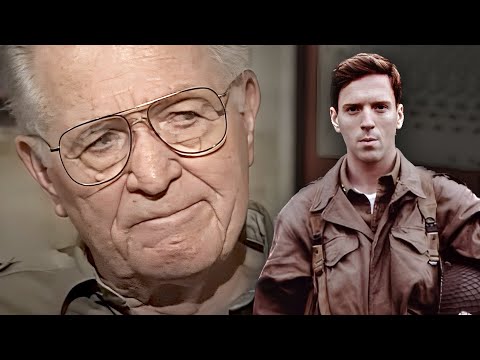
In an instant, Winters was no longer in Lancaster. He was back in the hedgerows of Normandy, under fire. “I picked myself up out of the gutter,” he recalled. “No thought, just a natural reaction from what you’ve been going through all these years.” The machine gun’s rattle had been replaced by a child’s toy, but his body didn’t know the difference. He had hit the dirt before his mind could catch up.
This was the hidden war—the one that never made it into the history books or the miniseries. For men like Winters, the transition back to civilian life was a battle of its own. The reflexes honed in combat didn’t simply switch off. “When you have a machine gun fire, you hit the ditch. You don’t care who you are. You don’t think, you’re reacting,” he explained. And react he did, even when the threat was only a stick on a fence.
The incident was a wake-up call. Winters realized that the war had left an indelible mark on his psyche. “But you recover from that slowly,” he said. Recovery was not a straight line but a gradual, often painful process. It meant confronting the invisible wounds that no medal could heal.
As he stood up from the gutter that day, brushing off the dirt and the embarrassment, Winters understood that the fight for normalcy had just begun. The enemy now was not a foreign army but the memories that ambushed him in moments of peace. And like any good soldier, he would face this enemy with the same quiet determination that had carried him through the war.
He didn’t tell anyone about the incident at first. How could he? How do you explain to your family that a child’s stick had sent you diving into the gutter? The shame of it sat heavy on him, a private humiliation he carried alone. In the war, his reflexes had kept him alive. At home, they made him feel like a stranger in his own skin.
But Winters was never a man to wallow. He had led men through fire and chaos; he would lead himself through this. He began to take longer walks, deliberately seeking out the sounds that unsettled him—the clatter of carts, the slam of a screen door—until they lost their power to throw him back into the past. Exposure was his strategy, the same steady patience he had used to train Easy Company.
Sleep offered no refuge. Night after night, he would wake in a cold sweat, the sheets twisted around him, certain he could still hear the distant thump of mortar fire. His wife, Ethel, learned not to touch him suddenly in the dark. She would speak his name softly first, a gentle anchor pulling him back to Lancaster. It was a small thing, but it mattered more than she ever knew.
Other men from Easy Company wrote to him, letters filled with the same quiet struggles. One couldn’t stand the smell of burning leaves. Another flinched at every backfiring truck. They were scattered across the country now, farmers and clerks and fathers, all fighting the same invisible war. Winters wrote back to each of them, offering the only comfort he could: you are not alone in this.
He found work, built a home, raised a family. To the outside world, he was simply a quiet, hardworking man who kept to himself. Few knew what he had done in the war, and fewer still understood what the war had done to him. The heroes of Easy Company had come home, but a part of them never left those fields in Europe.
Yet Winters refused to let the darkness have the final word. He had learned in combat that fear was not the absence of courage—it was the raw material of it. Every morning he rose, every day he carried on, was a small victory. The war had taught him how to survive; now he would teach himself how to live.
And in the quiet moments, walking those same Lancaster streets, he began to notice something he had missed before—the ordinary peace of a town at rest, the laughter of children who had never known war. It was worth fighting for, he realized. It always had been.
Years passed, and the reflexes dulled, though they never vanished entirely. There were still moments—a car backfiring on a summer afternoon, the crack of a branch underfoot—when Winters felt his shoulders tense, his body coiling for a ditch that wasn’t there. But the moments grew rarer, and the recovery came faster each time.
He rarely spoke of the war to his children. They knew their father had served, of course—the photographs and the occasional reunion with old soldiers gave that away. But the details, the hedgerows and the frozen forests, remained locked behind a quiet door.
It was Ethel who finally nudged him to write it down. “You carried those men for years,” she told him one evening. “Maybe carrying the words will be lighter.” He resisted at first, as he resisted most things that pulled at old wounds. But the letters from his men kept coming, and he kept answering them, and slowly the words began to flow.
What emerged was not a tale of glory but something rawer—a soldier’s honest accounting of fear and loss and the long climb back. He wrote of the boy with the stick, of the gutter, of the nights he woke certain the war had followed him home. He wrote of the men who hadn’t made it back, and of the ones who had, carrying their own invisible weight.
“The war ended,” he wrote in one passage, “but for those of us who fought it, it never truly finished. We simply learned to live alongside it.”
When the manuscript was finished, he tucked it away in a drawer, uncertain whether it would ever see the light of day. It felt too personal, too exposed. But the act of writing it had done its work. The memories no longer ambushed him; they walked beside him, acknowledged and understood.
He returned to his walks, the same Lancaster streets, the same picket fences. Only now, when a child’s stick rattled along the wood, he did not dive. He paused, drew a breath, and let the sound pass through him—just a sound, just a boy, just home.
It was, he decided, a kind of victory. Not the loud, celebrated kind that filled history books, but the quiet, daily kind that no one ever saw. The kind that asked a man to rise each morning and choose, again and again, the world of the living.
And Dick Winters, who had led Easy Company through the worst the war could offer, chose it every single day.
Decades later, when the miniseries made him famous, Winters received letters from strangers—veterans of other wars, and ordinary people who had never worn a uniform. They wrote of their own gutters, their own sticks on fences. “You told my story,” one man wrote, “and I didn’t know anyone else had one.”
He answered every letter, just as he had answered his men. The quiet discipline of it never left him.
When his grandchildren asked about the war, he told them the truth—not the glory, but the fear, the loss, and the long walk home. “Courage isn’t the absence of fear,” he told them. “It’s doing what must be done while you’re afraid.” They remembered that long after they forgot the battles.
In his final years, he walked those Lancaster streets still, slower now, a quiet old man nodding to neighbors who knew him only as Dick. The picket fences remained. Children still dragged their sticks along them.
And when the rattle came, he did not flinch. He smiled.
Because the boy with the stick had taught him something the war never could—that peace is not the absence of danger, but the presence of home. And he had finally, fully, come home.
What quiet battles are you still fighting today—and who might need to hear that they are not alone?






