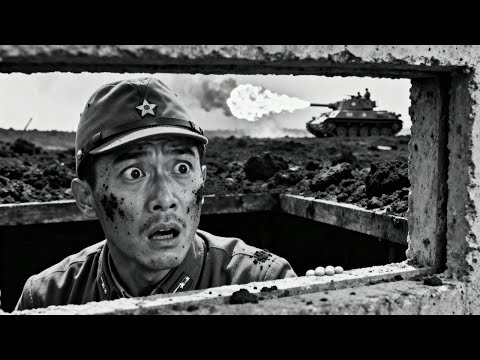
February 20, 1945. The volcanic ash beneath Lieutenant Yamada’s boots crunches like broken glass as he peers through the concrete slit of pillbox 247. Black smoke trails from something approaching through the sulfur-stained landscape. At first glance, it’s just another American Sherman tank—olive drab, familiar silhouette. But something feels different.
Inside the concrete fortress he helped build over the past year, Yamada allows himself a moment of confidence. This bunker can withstand direct hits from 16-inch naval guns. Its four-foot walls are reinforced with steel rods. Below his feet, tunnels connect to an underground network eleven miles long, seven stories deep—a subterranean city designed to make every American yard cost rivers of blood.
General Kuribayashi’s strategy is working perfectly. Let them land. Let them bunch up on the beaches, then make them pay for every inch with mathematical precision. One American dead for every yard gained. Ten American casualties for every Japanese defender lost.
But as tank 431 closes to 125 yards, Yamada notices something that makes his stomach tighten. The turret is traversing toward his position with mechanical precision. But where the familiar 75mm main gun should be, there’s something else—a modified barrel, a nozzle.
The sound hits him first. Not the thunder crack of a tank cannon, but something entirely new. A mechanical hiss like compressed air escaping under enormous pressure. Then comes the sight that will haunt his dreams for the next forty years.
A torrent of burning liquid erupts from the American tank, arcing through the Pacific morning like liquid hellfire. The stream stretches impossibly far—150 yards of napalm-thickened death.
It strikes the concrete aperture of the neighboring pillbox with devastating accuracy, splashing through the machine gun port and flowing inside like molten lava, seeking the lowest ground. The screams last only seconds.
Yamada’s field telephone crackles with panicked reports from positions across the sector. Strange American tanks. Something different. They’re burning us out.
His hands shake as he reaches for the receiver, watching black smoke pour from defensive positions that were supposed to be impregnable. Inside tank 431, Staff Sergeant Robert Misa’s voice cuts through the engine noise.
“Gunner, traverse right 30 degrees. Next target, pillbox, fire.”
How could they have known that eight modified Sherman tanks—created in secret by Navy Seabees working twenty-hour days in Hawaiian warehouses—were about to transform the nature of warfare forever? How could anyone have prepared for weapons that turned Japan’s greatest defensive strength, their underground fortress, into a crematorium?
Five months earlier, the story began in a classified workshop at Schofield Barracks, Hawaii, where the sound of welding torches filled the tropical air twenty hours a day. Machinist Mate First Class A. Riker wipes sweat from his forehead, leaving a streak of grease across his brow as he examines the CBH1 flamethrower system taking shape inside the turret of Sherman tank number 431—the same tank that will soon terrify Lieutenant Yamada.
“We’re not just building a weapon,” Riker tells his partner, Electrician’s Mate Second Class Joseph Kyle, as sparks cascade around them. “We’re building something to save Marine lives. Every bunker this thing burns out is a bunker our boys don’t have to die taking.”
The two Seabees have been living beside their welding equipment, sleeping in shifts, driven by reports from Peleliu and Saipan, where Marines died by the thousands trying to assault fortified positions that artillery couldn’t touch. The math is simple and heartbreaking. Portable flamethrower operators have a 70% casualty rate. Some units lose 92% of their flame operators—boys with 70-pound fuel tanks on their backs approaching concrete bunkers at ranges where Japanese machine gunners can see the whites of their eyes.
Colonel George F. Unmuth paces between the eight tanks taking shape in the warehouse. Each conversion requires 1,200 man-hours and 150 specially machined parts. At 64 years old with 44 years of military service, he understands that wars are won by innovation, not just courage.
His CBH1 system combines the best elements from British, American, and captured German flamethrower designs into something unprecedented. A weapon that can project napalm-thickened fuel 150 yards with the accuracy of a tank cannon.
“300 pounds per square inch of pressure,” Unmuth explains to a visiting Marine officer. “Triple the pressure of previous designs. The fuel mixture burns at 1,500 degrees Fahrenheit. Most critically, it can traverse 270 degrees and elevate from -10 to +35 degrees through the tank’s existing fire control systems.”
But the real innovation is psychological. These tanks look identical to regular Shermans until the moment they open fire. No special markings, no indication of their terrible purpose. To enemy observers, they appear ordinary until it’s too late.
Meanwhile, 8,000 meters away, General Tadamichi Kuribayashi stands in the command bunker beneath Hill 382, studying maps marked with precise defensive calculations. Every approach route has been measured. Every kill zone registered with artillery spotters.
His 21,000 defenders have spent the entire year of 1944 carving an underground empire from volcanic rock. 1,500 fortified positions connected by tunnels large enough to shelter entire battalions.
“Do not die until you have killed 10 Americans,” his standing orders read. “Every soldier will maintain position until overrun, then fight with grenades, bayonets, and finally bare hands.”
The general’s mathematics are elegant in their brutality. 21,000 defenders multiplied by 10 American casualties each equals 210,000 enemy losses—far more than the entire invasion force. The Americans may take Iwo Jima, but the cost will be so catastrophic they’ll abandon their plans to invade the Japanese homeland.
Japanese intelligence reports have analyzed every American weapon system. They know about portable flamethrowers—dangerous to the operators, limited in range, vulnerable to concentrated small arms fire. Special training emphasizes anti-flamethrower tactics. Target the distinctive twin tanks. Rush positions during the weapon’s minimum range. Exploit the operator’s vulnerability while reloading.
But all Japanese planning assumes flamethrowers will be carried by infantry. The concept of armored flamethrowers—tanks that can approach fortified positions under cover of their own armor while delivering accurate incendiary attacks at unprecedented range—has never been considered.
Private Takahashi Toshiharu crouches in a spider hole near the base of Mount Suribachi, a 20-kilogram bomb strapped to his back. At 31, the engineer from Kochi Prefecture has volunteered for the ultimate mission. Infiltrate enemy tank positions at night and detonate himself against American armor. He’s written his final letter home apologizing to his wife and children for not returning alive.
“There is no water, no bullets, no way I can live,” he whispers to his seven companions, all carrying identical explosive charges. “We are going to death with justice.”
But Takahashi has been trained to attack conventional tanks. His tactical manual describes Sherman armor thickness, weak points in the track system, blind spots where a determined soldier can approach undetected. Nothing in his training covers tanks that can fire liquid death at 150-yard range. Weapons that turn defensive advantages into killing grounds.
Staff Sergeant Robert Misa checks his watch as Tank 431 idles near Iwo Jima’s black sand beaches. Around him, the eight M4A3R3 flamethrower tanks sit among regular Shermans, their terrible secret hidden until the moment of engagement.
His crew—Driver Private James Morrison, Assistant Driver Private Robert Chen, Loader Corporal Anthony Vitelli, Gunner Corporal Thomas Carlson—represent months of specialized training on equipment that’s never been tested in combat.
“Remember,” Misa tells his men over the intercom, “surprise is our only advantage. We look like every other Sherman until we fire. After that, every Japanese gun on this island will be aimed at us.”
Through his periscope, he can see Marines dying by the hundreds, trying to advance against invisible Japanese positions. Conventional tactics are failing catastrophically. Naval gunfire can’t penetrate bunkers buried under ten feet of volcanic rock. Artillery shells explode harmlessly against positions designed to withstand direct hits from battleship guns.
The first day’s casualties are staggering. 2,420 Marines killed or wounded for less than 700 yards of territory gained. But what if eight tanks could change everything?
At exactly 1420 hours on February 20, 1945, the sound that would echo through military history forever breaks the volcanic silence of Iwo Jima’s northern sector. Inside Tank 431, Staff Sergeant Misa’s voice cuts through the engine noise with mechanical precision.
“Gunner, flamethrower. Pillbox, fire.”
Corporal Thomas Carlson’s finger finds the trigger, and the CBH1 system erupts with a sound witnesses will later describe as the devil’s own blowtorch. The compressed nitrogen system, operating at 300 pounds per square inch, propels a stream of napalm-thickened fuel oil in a perfect arc through the Pacific morning.
The burning liquid strikes the concrete pillbox aperture with devastating accuracy, splashing through the machine gun port and flowing inside like molten lava, seeking every corner, every hiding place. Lieutenant Yamada watches in paralyzed horror from his observation position 200 yards away.
The temperature inside the neighboring bunker soars past 1,500 degrees Fahrenheit in seconds. The oxygen is consumed so rapidly that Japanese soldiers suffocate before the flames even reach them. Those who survive the initial blast attempt to flee through rear exits, only to discover that liquid fire has flowed through ventilation shafts, turning their carefully constructed fortress into a crematorium.
“My God,” whispers Private Morrison, the tank’s driver, as screams cut through the morning air. Brief, terrible sounds that end almost as quickly as they begin.
But there’s no time for reflection. Japanese anti-tank guns have identified the threat, and a 47mm shell strikes Tank 431’s frontal armor with a sound like the world’s largest hammer hitting an anvil. The tank shudders, steel ringing against steel, but the shot ricochets skyward. The Sherman’s armor holds.
“Traverse right 30 degrees,” Misa orders, his voice steady despite the chaos erupting around them. “Continuous fire.”
Carlson triggers another burst, maintaining the flame for fifteen agonizing seconds until black smoke billows from every aperture of the fortification. Through the smoke and sulfur fumes, they can see Japanese soldiers emerging from positions—not in organized retreat, but in panicked flight, something no American has witnessed in three years of Pacific warfare.
“They’re running,” Chen reports from his position at the bow machine gun, disbelief clear in his voice. “They’re actually running away.”
Radio chatter explodes across Marine communications networks as reports flood in from across the front. Flame tanks operational. Japanese positions neutralized. Enemy abandoning fortifications without direct assault.
Tank number 434, supporting the 23rd Marines near the East Boat Basin, has developed what crew commander Sergeant William Patterson calls “corkscrew and burn” tactics—approaching in a spiral pattern to avoid anti-tank fire while maintaining continuous flame suppression. In one afternoon, his tank destroys four fortified positions that had stopped an entire battalion’s advance for two days.
But it’s Tank 432’s demonstration near Mount Suribachi that reveals the weapon’s true psychological impact. Patterson orders his driver to stop 100 yards from a complex of interconnected caves where dozens of Japanese soldiers watch from the darkness. Through his periscope, Patterson can see their eyes reflecting like animals caught in headlights.
He triggers a short burst of flame into the air—not at enemy positions, but skyward, as a demonstration of what could happen. The effect is instantaneous and unprecedented. Japanese soldiers begin fleeing from rear exits, abandoning positions they’ve been ordered to defend to the death. These are men who have survived the Sino-Japanese War, who have been trained from childhood that death before dishonor is the warrior’s only choice. Yet they’re running from the threat of burning alive.
Marine riflemen, positioned to exploit exactly this moment, are so surprised they initially fail to fire on the retreating enemy. In thirty minutes, an entire defensive sector collapses without the tank firing a shot directly at enemy positions.
Private Takahashi Toshiharu watches Tank 437 approach his spider hole, his suicide charge heavy on his back. His manual prepared him to rush a conventional Sherman at ten meters. But at fifty meters, the turret swings toward a bunker eighty yards to his left and liquid fire erupts where the main gun should be.
“The enemy was burned out with a flamethrower,” he later writes in his journal. “The flame is dark with black smoke. I could not see even an inch ahead.”
The tank passes directly overhead, and Takahashi remains frozen—his entire tactical doctrine rendered obsolete in a single afternoon.
By nightfall, the numbers reshape Marine Corps doctrine forever: forty-seven fortified positions destroyed by eight tanks, Marine casualties down forty percent, six hundred yards gained in sectors static for days. Kuribayashi’s elegant mathematics collapse into ash.
Forty years later, former Lieutenant Yamada stands on the same black sand facing former Staff Sergeant Misa. “I hated you for forty years,” Yamada says. “But war makes monsters of us all.”
They embrace as Mount Suribachi rises behind them—two old men who survived the fire.
What would you have done, had you been the one behind the trigger?






