The young American pilot banked his Avenger through a curtain of flak and saw a steel island on fire—a ship so enormous it seemed to defy the sea itself. Torpedoes had already struck below the waterline; smoke poured from craters in its superstructure. And then the ship fired its main guns into the water ahead of his approach, and the ocean exploded. Columns of seawater 300 feet tall erupted in his flight path. This was no ordinary battleship—it was the Musashi, the largest warship ever built.
He had been briefed 90 minutes earlier: target a Japanese battleship of unknown class. He was not told its name, nor that it carried the largest naval guns in history, nor that its waterline armor was thicker than his forearm. All he knew was what he saw—a ship that had already absorbed multiple torpedoes and bombs and was still sailing, still shooting, still fighting as though the damage meant nothing.
Other pilots would later say the Musashi took hit after hit for another three hours, soaking up punishment that would have sunk any other vessel afloat. When it finally rolled over and slipped beneath the surface at approximately 7:35 that evening, it had taken an estimated 19 torpedoes and 17 bombs. No warship in history had ever absorbed that much damage before sinking—and no warship ever would again.
But the pilot did not know the name of the ship he had attacked. It was called Musashi. And its death that afternoon was the single most important event in modern naval history that almost no one talks about—not because of how it sank, but because of what it proved, and because of the man who watched it die from the bridge of its sister ship several miles away. And because of what that man wrote in his diary that night.
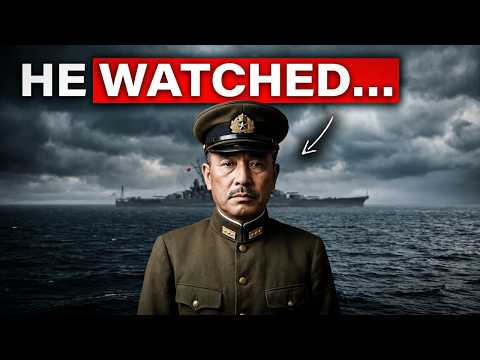
The man on the bridge was Vice Admiral Matome Ugaki. He was 54 years old, a gunnery specialist with a reputation for meticulous planning and relentless pessimism. Colleagues described him as brooding, dutiful, and inflexible. His wife had died in 1940, and the loss had hollowed something out of him that never filled back in. He commanded Battleship Division 1—the three most powerful surface warships on Earth: the Nagato, the Yamato, and until 7:35 that evening, the Musashi.
He stood on the bridge of the Yamato and watched as American aircraft tore his ship apart over the course of five hours. Through binoculars, he could see the bomb strikes sending debris skyward. He could see the torpedoes running in the water. He could see the Musashi’s bow settling lower with each successive wave of attackers, her massive pagoda mast listing slowly to port as the flooding shifted her center of gravity. He watched his ship die the way a surgeon watches a patient bleed out on an operating table—seeing every wound, understanding every consequence, and unable to stop any of it.
That night, Ugaki opened his diary. He had kept it faithfully since October 1941, recording the war with a candor no other senior Japanese commander matched. He called it Senshiroku—Seaweeds of War. In that diary, he had written about Pearl Harbor, about Midway, about the slow grinding attrition of the Solomons. He had recorded with painful honesty the deterioration of Japanese naval strength, the loss of irreplaceable pilots, the steady erosion of the empire’s defensive perimeter. He had buried his wife in 1940 and never recovered. His diary returns again and again to the search for a worthy time and place for his own death, as though the war was not merely a duty, but a personal appointment with an end he was trying to locate.
He had survived the aerial ambush that killed Admiral Isoroku Yamamoto on April 18, 1943. American P-38 Lightnings, acting on intercepted and decoded Japanese radio communications, ambushed two Betty bombers over Bougainville. Yamamoto was in the lead bomber. Ugaki was in the second. Both aircraft were shot down. Yamamoto was killed. Ugaki’s bomber crashed into the sea near the shoreline, and he was dragged from the wreckage with a broken arm. He was one of only three survivors. He had crawled from the wreck still clutching the short sword Yamamoto had given him. He carried that sword for the rest of his life.
He was a man who wrote about pain. He understood catastrophe. And on the night his most powerful warship was destroyed—the night the physical embodiment of everything his navy had been built to do was sent to the bottom of the Sibuyan Sea—he wrote a sentence that captured not grief, not strategic reassessment, not the recognition that an era had ended, but something far more revealing. He noted that the small number of enemy planes shot down was regrettable.
That was his reaction. The Musashi was gone. Over a thousand of her crew were dead. The Americans had lost only 18 aircraft. And the admiral who had watched it happen through binoculars sat down and complained about the anti-aircraft gunnery.
That sentence is the key to everything that follows, because it is not the response of a man who has witnessed a disaster. It is the response of a man who has witnessed the death of his faith and cannot bring himself to say so. The faith was called Kantai Kessen—the decisive battle—and it was not merely a strategy. It was the organizing principle of the entire Imperial Japanese Navy for four decades. It was the reason the Musashi existed. It was the reason Ugaki held his command. It was the reason Japan had spent a significant portion of its national treasury building the two largest warships the world had ever seen.
And on October 24, 1944, that faith died in the Sibuyan Sea, and the man who watched it die could not write its obituary.
But before we can understand what Ugaki could not bring himself to say, we need to understand what the Musashi was, why it was built, and what idea it was designed to prove. And that story begins not in the Sibuyan Sea, but 40 years earlier, on a strait between Korea and Japan, on an afternoon in May of 1905 that shaped the thinking of every Japanese admiral who came after it.
On May 27, 1905, Admiral Togo’s battle line crossed the Russian formation’s path at Tsushima and annihilated it. Japan had defeated a European great power at sea with big guns and bold maneuvering—and that afternoon became a religion. For four decades, Naval Academy cadets studied Tsushima like scripture. The doctrine hardened into Kantai Kessen: seek the one great battle, win it, and the war is decided.
When the Washington Naval Treaty limited Japan to a 3-to-5 ratio, planners decided quality would beat quantity. Each Japanese ship would be worth two or three American ones. The result was the Yamato class—Musashi displaced 72,800 tons, carried nine 18.1-inch guns, the largest naval rifles ever mounted, and armor over 16 inches thick. She was built in absolute secrecy behind a 400-ton hemp curtain.
But Japan had already proven the doctrine wrong. On December 10, 1941, Japanese torpedo bombers sank the British battleship Prince of Wales and the battlecruiser Repulse in under two hours. It was the first time in history that capital ships were sunk by air power alone at sea. Yamamoto, who had opposed the super-battleships, called them ‘elaborate religious scrolls that old people hang in their homes.’ He said the fiercest serpent may be overcome by a swarm of ants.
At Leyte Gulf, the ants came. Kurita’s Center Force sailed into the Sibuyan Sea, and 259 American sorties converged on the Musashi. Five hours of bombs and torpedoes. Her bow settled. Her speed dropped. She fell behind the formation—alone. Captain Inoguchi, the navy’s foremost gunnery theorist, handed his notebook to his executive officer and retired to his cabin to die with his ship. At 7:35 that evening, she rolled over and plunged. Of 2,399 crew, roughly 1,023 died.
Six months later, Yamato sailed on a one-way mission to Okinawa. American pilots, having learned from Musashi, concentrated their torpedoes on the port side. She capsized and exploded in a column of fire visible 100 miles away. Of 3,332 men, only 269 survived. Neither super-battleship ever fired its main guns at an enemy surface warship in a decisive engagement.
Ugaki’s war ended on August 15, 1945. He stripped his rank insignia, took Yamamoto’s sword, and climbed into a dive bomber bound for Okinawa. His final radio transmission reported diving on an enemy vessel. American records show no successful kamikaze strike that day. He struck the water.
The battleship admiral died for a principle he had watched disproven with his own eyes. That silence in his diary—the complaint about anti-aircraft gunnery instead of an obituary for a faith—is the sound of a man choosing not to see. What institution in your own life is still clinging to a doctrine the evidence has already buried?






