She was the most powerful woman in France, the king’s beloved mistress, the mother of his children. Yet behind the glittering façade of Versailles, whispers of black masses, poisoned chalices, and a pact with the devil would soon threaten to bring her down. This is the story of Madame de Montespan, the woman who had everything—and risked it all for love.
Born Françoise-Athénaïs de Rochechouart in 1640, she was a noblewoman of impeccable lineage, renowned for her wit, beauty, and charm. But her path to the king’s bedchamber was paved with ambition and, some said, darker forces.
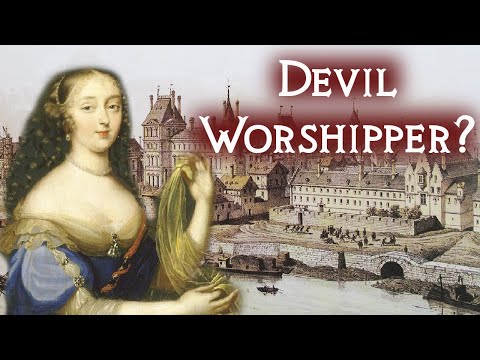
At court, Françoise caught the eye of Louis XIV, the Sun King himself. Their affair began in the winter of 1666, and by July 1667, she had replaced his official mistress, Louise de La Vallière. But La Vallière had been naive; Françoise was not. She knew that to keep a king’s heart, one needed more than just beauty.
Rumors began to swirl that Madame de Montespan had sought the help of a notorious sorceress, Catherine Monvoisin, known as La Voisin. It was said that she purchased aphrodisiacs, participated in black masses, and even offered her own body as an altar for the devil. One account describes a ritual where Françoise lay naked on black velvet while a priest invoked demons, and a child’s blood was collected in a chalice. These blasphemous acts, if true, were her desperate attempts to secure the king’s love and eliminate her rivals.
Meanwhile, her husband, Louis-Henri de Pardaillan de Gondrin, remained oblivious until 1668, when he learned of her pregnancy by the king. His rage was explosive—he had his carriage painted black and declared he was mourning his wife’s disappearance. Louis XIV promptly exiled him, and the couple eventually separated in 1674.
As the king’s mistress, Françoise bore him seven children, three of whom were legitimized in 1673. She was at the height of her power, called by some the “true queen of France.” Yet the Church frowned upon her adulterous union. In 1675, a priest refused her absolution, declaring, “Is this madame that scandalizes all France? Go abandon your shocking life and then come throw yourself at the feet of the ministers of Jesus Christ.”
But the real storm was yet to come. In 1677, the Affair of the Poisons erupted, and La Voisin, under interrogation, named Madame de Montespan as a client. She claimed that Françoise had bought aphrodisiacs and participated in black masses to win and keep the king’s favor. The accusations sent shockwaves through the court. Some even whispered that she had plotted to poison the king himself when he showed interest in another woman, the Duchess of Fontanges.
Louis XIV, shocked and desperate to protect the mother of his children, ordered the testimony against her suppressed. Her accusers were secretly imprisoned for life, and Françoise was never interrogated. Yet the damage to her reputation was done.
She turned to charity, founding hospitals and schools, but in 1691, she retired from court to a convent, living a life of penance. She died in 1707, her last word a whispered “Pardon.”
But was she truly guilty of the dark deeds she was accused of? Or was she the victim of a scandal that sought to bring down a powerful woman? The truth may lie buried in the shadows of Versailles, waiting to be uncovered.
The scandal did not fade quietly into the archives. Even as Louis XIV ordered the testimony suppressed, the whispers refused to die. Courtiers who had once bowed to Françoise now crossed themselves when she passed, and mothers pulled their daughters closer as though the very air around her carried a contagion.
No longer the radiant center of the court, she became a figure of suspicion—watched, avoided, and feared. The king still visited her chambers, but the visits grew rarer, and the warmth between them cooled into something formal and guarded. She had won his heart through means no one could prove, and now that same heart was slipping away, and no ritual or potion could call it back.
It was in these diminished years that her children became her only comfort. The three legitimized offspring of the king—Louis-Auguste, Louis-César, and Françoise-Amélie—bore the surname de Bourbon and the weight of their mother’s tarnished name. They moved through Versailles with the awkward grace of children caught between two worlds, royal in blood but scandalous in origin.
Françoise watched them from a distance, as was the custom, their daily lives entrusted to governesses and tutors. Yet she wrote to them constantly, letters filled with a fierce, almost desperate tenderness, as though she feared they too might be taken from her by the same forces that had eroded her position.
Then, in 1681, a new shadow fell across her already darkened reputation. The Duchess of Fontanges, the young beauty who had captured the king’s wandering eye, died suddenly at the age of twenty. The cause was officially declared a lung ailment, but the court, ever hungry for conspiracy, murmured otherwise.
Had Madame de Montespan finally done what the rumors had long accused her of? Had she poisoned her rival to reclaim the king’s love? The accusation was never proven, and the physicians insisted the death was natural. But Françoise’s enemies needed no proof—only a whisper, and the whisper spread like fire through dry grass.
She withdrew further from the court’s gaze, spending longer hours in prayer and charitable work. The woman who had once commanded the attention of all France now sought the anonymity of hospital wards and orphanages, her hands busy with linen bandages and her mind fixed on the next world rather than this one.
In 1691, she made the decision final. She left Versailles for the convent of Saint-Joseph in Paris, exchanging silk gowns for the coarse habit of a penitent. The king granted her a generous pension, and she used it not for herself but to fund the institutions she had founded—a hospital for the poor, a school for orphaned girls, a refuge for the destitute.
Yet even in the convent, the past followed her. Visitors came seeking stories of the old days, and she turned them away. She wanted no chroniclers, no memoirs, no legacy built on the ashes of her former life. When a young nun once asked her about the black masses, Françoise is said to have replied only, “The devil takes many forms, my child, but the worst of them is the one we wear ourselves.”
Her penance was severe. She fasted, wore hair shirts, and rose before dawn for prayers. Some of the sisters whispered that she was trying to atone for something far darker than mere adultery—that the specter of La Voisin still haunted her, and that the child’s blood spilled on that black altar so many years ago would not be washed away by any amount of holy water.
But whether her guilt was real or imagined, one truth remained: the woman who had once been the most powerful in France now knelt in the cold stone chapel, her rosary beads clicking in the silence, praying for a mercy she was not certain she deserved.
Her husband, Louis-Henri, had spent years in exile, a broken and bitter man. Yet as death approached, something in him softened. He wrote to Françoise, confessing a love he had never truly abandoned, and named her executor of his estate. Whether it was forgiveness or a final cruel joke, she never said. She simply accepted, as she had accepted everything else.
By the early 1700s, Françoise was aging, her beauty faded, her breath growing short. The heart that had once beat for a king now struggled to beat at all. She passed in and out of consciousness, and in those lucid moments, she asked forgiveness of everyone she had wronged—her husband, the Church, the children she had barely raised, and perhaps, in the silence of her own mind, the rivals she had destroyed.
Her last word was “Pardon.” It was not a plea for herself, but a final offering to a world that had judged her harshly.
The Affair of the Poisons never fully released its grip on the French court. Even after La Voisin was burned at the stake in 1680, her ashes scattered to the wind, the names she had spoken lingered like a stain. The Chambre Ardente, the special court convened to investigate the poisonings, had been dissolved by the king’s order, but its records—those that survived—remained sealed in the Bastille, a dark archive of aristocratic sin.
For decades afterward, courtiers spoke of Madame de Montespan in hushed tones. Some insisted she was innocent, a victim of La Voisin’s lies and the court’s insatiable appetite for scandal. Others swore she had done everything the sorceress claimed and more, that the black masses had been real, and that the devil had indeed answered her prayers—for a price.
One thing was certain: no one who had witnessed her rise and fall ever forgot her. She had been the sun around which the court orbited, and when she fell, she left a void that no other mistress could fill. The Duchess of Fontanges was dead, La Vallière was cloistered, and the king, aging and pious, had turned to Madame de Maintenon, a woman of virtue and restraint—everything Françoise had once pretended to be.
Yet in the convent of Saint-Joseph, the sisters remembered her differently. They spoke of her kindness to the poor, her generosity to the orphaned, her humility in prayer. They did not know the woman of the black masses, the poisoner, the sorceress. They knew only the penitent, the woman who had washed the feet of beggars and kissed the hands of the sick.
Which was the true Françoise? Perhaps both. Perhaps neither. The human heart, after all, is a labyrinth of light and shadow, and the line between sinner and saint is thinner than any of us dare admit.
As the years passed, the convent of Saint-Joseph became her entire world. The woman who had once danced in the gilded halls of Versailles now knelt on cold stone, her knees aching, her voice a whisper among many. She had traded the king’s bed for a nun’s cell, and in that exchange, she found a strange, unsettling peace.
But peace did not mean forgetfulness. In the quiet hours before dawn, when the other sisters slept, Françoise would sometimes wake with a start, the echo of a child’s cry ringing in her ears. She never spoke of it, but the sisters noticed how she would clutch her rosary tighter on those mornings, her lips moving in silent, desperate prayer.
One winter evening, a young novice summoned the courage to ask her directly: “Madame, is it true what they say? Did you truly call upon the devil?” Françoise looked at the girl for a long moment, then smiled—a sad, weary smile. “Child, I called upon many things in my youth. Power. Love. Revenge. Whether the devil answered or my own heart did, I can no longer tell.”
She died on the 27th of May, 1707, at the age of sixty-six. The sisters gathered around her bed, and as her breath grew shallow, she whispered her final word: “Pardon.” Not to God, not to the king, but to the world she had scandalized and the children she had barely known.
They buried her in the convent cemetery, a simple stone marking her grave. No crowds came, no courtiers wept. But the poor of Paris remembered. They came in silence, laying wildflowers on the earth, and whispered that the woman who had once been called the true queen of France had finally found her kingdom—among the forgotten.
So what do you think, dear reader? Was Madame de Montespan a sorceress who sold her soul for a king’s love, or a desperate woman trapped in a world that demanded everything and forgave nothing? Let us know in the comments below.






