The loudspeakers blared cheerful dance tunes across the camp, a grotesque soundtrack designed to drown out the gunfire and the screams. It was November 3, 1943, and the SS had launched Aktion Erntefest—Operation Harvest Festival—the single largest massacre of the Holocaust. In just 48 hours, they would murder 42,000 Jews in three camps: Majdanek, Poniatowa, and Trawniki. The victims were marched to pre-dug trenches, told they were anti-tank ditches, and shot in layers. The killers wanted no witnesses. They almost succeeded.
But almost is not the same as no one.
At Majdanek, a handful of men were spared from the slaughter—not out of mercy, but because the SS needed bodies sorted and graves managed. Among them were Josef Resnick and Josef Sterdynak. They stood at the lip of the pit, saw the trenches packed with their own people, some still moving, some calling out under the weight. For days they lived inside the killing field, walking among tens of thousands of corpses, knowing that when the work was done, the same bullet awaited them.
They understood the arithmetic. To stay was to die on a schedule.
So they ran. Under cover of darkness, they slipped past the guards and escaped, carrying in their heads the only first-hand account of what Operation Harvest Festival looked like from the edge of the ditch. Their testimony would later ensure that the largest shooting massacre of the Holocaust was not erased from history.
That was just one story. Across Eastern Europe, in forests and ghettos and forgotten camps, a handful of people did the impossible: they climbed out of mass graves and lived. A teenage boy who told a widow he was Jesus Christ. A woman who lay buried under a mountain of shoes. A mother who was shot in the head and crawled out from under her own dead family. A brigade of prisoners who scratched a tunnel out of a pit of ash with stolen spoons.
These are the stories the SS tried to bury. But the dead had no voice but theirs—and they spoke.
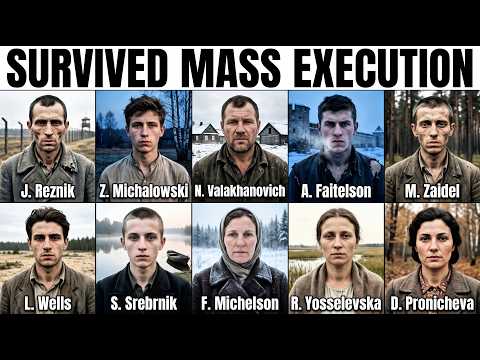
What follows is the account of ten such survivors, each of whom walked out of a place built only for death. Their names, their faces, and their words are the reason we know what happened in those pits. And their stories begin, as so many do, with a single moment of impossible luck—or perhaps, of stubborn will.
The first name on that list is Zvi Michalowski, a teenage boy from Eisiskes, a town that had been home to Jews for nearly 900 years. In September 1941, the Germans and their Lithuanian auxiliaries rounded up the community’s 4,000 Jews, herded them into synagogues, and then marched them to the old Jewish cemetery. The men were shot first, in batches of 250. Zvi stood at the edge of the pit with an older man beside him. As the machine guns opened fire, the man put an arm around Zvi’s neck and pulled him down. A bullet grazed Zvi’s neck, leaving a scar he would carry for life, but it did not kill him. The man fell on top of him, dead, and his blood ran over the boy. Zvi lay still under the bodies while the killers walked the edge, finishing off anyone who moved.
When the shooting stopped and the gunmen went off to celebrate, Zvi climbed out of the grave. Naked, covered in blood, half-frozen, he went to the houses near the cemetery and begged to be let in. One after another, his neighbors turned him away. One peasant lifted a lamp, looked at the bloodied figure on his step, and shouted at him to go back to the grave where he belonged. Finally, an old widow at the edge of the forest took pity on him—or perhaps she was terrified into it. According to the account recorded by the historian Yaffa Eliach, Zvi told the woman he was Jesus Christ come down from the cross, and the blood and wounds were proof. She fell at his feet and let him in. He warmed himself, took bread and clothing, and slipped away before dawn.
Zvi reached the partisans in the forest and survived the war. He spent the rest of his life as living evidence that the community of Eisiskes had existed and been destroyed. Yaffa Eliach, who herself survived the war in hiding as a small child, later gathered more than a thousand photographs of the town’s people and built them into the Tower of Faces at the United States Holocaust Memorial Museum—three stories of faces kept alive by the handful who got out of the pits.
Further east, in Belarus, there was a place called Maly Trostenets, a former collective farm on the edge of Minsk that became the largest killing site on all of occupied Soviet territory. The Germans turned it into a labor camp and used the nearby Blagovshchina forest for mass shootings and mass burning. Trains arrived through 1942 and 1943 carrying Jews from Minsk, Vienna, Berlin, and Prague. Most never spent a night in a barracks. They were taken from the trains, robbed, driven to the pits, and shot. Many were killed in gas vans—sealed trucks rigged so the engine exhaust poured into the rear compartment. The locals called them soul killers.
How many died there is still argued over. Yad Vashem says 65,000. The historian Stefan Lehnstaedt argues at least 106,000. The official memorial carries the figure 206,500. The honest answer is that well over 100,000 were murdered, and the exact total may never be known because the Germans worked hard to make sure it could not be counted. As the Red Army drew near in the summer of 1944, special details were ordered to open the graves and burn the bodies. In the last days of June 1944, the Germans murdered the remaining prisoners—locking people into a barn and setting it alight. Roughly 6,500 died in that final spasm just days before liberation.
From the camp itself, almost no one survived. A few skilled laborers were kept alive to sort the clothing of the dead and clean out the gas vans. One of them, a young Red Army soldier named Shvalyev who had been captured and brought to the camp, was forced for months to mend the clothes of murdered Jews and clean the soul-killer trucks. In the autumn of 1943, he slipped away, met the woman who would become his wife in a nearby village, and joined the partisans. He lived, and after the war he became one of the very few people able to describe what the farm at Maly Trostenets had really been.
From the final massacre in that burning barn, the record preserves only two names of people who came out alive: Stepanida Savitskaya and Nikolai Valakhanovich. Two people out of the thousands killed in those last three days. They gave testimony afterward about the horror they had lived through.
And there is one more story from the orbit of Maly Trostenets that shows just how far human beings will go to live. On October 21, 1943, when the last Jews of the Minsk ghetto were rounded up to be killed, 26 people hid themselves in an underground bunker that two Jewish stonemasons had cut beneath the ground. They lived down there in the dark for months. In the first month, three died, and the others buried the bodies in the floor and went on lying on top of that earth. Two girls who crept out for food were caught and killed. After eight months, only 13 of the original 26 were still alive—children slipping in and out of unconsciousness from hunger, adults too weak to move. The Germans had counted them all as dead long before. But they were not dead, and some of them came out at the end.
The survivors connected to Maly Trostenets—the man who cleaned the gas vans, the two who lived through the final barn massacre, the people who lay for months on the graves of their own friends in a buried room—are almost the only reason we can say anything at all about a place the SS tried to wipe from the map entirely.
The largest killing site in the occupied Soviet Union nearly succeeded in becoming a perfect secret. A few witnesses made sure it did not.
Further north, outside the Lithuanian city of Kaunas, stood an old stone fortress built by the Russian Empire before the First World War. By 1941, the Ninth Fort had a new purpose. The Germans and their Lithuanian collaborators used it as a killing ground, and over the course of the occupation between 45,000 and 50,000 people were shot there—Jews from Kaunas, Jews transported from France and Germany and Austria. The people who knew what happened inside called it the fort of death.
In late 1943, as the front retreated, the Germans set out to destroy the proof. They assembled a group of prisoners at the fort—Jews from the Kovno ghetto mixed with Jewish prisoners of war from the Red Army—to open the graves and burn the bodies. Their legs were locked together in chains. Machine-gun towers covered them. There was one guard for nearly every prisoner. Two of the older or sick men had already been shot to thin the group down. Sixty-four were left to finish the job, and they understood exactly what their reward would be.
So they decided to break out.
At first they tried to cut a tunnel through the floor of their cell, hiding the loosened earth in their pockets and scattering it during the day. That plan failed. They did not give up. They turned their attention to the heavy iron door of their cell. Over many nights, one of the prisoners, a man named Krakinowski, worked at that door, boring 314 small holes through the metal, then cutting the bridges between the holes with a hand file until a section could be lifted away. They picked the locks beyond it and shaped keys to get through the inner gates of the fort. They worked in the dark, in chains, with the constant risk that a single careless sound would end everything.
They chose Christmas Eve, the night of December 24 into the 25th, 1943, because they knew the guards would be drinking and the watch would be loose. That night, through the opening they had made in the iron door and the gates beyond, all 64 men got out of the fort of death and scattered into the snow.
The escape was both a triumph and a tragedy. Sixty-four went out. Some headed toward the city, some toward the forests, some toward the homes of relatives. The German search was relentless, and most were caught and shot. In the end, only 11 of the 64 lived to the end of the war.
But those 11 carried something out with them that the SS would have given anything to destroy. On the very night of the escape, in a hiding place in the ghetto, the men who reached it sat down and wrote out a signed protocol—a sworn statement listing what they had been forced to do at the Ninth Fort. They recorded the number of graves they had opened, the dimensions of those graves, the fact that they had burned around 12,000 bodies, that roughly 7,000 of those were Jews from Kovno, and that the position of the bodies showed many people had been buried while still alive, only wounded. It was signed by men named Vassilenko, Diskant, Feitelson, Gelbtrunk, Krakinowski, Deitz, and others.
The escape was led by a 20-year-old named Alex Feitelson. The men who lived joined the partisans and went on fighting. For the rest of their lives, they marked the 25th of December as a second birthday. They had been condemned to vanish along with the evidence of 50,000 murders. Instead, they smashed a hole through an iron door, walked out of the deepest pit of the war, and made certain that the fort of death would have to answer for what it was.
The next name on the list belongs to a forest just outside Vilnius—a city so rich in Jewish life it had been known for centuries as the Jerusalem of the North. At Ponar, called Paneriai in Lithuanian, around 100,000 people were shot in pits between 1941 and 1944, about 70,000 of them Jews. The pits had not started as graves. The Soviets had cut them to store fuel for a planned airfield. When the Germans came, they found the holes already there, ready-made, and turned them into a place of mass execution that swallowed almost the entire Jewish population of the city.
By the end of 1943, the Germans were closing the books. A unit of about 80 prisoners brought up from the Stutthof concentration camp—known to history as the burning brigade—was put to the most terrible work imaginable. Their legs were shackled. They lived in a wood-walled bunker they had built inside one of the very pits where the killings had happened. By day, they pulled the dead out of the mass graves with bent iron hooks, stacked them on huge pyres of timber, and burned them. Then they crushed and sifted the remains to leave no bone behind. The commandant told them plainly that around 90,000 people lay in those graves, and that there must not be a single trace left when the work was done.
The men knew that the day the last body burned would be the day they followed it into the fire.
The cruelty broke some of them. One prisoner, Isaac Dogim, was laying corpses on a pyre when he recognized the decomposed bodies of his own wife, his three sisters, and three nieces—he knew his wife by a medallion he had given her on their wedding day. That moment turned grief into resolve. Dogim became one of the leaders of an escape.
The plan was to tunnel out of their own pit. A prisoner named Yuri Farber, an engineer before the war, worked out the design. Over roughly 76 days, the burning brigade scraped a passage through the sandy earth using stolen spoons, scraps of metal, and their bare fingers—burning bodies all day under the guns, scratching the tunnel forward at night. It ran some 30 to 35 meters from the floor of the pit toward the forest.
On the night of April 15, 1944, the last night of Passover, they filed off as many chains as they could and went out one by one. Guards opened fire; most were cut down before the trees. But about a dozen got clear, and 11 lived through the war—among them Motke Zeidel, the youngest, who later appeared in Claude Lanzmann’s Shoah. In 2016, archaeologists using ground-scanning technology found the exact path of the tunnel the brigade had scratched from the earth with spoons.
They had left behind a witness that even the earth itself eventually confirmed.
Ten graves. Ten times the SS believed no one was left alive to tell the story. They were wrong every time—and every one of them carried the same impossible weight: the knowledge that the dead they left behind had no voice but theirs. So they spoke. They testified, wrote memoirs, sat for interviews until they were old, and made certain the killers’ great secret stayed in the daylight where it belongs.
These people refused to be erased. The least we can do is keep saying their names.
Which of these ten survivors stayed with you the most—and where in the world are you watching from? Tell us in the comments below.






