At 7:00 AM on September 19, 1944, the dense fog over Lorraine was so thick that American tank crews could barely see the ends of their gun barrels. Somewhere in that white wall, the guttural roar of German Panther engines grew louder—brand-new tanks, superior in armor and firepower, advancing with crews confident they would crush the defenders.
What happened next would shatter the myth of German invincibility and prove that the best crew, not the best tank, wins the battle.
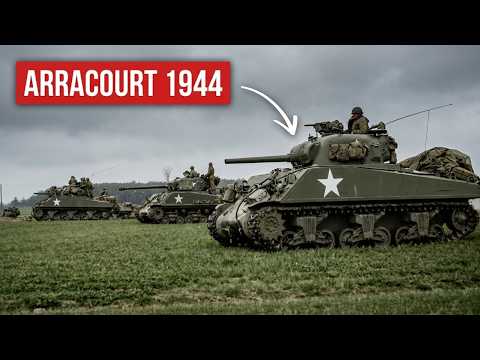
The M4 Sherman was never designed to duel Panthers. It was built for mass production and reliability—nearly 50,000 rolled off American assembly lines, each carrying a five-man crew and a 75mm gun that could not penetrate the Panther’s frontal armor at any range.
American tankers knew the grim statistics. They had seen Shermans burn in Normandy. Some joked bitterly about needing five Shermans to kill one Panther. That ratio was a myth, but the fear was real.
Yet the Fourth Armored Division was no ordinary unit. Activated in 1941, its men had trained together for over three years—an eternity in a war where many units entered combat after mere months.
Their commander, Major General John Wood, was called “the Rommel of the American armored forces.” Under him served Lieutenant Colonel Creighton Abrams, already a legend in Patton’s Third Army. Patton himself had declared Abrams his peer as a tank commander, calling him “the world champion.”
Abrams led from the front in his tank Thunderbolt, with gunner Corporal John Gatuski—a partnership that exemplified the crew cohesion that would prove decisive.
But by September 1944, Patton’s spectacular advance had ground to a halt. The Third Army had run out of fuel. Eisenhower had prioritized Montgomery’s advance, leaving Patton with as little as 25,000 gallons a day—one-eighteenth of what he needed.
Hitler saw his chance. He ordered the Fifth Panzer Army to strike Patton’s exposed spearhead near Arracourt.
The German plan looked impressive on paper: two new Panzer Brigades, each with 36 brand-new Panthers and 36 Panzer IVs. But these magnificent machines were crewed by men who had trained together for only two weeks. Junior officers were infantrymen reassigned to armor. Many could not even read maps.
As one German general later wrote, their training was “just as incomplete as their equipment.”
On the American side, Combat Command A stood dangerously exposed around the village of Arracourt—a thin salient far ahead of friendly lines. On the evening of September 18th, Lieutenant Wilbur Berard heard German tank engines in the distance. He positioned his three Shermans, laid anti-tank mines, and waited through the long dark hours.
Dawn brought fog—so thick that visibility dropped below 75 meters. The Panther’s greatest advantage—its ability to kill at 2,000 meters—evaporated.
At 7:00 AM, the 113th Panzer Brigade advanced into the mist. Two concealed Shermans opened fire at point-blank range. Two Panthers exploded instantly, their turrets blown apart. Sergeant Dunn engaged a third at 600 meters; three rounds later, it was burning.
Then came one of the most remarkable engagements of the war. Captain Kenneth Lamersin raced four Shermans along a ridge, arriving just three minutes before the German column passed below. From that perfect flanking position, they destroyed five Panthers before a single German tank could return fire. Lamersin then dismounted on foot to locate a concealed anti-tank gun, directing fire until it was destroyed.
His four Shermans had destroyed eight Panthers without losing a single tank.
By noon, the German offensive was in shambles. When Colonel Clark’s command post came under direct threat, Captain Jimmy Leach arrived with Company B. Clark pointed at the advancing Panthers and ordered him to eliminate them immediately. Leach’s flanking attack destroyed all nine.
By day’s end, the 113th Panzer Brigade had lost 43 tanks. American losses were five Shermans.
The kill ratio was five to one—but in reverse of what German propaganda claimed.
The following days saw more desperate fighting. Artillerymen fired 155mm howitzers at direct range, destroying two Panthers. Major Charles Carpenter, flying a tiny Piper Cub with bazookas strapped to the wings, dove through ground fire to destroy four tanks in a single afternoon.
When the skies cleared, P-47 Thunderbolts hunted German armor mercilessly. The Germans now faced a lose-lose dilemma: fog negated their long-range guns, and clear skies brought American air power.
On September 29th, the Germans made one final push. They gained the crest of Hill 318—then the fog lifted. American tanks and artillery caught the exposed Panthers in the open. Twenty-three German tanks were destroyed that afternoon.
The Fifth Panzer Army, reduced to 25 operational tanks, withdrew. The Battle of Arracourt was over.
The final tallies told a story that stunned military analysts on both sides. Of the 262 tanks and assault guns committed by the German Fifth Panzer Army, 86 were destroyed outright and another 114 damaged or broken down. Only 62 remained operational—a loss rate exceeding 76 percent.
Combat Command A lost 25 tanks and seven tank destroyers over eleven days. The 37th Tank Battalion under Abrams claimed 55 enemy tanks destroyed while losing just 14 Shermans.
But the numbers alone could not explain what had happened in the fog. Something deeper had been revealed.
On September 23rd, Oberst von Secondorff, commander of the shattered 113th Panzer Brigade, was killed near the village of Lagarde. His brigade effectively ceased to exist. The 111th was reduced to seven tanks and eighty men. Both formations were later disbanded entirely.
When American troops came upon nine Panthers lodged in a draw, they found the crews dismounted and eating supper—caught completely by surprise. These were not the habits of veteran armored soldiers, but of green crews who did not understand the fluid nature of tank warfare.
General Walter Krueger of the 58th Panzer Corps would later write bitterly that his brigades had been “barrel scrapings whose combat value was slight.” Hitler had gambled that factory-fresh Panthers could compensate for every other deficiency. The gamble had failed catastrophically.
Among the Americans, one story stood apart. Four days before the main battle, Sergeant Joseph Sadowski of Company A, 37th Tank Battalion, had earned the Medal of Honor at the village of Valhey.
When an 88mm round struck his Sherman at twenty yards, the tank burst into flames. Sadowski ordered his crew out—then discovered his bow gunner trapped inside, the hatch jammed shut.
He climbed onto the smoking hull and tried to pry the hatch open with his bare hands. German machine-gun fire raked the tank. He was hit once, then again, then again. He kept pulling until he could no longer stand, then slid from the tank and died in the mud beside its tracks.
His sacrifice inspired the remaining crews of his platoon to press forward and destroy the position that had killed him. Today a monument stands in Valhey honoring his refusal to abandon a trapped crewman at the cost of his own life.
Abrams himself emerged from Arracourt with an enhanced reputation. He had exposed himself repeatedly to rally his men, and Thunderbolt’s gunner, Corporal John Gatuski, was credited with more destroyed enemy vehicles than any gunner in the battalion.
Abrams would earn a second Distinguished Service Cross at Bastogne that December. After the war he rose to four-star general, commanded American forces in Vietnam, and served as Army Chief of Staff. The Army would name its next-generation main battle tank after him—the M1 Abrams.
The strategic consequences reached far beyond Lorraine. Half of all Panther production in August 1944 had gone to forming those two brigades. Now they were burned-out hulks in the fields of France, their crews dead or captured.
Heinz Guderian, Inspector General of Armored Troops, had argued those Panthers should reinforce existing Panzer divisions whose experienced crews could actually employ them. Hitler had overruled him. Arracourt proved Guderian right and Hitler catastrophically wrong.
The veteran 11th Panzer Division, committed late in the battle, performed far better than the new brigades despite having fewer tanks—precisely because its crews knew how to fight together.
As Oberst Friedrich von Mellenthin of Army Group G later admitted, the German attacks “appeared at the time to have achieved their purpose, but in fact Patton had been compelled to halt by Eisenhower’s order.” The pause had nothing to do with German success.
Military historian Steven Zaloga, who wrote the definitive account of the battle, concluded that the outcome was decided far more by crew quality and training than by the technical merits of either tank. He noted a broader pattern: in almost every case in World War II, the attacker lost more tanks than the defender. When the Germans attacked at Arracourt, the numbers reversed catastrophically.
The lessons have been taught at American military schools ever since. At Fort Moore and the Command and General Staff College, officers study how Abrams and Clark coordinated their forces, how company commanders like Lamersin and Leach exercised initiative at the critical moment, and how tanks, tank destroyers, artillery, infantry, and air power became a force greater than the sum of its parts.
Today a Sherman tank and a monument to General Wood stand in the village of Arracourt, silent sentinels over farmland that has returned to peaceful cultivation. The fog that once concealed advancing Panthers now merely delays the morning harvest.
The men who fought there were ordinary Americans—factory workers, farmers, clerks—who had been drafted or volunteered to serve their country. They faced an enemy equipped with machines that outclassed their own in armor and firepower, and they had been told by enemy propaganda and by grim statistics alike that their tanks were deathtraps.
They proved all of it wrong.
In the end, Arracourt was more than a victory. It was a repudiation—of the idea that technological superiority determines battlefield outcomes, of Hitler’s gamble that elite equipment could substitute for trained formations, and of the persistent myth that the Sherman was fundamentally inadequate against German armor.
The men of the Fourth Armored Division deserve to be remembered not as operators of inferior equipment who somehow got lucky, but as consummate professionals who applied their training and skill to defeat a formidable enemy. They turned supposed death traps into panzer killers.
That is the legacy of Arracourt. That is what those Shermans and Hellcats and Thunderbolts achieved in the fog and mud of Lorraine in September 1944. They did not just win a battle—they demonstrated a truth about warfare that remains valid to this day.
The best crew, not the best tank, wins the fight.
So the next time you hear someone claim that technology alone decides wars, remember the fog-shrouded fields of Lorraine—and ask yourself: what other “invincible” myths are we still believing today?






