In the high-stakes world of fifth-generation fighter jets, three names dominate: the F-22 Raptor, the J-20 Mighty Dragon, and the Su-57 Felon. Each represents the pinnacle of air superiority for the United States, China, and Russia. But there is a fourth design—one that was meant to join their ranks, yet has been largely forgotten. This is the story of the Shenyang J-31, a stealth fighter that emerged from the shadows of China’s secretive military-industrial complex, only to vanish into obscurity. Or did it?
Born in the early 2000s, the J-31 was China’s ambitious bid to create a true air-superiority fighter. But as with most Chinese military projects, details were cloaked in secrecy. What we do know is that by 2008, the J-31 had already lost the race to the J-20. Yet, in a twist of fate, it would be reborn as a private venture, a potential export rival to the F-35, and possibly even a carrier-based stealth fighter. Its journey is a testament to China’s relentless pursuit of aerospace dominance—and a warning to the West.
The story begins in the 1990s, when China launched its own fifth-generation fighter program. In 2002, the People’s Liberation Army Air Force (PLAAF) officially announced a competition for a next-generation fighter, known in the West as the J-XX program. Three major companies were expected to compete: Chengdu Aircraft Corporation, Shenyang Aircraft Corporation, and Xi’an Aircraft Company. Chengdu had already proven itself with the JF-17, while Shenyang was the veteran producer of Chinese bombers like the H-6 and JH-7. But it was Chengdu that would ultimately win the bid in 2008, leading to the J-20.
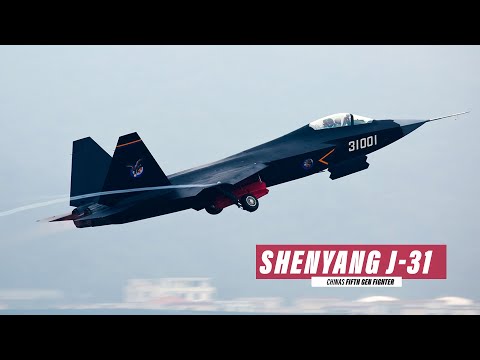
Shenyang, however, did not give up. The company had proposed a larger fifth-generation design, but it was rejected. Undeterred, Shenyang turned to self-funding to develop an export-oriented stealth fighter. By 2011, reports surfaced of a prototype, unofficially dubbed the F-60. In 2012, a scale model was unveiled, and the aircraft was officially designated the J-31 (or FC-31 for export). It looked like a hybrid of the F-35 and F-22, and in October 2012, it made its first flight—away from public eyes.
The J-31 was publicly revealed in 2014, and Shenyang insisted it was a private venture, free from military interference. But the initial reception was mixed. Critics pointed out apparent shortcomings, especially in its engines. Early flights in 2014 showed a aircraft still in its infancy, with engines that appeared inefficient, leaving trails of unburned fuel. Some speculated it used Russian RD-93 engines, though it was more likely powered by domestic WS-13 turbofans. The aircraft seemed to rely heavily on afterburners, suggesting aerodynamic inefficiencies. But these tests were a decade ago, and China’s engine technology has since matured.
Despite the skepticism, Shenyang pressed on. In 2015, a modified version flew at the Dubai Airshow, signaling export ambitions. Over the years, reports about the program’s status fluctuated. Some claimed it was dead; others insisted it was still being marketed to potential buyers as an F-35 competitor. Then, in 2018, Chinese state media revealed that both the Navy and Air Force were seeking a newer version. By 2020, rumors emerged of a third iteration—the J-35—with a redesigned airframe, improved avionics, new engines, and reduced radar cross-section. This version reportedly received government funding, marking a shift from private venture to state-backed project.
In 2021, the J-31 appeared again, this time in a naval camouflage, suggesting a carrier-capable variant. It was speculated to be a modified version of the second iteration, designed for China’s Type 003 aircraft carrier with electromagnetic catapults. So, what can this aircraft do? As with all fifth-generation designs, specifications are deliberately vague. But some assumptions can be made.
Stealth is paramount. Unlike the J-20, the J-31 reportedly relies on radar-absorbent coatings rather than specialized materials. With redesigned engine nozzles and new WS-19 engines, officials claim low radar signature in Ku and L bands. But only real-world testing will confirm this. In terms of armament, the J-31 boasts a payload of 18,000 pounds, with 4,400 pounds internal—comparable to the F-35. Its maximum speed is Mach 1.8, slightly faster than the F-35, and it has a service ceiling of 50,000 feet. The key difference is range: the J-31 is said to have a combat radius of 1,200 kilometers, while the F-35 claims over 2,000 kilometers. In the vast expanses of the Pacific, range is a strategic advantage.
Originally designed as an air-superiority fighter, the J-31 has evolved into a multi-role platform. Its specifications now align closely with the F-35, and given China’s rapid technological advancement, it could soon rival Western and Russian fighters. With the backing of the world’s second-largest economy, the J-31 benefits from China’s booming aviation industry.
The future will reveal how capable the J-31 truly is. But one thing is certain: this forgotten fighter is not ready to fade away just yet.
To understand the J-31’s true potential, one must look beyond the aircraft itself and into the industrial machine that built it. Shenyang Aircraft Corporation is no newcomer to the game. Founded during the Korean War, it has spent decades producing and improving on foreign designs, particularly those of Russian origin. Its history of reverse-engineering and upgrading Sukhoi fighters—from the J-11 to the J-16—demonstrates a pattern of rapid capability absorption. If any Chinese company could turn a flawed prototype into a world-class fighter, it is Shenyang.
Consider the J-11B saga. In 1996, China acquired licenses to manufacture 200 Su-27UBK fighters. The first batches assembled in China were reportedly poor in quality, requiring Russian assistance to rebuild them. But by 2003, Shenyang had not only matched Russian standards but begun incorporating domestic components. By 2011, the J-11B was reportedly 90% indigenous. This trajectory—from clumsy copier to confident innovator—is the lens through which the J-31 must be viewed.
Then there is the question of stolen technology. In 2009, hackers breached the Joint Strike Fighter database, exfiltrating terabytes of data on the F-35. Whether or not the J-31 directly incorporates F-35 secrets, the timing is impossible to ignore. The aircraft’s resemblance to the F-35 is more than skin-deep; its internal weapons bay, sensor placement, and overall configuration suggest a deep familiarity with American design philosophy. This is not to say the J-31 is a clone—it is not—but it is clearly informed by Western ideas.
What makes the J-31 particularly intriguing is its dual identity. On one hand, it is a state-funded project for the PLA Navy, destined for the deck of the Type 003 carrier. On the other, it remains a candidate for export, marketed as a cheaper alternative to the F-35. This dual-track approach is unusual. Most nations either build for themselves or for export, not both. China seems to be hedging its bets, using domestic orders to sustain production while courting foreign buyers to offset costs.
The carrier variant is especially significant. The Type 003, China’s third aircraft carrier, will use electromagnetic catapults—a technology pioneered by the US Navy’s Ford-class. Operating a stealth fighter from a carrier is a complex engineering challenge, requiring reinforced landing gear, folding wings, and corrosion-resistant coatings. If the J-31 has truly mastered these requirements, China will have joined an exclusive club currently occupied only by the United States.
But questions remain. The J-31’s range—1,200 kilometers—is modest compared to the F-35’s 2,000-plus. In a Pacific conflict, where distances are vast and refueling assets are vulnerable, this shortfall could be decisive. China’s response has been to build island bases and develop aerial refueling tankers like the Y-20U. But these are stopgaps, not solutions. A fighter that must turn back early is a fighter that cannot dominate.
Engine technology is another unknown. The WS-19 turbofan, reportedly fitted to the latest J-35 variant, is said to provide thrust comparable to the F-35’s F135. But thrust is only part of the equation. Reliability, fuel efficiency, and maintenance requirements matter just as much. China has historically struggled with high-performance jet engines, relying on Russian imports for its most critical platforms. The WS-19 represents a critical test: can China finally build a world-class fighter engine without foreign help?
Avionics are another area where the J-31 likely excels. China has made enormous strides in radar, electronic warfare, and data links. The J-20 already features a sophisticated sensor suite, and the J-31 is expected to inherit similar capabilities. Its nose-mounted AESA radar, distributed aperture system, and helmet-mounted display suggest a level of situational awareness approaching that of Western fighters. In a networked battlefield, information dominance may matter more than raw speed or stealth.
Yet for all its promise, the J-31 remains a mystery. No confirmed combat exercises, no verified performance data, no independent assessments. Everything we know comes from leaks, state media, and educated guesswork. This opacity is deliberate. China wants the world to know the J-31 exists, but not what it can do. The psychological effect—forcing adversaries to plan for an unknown threat—may be as valuable as any physical capability.
As the 2020s progress, the J-31’s future will depend on decisions made in Beijing. Will it enter mass production for the PLA Navy? Will it find export customers among nations unable to buy the F-35? Will it evolve into a family of variants, including electronic warfare and reconnaissance platforms? The answers will shape not only China’s military aviation but the balance of power in the Indo-Pacific.
One thing is clear: the era of dismissing Chinese fighters as inferior copies is over. The J-31, whatever its flaws, represents a serious attempt to build a world-class stealth fighter. Its journey from rejected proposal to carrier-borne contender is a story of ambition, adaptation, and relentless improvement. The forgotten fighter may yet have the last laugh.
The J-31’s path from rejected proposal to carrier-borne contender mirrors China’s broader aviation journey—from copying to competing. What was once dismissed as a flawed F-35 clone now threatens to redefine naval air power in the Indo-Pacific.
As the Type 003 carrier nears completion, the J-31’s fate will be decided not in press releases but on the deck. If it succeeds, China joins the US in operating stealth fighters from carriers—a capability no other nation possesses. If it fails, the program may quietly fade, another footnote in aviation history.
Yet the J-31’s legacy is already secure. It proved Shenyang could self-fund a stealth fighter, absorb foreign technology, and iterate toward a credible product. Whether or not it enters service, the knowledge gained will feed into China’s sixth-generation efforts.
For now, the J-31 remains a shadow—visible but unproven. Its story is a reminder that in the high-stakes game of military aviation, nothing is truly forgotten. It simply waits for its moment.
What do you think—will the J-31 ever see combat, or is it destined to remain a footnote? Share your thoughts in the comments below.






