December 1942. The steamy jungles of Papua New Guinea held a secret that would poison the alliance between Australia and America for the rest of the war. General Douglas MacArthur, safe in his air-conditioned office in Port Moresby, had just told Washington that the Japanese fortress at Buna-Gona was nearly impossible to take. He painted a picture of an impregnable stronghold, a target that would require months of bloody attrition.
But on the ground, a ragged, disease-ridden Australian division was about to prove him wrong. In just ten days, using only grenades and Owen guns, they would shatter the fortress that MacArthur had called virtually untouchable. And when they did, the general’s response would be a betrayal so brazen it would echo through the corridors of military history.
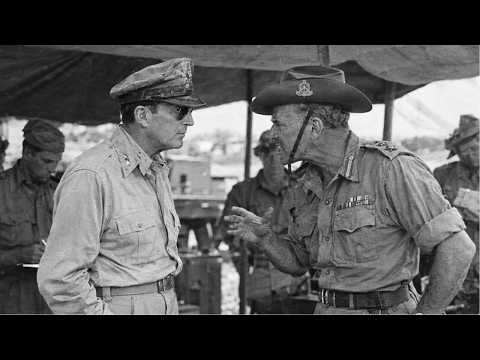
The men who accomplished this feat were not superhuman. They were barely standing. The Australian 7th Division had already been through hell. Malaria burned through their veins, dengue fever split their skulls with pain, and dysentery cramped their guts so badly they could hardly walk. More than half were too sick to fight. Their uniforms hung in tatters, their boots had rotted away, and they were desperately short of medicine and food.
Yet they were ordered to attack the most heavily fortified Japanese position in the entire Pacific. The Japanese had dug in with 11,000 troops along 15 miles of coastline, building hundreds of bunkers with four-foot-thick walls of coconut logs, packed sand, and steel plates. Bullets bounced off them like pebbles. Small bombs did nothing. The jungle was so thick you couldn’t see ten feet ahead, and the swamps were dark, foul-smelling pits of rotting vegetation and death.
MacArthur, meanwhile, sat hundreds of miles away in a cool house in Port Moresby. He had told Washington in October that the campaign was nearly over, that the Japanese would be wiped out in days. But weeks passed, and the bunkers still stood. The American 32nd Division tried a direct assault and lost 1,900 men in eleven days without gaining a single yard. The swamps swallowed them, the bunkers cut them down, and the mud pulled them under.
Then a new man arrived at the front. His name was George Vasey, a brigadier in the Australian Army. He was no polished staff officer. He was a loud, tough, profane soldier who fought alongside his men. He had already survived the deserts of the Middle East, and now he was sent to one of the most dangerous places on earth.
Vasey took one look at the swamp, the bunkers, and his sick, starving men, and realized something MacArthur refused to see: this was no ordinary battle. You couldn’t just charge the bunkers and win. The maps at headquarters showed open ground and clear paths, but the maps were wrong. The real ground was a tidal swamp that swallowed men up to their chests. Crocodiles lurked in the creeks. The long grass was sharp enough to slice skin. Every step meant wading through black water teeming with insects and rot.
Vasey knew that large attacks would never work. The Americans had proven that with their blood. He had a different idea. He would send small groups of eight to ten men to crawl through the swamp at night. They would sneak up to the bunkers from the flanks and drop grenades through the ventilation holes in the roofs. It would take dozens of grenades and hundreds of bullets to destroy each bunker. They would fight at close range in the dark. It would be slow, brutal, and would take many days of crawling through the stinking mud. But it was the only way that might work.
The map said the swamp was impassable. The generals said the bunkers were impregnable. Vasey looked at the dark water, looked at his sick and hungry men, and decided to try anyway.
He changed his men’s tactics immediately. No more large groups charging the bunkers. Instead, he split his force into small teams of eight to twelve men. These teams waited for nightfall. Then they crawled on their bellies through the black swamp water. The water was warm and thick as soup. It stank. Leeches stuck to their skin. Mosquitoes bit every inch of exposed flesh. But the small teams could move quietly. The Japanese couldn’t hear them coming over the sound of rain and frogs.
Each team carried Owen submachine guns and bags of grenades. The Owen gun was short, sturdy, and perfect for close-quarters fighting. It fired fast and loud. The grenades were heavy and cold in their hands. When a team found a bunker, they didn’t shoot at its thick walls. The walls were made of wood and steel, 1.2 meters thick. Bullets bounced off. Instead, the men crawled right onto the roof of the bunker. They found the small ventilation holes the Japanese used to breathe. Then they pulled the pins on their grenades and dropped them into the holes. The explosions inside were horrific. The ground shook. Smoke billowed from every crack.
It took 200 to 300 bullets and six to eight grenades to destroy a single bunker. And there were hundreds of bunkers. Progress was agonizingly slow. Some days the Australians advanced only 50 yards. On good days, 100 yards. The Americans had tried to take thousands of yards in one attack and lost hundreds of men. The Australians took 50 yards and kept most of their men alive. It was a different kind of war entirely.
The first real test came in late November. A company from the 2/9th Battalion crept toward a place called Duerumo Creek. The map said the swamp there was too deep to cross. The Japanese thought the swamp protected their flank, so they didn’t post enough guards. That was their mistake. Under cover of darkness, a company of Australian soldiers waded into chest-deep water. Mud clung to their legs with every step. Crocodiles slid away from the noise. The men held their rifles above their heads to keep them dry. They reached the Japanese flank undetected. In that one night, they destroyed seven bunkers. Only 12 Australian soldiers were wounded. If they had used the old tactics, the same result would have cost over 100 men.
The new plan was working. By December 1, about 4,500 Australian soldiers were fighting near Gona, facing roughly 2,000 to 2,500 Japanese troops hidden in deep bunkers. But the numbers were misleading. More than 70 out of every 100 Australian soldiers were sick with malaria or dengue fever, shivering with cold even in 90-degree heat, their skin yellowed, many unable to walk without help. The real fighting strength was much smaller than the numbers suggested, and getting food and ammunition to the front line was almost as hard as the fighting itself.
There were no roads, no trucks. Papuan natives carried everything on their backs, each carrier hauling 40 to 60 pounds of supplies through the jungle. The trip from the nearest airstrip to the front took five to seven days, and the carriers walked barefoot through mud and sharp grass. Without them, the Australian soldiers would have had no food, no ammunition, no medicine. They were the true heroes of the supply line.
But MacArthur didn’t care about any of that. He sat in his cool office far away, furious. He sent a sharp message to Vasey, ordering him to speed up, to accelerate the timetable. MacArthur wanted immediate results and would accept no excuses about swamps or disease or thick bunkers. Vasey read the message and reportedly told his staff that the generals in their offices should come to the front and see the mud for themselves before issuing orders. It was a bold statement for a man under MacArthur’s command. Vasey could have been sacked like Toby Allen, but he had a powerful friend: General Sir Thomas Blamey, the commander of the Australian Army. Blamey didn’t always see eye to eye with MacArthur—they argued often—but Blamey trusted Vasey. He knew the swamp was real, the bunkers were real, the disease was real. Blamey stood up to MacArthur and told him the Australians would fight the battle their way, at their own speed. That gave Vasey the freedom he needed.
The decisive moment came on December 8 and 9. Two Australian battalions, the 2/16th and 2/27th, launched a surprise attack from two directions at once. They squeezed the Japanese position at Gona Mission like a nutcracker. The attack drove through the deepest part of the swamp. The Japanese never expected anyone to come from that direction. They thought the swamp was a wall no army could cross. The Australians proved them wrong.
The fighting was savage and close. Men fought with knives and bare hands in the dark. Grenades exploded in the water, sending geysers of black mud into the air. The noise was deafening. The smell of gunpowder mixed with the stench of the swamp. In less than 36 hours, the Australian soldiers broke through the last Japanese defense lines. Gona fell on December 9, 1942. The Japanese garrison of 800 to 900 men was almost completely destroyed. Fewer than 50 were taken prisoner. Most fought to the end.
They had taken the fortress with almost nothing. No tanks. The few American tanks in the area were stuck in mud miles away. Artillery was scarce—the big guns fired no more than 200 rounds a day, barely enough to keep the enemy pinned down. More than half the Australian division was bedridden in hospital tents, too sick to stand. The men who took Gona were starving, soaked, covered in insect bites, and relying on sheer willpower. They had no advanced weapons, no heavy armor, no air support. All they had was courage, grenades, and a plan that the generals in their clean offices said would never work.
But it worked. Their impossible objective was taken, and MacArthur was about to find out.
When the news reached MacArthur’s headquarters, the general did not mention the Australians in his official communiqué. Instead, he wrote that the victory reflected “the brilliant leadership and indomitable fighting spirit of the forces under my command.” Under his command. Not a single word about the Australian soldiers who had crawled through the mud, who had dropped grenades into ventilation holes while burning with malaria, who had died in a swamp that the maps said was impassable.
The Australians read those words in their muddy trenches and felt a cold fury settle in their guts. They had answered his impossible mission with their blood, and he answered with erasure. The numbers made the insult worse. American frontal assaults had cost five times as many casualties per yard gained as Vasey’s small-team plan. Five times. Yet MacArthur’s message made it sound as if his original strategy had worked all along.
Back in Australia, the old soldiers shook their heads in pubs for decades. “MacArthur stole our story,” they said. And they were right. The official histories, written in Washington and London, gave the general the genius and the Australians a footnote. But the swamp remembered. The bunkers remembered. And the men who took them never forgot.
So the next time someone tells you something is impossible, remember the Australians at Buna-Gona. Remember the black water, the wooden bunkers, the grenades in the dark. Remember that the man who called it impossible was the one who wrote the report and took the credit anyway. And remember that the real heroes are the ones who never stopped to argue about whether the mission could be done. They just waded into the swamp and did it, bunker by bunker, yard by yard, grenade by grenade.
That is the story the maps will never show you, and the truth the comfortable offices never want to hear. What would you have done if you were one of those soldiers, reading MacArthur’s message in your muddy trench?






