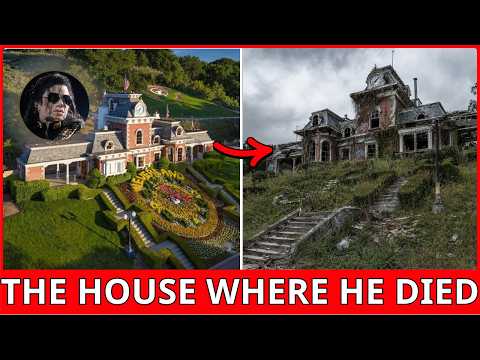
What if Hollywood’s most famous landmarks aren’t movie studios, but death scenes? Behind these doors, legends took their final breath. Marilyn Monroe, Michael Jackson, Whitney Houston, Heath Ledger. Some homes were demolished. Some became tourist obsessions. And some are still standing exactly as they were the night everything changed. Today, we’re revisiting the real places where Hollywood’s biggest stars met their final chapter, and some of the stories are stranger than fiction.
Few addresses in Hollywood history have attracted more attention than 100 North Carolwood Drive. On June 25th, 2009, emergency vehicles rushed to the rented Holmby Hills mansion, where Michael Jackson, the King of Pop, was found unresponsive. Within hours, the news spread across the globe. One of the most famous entertainers in history was gone at the age of 50, and the world seemed to stop for a moment.
Jackson had spent decades redefining music, breaking records, and creating a level of fame few people will ever experience. But behind the scenes, he was preparing for a highly anticipated comeback tour, while dealing with intense physical and emotional pressures. Investigators later determined that a powerful anesthetic had been administered by his personal physician, Conrad Murray, who was eventually convicted in connection with Jackson’s death. Suddenly, what should have been a triumphant return became one of the biggest celebrity tragedies of the modern era.
Today, the mansion still stands in one of Los Angeles’s most exclusive neighborhoods. Surprisingly, Michael Jackson never actually owned the house where he died. He was renting it. It’s a strange twist for a man who once owned one of the most famous properties on Earth. In true Hollywood fashion, even the King of Pop managed to leave behind one final plot twist. More than a decade later, the house remains a landmark tied forever to the day music lost one of its greatest icons.
If there’s one address in Hollywood that refuses to stop haunting people, it’s 12305 5th Helena Drive. Hidden behind gates in Brentwood, Los Angeles, the quiet Spanish-style home looks completely ordinary today. Almost immediately, questions started to emerge. Why was there a delay before police were contacted? Why did some witness accounts seem to conflict with one another? And how did the most photographed woman on Earth die under circumstances that still spark debate decades later? The deeper investigators, journalists, and fans looked into the case, the stranger it seemed. What should have been a closed chapter instead became one of Hollywood’s greatest mysteries.
Marilyn appeared to have everything: beauty, fame, wealth, and worldwide admiration. Yet behind the glamorous image was a woman carrying enormous personal struggles. Today, her final home still stands, attracting curious visitors from around the world. Tour buses slow down, cameras come out, and the questions never seem to stop. More than 60 years later, Marilyn Monroe’s house remains one of Hollywood’s most infamous landmarks. Because in a city built on illusion, some mysteries simply refuse to disappear.
High above Beverly Hills stood a beautiful home on Cielo Drive, the kind of place that looked straight out of a Hollywood dream. But on August 9th, 1969, that dream became a nightmare. Inside the house, actress Sharon Tate, just 26 years old and 8 months pregnant, was killed along with four others in one of the most shocking crimes Hollywood has ever seen. Overnight, the address became infamous around the world.
At the time, Sharon was a rising star with a promising future ahead of her. Instead, her name became forever linked to a tragedy that changed Hollywood’s sense of safety. The brutal crime dominated headlines and remains one of the most discussed cases in true crime history. More than 50 years later, people still remember exactly where it happened, even if they don’t remember what movie was playing that summer.
Today, the original house no longer exists. It was demolished in 1994, and the address was even changed in an effort to leave the past behind. A new mansion now sits on the property, but the story refuses to disappear. Hollywood may be great at creating new endings, but some chapters are impossible to rewrite. And Sharon Tate’s final home remains one of the darkest landmarks in entertainment history.
Some Hollywood hotels are famous for luxury. Others are famous for scandal. And then there’s the Chateau Marmont, a place that has collected celebrity stories the way some people collect souvenirs. But, one of its darkest chapters began on March 5th, 1982 inside Bungalow 3, where comedian John Belushi was found dead at just 33 years old.
Belushi wasn’t just a star, he was a force of nature. As one of the breakout talents from Saturday Night Live and the unforgettable star of The Blues Brothers, he seemed unstoppable. His energy was legendary, his comedy was chaotic, and his popularity was at an all-time high. But, behind the laughter, his personal struggles were becoming impossible to ignore. His death from a drug overdose shocked fans around the world and instantly became one of Hollywood’s most talked about tragedies.
More than 40 years later, the Chateau Marmont is still open, and the famous bungalows are still available to rent. Guests check in hoping for a taste of old Hollywood glamour, though hopefully not the full historical experience. The hotel remains one of the most infamous landmarks in Los Angeles, where luxury, celebrity, and controversy have shared the same address for decades. And among all its stories, John Belushi’s final chapter remains one of the most unforgettable.
William Holden spent decades playing Hollywood’s ultimate leading man. From Sunset Boulevard to Stalag 17, he embodied charm, confidence, and old-school movie star glamour. But, on November 16th, 1981, his story came to an end in a way that felt more like a tragedy than a Hollywood script. Inside his Santa Monica apartment overlooking the Pacific Ocean, Holden fell while intoxicated and struck his head on a bedside table. The injury caused severe bleeding and investigators later determined he remained conscious for a period of time before passing away alone.
There were no dramatic final words, no flashing cameras, and no red carpet farewell. Just one of Hollywood’s biggest stars facing his final moments in silence. Today, the apartment building still stands on Ocean Avenue looking much the same as it did decades ago. People pass by every day with no idea what happened inside. It’s a sobering reminder that fame can fill theaters, magazine covers, and bank accounts, but it can’t guarantee a happy ending. For a man who spent his career larger than life, William Holden’s final chapter was surprisingly ordinary. And somehow, that makes it even more heartbreaking.
On Halloween night in 1993, Sunset Boulevard wasn’t celebrating. It was about to witness one of Hollywood’s most tragic moments. Outside the Viper Room, a popular nightclub partly owned by Johnny Depp, River Phoenix, one of the most promising young actors of his generation, collapsed on the sidewalk. He was just 23 years old.
River wasn’t just famous. He was seen as the future of Hollywood. Critics praised him, directors wanted him, and audiences believed he was destined for greatness. But behind the rising fame was a life struggling under pressure. That night after a drug overdose, everything came to a sudden and shocking stop. His brother, Joaquin Phoenix, was there calling 911 in panic while his sister Rain tried desperately to keep him alive. In minutes, a rising star became global headline news.
Today, the Viper Room is still open on Sunset Strip, though it has changed owners many times. Tourists walk past it every night often unaware of what happened just outside its doors. The exact spot where River collapsed is now just another piece of sidewalk blending into the noise of Los Angeles. In Hollywood, even the most tragic moments eventually fade into the background. But some names like River Phoenix never really disappear.
At 1895 Rising Glen Road in the Hollywood Hills, the house looked like another luxury celebrity home, quiet streets, expensive views, and the kind of place where nothing should ever go wrong. But on December 20th, 2009, that illusion collapsed when actress Brittany Murphy was found unresponsive inside. She was just 32 years old.
Brittany wasn’t a background name in Hollywood. From Clueless to 8 Mile, she was known for her energy, humor, and unmistakable screen presence. But behind the scenes, her life was far less polished. Health issues, public pressure, and constant speculation surrounded her final years. Her death was officially attributed to pneumonia combined with drug intoxication, leaving fans stunned and searching for answers that never fully satisfied them.
Then came the twist that made everything even harder to explain. Just 5 months later, her husband Simon Monjack also died inside the same house under similar circumstances. Suddenly, what was already a tragedy turned into one of Hollywood’s most talked-about modern mysteries. Theories exploded online. Some blamed the house, some blamed environmental factors, others simply couldn’t believe the coincidence.
The home has been sold, but the story still follows it. Two lives ended in the same place within months, turning a quiet Hollywood Hills property into a symbol of unanswered questions. In a city where drama is normal, this address still stands out as one of the most unsettling chapters.
Off the coast of Catalina Island, the yacht Splendour looked like a perfect Hollywood escape, luxury ocean views, and zero paparazzi. Until November 29th, 1981, when it became the center of one of the most confusing deaths in celebrity history. Natalie Wood, a beloved film star, was later found floating in the water nearby wearing a nightgown. She was terrified of deep water her entire life. Hollywood irony level extreme.
That night, Natalie was on board with her husband Robert Wagner and actor Christopher Walken. What exactly happened remains one of Hollywood’s longest-running unanswered questions. There was drinking, there were disagreements reported, and then silence. Official accounts evolved over time, but nothing fully explained how she ended up in the water. Bruises were noted, theories exploded, and investigators eventually reopened the case in 2011. In 2018, Wagner was named a person of interest, but still no final answer ever arrived.
Today, the yacht has been sold and renamed as if changing the name might reset the story. It didn’t. The ocean doesn’t keep receipts, but Hollywood certainly remembers. And in a town where every mystery eventually gets a remake, this one is still waiting for its ending.
Hollywood loved stars who shined bright, but Janis Joplin didn’t shine, she burned. On October 4th, 1970, inside room 105 of the Landmark Motor Hotel in Hollywood, the world was shocked to learn that the voice of a generation had been found dead on the floor. She was just 27 years old, a member of the infamous 27 Club, where fame and tragedy seem to collide at exactly the same age.
Janis wasn’t a typical Hollywood star. She didn’t fit the polished image studios loved. She was raw, loud, emotional, and completely unforgettable. Her voice could shake arenas, and her presence could silence them. But behind the music, there was a constant battle with addiction and isolation. On that night, investigators determined the cause was a heroin overdose, unusually pure and unexpectedly lethal. She was found with a small amount of cash in her hand, just enough for a vending machine run, as if life had stopped mid-sentence.
What makes the story even more surreal is what happened after. Her album, Pearl, climbed to number one after her death, turning her into a legend she never lived to see. In Hollywood, success often comes with timing, but for Janis Joplin, fame arrived like an echo after silence. Room 105 still exists today, occasionally requested by guests who know exactly what happened there and still choose to stay anyway. Some voices fade over time. Janis Joplin’s only got louder.
421 Broome Street in SoHo, Manhattan looked like just upscale loft in a city that never sleeps until January 22nd, 2008, when it became the center of a global shock. Inside that apartment, Heath Ledger was found dead by his masseuse. He was only 28. One morning, Hollywood woke up to a headline it couldn’t process, a rising star gone in the middle of New York silence.
Heath wasn’t just another actor on the rise, he was in the middle of becoming a legend. Brokeback Mountain had already changed how people saw him and his transformation into the Joker in The Dark Knight was building almost myth-like anticipation. Official reports later confirmed an accidental overdose from a combination of prescription medications. But in true Hollywood fashion, facts didn’t stop the conversation. They only started it.
Fans, critics, and the internet all tried to make sense of how someone at the peak of his career could disappear so suddenly. Today, the SoHo loft still stands as a private residence in one of Manhattan’s most expensive neighborhoods. No museum sign, no guided tour, no dramatic memorial, just another building blending into the city skyline. But every now and then, people passing by slow down for a second, remembering that behind one quiet window, one of cinema’s brightest talents delivered his final scene without ever realizing the credits had rolled.
In the heart of London’s Chelsea neighborhood, behind a quiet door on June 1969, one of Hollywood’s most powerful voices reached its final silence. Judy Garland was found dead in a small bathroom at just 47 years old. For the world, it felt almost unreal, like someone had paused the music halfway through the most important song.
Judy wasn’t just a performer. She was a phenomenon. From The Wizard of Oz to sold-out concerts that shook entire cities, she lived a career that most artists could only dream of. But behind the glitter was a life under constant pressure, studios controlling her image, years of exhaustion, and personal battles that never left her alone. On that final day, the official cause was a barbiturate overdose. No dramatic scene, no spotlight, just a quiet ending in a place far from the world that once worshipped her.
And maybe that’s the cruel joke Hollywood doesn’t like to admit. The woman who once asked, “Somewhere over the rainbow?” spent much of her life searching for a peaceful place that never quite arrived. Still, her voice never left. Today, Judy Garland remains one of cinema’s most unforgettable legends, her songs still echoing like they refused to accept the credits have rolled. Because in Hollywood, even when the lights go out, some stars keep singing anyway.
Beverly Hills, February 11th, 2012. Inside room 434 of the Beverly Hilton, the night before the Grammys, the world’s biggest music celebration was just one floor away. Downstairs, celebrities were getting ready for red carpets, cameras, and champagne. Upstairs, one of the greatest voices in history was found unresponsive in a bathtub. Whitney Houston was 48 years old.
Whitney wasn’t just famous, she was a standard no one else could reach. I Will Always Love You wasn’t just a song. It was a global event. Her voice filled stadiums, weddings, movies, and memories. But behind that perfection was a long struggle with pressure, addiction, and the impossible expectation of always being flawless in a world that never lets icons rest.
On that day, reports pointed to a combination of heart disease and cocaine use as contributing factors. No spotlight. No applause. Just silence in a hotel room that hours later would host celebrities pretending nothing had happened upstairs. And that’s the cruel rhythm of Hollywood. One floor below, people were celebrating legacy. One floor above, legacy had already ended.
The Beverly Hilton is still open today, still hosting glamorous events, still selling the illusion that nothing breaks behind closed doors. Even room 434 can still be booked because in Hollywood, tragedy doesn’t close the business. It just becomes part of the address.
Bob Crane’s Scottsdale apartment. June 29th, 1978. The star of Hogan’s Heroes was found brutally killed, an electrical cord around his neck. The wholesome sitcom face had a hidden double life that shocked even seasoned detectives. Today the building stands rebranded and renovated, as if fresh paint could reset history.
George Reeves, television’s Superman, was found dead from a gunshot wound in his Benedict Canyon home on June 16th, 1959. Ruled a suicide, yet questions never stopped. Even Superman couldn’t escape the final scene written for him.
Sal Mineo, Oscar-nominated alongside James Dean, was stabbed to death in his own carport on February 12th, 1976. The parking space is still there, used by residents who never think twice. Sometimes the most tragic scenes happen just out of frame.
Dorothy Dandridge, the first Black woman nominated for Best Actress, died quietly on Fountain Avenue in 1965. No monument, no crowd, just an address carrying a legacy too big for its walls.
Freddie Prinze, breakout star of Chico and the Man, was gone at 22 in a Beverly Comstock suite. His son would grow up to carry the name forward. Even the brightest comedies can end in silence.
And Ramon Novarro, silent film legend, beaten to death in his Laurel Canyon home in 1968. The house is gone now, replaced by something modern. But in this town, even golden-age legends don’t always get a peaceful ending, just a final cut.
So many doors, so many final breaths. Which of these addresses would you never dare to visit after dark?






