As the Third Reich crumbled to ashes in 1945, the women who had stood beside its architects—wives, mothers, and silent partners—were thrust into a world that condemned them. Their husbands faced trials, executions, or suicide, but these women faced a different kind of reckoning: a life stripped of privilege, haunted by complicity, and often marked by unwavering devotion to a fallen ideology. What happened to them in the aftermath is a story of survival, denial, and the chilling banality of evil.
Take Ilsa Hess, wife of Rudolf Hess, Hitler’s deputy. When her husband flew to Britain in 1941 on a bizarre peace mission, she was left to defend his name alone. After the war, Rudolf was sentenced to life in Spandau Prison, and Ilsa lost everything. Yet she never wavered. She wrote books portraying him as a misunderstood idealist, became a leading figure in neo-Nazi circles, and until her dying breath in 1995, insisted on his innocence. “I have no regrets,” she reportedly said, even as the world condemned the regime she championed.
Then there was Margarete Himmler, wife of the Reichsführer-SS. A fervent anti-Semite, she embodied the Nazi ideal: tall, blonde, and ruthless. After the war, she was interned, then released, but she refused to leave the camp at first—“I have nowhere to go, and I fear being lynched,” she confessed. She lived out her days in anonymity, supported by former SS comrades, never expressing remorse. Her daughter Gudrun remained fiercely loyal to her father’s memory, declaring, “I want to remain like my father.” Margarete died in 1967, her silence a shield against accountability.
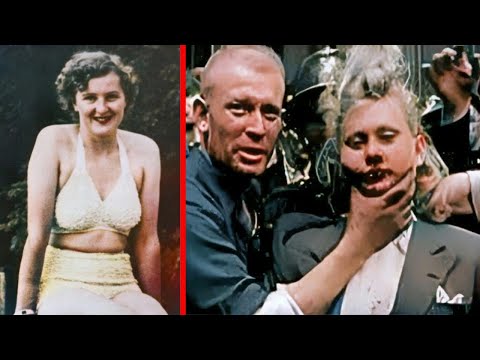
Henriette von Schirach, wife of Baldur von Schirach, was an exception. In 1943, she witnessed the brutal deportation of Jews in Amsterdam and confronted Hitler himself, pleading for mercy. Hitler exploded: “That is the last thing I need—sentimental nonsense!” He expelled the Schirachs from his inner circle. After the war, Henriette divorced her husband and tried to reclaim confiscated assets, even lobbying to reduce his sentence. She never condemned Hitler, but her single act of defiance sets her apart—a flicker of humanity in a sea of denial.
These women, and others like Emmy Göring and Magda Goebbels, navigated a postwar world that offered little sympathy. Some faced prison, others poverty; all faced the weight of their husbands’ crimes. Their stories are not just about survival, but about the choices made when the world collapses—and the ideologies that refuse to die.
Magda Goebbels, the tragic first lady of the Third Reich, met a far darker end. As the Soviet army closed in on Berlin in April 1945, she and Joseph moved their six children into the Führerbunker. While Joseph contemplated suicide, Magda made a decision that would shock history. “I cannot leave my children to live in a world without National Socialism,” she reportedly said. On May 1, 1945, she and Joseph poisoned all six children—Helga, Hildegard, Helmut, Holdine, Hedwig, and Heidrun—with cyanide. Magda then took her own life, leaving behind a legacy of fanaticism that even in death refused to yield.
Emmy Göring, widow of Hermann Göring, faced a different reckoning. After her husband’s suicide in 1946, she was interned and later sentenced to forced labor. Stripped of her vast wealth—including a wardrobe of over 300 dresses—she lived in a small Munich apartment. “I was apolitical,” she insisted in a 1951 interview, though she never condemned Hermann. She published a memoir in 1967 defending him as a good husband and father, and even suggested Germany would have fared better under his leadership than Hitler’s. She died in 1973, unrepentant to the end.
Lina Heydrich, widow of Reinhard Heydrich, the “Butcher of Prague,” proved equally unyielding. After her husband’s assassination in 1942, she was given a castle in Prague, where she reportedly whipped Jewish forced laborers. Postwar, she was imprisoned for three years, then released. She opened a guesthouse that became a clandestine meeting place for former Nazis. “National Socialism was a faith, and I can never renounce it,” she declared in a 1976 interview. She died in 1985, her memoirs defending the regime and claiming ignorance of the Final Solution.
Gerda Bormann, wife of Hitler’s private secretary Martin Bormann, met a tragic fate. After the war, she was interned, then released, but struggled to support her ten children. She moved to Italy, where she died of cancer in 1946, leaving her children orphaned. Her husband’s fate remained unknown for decades—Martin Bormann’s remains were not identified until 1972, confirming his suicide in 1945.
These women shared more than just the titles of wife or widow; they shared a refusal to confront the truth. While some, like Henriette von Schirach, showed a flicker of conscience, most retreated into denial or defiantly upheld the ideology that had destroyed millions. Their postwar lives were marked by loss—of status, wealth, and often family—but rarely by remorse.
As the years passed, their stories faded into history, but the questions they raise linger. How much did they know? How complicit were they? And why did so few ever express regret? The answers remain as troubling as the women themselves—a testament to the seductive power of ideology and the human capacity for self-deception.
Yet the story does not end with these women alone. Behind every title and every sealed file lies a paper trail—letters, diaries, interrogation transcripts—that historians continue to mine for answers. What emerges is not a portrait of ignorance, but of selective memory. These women saw enough to know, and chose enough to forget.
Consider the case of Ilse Hess once more. In the 1950s, she corresponded with hundreds of sympathizers, carefully cultivating a network that spanned continents. Her apartment in Munich became a pilgrimage site for those who refused to accept Nuremberg’s verdict. “They hanged the wrong men,” she wrote to a supporter in 1953, a sentence that would have been unthinkable in public but flowed freely in private.
Her son, Wolf Rüdiger Hess, inherited the cause. He spent decades demanding his father’s release, publishing pamphlets and giving interviews that portrayed Rudolf as a peacemaker betrayed by both Hitler and the Allies. When Rudolf died in Spandau in 1987, Wolf insisted it was murder, not suicide—a conspiracy theory that persists in neo-Nazi circles to this day.
Margarete Himmler’s postwar years were quieter but no less revealing. Neighbors in Munich recalled a reserved woman who kept her curtains drawn and rarely spoke to anyone. Yet her pension came partly from the Bavarian state, and she supplemented it with donations from the Hilfsgemeinschaft auf Gegenseitigkeit—the mutual aid society for former SS members. She accepted the money without comment, as though it were her due.
Her daughter Gudrun proved even more steadfast. Known as Püppi to her father, she grew into a woman who dedicated her life to rehabilitating his image. In the 1950s, she joined the Stille Hilfe, an organization that helped fugitive Nazis escape justice. She visited Spandau regularly, smuggling letters and maintaining the fiction that her father was a misunderstood idealist.
What Gudrun never acknowledged—what she could not afford to acknowledge—was the mountain of evidence her father had left behind. The Einsatzgruppen reports. The concentration camp inspections. The Posen speech, where Heinrich Himmler spoke openly of exterminating the Jewish people. She had heard the rumors as a child, and she chose to believe they were lies.
This pattern repeats across the widows of the Reich: a deliberate narrowing of vision, a refusal to connect the dots. Lina Heydrich, too, claimed ignorance of the Final Solution, even though her husband had chaired the Wannsee Conference where its logistics were planned. She lived comfortably on a pension from the West German government, which classified her as a war widow entitled to support.
Her guesthouse on Fehmarn Island became a gathering place for old comrades, where they swapped stories and toasted absent friends. “We were idealists,” she told a visitor in the 1970s. “We wanted to build a better Germany.” The visitor did not ask what kind of Germany that would have been for the Jews, the Roma, the disabled—those deemed unworthy of the new order.
Emmy Göring, meanwhile, retreated into a world of small comforts. She kept a photograph of Hermann on her bedside table and spoke of him fondly to anyone who would listen. Her memoir, published in 1967, sold modestly but earned her a small income. In it, she described Hitler as a charming host and her husband as a devoted family man. “Politics was not my concern,” she wrote. “I was a wife and mother, nothing more.”
The claim rings hollow when one considers the stolen paintings that once hung in Carinhall, the Görings’ sprawling estate. Emmy had chosen every piece, delighted in their beauty, and never asked where they came from. After the war, she insisted she had known nothing of their origins—a defense that allowed her to keep two dresses and a few personal effects while the rest vanished into Allied vaults.
Henriette von Schirach, the one who had dared to confront Hitler, fared little better in the court of public opinion. Her divorce from Baldur in 1949 was seen by some as a betrayal, by others as a convenient escape. She remarried in 1950, to a man named Walter Schmidt, and tried to rebuild a life far from the spotlight.
But the past would not release her. In 1956, she published The Price of Glory, a memoir that defended her father’s work as Hitler’s photographer and described the Führer as a warm, approachable man. The book was condemned by critics, but it sold well—a sign that nostalgia for the Reich had not entirely vanished.
Her later works, Anecdotes About Hitler and Women Around Hitler, cemented her reputation as an apologist. She portrayed the Nazi elite as flawed but human, their crimes reduced to footnotes. When asked about the Holocaust in a 1980 interview, she shrugged. “I am not a historian,” she said. “I only write what I saw.”
What she saw, apparently, was dinner parties and mountain retreats, not the cattle cars or the gas chambers. What she saw was the Führer’s kindness to children, not the orders he signed that sent millions to their deaths.
What she saw was a world of comfort built on bones, and she never once looked down. When pressed by a persistent journalist in 1983 about the deportations she had witnessed in Amsterdam, Henriette offered a response that has haunted historians ever since: “I saw suffering, yes. But I also saw order. You cannot judge a whole era by its worst moments.” The journalist, stunned, asked if she regretted confronting Hitler. She paused, then said: “Only that I failed.”
That single admission—a flicker of something like conscience—set her apart from the others. Yet even Henriette could not bring herself to condemn the ideology that had shaped her entire life. She died in 1992, still insisting Hitler had been a man of vision, still defending her husband as an idealist. Her obituary in a Munich paper noted simply: “She never learned to say sorry.”
These women are gone now—all of them. Their graves are unmarked or forgotten, their memoirs out of print, their names reduced to footnotes in histories of the Reich. But the questions they left behind remain stubbornly alive. How much did they know? How much did they choose not to know? And what does their silence teach us about the human capacity for self-deception?
The wives of Nazi leaders were not monsters in the conventional sense. They were mothers, hostesses, letter-writers, and gardeners. They worried about their children’s education and their husbands’ health. And yet they lived in houses built on stolen wealth, wore dresses sewn by slave labor, and raised their children to worship a man who had ordered the murder of millions.
When the war ended, they faced a choice: confess or conceal. Most chose concealment. Some chose defiance. None, it seems, chose true repentance.
Perhaps that is the most unsettling lesson of all—that evil does not always announce itself with a shout. Sometimes it arrives quietly, in the form of a devoted wife, a loving mother, a woman who simply did not ask. And when history finally demands an accounting, she looks away and says: “I was only a wife.”
But history keeps asking. And so must we.
If you had been in their place—surrounded by power, privilege, and propaganda—would you have asked the questions they refused to ask? Or would you, too, have looked away?






