In the sweltering summer of 1900, a tiny foreign community in Beijing found itself surrounded by a sea of enemies, outnumbered and outgunned, with no escape and no guarantee of survival. For 55 days, they would hold out against a relentless siege, fighting not just for their lives but for the very survival of Western influence in China. This is the story of the Boxer Rebellion, a bloody uprising that pitted a desperate empire against the might of eight nations—and of the men, women, and children who lived through the harrowing siege of the diplomatic quarter.
As the Qing dynasty crumbled under the weight of foreign exploitation, a secret society known as the Boxers rose from the shadows, vowing to expel the “foreign devils” and restore China to its former glory. Their cry, “Support the Qing, destroy the foreigners!”, echoed across the land, drawing thousands to their cause. By June 1900, they had descended upon Beijing, cutting telegraph lines, burning churches, and slaughtering Chinese Christians. Inside the Legation Quarter, a makeshift fortress of eleven nations, a few hundred civilians and soldiers prepared for the worst.
The world watched in horror as the situation spiraled out of control. The Empress Dowager Cixi, the formidable ruler of China, hesitated, torn between crushing the Boxers and using them to rid her country of foreign influence. When the allied powers demanded control of Chinese military and financial resources, she threw her support behind the rebels. “If we must perish, why not fight to the death?” she declared, and the siege began.
Inside the Legation Quarter, the defenders—diplomats, missionaries, Marines, and civilians—hastily fortified their perimeter. Sir Claude MacDonald, the British minister, took command, organizing a defense that included a makeshift cannon cobbled together from parts of different nations, aptly named the “International Gun.” Among the defenders was Captain John T. Myers of the U.S. Marines, whose daring counterattack on July 3 would become one of the siege’s most celebrated moments. With bayonets fixed, Myers and his men charged the Chinese barricades on the Tartar Wall, driving the enemy back and securing a critical vantage point.
But the reprieve was brief. The Boxers, now joined by regular Chinese troops, launched furious assaults, setting fires and exploding mines beneath the legation walls. The defenders, exhausted and dwindling in number, clung to their positions. Outside the city, a relief force under Admiral Edward Seymour had been stopped in its tracks, and the world wondered if the legations would fall before help could arrive.
As the siege dragged on, the defenders faced not only enemy fire but also dwindling food, water, and ammunition. The summer heat was oppressive, and disease spread. Yet they held on, inspired by the leadership of MacDonald and the courage of men like Myers. On August 14, the sound of artillery and machine-gun fire signaled the arrival of the relief column. The allied troops, after a grueling march, breached the city walls and fought their way to the legations. The siege was over—but the cost had been high. Fifty-five defenders had been killed, and over a hundred wounded. The Boxer Rebellion would eventually be crushed, but its legacy would linger, a testament to the resilience of the human spirit in the face of overwhelming odds.
The relief column that finally reached the Legation Quarter was not the same force that had set out from Tianjin weeks earlier. What had begun as a rushed rescue mission had been transformed into a full-scale invasion. More than twenty thousand troops from eight nations now marched on Beijing, and at their head was a British general named Alfred Gaselee. His name would be attached to the campaign, but the army he commanded was a patchwork of empires—Japanese, Russian, French, German, American, Italian, Austrian—each with its own agenda and its own grudges.
The Japanese, who had contributed nearly half the total force, were still smarting from being denied overall command. Their soldiers fought with a ferocity that stunned even the hardened veterans of the other contingents, and they paid for it in blood. At the Battle of Beicang, they absorbed the heaviest casualties of the entire advance. At Yangcun, the British and Americans took the lead, charging through the summer heat that had turned the plains into a furnace.
For the men marching toward Beijing, the enemy was not only the Boxers and the Qing army but also the land itself. Temperatures soared past forty degrees Celsius, and water was scarce. Soldiers collapsed from heatstroke and exhaustion. Men who strayed from the column in search of wells were found later, mutilated, their bodies left as warnings. The Cossacks and Japanese, in turn, retaliated with a brutality that shocked even their own officers. Villages were burned, prisoners beheaded, and the line between soldier and executioner blurred beyond recognition.
Inside the Legation Quarter, the defenders knew nothing of the relief force’s progress. Their world had shrunk to a few hundred yards of barricaded streets, crumbling walls, and the constant crack of rifle fire. Rations were stretched to the breaking point. Horses had been slaughtered for meat. Wells were running dry or had been poisoned. The International Gun—that ramshackle cannon assembled from British, Italian, Russian, and American parts—had become a symbol of their stubborn defiance. Each time it fired, the defenders cheered, even as the recoil threatened to tear it apart.
The wounded filled every available space. Captain Myers, still recovering from the spear wound to his leg, spent his days organizing the defense of the American sector from his sickbed. Sir Claude MacDonald, in his white tennis trousers, walked the perimeter daily, offering encouragement and making impossible decisions. The minister who had once been a soldier knew that their only hope lay in holding out just a little longer.
On the night of August 13, the defenders heard something new: the distant boom of artillery, followed by the sustained rattle of machine-gun fire. At first, some thought it was the Boxers bringing up heavier guns for a final assault. But the firing came from the east, from beyond the city walls. By dawn on August 14, the truth was unmistakable—the relief column had arrived.
The assault on Beijing was chaos. General Gaselee had planned a coordinated attack on four gates, with the Russians, Japanese, British, and Americans each targeting a different entry point. But nothing went according to plan. The Americans arrived at their assigned gate only to find the Russians already there, claiming it for themselves. Colonel Adna Chaffee, refusing to waste time on a dispute, ordered his men to scale the city wall directly.
It was a thirty-foot climb under fire, and the first man to volunteer was a bugler named Calvin Titus. He scrambled up the wall while bullets chipped the stone around him, and at 11:03 a.m., he planted the American flag on the parapet. The rest of the 14th Infantry followed, and the Stars and Stripes flew over Beijing for the first time.
Meanwhile, the British and Indian troops, guided by a local informant, found a water gate that led directly into the Legation Quarter. They waded through the filthy canal, rifles held above their heads, and emerged inside the compound to the astonishment of the defenders. At 2:30 p.m., General Gaselee himself entered the legation, where Sir Claude MacDonald—still in his tennis whites—greeted him with a handshake and a weary smile. The siege was over.
The cost was staggering. Fifty-five defenders had been killed, and 135 wounded—a casualty rate of forty-six percent. Thirteen civilians had also died. Beyond the compound walls, the toll was far greater. More than two hundred missionaries and their families had been slaughtered, along with over thirty thousand Chinese Christians. The Catholic cathedral, where three thousand Chinese Catholics had taken refuge under the protection of a handful of Italian and French soldiers, held out until August 16, two days after the legations were relieved.
But the story was far from finished. The Empress Dowager Cixi had fled Beijing in disguise, traveling west toward the ancient capital of Xi’an. The Boxers, abandoned by their imperial patrons, were hunted down by the thousands. And the allied armies, now in control of northern China, embarked on a campaign of retribution that would stain their victory with infamy.
What followed the relief of the legations was not peace but a season of vengeance. The allied commanders, freed from the urgency of rescue, turned their attention to punishment. Public beheadings became routine, executions multiplied, and the countryside was scoured for Boxer remnants. Villages suspected of harboring rebels were put to the torch, crops were trampled, and livestock was seized or shot. The line between soldier and marauder dissolved entirely.
No nation’s contingent was innocent, though contemporary journalists tended to single out the Germans, Russians, and Japanese for particular condemnation. The German contingent arrived late but with a ferocity that matched their emperor’s rhetoric. Kaiser Wilhelm II had told his troops to behave like Attila and his Huns, and they obliged with a thoroughness that would embarrass Germany when those same words were thrown back at it during the First World War.
Many Westerners were sickened by what their armies had become. Mark Twain, never one to mince words, declared that the Boxers were patriots—men fighting for their homeland against foreign invaders. It was a sentiment that few in power shared, but it echoed across the decades.
The Empress Dowager Cixi, meanwhile, had not been idle in her flight. From the safety of Xi’an, she continued to direct what remained of her government, issuing edicts and negotiating through intermediaries. The allies demanded her execution, along with that of the Boxer leaders and the anti-foreign officials who had supported them. Cixi refused to surrender General Dong Fuxiang, the Muslim commander whose troops had fought so fiercely against the relief columns, and the allies eventually dropped the demand rather than prolong the standoff.
The final settlement came in September 1901, when Cixi signed the Boxer Protocol. Its terms were harsh: China would pay an indemnity of 450 million taels of silver, spread over thirty-nine years, with interest that nearly doubled the total. Foreign troops would be stationed permanently in Beijing, and the legation quarter would become a fortified enclave beyond Chinese jurisdiction. The Qing dynasty, already reeling, never recovered its authority.
Yet the story of the siege’s survivors had its own strange twists. Admiral Sir Edward Seymour, whose relief expedition had been humiliated and nearly destroyed, returned to England to a hero’s welcome in Portsmouth. He retired as a full admiral in 1910 and died in 1929, his reputation restored by the passage of time.
Captain John T. Myers, the Marine who had led the counterattack on the Tartar Wall, went on to serve in the First World War and retired as a major general in 1934. His exploits in Beijing were later fictionalized in another film, The Wind and the Lion.
Sir Claude MacDonald, the tennis-playing minister who had commanded the defense, was rewarded with the ambassadorship to Japan. His Japanese counterpart in the siege, Colonel Shiba Goro—who had defended the Fu compound with such tenacity—became a military attaché in Britain. He survived the Second World War but took his own life when Japan surrendered in 1945.
And Empress Dowager Cixi died in November 1908, one day after the death of her nephew, the Guangxu Emperor. On her deathbed, she named two-year-old Puyi as his successor. He would become the last emperor of China, a child who inherited a throne that was already crumbling.
The siege of the legations had lasted fifty-five days, but its consequences would ripple for decades. The indemnity payments were never fully collected—they were canceled during the Second World War, when China allied with most of the same eight nations against Japan, the very country that had contributed the largest force and suffered the heaviest losses in 1900. History, as it often does, had woven a path no one could have predicted.
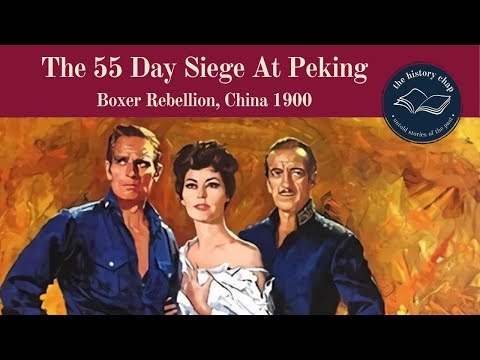
As for the film 55 Days at Peking, it remains a product of its time—a Hollywood epic that plays fast and loose with history but introduces audiences to a conflict rarely taught in schools. David Niven and Charlton Heston deliver unforgettable performances, even if their characters’ names were changed for the screen.
Heston would later star in another nineteenth-century epic, Khartoum, as General Charles Gordon—a story I’ve covered before and one worth revisiting to understand the history behind the spectacle.
So what do you think—should filmmakers prioritize historical accuracy, or is it enough that they spark our curiosity to learn more? Let me know in the comments below.






