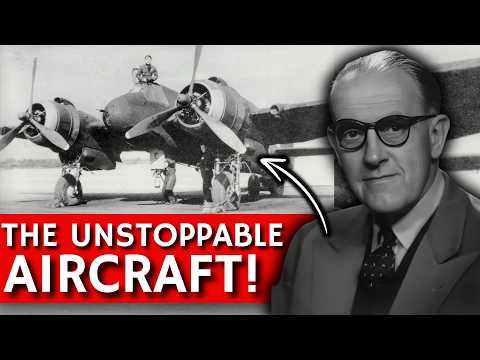
In the autumn of 1940, a hangar full of Spitfires and Hurricanes gleamed with elegance and pedigree—machines that made grown men stop and stare. But from the shadows rolled something else: wide, blunt, brutal. A thick barrel of a fuselage slung between two massive radial engines, looking less like an aircraft and more like industrial boilers with propellers. One squadron commander reportedly said it resembled a flying brick shed. He wasn’t entirely wrong.
Yet that ugly, unloved machine would go on to destroy more enemy aircraft in confirmed aerial kills than almost anything else the Royal Air Force ever put into the sky. It would be feared on every front, from the cold Channel coast to the blistering deserts of North Africa to the jungle islands of the South Pacific. The Germans called it something they rarely called any British aircraft: a serious problem.
And it all started because the RAF found itself staring into an abyss with no answer, no plan, and no time.
The year was 1938. Europe was sharpening its knives, and Britain was only beginning to wake up to the crisis it had been sleeping through. The RAF understood that the next war would not be fought only in daylight. The Spanish Civil War had shown what modern bombers could do under cover of darkness. And darkness, for all its terrors, was something British scientists believed they could turn into an advantage.
A new technology had emerged: airborne interception radar. A radio transmitter in a fighter’s nose would send out pulses of energy, bouncing off enemy aircraft and returning as a signal. A radar operator in the backseat could guide the pilot toward the target—all without the pilot ever seeing the enemy.
But there was a catch. The radar sets of 1938 were not small. They were heavy, awkward, power-hungry machines that required a dedicated operator surrounded by glowing cathode ray tubes and tangled wiring. You could not fit that equipment into a Spitfire. You could not fit it into a Hurricane. You needed something bigger, heavier, twin-engined, and built from the ground up to carry the weight of the future. And the RAF had exactly nothing of the sort ready to fly.
Enter Roy Fedden and the Bristol Aeroplane Company, and with them a design decision so pragmatic it bordered on mad. Bristol had spent years developing the Beaufort torpedo bomber—solid, workmanlike, reliable, but already showing its limitations. It was never going to be a fighter.
Yet when the Air Ministry issued its urgent specification for a heavy fighter capable of carrying airborne radar, Leslie Frise, Bristol’s chief designer, looked at the Beaufort and saw not a bomber, but a donor. He proposed something almost never done before: take the wings, tail, undercarriage, and structural bones of the Beaufort, and build an entirely new fuselage around them. Not a modified Beaufort—a completely different aircraft sharing the same skeleton.
It was Frankenstein engineering. It was borrowing from the parts bin on a scale that made design purists wince, and it was the only way, given the time available, to deliver a combat-ready aircraft before the war turned completely against Britain.
The new fuselage was narrower and more purposeful. The crew would sit in tandem—pilot in front, radar operator behind and below. The nose would be packed with weaponry on a scale no British aircraft had attempted: four 20-mm Hispano cannons, each firing 600 rounds per minute, plus six .303-in Browning machine guns, three per wing. When all ten weapons fired simultaneously, the aircraft unleashed a concentration of destructive energy that could shred a heavy bomber in less than two seconds of trigger time.
They called it the Beaufort fighter—the Beaufighter. And from the very first test flight, it made its personality absolutely clear.
It was difficult. Viciously, stubbornly, exhaustingly difficult. The test pilots who climbed into it in the summer of 1940 found an aircraft that demanded constant aggressive physical input. It was unstable in yaw—the nose wanted to wander, to swing left and right in ways no autopilot could tame. Flying straight required continuous rudder correction. In a long patrol lasting several hours, the physical toll on a pilot’s legs was significant.
Takeoff had its own drama. With power applied, the Beaufighter had a pronounced tendency to swing sharply to the left. Multiple pilots who relaxed their concentration at the wrong moment found themselves heading very deliberately in a direction they had not planned for. Several early aircraft were damaged before crews fully understood what the machine required.
The answer was simple in theory and demanding in practice: you flew the Beaufighter firmly, deliberately, with constant attention. You commanded it, or it would remind you that it had opinions of its own.
And yet, beneath all that brute force awkwardness, something extraordinary was happening. Because if the Beaufighter was hard to fly, it was nearly impossible to destroy.
The key lay in those two enormous engines sitting in the wing nacelles. Each was a Bristol Hercules—an air-cooled 14-cylinder radial producing around 1,590 horsepower in its early marks. But the headline numbers only told part of the story. The deeper story was in the way the Hercules worked.
Unlike the liquid-cooled Merlin engines in the Spitfire and Hurricane, the Hercules did not rely on water jackets and coolant pipes. It was air-cooled. When a bullet punched through the engine casing, the worst that usually happened was one or two cylinders stopped contributing. The remaining cylinders kept running. There was no coolant leak, no glycol mist filling the cockpit, no sudden catastrophic temperature spike. The engine just got slightly rougher and kept going.
Pilot after pilot reported returning to base with one engine running on what sounded like half its cylinders, oil streaming from holes in the cowling, and the aircraft still flying. Against liquid-cooled engines, this was not a comparison. It was a massacre in reverse.
But the Hercules held another engineering secret almost no one outside Bristol fully appreciated. Its valves were not conventional poppet valves. They were sleeve valves—a thin steel sleeve sliding up and down between piston and cylinder wall, opening and closing ports cut into its surface. This allowed a more efficient combustion chamber shape, reduced mechanical complexity at the top of the engine, and let the engine run at very high power settings for extended periods without the valve-burning failures that plagued competitors.
Roy Fedden had spent years developing the sleeve valve concept, and the Hercules was its masterpiece. The engine was, in the opinion of many who worked with it, the finest air-cooled radial engine produced by any Allied nation during the war.
By the autumn of 1940, the Beaufighter was entering service just as Britain’s night skies were turning lethal. The Luftwaffe’s Blitz had begun in earnest. German bombers crossed the English coast after dark in large numbers, guided by radio navigation beams, dropping thousands of tons of bombs on British cities.
The RAF’s night defenses were, to be honest, almost embarrassing. Pilots were sent up in Hurricanes and Blenheims with little more than their own eyesight. The kill rate was dismal. The frustration among crews was intense. And then the Beaufighter arrived, carrying the AI Mark IV radar.
It was not a precise instrument. Noisy, temperamental, demanding considerable skill from the operator in the back seat. Its effective range was only about four miles, with a minimum range of around 300 yards—below that, the target disappeared from the screen entirely. But four miles in a dark sky was four miles more than any British night fighter had ever had before.
For the first time, a radar operator could talk a pilot through an intercept, calling out bearing corrections and closing speeds until the enemy aircraft was visible against the sky—and the Beaufighter could use its ten guns to solve the problem permanently.
John Cunningham, later celebrated as Cat’s Eyes—with Fleet Street inventing the fiction that he ate carrots to explain his night vision—was one of the first to master the combination. His operator, Jimmy Rawnsley, matched him in patience and precision. Together they built a working system other crews studied and imitated.
Guy Gibson, who would later lead the Dambusters, flew Beaufighters during this period too. He found it less forgiving than anything he had flown. He wrote that it required more physical effort to fly accurately than any other aircraft he had known, and that it had killed several of his friends who had not taken its demands seriously. But he also acknowledged that when the radar locked up a contact and the geometry of the intercept came together in the darkness, the Beaufighter was a weapon of terrifying finality. It did not wound. It destroyed.
By the spring of 1941, the German night bombing campaign was beginning to find that British nights were no longer safe. The toll was rising. The calculations were changing.
Then came the AI Mark VIII radar in 1942—centimetric wavelengths, vastly more accurate, housed in a distinctive streamlined nose fairing crews called the thimble nose. The minimum range problem was dramatically reduced. The Beaufighter had become a true system: machine, electronics, and human skill woven into something greater than the sum of its parts.
But the aircraft’s story was never just about the night skies over Britain. In the Mediterranean, Allied shipping was desperate. Axis convoys ran supplies to Rommel’s army along routes from Italian ports to Libyan harbors. The Beaufighter, fitted with rockets and torpedoes and flying from Malta and North Africa, became one of the primary tools for strangling those supply lines.
Low-level strike missions over the Mediterranean were never safe. Ships carried anti-aircraft guns, escorting fighters were alert, and the sea at low altitude was unforgiving. But the Beaufighter’s speed, firepower, and ability to absorb punishment made it the best option available. Squadron after squadron recorded attacks that ranged from damaging to devastating.
Robert Braham was perhaps the single most lethal practitioner the Beaufighter ever produced. He flew it in both night fighter and strike roles, and his approach was a master class in using the aircraft’s characteristics as weapons. He studied the geometry of each kill the way a chess player studies the board. When he attacked, he attacked with everything—slashing high-speed passes that gave the enemy minimum time to respond and the Beaufighter minimum exposure to return fire. He understood instinctively what the aircraft was. Not a duelist. Not a sporting machine. A predator, working best when the prey never knew it was there until it was too late.
By the end of the war, Braham had accumulated one of the highest individual scores of any RAF pilot in any role—and he had done most of that work in an aircraft the aviation press had barely noticed.
In Southeast Asia and the Pacific, the Beaufighter found a new identity. Australia had been building its own version under license since 1942—the Mark 21, with .50-calibre Browning heavy machine guns replacing the .303s in the wings. The heavier rounds carried more kinetic energy at extended ranges and produced more reliable destructive effect on surface targets.
The Battle of the Bismarck Sea in early March 1943 was one of the defining moments of the Pacific air war, and the Beaufighter was at its center. A Japanese convoy carrying troops and supplies to New Guinea was intercepted over two days in extraordinarily difficult conditions. The Beaufighters flew ahead of the bombers, attacking at mast height with cannon and machine-gun fire to suppress the anti-aircraft defenses before the bombers arrived.
The results were devastating. Eight transport ships and four destroyers were sunk. Japanese troop reinforcements to New Guinea were set back severely. Japanese accounts describe the low-level strafing attacks as the most frightening element of the whole engagement. For many soldiers on those transports, the last sound they heard was the roar of Bristol Hercules engines approaching from the sea.
And yet, throughout all of this, the Mosquito was getting the attention. The Mosquito was elegant. It was fast. It was built from wood, which seemed improbable and miraculous. The press loved it. The public loved it. Historians loved it.
But when the final tallies of confirmed aerial victories were compiled after the war, the numbers told a different story. The Beaufighter had 965 confirmed aerial victories. The Mosquito had 835. The aircraft dismissed as ugly, the one that required constant physical effort and offered no elegance in return, the one built from borrowed parts in a desperate hour, had outfought the beautiful one by a margin no amount of narrative could erase.
The reasons were not complicated. The Beaufighter was available earlier, in larger numbers, at the moment the night bombing offensive was at its peak. It was present on more fronts simultaneously. It could absorb more combat damage and still return. Its engines were more tolerant of the conditions encountered on low-level maritime strikes. And in the hands of crews who had fully learned its demands, it was an utterly ferocious weapons platform.
The Mosquito was brilliant. The Beaufighter was merciless. They were different tools built for partially overlapping roles. The Beaufighter won on aggregate in the most demanding conditions—which is the only metric that ultimately matters.
The nickname Whispering Death, attached to the Beaufighter with the adhesive persistence of wartime legend, deserves honest examination. The story holds that Japanese troops gave the aircraft this name because its engines were unusually quiet, allowing it to appear with little warning. It makes for evocative storytelling. It does not survive close contact with the evidence. The Bristol Hercules radials were not quiet aircraft. They were exactly as loud as large 14-cylinder air-cooled radials should be expected to be.
What is likely true is that the combination of low-altitude approach, high speed, and the specific acoustic characteristics of radial engines at certain attack angles could give targets less warning time than attacks from other aircraft types. But the name as a poetic label for silence has no verifiable wartime origin.
What can be said with complete honesty is that the Beaufighter was feared—not because of a nickname, not because of a story, but because of what it actually did. Because of the rockets it fired into shipping, because of the cannon shells it put through bombers in the dark, because of the way it appeared, struck, and was gone before a defense could organize. The fear was earned.
Roy Fedden, whose sleeve-valve engines had made the whole thing possible, would spend years in arguments with Bristol’s management over questions of pay, credit, and control, eventually leaving under circumstances not to the company’s credit. The engineer most responsible for giving the Beaufighter its mechanical heart was not granted the recognition within his own organization that the quality of his work deserved. He was knighted in 1942, which was something. But Fedden was the kind of engineer who measured recognition in technical terms rather than titles. And the Hercules engine, running on those distinctive sleeve valves in hundreds of aircraft over every ocean on Earth, was the monument he had actually wanted to build.
The sleeve valve concept he had championed—called impractical and overcomplicated by critics for years before the Hercules proved otherwise—outlasted the doubters entirely. Every aircraft the Hercules powered carried with it a quiet refutation of every expert who had said it could not be done reliably at scale. Fedden had been right. And the aircraft his engine powered proved it again and again over five years of combat on six continents.
The Beaufighter remained in production until 1946. By the end of the war, over 5,700 had been built across all variants and production locations. They had served in Fighter Command, Coastal Command, the Desert Air Force, the Balkan Air Force, and the air forces of Australia, Canada, New Zealand, and South Africa. They had sunk ships, destroyed bridges, suppressed airfields, hunted submarines, and intercepted bombers in conditions ranging from Arctic overcast to tropical haze.
The final operational sorties were flown years after the official end of production by air forces that had discovered, as so many did, that ugly aircraft built for a brutal purpose are often harder to replace than the beautiful ones.
The Beaufighter did not win the war by itself. No aircraft does. But in the specific grinding, unglamorous work of denying the enemy the use of the sea at night, of turning the darkness from a shield into a killing ground, of arriving over a convoy at wave height and leaving nothing intact, it was without equal. It was a barroom fighter in a world that kept giving prizes to the ballroom dancers. And it hit harder than any of them.
There is no elegant ending to the story of an aircraft that was never elegant to begin with. It came from necessity, built from borrowed bones, flown by men who had to wrestle it into submission every time they strapped in, and it killed more aircraft than almost anything else the RAF put into the sky. The engineers who built it had no time for beauty. They had a war to win. And the Beaufighter—ugly and honest and utterly without pretense—won its share of it. Not with grace, but with hard, unforgiving results.
The ugly ones always hit the hardest.
So here’s a question worth asking: in a world that still celebrates the elegant and the photogenic, how many of today’s unglamorous workhorses are quietly winning battles we never hear about—and will we only appreciate them when the history books are finally written? Tell us what you think in the comments.






