In the spring of 1697, the most powerful monarch in Europe set his sights on a small fortress that would become the blueprint for siege warfare for centuries to come. King Louis XIV of France, determined to force his enemies to acknowledge his supremacy, prepared to unleash his ultimate weapon: Sebastien Le Prestre de Vauban, the greatest military engineer of the age. Their target was Ath, a bastion fort that Vauban himself had designed years earlier. Now, he would be tasked with destroying his own creation.
The fortress was considered nearly impregnable, a masterpiece of defensive architecture with water-filled ditches, massive bastions, and carefully calculated angles of fire. Its garrison of 3,600 soldiers, though small, was confident behind walls that had been modernized by the legendary engineer himself. But they were about to face a siege unlike any other—one that would be studied for generations as the perfect example of how to crack an unbreakable nut.
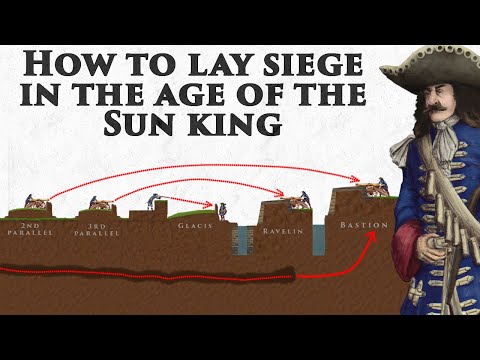
Vauban’s approach was methodical, almost surgical. He had spent decades perfecting the art of siegecraft, and at Ath, he would demonstrate his genius with a chilling efficiency. The French army, 40,000 strong, surrounded the town while another 140,000 men formed observation armies to keep relief forces at bay. Inside the fortress, the defenders could only watch as the noose tightened.
“Things are going marvelously,” Vauban would later write. “I see with great pleasure that I know their works better than they do.” It was not arrogance—it was fact. The engineer had designed Ath’s defenses himself, and now he knew exactly where to strike.
The siege began with the construction of massive earthworks, a circumvallation that ringed the entire town. Thousands of civilians were conscripted to dig trenches, build palisades, and haul supplies. Meanwhile, Vauban’s engineers crept close to the walls under cover of darkness, studying every detail, looking for weaknesses that even the defenders had overlooked.
On the defender’s side, chaos reigned. The governor, a 65-year-old named Fernao Gastola Morales, was only in charge because better-suited officers had been captured before the siege began. His attempts to prepare were hampered by confusion and indecision. When a young prince, Anton Gunther of Unheld, took over, he ordered the burning of buildings outside the walls and flooded the ditches, but it was too little, too late. The French were already in position.
Vauban’s plan was a masterclass in efficiency. He would use ricochet fire—a technique he had pioneered—to bounce cannonballs along the defenders’ parapets, turning the covered way into a killing zone. He would advance his trenches in zigzags, protecting his sappers from enemy fire. And he would do it all with such speed that the garrison would be overwhelmed before they could mount an effective defense.
As the first shots were fired, the French artillery roared to life. The defenders’ guns answered, but their salvos were wasted—Vauban’s workers were still out of range. “All their salvo did was wasting powder, making noise, and revealing their exact range of fire,” one observer noted. The master engineer watched with a sneer, knowing that every wasted shot brought him closer to victory.
Within days, the trenches had advanced to within 300 meters of the counterscarp. The second parallel was dug, and the French guns were brought forward. The bombardment was relentless, smashing through palisades and clearing the covered way. The defenders, once confident, now huddled behind their walls, their fire diminishing as the French artillery found its mark.
Vauban himself was wounded during the assault, a musket ball piercing his collarbone. But he shrugged off medical attention, refusing to leave the field. “He was used to taking a hit from time to time,” his comrades noted. Nothing would stop him from completing his masterpiece.
The end came swiftly. The covered way was taken, the outworks fell, and the walls began to crumble under the relentless bombardment. The defenders, hopeless and abandoned, raised the white flag. The siege had lasted just two weeks—a record-breaking time for such a formidable fortress.
As the French flag rose over Ath, military engineers across Europe took notice. Vauban had not just captured a fortress; he had redefined the art of siegecraft. His methods would be studied, copied, and feared for generations. And the perfect siege of Ath would become the standard by which all others were measured.
The numbers told the story better than any chronicle could. The French had mourned just 50 dead and 250 wounded, while the garrison’s losses remained unknown but certainly devastating. Against a fortress Vauban himself had called nearly perfect, such figures seemed almost impossible.
Never before had a place been attacked with as much art and speed at the same time. The engineer’s own words, spoken without a trace of bragging, became the epitaph of Ath’s defiance.
Word of the siege spread through the courts and academies of Europe. Engineers pored over sketches of the zigzag trenches, the ricochet batteries, the cavaliers of earth raised to enfillade the ramparts. What Vauban had done at Ath was not merely a victory—it was a lesson written in powder and soil.
For the defenders, the lesson was harsher. They had trusted in walls designed by the very man who now dismantled them. Vauban knew their works better than they did themselves, and no bastion, however cutting-edge, could survive that kind of intimate knowledge.
When the white flag rose and the remnants of the garrison marched out on the seventh of June, the age of the impregnable fortress quietly ended. From that day forward, any commander who faced a Vauban-trained engineer knew the truth: the question was never whether the walls would fall, but how quickly.
So the perfect siege passed into legend—studied by history buffs, recreated by engineers, and whispered about in every bastion fort from Flanders to the Rhine. And the master of siegecraft returned to Louis with a wound in his collarbone and a reputation that would outlast every wall he ever broke.
But here is the question that lingers long after the smoke clears: if a fortress is only as strong as the mind that designed it, what happens when that same mind turns against its own creation—and what does that say about the walls we build today?






