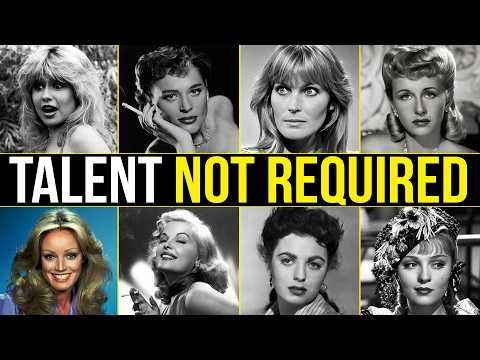
Pia Zadora had just won a Golden Globe for New Star of the Year, but the ceremony was weeks away from becoming a scandal. Her husband, businessman Meshulam Riklis, had spent millions to make her a star, and the film that earned her the award hadn’t even opened in New York yet. When it did, six days later, the backlash was immediate. Members of the Hollywood Foreign Press Association had been treated to a free night at Riklis’s Riviera Hotel in Las Vegas just weeks before the vote. Accusations flew that the Globe had been bought. CBS dropped its broadcast deal. Zadora and Riklis denied everything, but the damage was done. Riklis, however, was undeterred. He financed another major vehicle, The Lonely Lady, pouring in roughly half of its $6–7 million budget and refusing screen credit. He predicted it would make $5 million overseas and insisted the publicity alone was worth $10 million. Instead, the movie opened in 703 theaters and took in only about $1.2 million its opening weekend. It later won six Razzies, including Worst Picture and Worst Actress. Riklis eventually admitted, “We’re ashamed.” Yet even in 1985, he was still publicly predicting Zadora would become a superstar.
Zadora was far from the only actress whose career was fueled by a powerful man’s obsession. Bo Derek’s rise after 10 was followed by films built entirely inside her marriage. She produced and starred in Tarzan, the Ape Man, while her husband John directed and photographed it. The Washington Post called her acting range “teensy-weensy” and the film “an amateur night in the jungle.” But the money was real: Tarzan grossed $36.6 million in the U.S. and Canada, enough to keep the partnership going. Bolero pushed further—Bo starred and produced, John wrote, directed, and photographed. The MPAA gave it a preliminary X rating, so they released it unrated. It cost $7 million and grossed $8.9 million domestically. Then came the Razzies: nine nominations, six wins, including Worst Picture and Worst Actress for Bo. Six years later, Ghosts Can’t Do It tied for Worst Picture, and Bo and John again took home Worst Actress and Worst Director. Even Donald Trump won Worst Supporting Actor for his cameo.
Not every pet project ended in Razzie glory. Bella Darvi’s story was darker. Darryl F. Zanuck and his wife Virginia didn’t just bring her to Hollywood—they paid off her gambling debts, put her through acting lessons, and built her screen name from their own: Dar from Darryl, Vi from Virginia. Zanuck made her his protégé and lover, and Fox pushed her immediately. Helen Highwater paired her with Richard Widmark, but The New York Times said she “does not succeed convincingly.” That didn’t slow the campaign. She was cast as Nefer in The Egyptian, winning the role over Ava Gardner, and Hedda Hopper predicted she’d be one of the stars of 1954. But the performances never matched the promotion. Criticism focused on her limitations, including an accent that could be difficult to understand. Fox still moved her into The Racers opposite Kirk Douglas—her third major Hollywood vehicle in less than two years. Zanuck’s protection even extended to her love life: when he found out she was interested in Jean Evans, who was negotiating a major Fox contract, Zanuck canceled the contract plans. By late 1954, Darvi had left Hollywood for Paris. The Racers opened in 1955 and became her third and final American feature. Zanuck later summed up his effort in one sentence: “I was guilty of egomania.”
Sometimes the pet project was a family affair. Rob Zombie didn’t wait for his girlfriend Sheri Moon to build an acting career—he wrote House of 1000 Corpses with her in mind, casting her as Baby Firefly. That became the arrangement. He routinely wrote parts around actors he already wanted, and Sheri kept returning in his films: The Devil’s Rejects, Halloween, Halloween II, The Lords of Salem, 31, 3 from Hell, and The Munsters. Outside his projects, her screen work remained limited. The criticism became especially direct with The Lords of Salem. Roger Moore wrote that after making so many movies with her husband, Sheri “still had not learned a damned thing about acting,” adding that it was no wonder nobody but Rob puts her in his movies. Sheri never pretended otherwise. In 2016, she said she disliked auditions, didn’t actively chase outside work, and preferred working with Rob because she trusted him. Rob joked, “She turns down everything.” She pointed to positive experiences with Tobe Hooper and David Duchovny but said she was highly selective and didn’t want the normal audition grind. Rob kept casting her anyway. In 2022, more than 20 years after writing her first movie role, he made her Lily Munster in The Munsters.
Perhaps the most brazen pet project belonged to Herbert J. Yates, president of Republic Pictures. He kept building starring vehicles around the same actress, Vera Ralston, even after audiences repeatedly failed to follow. Director Joseph Kane, who worked with her on roughly a dozen pictures, described her as cooperative and hardworking but added one brutal judgment: “Although she never became a good actress, Yates kept assigning her major roles anyway.” By 1952, the man choosing the roles was also her husband. The conflict became public at Republic’s 1958 annual shareholders meeting. The company had lost $1,362,420 the previous year, closed most of its foreign distribution branches, and cut its domestic offices from 36 to 19. Shareholders demanded to know why Yates’ wife kept appearing in flop after Republic flop while he still collected a $150,000 salary. Yates’ answer was blunt: “We have one problem, getting out of the motion picture business.” Then the fight moved to court. In August 1958, stockholder Abraham Melzer filed a petition in New York State Supreme Court accusing Yates and 10 associates of nepotism and other acts intended for personal enrichment. He asked the court to dissolve the company to prevent further waste of assets. Another stockholder accusation claimed that 18 of the 20 films built around Ralston had flopped. Ralston retired from films that year. Victor M. Carter was already buying Republic stock and negotiating for Yates’ holdings. The sale closed on July 1, 1959. That same month, Carter replaced Herbert J. Yates as Republic’s president and chairman.
The pattern repeated across Hollywood. Fred Silverman, after backing Susan Anton at ABC, moved to NBC in June 1978 and made her one of the first performers he signed. Her deal called for a variety series plus guest appearances. He put her into Cliffhangers, where she starred in Stop Susan Williams, one of three serialized adventures packed into the same hour. The show was scheduled directly against Happy Days and Laverne & Shirley. Her character was repeatedly dropped into old-fashioned peril—hanging from ledges, facing a lion, even sharing a bubble bath with a real cobra. Anton later admitted the format had a basic problem: viewers who missed the beginning could struggle to follow the continuing story. The ratings confirmed it. An April episode drew only 17% of the audience and ranked 64th out of 67 programs. NBC canceled Cliffhangers after 10 broadcasts. An 11th episode had already been produced but never aired in the United States, so Stop Susan Williams ended before American viewers saw its final chapter. NBC was already giving Anton another showcase. Presenting Susan Anton premiered on April 26, 1979, while Cliffhangers was still on the schedule. The Washington Post wrote that Silverman thought she was “the cat’s meow” and that NBC believed in her likeability. In May, Silverman went even further, calling her “the Dinah Shore of the 1980s.” Presenting Susan Anton lasted four episodes. Its final broadcast aired May 17, 1979.
Zanuck’s obsession with Juliette Greco was different—he wasn’t trying to discover her; he was trying to turn a famous French singer into a movie star. While they were having an affair, he had her hair lightened, her nose straightened, and made sure she appeared in The Sun Also Rises. Then he kept giving her bigger pictures: The Roots of Heaven, Crack in the Mirror, and The Big Gamble. Film historian Peter Lev later identified all four Zanuck productions featuring her as money losers. The reviews kept giving warning signs. In The Roots of Heaven, Bosley Crowther wrote that Greco “slips into a drab decline as the film deteriorates.” Crack in the Mirror was dismissed by The New York Times as “cold and bloodless.” Zanuck himself later called it “a very second-rate film.” By The Big Gamble, Crowther wrote that “not even the volcanic Miss Greco can maintain her inner smoldering fire.” Zanuck still treated the films as personal projects. Director Richard Fleischer remembered that Zanuck normally trusted him and stayed away from the set. With Greco, that changed. Whenever she was filming The Big Gamble, Zanuck stood directly beside him, watching. Fleischer later described Zanuck as “a man possessed” and wrote that expensive gifts and movie roles became part of the obsession. What Juliette wanted, Juliette got. The Big Gamble opened in 1961 and became the fourth money-losing Zanuck production to feature her.
Hugo Haas gave Cleo Moore something Hollywood itself rarely did: leading roles. She appeared in seven of his films while Haas repeatedly wrote, produced, and directed low-budget melodramas built around the same blonde he had chosen as his favorite star. Columbia had bigger ambitions for her at first—the studio hoped Moore might become another Marilyn Monroe or Rita Hayworth. Instead, she remained largely trapped in B pictures. When Columbia signed Kim Novak and began promoting her as its new great blonde hope, Moore’s position became even weaker. The reviews did not make the case for her. Bait was built around Moore, Haas, and John Agar. The New York Times called the story “pitifully meager” and mocked the acting by all three. Haas kept casting her anyway. Columbia finally gave Moore top billing in Overexposed in 1956. Variety noted that her figure offered obvious promotional value but said her performance “seldom is credible.” Motion Picture Daily singled out Richard Crenna instead, predicting his performance could lead to starring roles. Moore asked to be released from her Columbia contract that year after a dispute over publicity obligations. Haas still gave her another lead. He cast her opposite himself and Vince Edwards in Hit and Run, returning once again to his familiar setup of an older man, a younger blonde, and jealousy. The film was released in 1957 and became the seventh Haas-Moore collaboration. It was also Cleo Moore’s final screen appearance.
Howard Hughes was not waiting for Faith Domergue to prove she could carry a film. He bought her Warner Brothers contract, paid for acting and diction lessons, and promised to make her a star before audiences had much chance to judge her. Vendetta was billed as the vehicle. Max Ophüls wanted James Mason and Madeleine Carroll as Domergue’s costars. Hughes vetoed the idea partly because he feared better-known performers would overshadow his inexperienced protégé. The protection went further. During the years of rewrites and reshoots, a major character was cut partly to give Domergue more screen time, and new writers were hired specifically to expand her role. All of that happened before the public verdict arrived. Where Danger Lives reached theaters first in 1950 opposite Robert Mitchum and Claude Rains. Time mocked Domergue as a graduate of Hughes’s “straining bodice school of dramatic art” and said she left the impression that her best work had been in publicity stills. The New York Times was similarly unimpressed, reducing her appeal to a sultry appearance and the ability to deliver simple lines. Hughes still released Vendetta as her major showcase later that year. The film had taken four years to reach theaters and gone through multiple directors while Hughes kept reshaping it around her. The reviews did not justify the effort. The New York Times called the acting unconvincing and described Domergue as “less than a fiery heroine.” After the Hughes-backed launch collapsed, she moved into smaller pictures, television, and science fiction B movies.
Samuel Goldwyn spent nearly $200,000 grooming Anna Sten before Nana was even finished—teaching her English, building a publicity campaign, and surrounding her with top Hollywood talent. Then the movie itself became a money pit. A version directed by George Fitzmaurice was scrapped after extensive shooting. Dorothy Arzner took over, major roles were recast, and the production restarted. By release, Nana represented an investment of about $1,000,000. Goldwyn still advertised her as his “million-dollar discovery.” Nana flopped, so he tried again immediately. For We Live Again, Goldwyn paid Fredric March $100,000 to take second billing, hired Rouben Mamoulian, Gregg Toland, and Alfred Newman, and even sent a second unit to the Soviet Union for background footage. The reviews were much better, and The New York Times praised Sten’s vitality, loveliness, and dramatic skill. Ticket buyers still stayed away. Goldwyn gave her one more major vehicle, The Wedding Night with Gary Cooper and director King Vidor. During a love scene, Sten repeatedly struggled to pronounce “Earth’s Return.” Vidor wanted to cut the phrase. Goldwyn refused and erupted that his career and reputation depended on the picture. Cooper privately nicknamed her “Anna Stench.” The irony was that Sten received some of her best reviews for the finished film. The box office failed anyway. After three expensive attempts, Goldwyn ended the experiment, and Sten agreed to cancel her contract. The Wedding Night acquired a Hollywood nickname that lasted much longer than the campaign itself: Goldwyn’s Last Stand.
Each of these women was given a launch most actresses would kill for—money, directors, co-stars, and headlines. What none of them could be given was the one thing that mattered: an audience that wanted to watch. The money bought the spotlight, but it could never buy the verdict.
Riklis kept predicting a superstar even after the Razzies. Goldwyn ended his experiment with a nickname that outlived the campaign. Yates lost his studio. And Sheri Moon, more than twenty years on, still turns everything down—except the parts her husband writes for her.
So who was the most infamous manufactured star of them all—Zadora’s bought Globe, Goldwyn’s million-dollar discovery, or Yates’s wife who sank a studio? Which one did Hollywood’s money fail hardest to turn into a star?






