The Douglas fir was three hundred feet tall and weighed two hundred tons. When it hit the ground, the crash echoed through the ravine like a cannon shot—and then the real work began. No roads. No bulldozers. Just mud-choked slopes, shattered stumps, and a log so massive it seemed to defy every law of physics. The men who faced it knew that moving this giant wasn’t just a job—it was a war against nature itself.
In the early days of American logging, the Pacific Northwest was a brutal adversary. Rain turned hillsides into slick chutes, and grades of 45 to 55 percent made standing upright a challenge, let alone dragging a forty-ton log. “A strong horse could pull about 2,000 pounds on a sled,” one old-timer recalled. “But that log weighed 80,000. That’s forty times what a team could budge—even on flat ground.” Animals collapsed from exhaustion, crushed by runaway timber. Men lost wages, limbs, and lives. Roads were a fantasy; building one through dense forest and ravines would take months of labor with tools that didn’t yet exist.
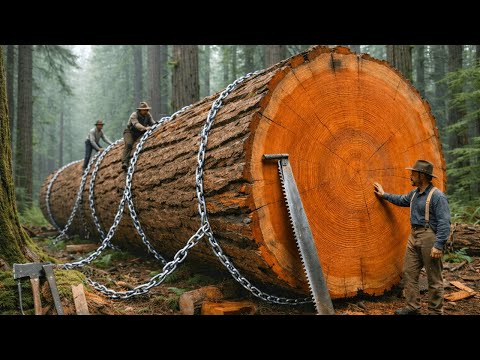
The ground itself set a hard limit. Distance from stump to landing stretched hundreds of yards—far beyond the reach of muscle alone. Each foot of progress meant fighting friction and inertia with every ounce of animal strength. And when a log dug into mud or wedged between stumps, the strain could snap a horse’s leg or drag a team backwards down a slope. “The value of a single log outweighed the lives of the animals hauling it,” a foreman wrote. It was a cold equation, but one that drove men to seek a new kind of power.
Steam changed everything. The steam donkey—part locomotive, part iron brute—stood on heavy skids, its firebox roaring, boiler hissing. A piston drove gears that turned a giant drum, winding up to 6,000 feet of steel cable. With a pull measured in tens of thousands of pounds, it could drag a log inch by inch out of a ravine or up a muddy slope, all while the machine stayed anchored in place. The crew kept this iron animal alive: firemen shoveled coal, watching the pressure gauge climb toward 180 pounds per square inch; the donkey puncher stood at the throttle, eyes on the cable; and the whistle punk, stationed where the logs were hooked, relayed signals with one blast for stop, two for go ahead slow, three for emergency, four for the choker is tight.
“There was no room for mistakes,” a donkey puncher remembered. “A missed signal could mean a crushed hand or worse.” Everything depended on timing and trust—the fireman’s steam, the puncher’s throttle, the whistle punk’s code—all working in concert to move a single log a few hundred feet closer to the landing. The ground was still an enemy, but now, for the first time, human ingenuity and steel could outmatch mud, gravity, and distance.
The next leap would come from lifting logs clear off that ground. High-lead rigging changed the rules of the forest. Instead of dragging logs over every stump and through every mud hole, crews began lifting them into the air. The heart of this system was the spar tree—a living Douglas fir, straight as a mast, stripped of branches and topped by hand. Some spars stood 150 to 200 feet above the ground, chosen for their strength and anchored by thick guy wires tied to stumps and boulders. A high climber, wearing iron spurs and a leather belt, would ascend the spar with an axe and a handsaw. At the top, sometimes swaying in the wind, he would cut away the crown. The tree would shudder and whip as the top fell, but the climber clung on, then set about rigging heavy steel blocks and pulleys that would carry the working lines.
Down below, a cable as thick as a man’s thumb ran from the steam donkey up through the block at the peak of the spar, then out hundreds of feet into the woods. Choker setters worked fast and close to danger, wrapping a wire rope called a choker around a log and signaling the donkey crew to pull. When the main line tightened, the log would rise, scraping free of the slash and stumps that stopped ground skids cold. With the log hanging a dozen or more feet in the air, friction dropped by half or more. What once took hours of muscle and risk now happened in minutes. Hallback lines and skylines allowed logs to be moved back and forth across ravines, lifted clear of the worst terrain. The whole system depended on tension—steel cables stretched to their limits, pulleys groaning, every man’s life in the hands of the crew and the strength of the spar.
The scale was staggering, but so was the danger. Every lift was a bet that the cable would hold, that the knots were true, and that the forest would not take back what men tried to claim. A choker setter crouches in the brush, hands slick with rain and sap, looping a wire rope around a log the size of a boxcar. The whistle punk’s call cracks through the trees. The donkey puncher eases the throttle. Steel cable tightens, humming with invisible force. But when a log hangs up—caught on a stump or wedged in the mud—tension spikes in an instant. The cable stretches, straining against forty or sixty tons of dead weight. There is no warning, just a sudden, sharp report. The line snaps.
It does not fall. It whips through the air at more than one hundred miles per hour—faster than a car on the highway, faster than any man can run. In that moment, a logger standing in the wrong place may never see what hits him. The old-timers called it invisible death. Records from the era are blunt: in some years, cable snaps ranked among the deadliest hazards in the woods. Choker setters, closest to the action, were the most likely to pay the price. One bad splice or a hidden flaw in the wire could turn a routine pull into a fatal accident—thousands of foot-pounds of stored energy released in a blink, slicing through brush, timber, and flesh alike.
Yet the math behind the danger made it hard to stop. A yarder or steam donkey cost ten thousand dollars—more than most men would see in a lifetime. But at Simpson Logging Camp 5, output after high-lead rigging tripled in just two years. Machines paid for themselves in six months. With labor cheap and logs precious, the risk became part of the calculation. Fatalities climbed, but so did profits. For every man lost, hundreds of logs reached the landing. The cable’s deadly promise was simple: more wood, faster, whatever the cost.
Still, the men who worked the rigging were not reckless. They were professionals, and the best of them survived on instinct honed by years in the brush. A choker setter learned to read the tension in a line by the sound it made—a low hum meant the pull was steady, a high whine meant trouble. The whistle punk watched the spar as much as the signal wire, because a spar tree under load could split and come down like a falling mountain. “You watched the top of that tree like you watched your own wife,” one rigging slinger said. “If she started to lean, you ran. You didn’t ask questions.”
By the 1920s, the technology had matured. Steel towers began replacing wooden spar trees on the biggest operations—taller, stronger, and reusable from one landing to the next. The towers arrived in pieces by rail and were bolted together on site, their lattice legs anchored to concrete blocks. The steam donkey gave way to diesel and then to electric yarders, and the cables grew longer and stronger. But the essential choreography never changed: the choker setter in the brush, the whistle punk with his wire, the engineer at the throttle. Three men, a length of steel, and a log that could crush them all.
What the old crews left behind is still visible today. Walk through a second-growth forest in the Pacific Northwest and you can find them—rusted cables coiled around stumps, iron chokers half-buried in moss, the gray skeleton of a spar tree still standing with its top cut flat. These are the scars of progress, reminders that every board and beam in the growing nation was pulled from the woods by men who traded danger for distance. The cost of conquering nature shifts with every new machine, but it never vanishes. What we build today leaves marks that outlast us.
The men who worked these rigs rarely spoke of the fear. They spoke of the rhythm—the hum of the cable, the bark of the whistle, the groan of the spar. “You didn’t think about dying,” one old choker setter said. “You thought about the next log. The one after that. You thought about getting home.” That was the code of the woods: keep your hands moving, your eyes open, and your mouth shut.
By the time the last old-growth giants fell, the Pacific Northwest had fed a nation’s hunger for timber—schools, ships, railroads, homes. The steam donkey and the spar tree were relics, replaced by towers and trucks and chainsaws. But the men who rigged those first lines had proved something: that human ingenuity could outmatch mud, gravity, and distance, even at a terrible price.
Today, the forests have grown back thick and green, hiding the old skid roads and rusted cables. But walk deep enough and you’ll find them—the scars of a war that built America. The cost of progress shifts with every new machine, but it never vanishes. The question is not whether we leave marks, but what we remember of the men who made them.
So here’s what I want to know: Should the loggers who risked everything for America’s growth be remembered as heroes—or as cautionary tales? Tell me in the comments below.






