In February 1943, the Tunisian desert was littered with the burning husks of American tanks. German soldiers of the 10th Panzer Division strolled through the wreckage, smoking Lucky Strikes and laughing. They had just annihilated the US II Corps at Kasserine Pass, and they believed they had seen the true face of the American soldier: soft, disorganized, and cowardly. They were catastrophically wrong.
This is not a story of a battle won or lost. It is a forensic audit of how an entire military machine processed its own humiliation and rebuilt itself into the most terrifying force on Earth—in just six weeks.
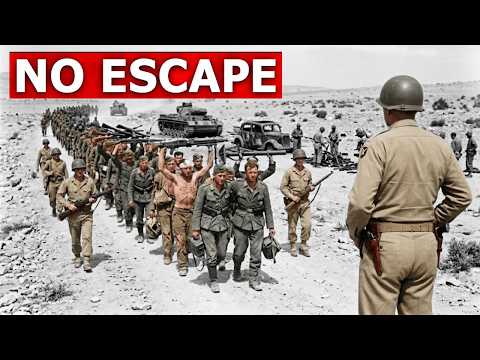
The Germans saw the disaster at Kasserine as proof of American weakness. General Fredendall had commanded from a bunker 70 miles behind the lines, his troops scattered in isolated pockets, their radios silent. When Rommel’s panzers struck, the American line shattered. Over 6,300 casualties. A chaotic rout. The Wehrmacht concluded that democracy could produce tanks but not warriors. “They are amateurs,” German officers wrote in their reports. “They will break every time.”
But while the Germans celebrated, something cold and mechanical was already happening inside the American command. Dwight D. Eisenhower did not cover up the disaster. He ordered a forensic accounting of every failure—leadership, doctrine, communication. The diagnosis was brutal: the system was broken. The solution was equally brutal: replace the broken parts and rewrite the software.
Lloyd Fredendall was removed and sent home in obscurity. In his place, Eisenhower summoned George S. Patton—a man who understood that war was not an administrative puzzle but organized violence. Patton arrived with a mandate for shock therapy. He ordered officers to the front lines. He fined soldiers for not wearing helmets. “When a subordinate reported no officer casualties, Patton exploded—it proved his officers weren’t leading from the front,” one aide recalled.
At the same time, American industry was performing a miracle of its own. Ships loaded with brand-new Sherman tanks, half-tracks, and radios streamed into North Africa. The losses that the Germans believed would cripple the II Corps for months were erased in weeks. But material alone doesn’t win wars. The true transformation was doctrinal.
The Americans had fought three separate wars at Kasserine—infantry, armor, and artillery uncoordinated. Patton forced them to train together, to live together, to communicate. The SCR-300 backpack radio became the nervous system of the new army. A lieutenant pinned down in a ditch could now call down a devastating artillery strike within minutes. The technique was called Time on Target—every shell from every gun arriving at the exact same second, with no warning. “One moment a German company would be walking in silence. The next, the entire grid square would detonate,” a survivor later said.
By late March 1943, the 10th Panzer Division prepared to attack again, expecting the same frightened amateurs. They rolled into El Guettar Valley with confidence. They found something else entirely.
The German tank commanders, standing half-exposed in their cupolas, saw nothing but empty desert and rocky slopes. No American tanks charging to meet them. No panicked infantry fleeing. Just an unnatural, waiting silence. It was the silence of a system that had already calculated their destruction.
At 6:00 AM, the lead Panzer Mark IV struck a buried mine. The explosion sheared off its tracks and slewed the thirty-ton machine to a halt. It was not a random accident. It was the trigger.
Forward observers of the US 1st Infantry Division spoke quietly into their SCR-300 radios. Miles behind the ridgeline, fire direction centers converted those coordinates into firing solutions. Dozens of 105mm and 155mm guns answered—not one by one, but in perfect mathematical unison.
The entire valley floor erupted in a single, synchronized apocalyptic shockwave. Because of the Time on Target calculation, there was no warning whistle, no distant boom. The sound of firing and the arrival of the shells were outpaced by the ordnance itself. Hundreds of high-explosive rounds detonated at the same fraction of a second, directly above the German formation.
Airburst fuses turned the shells into aerial shotguns. The motorized infantry—supposed to dismount and protect the tanks—was obliterated instantly. Half-tracks flipped onto their sides. Motorcycles shredded into burning metal. Survivors were pinned to the earth, blind and deaf in the smoke and roar.
The Panzers slammed their hatches and tried to maneuver, but they had lost their infantry screen. They were blind, alone, and trapped inside a pre-planned artillery grid. And the artillery was only the anvil.
The hammer was waiting in the wadis. Camouflage netting fell away from the M10 tank destroyers of the 601st Battalion. Their three-inch high-velocity guns barked with a flat, sharp crack. Armor-piercing rounds punched clean through German steel that had seemed invincible at Kasserine. Turrets blew off chassis. Ammunition racks cooked off in internal infernos.
General Wolfgang Fischer watched through his field glasses and could not comprehend what he was seeing. This was not the same army he had beaten six weeks earlier. These Americans did not panic. When a German tank closed on an infantry position, the riflemen held their foxholes and let it roll over them—then poured point-blank fire into the infantry following behind.
By late afternoon, the 10th Panzer Division had lost thirty tanks—more than half its attacking force. Fischer ordered a humiliating general retreat, leaving his dead in the valley. The survivors carried back a terrifying realization: the amateur Americans had not merely beaten them. They had scientifically dismantled them.
The veterans of El Guettar returned to their lines in shock. They described a wall of exploding steel that materialized from nowhere, an enemy that did not react to German maneuvers but simply deleted the grid square they occupied. This was the moment the fear took root.
It spread through the Afrika Korps like a slow, creeping dread. The Americans were not a static entity to be judged by a single battle. They were a learning organism that fed on its own mistakes—analyzing every German tactic, engineering a countermeasure, and deploying it with overwhelming force within weeks.
The British took months to adapt, bound by committees and doctrine. The Americans adapted almost instantly, driven by a ruthless pragmatism that valued results above tradition. El Guettar was the proof of concept. The defective parts had been replaced, the software rewritten, and the machine tested under the most extreme conditions.
The ledger was balanced in blood and burning steel. Thirty German tanks permanently deleted. Hundreds of irreplaceable Afrika Korps veterans dead. On the other side, the American 1st Infantry Division had held its ground and shattered a superior armored force.
The accounting was undeniable. The system had worked. But the men who survived El Guettar understood something the Germans still could not grasp. This was not the end of the lesson. It was only the first field test of a doctrine that would soon be unleashed across Sicily, Italy, and the killing fields of Western Europe.
Patton’s Third Army wheeled 90 degrees through frozen roads to relieve Bastogne. The green troops of the 99th held Elsenborn Ridge, calling artillery onto their own positions. When the Germans demanded surrender, the reply was one word: “Nuts.”
The Bulge was the final exam—and the system passed. The German offensive died not in Wagnerian glory but in a frozen slaughter beneath a rain of American steel.
Kasserine was never a defeat. It was an involuntary audit. The graves in Tunisia and Normandy were the tuition paid to teach the US Army how to become unstoppable.
So here is the question that still divides historians: was this cold, mechanical process of learning and overwhelming firepower the true future of war—or did it strip conflict of its last remnants of humanity? What do you think?






