“Dust off! Dust off!” The radio crackled with desperation. In the jungles of Vietnam, this call signaled life or death. For the medics of the 283rd Air Medical Detachment, it was a call they answered over six thousand times in a single month.
Among them was Specialist 5 Marcelino Burgos from Brooklyn, Chief Warrant Officer T.C. Gibson Jr. from Philadelphia, Mississippi, and Captain Bill Colbert from Knoxville, Tennessee. Their mission: to rescue the wounded from the heart of battle, often at the risk of their own lives.
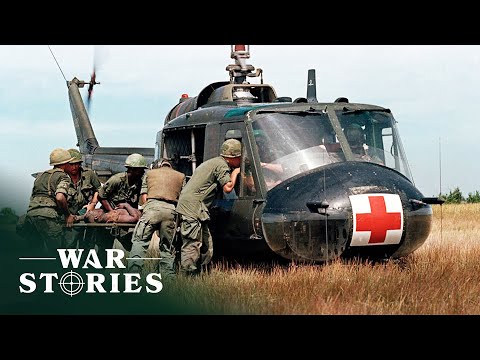
The Vietcong frequently mimicked their radio frequencies, ambushing rescuers. The red cross on the helicopter offered no protection—they carried weapons only for their patients’ defense, not their own.
On this day, a patrol was ambushed and pinned down. The medic team scrambled. “We have purple smoke,” came the report. As they approached, the jungle erupted with gunfire. The helicopter descended into a hail of bullets, rotors slicing through the humid air.
Meanwhile, in a small village, a young mother’s daughter was shot while riding her bicycle. She would be dead within the hour. Four members of that family had already died that afternoon.
Captain Lloyd J. Easton, a former drugstore manager from Oregon, now served as an executive officer. The work was different here—each life saved was a small victory.
“Dust off 31, we’re coming in,” the pilot radioed. On the ground, the element call sign was Alpha Mustang Alpha 5. They threw smoke to mark the landing zone.
Two patients were on board: one with a gunshot wound, the other, Dennis Aldrich, had stepped on a claymore mine. A metallic fragment had shattered his spleen, destroyed part of his kidney, and lodged in his lung. He couldn’t be given anesthetic and live.
The prognosis was questionable. Some wouldn’t make it. But for those who did, this was just the first stage in a journey that would stretch 9,000 miles to home.
Mission 404 was done. But 405, 406, 407, and countless others awaited. The chopper medic’s day was far from over.
In Saigon, a remodeled and guarded apartment building housed the Far Eastern Joint Medical Regulating Office. Navy, army, and air force personnel worked side by side in this quiet headquarters. From here, the life of every casualty was guided to the hospital best equipped to heal him.
A teletype machine clattered to life. “Change in destination—Aldrich, Dennis D. Wound, left back.” Through the fingers of the teletype, the world learned a soldier had been struck down. His rank, condition, and needs were noted, and hospitals across the globe were alerted.
Far away at Scott Air Force Base in Illinois, General Howell Estes presided over the daily briefing. “There are thirty-three C-141 missions moving today,” an officer reported. Aerovac flights, channel traffic, embassy runs—all coordinated under one roof.
“How about this urgent case en route to Kelly?” the general asked. A burn patient, thirty-five percent of his body seared, needed the Brooke Army Hospital burn center. A flight surgeon was already aboard.
Weather reports followed—thunderstorms in the Philippines, fog at Taipei, light turbulence along the Pacific routes. Every detail mattered when lives hung in the balance. The general listened, nodded, and gave his approval.
In the weeks since, Dennis Aldrich had passed through several hospitals—the Third Surgical, the 97th Evacuation, the 377th. Each stop brought more surgery, more repair to his shattered body. Now he was arriving at Clark Air Base in the Philippines, where Dr. Louis Patterson, a noted chest surgeon, waited.
“When he got here, our X-ray showed this retained large metallic fragment in the left upper lobe,” Dr. Patterson explained. “It is our policy to remove these fragments because we know they will get into trouble sooner or later.”
The injuries in this war were different. The M-14 rifle fired a missile far faster than those of previous wars, imparting enormous energy that killed tissue far from the bullet’s path.
Dr. Patterson remembered the first patient he lost to a pure chest injury—a young man whose right lung was practically destroyed within twenty-four hours. He had chosen to patch the remaining lung rather than remove it entirely. The choice had been wrong. The boy died of infection.
“You never forget that type of patient,” he said quietly. “Yet on the other hand, it made me work all the harder.” And work he did, achieving remarkable success in primary repairs of wounded lungs.
Three days after Dr. Patterson emerged exhausted from his operating room, Dennis took his first unaided steps. These quiet steps were a victory for all who had held his future in their hands. The journey was not over, but he was on his way.
Air Force nurses Captain Dorothy Brooks and Marge Selger, specially trained to man an airborne hospital, prepared twenty-five patients for the next leg—from Clark through Japan to the United States. Their days were not measured in hours; they were on constant call.
“Good morning, Dennis. How are you this morning?” Captain Brooks asked. “Feeling like going home yet?” Dennis managed a tired grin. “Am I ready.”
Nearby lay Raymond Hagel, a paraplegic after a bunker collapsed on him. Brooks knelt beside his litter. “Where’s your home?” she asked gently. “Philadelphia,” he said. “Say hello to Philadelphia for me,” she replied.
The C-141 was no plush airliner—“a box, a wing, the way home,” as one boy put it. In ninety minutes it was transformed into a hand-crafted hospital ward: comfort pallets, oxygen inches from every face, medication within reach. Patients weren’t cargo, weren’t passengers—patients were patients.
No doctor flew aboard. The chief medical officer was the nurse in charge. “It can be frightening to think someone else’s life is in your hands,” Brooks admitted, “but there’s no one else around. All you can do is hope you make the right decisions.”
She understood something deeper: “We would be their mirror—how we reacted to them would shape how they saw themselves.” Some men were afraid to voice their fears, lest it seem unmanly. But in that shared loneliness of nurse and patient, no words were needed.
Night fell over the Pacific. Sunset brought healing sleep, and sometimes dreams—flashes of explosions, of the medic yelling for a helicopter. Dennis dreamed of the rice paddy, the deep water at his knees, the blast that threw him down.
At 826 Forest Street in Stevens Point, Wisconsin, a family nervously waited. Five sisters, two brothers, a mother and father—no girlfriend, just a family. He need not be a hero. He need only return safely. For every surviving soldier is a hero.
The wheels touched down on American soil. The long bandage of care—stretching 9,000 miles—had finally reached his own bed. Mission 404 was finished. But for the men and women of dust-off, the numbers would keep counting for as long as they were needed.
So tell us: when you hear “Dust off!” echoing across the rice paddies, what do you think of first—the courage of the crew, or the fragility of the boy on the litter?






