The darkness on Hill 107 was absolute, broken only by the distant flash of artillery and the crackle of distant gunfire. Lieutenant Colonel Leslie Andrew, his head wrapped in a bloody bandage from a shrapnel wound, stared into the void where his companies should have been. Silence. No runners, no reports, no reinforcements—only the creeping certainty that the German paratroopers were closing in on the airfield below.
It was 10 p.m. on May 20, 1941, and the first day of the German invasion of Crete had been a maelstrom of chaos and blood. Andrew’s 22nd New Zealand Battalion had fought ferociously, but now they were blind, deaf, and dangerously exposed. The fate of the entire island hung in the balance, and Andrew had to decide: hold the high ground and risk annihilation, or withdraw and hand the enemy the keys to Crete.
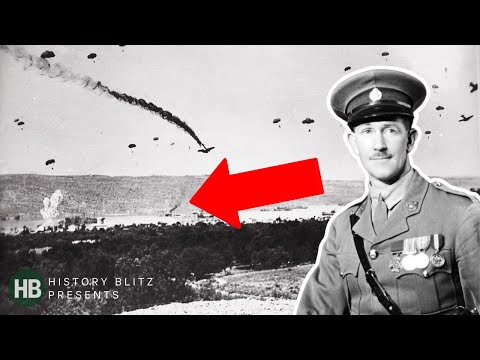
Just hours earlier, the skies had darkened with hundreds of German transport planes, unleashing the first major airborne assault in history. Elite Fallschirmjäger paratroopers descended in waves, targeting the three vital airfields at Maleme, Rethymno, and Heraklion. On Hill 107, the New Zealanders had met them with a hail of bullets, cutting down many before they even touched the ground. For a moment, it seemed the defenders might hold.
But the Germans kept coming, and the communication lines that bound Andrew’s battalion together snapped under the onslaught. C and D companies, positioned around the airfield, went silent. HQ was unreachable. Andrew, moving from trench to trench under relentless bombardment, sent runners to Brigadier Hargest requesting reinforcements. None came.
As night fell, Andrew weighed his options. He had no way of knowing if his companies still held their positions or had been overrun. If he stayed, his remaining men risked being overrun by morning or decimated by the Luftwaffe’s dawn bombardment. The political pressure not to lose the 22nd Battalion—a significant component of the New Zealand Army—weighed heavily on him. With a heavy heart, he gave the order to withdraw.
The decision rippled through the darkness. C Company, still holding the airfield, did not learn of the withdrawal until morning. By then, it was too late. Hill 107 and the Maleme airfield were left undefended, and the Germans seized their foothold on Crete.
But why was this tiny island so crucial? To understand, we must rewind a few weeks to the Battle of Greece, where a chain of events set Crete on its collision course with history. Greece had been neutral until Mussolini’s Italy invaded in October 1940, prompting Britain to pledge support. British troops arrived on Crete, allowing Greek forces to redeploy north. The Greeks, against all odds, pushed the Italians back into Albania, but their success exposed Hitler’s southern flank.
With Operation Barbarossa looming, Hitler could not afford a British foothold in Greece that threatened the Romanian oil fields—his only fuel source once the invasion of the Soviet Union began. Germany moved to intervene, and the Balkans erupted in flames.
On April 6, 1941, the Wehrmacht launched a swift invasion of Yugoslavia and Greece. The Allies, outmatched and outflanked, were pushed into a fighting retreat. By April 30, some 50,000 troops had been evacuated to Crete, but many arrived without heavy equipment or supplies. The island was now garrisoned by a mix of British, Australian, New Zealand, and Greek forces, placed under the command of Major General Bernard Freyberg.
Freyberg faced an impossible task. The three airfields were vital, but he lacked the manpower to defend them all. The New Zealand division, including Andrew’s 22nd Battalion, was positioned in the west to defend Maleme and Hill 107. Anticipating a seaborne assault, the Allies were aware of the possibility of an airborne attack—but they were not fully prepared for the scale of what was coming.
On the morning of May 20, the Luftwaffe unleashed its paratroopers, and the battle for Crete began. The defenders at Rethymno and Heraklion held firm, but at Maleme, the situation teetered on a knife’s edge. Andrew’s battalion, though bloodied, had not broken—yet. But as night fell and the silence from his companies grew louder, Andrew made the call that would echo through history.
In the days that followed, the consequences of that decision unfolded with brutal speed. German engineers, working through the night, cleared the Maleme airstrip of wrecked gliders and craters. By the morning of May 21, Junkers Ju 52 transports were already touching down, disgorging fresh mountain troops and heavy weapons that the Fallschirmjäger had desperately lacked on the first day. What had been a knife’s edge now tipped decisively toward the invaders.
Andrew’s men, dug into their secondary positions, could only watch as the airfield they had defended so fiercely became the enemy’s lifeline. There was no time to dwell on it. The Germans pushed outward from Maleme, probing for weakness, and the 22nd Battalion found itself fighting a series of savage rearguard actions through olive groves and terraced hillsides.
Meanwhile, Brigadier Hargest’s headquarters remained largely in the dark about the true situation. Reports were fragmentary, contradictory, and often hours old. One moment a runner would gasp that the airfield was lost; the next, a stray signal suggested C Company was still holding. The fog of war, thick enough on any battlefield, was near impenetrable on Crete.
It was against this backdrop of confusion that the Allied commanders made their own fateful choices. Freyberg, under pressure from London and desperate to reclaim the initiative, ordered counterattacks to retake Maleme. But the units earmarked for the assault were scattered, exhausted, and uncertain of the enemy’s strength. Two battalions of the New Zealand 5th Brigade were thrown forward on the night of May 21-22, only to find the Germans dug in and waiting.
The counterattack faltered in the darkness. Men who had fought for two days without sleep stumbled into ambushes. Tanks that should have spearheaded the assault broke down or were knocked out by German anti-tank guns. By dawn, the survivors were back where they started, having suffered grievous losses for no gain.
With the counterattack failed, the initiative passed irrevocably to the Germans. They now held the airfield, the high ground, and the momentum. Freyberg’s forces were forced onto the back foot everywhere, fighting not to hold ground but merely to delay the inevitable.
It is here, in the chaotic withdrawal across the island, that the story of Crete shifts from grand strategy to the raw courage of individual soldiers. The fighting retreat toward the southern coast would produce moments of extraordinary heroism—and none more legendary than the bayonet charge at 42nd Street.
The road known as 42nd Street ran south from Chania, a dusty ribbon winding through olive groves and terraced hills. It was the main artery of the Allied retreat, and by May 27, it had become a choke point of desperate importance. Australian and New Zealand rearguard units dug in along the roadside, their faces grey with exhaustion, their ammunition running low.
Among them were men of the Australian 2/7th Battalion and the New Zealand 28th (Māori) Battalion—troops who had already given everything they had and were now asked to give more. They knew that behind them, thousands of their comrades were stumbling toward the evacuation beaches at Sfakia. Every hour bought was an hour of life.
On the morning of May 27, the German mountain troops advanced in force down the road, confident and methodical. They expected a beaten enemy, a rearguard already broken in spirit. What they found instead was a line of men who had decided that if they were to die, they would do it with bayonets fixed.
The order came from Brigadier Lindsay Inglis and Lieutenant Colonel Colvin: counterattack. The Australians and New Zealanders rose from their trenches and charged straight into the German advance. The shock was absolute. Mountain troops who had swept aside resistance for days suddenly found themselves face to face with screaming soldiers in close-quarters combat.
The fighting was savage and intimate—rifle butts, bayonets, and bare hands. In the olive groves, the Germans faltered, then broke. The charge drove them back, inflicting heavy casualties and shattering the myth of invincibility that had surrounded the Fallschirmjäger and Gebirgsjäger alike.
It was a victory measured not in ground gained but in minutes bought. The rearguard held long enough for the main body to slip further south, toward the fishing village of Sfakia and the promise of rescue.
But the cost was steep. The men who charged at 42nd Street were the same men who had fought on Hill 107, who had watched Maleme fall, who had trudged through dust and blood for a week without proper sleep or food. They were running on fumes and sheer will.
As the sun set on May 27, the rearguard pulled back once more, leaving behind the dead and the dying. The road to Sfakia lay open, but the German pursuit was relentless. There would be more roadblocks, more desperate stands, more men left behind to cover the retreat of their comrades.
And at Sfakia, the Royal Navy was waiting—but so was the Luftwaffe, and the evacuation would prove as costly as the battle itself.
The evacuation from Crete was a nightmare of moonlit beaches and burning ships. German bombers swept low over Sfakia, strafing the queues of exhausted men waiting for rescue. Royal Navy destroyers, packed to the gunwales, slipped away into the darkness while soldiers who had fought for ten days watched them go. Some 12,000 men remained on the island when the last ship departed.
Among those left behind was Colonel Campbell at Rethymno, who surrendered his garrison on May 30. At Spakia, the final 5,000 defenders laid down their arms on June 1. The swastika rose over Crete—but the victory was hollow.
Hitler never again authorized a major airborne operation. The Fallschirmjäger, the elite of the German military, had been shattered on Crete; they would spend the rest of the war as elite infantry, never again descending from the sky in force. The island was won, but the paratrooper arm was effectively destroyed.
For Leslie Andrew, the withdrawal from Hill 107 became the defining burden of his life. He was awarded the Victoria Cross for his earlier war service, but the decision on that dark May night haunted him. Historians have debated it ever since—was he right to pull back, or did he hand the Germans the one airfield they needed?
The men of the 22nd Battalion, the Australian 6th Division, and the New Zealand 2nd Division would fight again in North Africa and Italy, their ranks rebuilt, their spirit unbroken. But Crete remained a scar—a battle that might have gone differently.
Easy for us, safe in our armchairs, to second-guess a wounded man in the dark, with no communications and no reinforcements. But that is the historian’s privilege and the soldier’s curse.
So here is the question: if you were Leslie Andrew on Hill 107 that night—blinded by silence, bleeding from a head wound, hearing the enemy close in—what would you have done? Would you have held the high ground at all costs, or pulled back to save your men? Let us know in the comments below.






