High above enemy territory, Captain Robbie Risner faced an impossible choice. His wingman’s jet was crippled, fuel pouring out, and below lay North Korea. Ahead, the Chinese border. He could turn for home and save himself—or attempt something no jet pilot had ever tried.
“I’ll see you back at base,” his wingman, Lieutenant Joe Logan, had said. But would he?
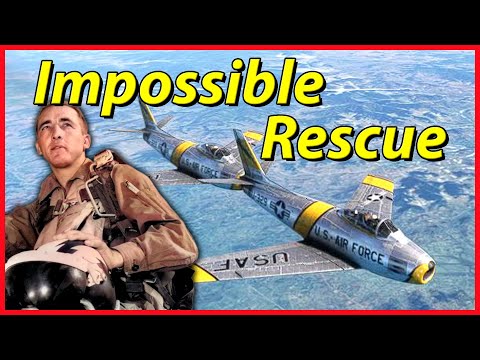
It was September 15, 1952. The Korean War raged on, and in the sky near the Yalu River—MiG Alley—American F-86 Sabres patrolled daily. Captain Risner, a seasoned pilot, led one such mission, escorting fighter-bombers. Flying on his wing was his trusted friend, Joe Logan.
Near the Yalu, MiGs appeared, and the sky exploded into violence. Risner engaged in a fierce dogfight, while Logan stayed close, protecting his leader. As they climbed back across the river, ground fire struck Logan’s Sabre. Fuel and hydraulic fluid streamed out. Capture seemed certain if he ejected over enemy territory.
Risner could have turned south, returned to base, and no one would have questioned him. But he didn’t. Instead, he stayed with his stricken wingman. Then, a remarkable idea took shape: what if he could push Logan’s jet to safety?
There was a rescue detachment at Chodo Island, 60 miles south. If Risner could get Logan there, bailout would be survivable. He told Logan to shut down his engine, turning the Sabre into a glider. Then, Risner eased his own F-86 behind him.
There was no handbook for this. He inched closer, carefully. The first contact was rough, forcing him to break away. He tried again, slower, more deliberate. Metal touched metal. For a moment, it held. But turbulence threatened to break them apart, and fuel sprayed over Risner’s windscreen, nearly blinding him.
Mile after mile, Risner nudged Logan’s powerless jet southwards. “It was the most difficult flying I ever did,” he later said. The jets separated repeatedly, and each reconnection risked collision. But Risner kept pushing.
At last, they reached Chodo. Logan ejected, his parachute opening cleanly. “I’ll see you back at base,” he had said. But tragedy struck: Logan became entangled in his parachute lines and drowned before rescuers could reach him.
Above, Risner circled in silence. He turned south for home, his aircraft battered, nose damaged, windscreen smeared. He landed at Kimpo with little fuel left. The loss of his wingman devastated him.
Yet, the Air Force recognized the extraordinary nature of his attempt. Risner was awarded the Silver Star. He would go on to become a double ace in Korea, but greater trials awaited him in Vietnam, where he was shot down and endured seven years as a prisoner of war.
Robbie Risner never called himself a hero. He believed he had simply done what any wingman should do: stay with your friend for as long as you possibly can. He couldn’t leave a man behind.
That is why his story endures—not because of jets or victories, but because it speaks to loyalty, duty, and the bond between those who fly together.
But the story of Robbie Risner does not end with that lonely flight home from Chodo. The Silver Star was pinned to his chest, the citation read aloud, and the Air Force moved on to the next mission. Risner, however, could not move on so easily. In the quiet hours after the ceremony, he kept replaying the final moments—the clean white bloom of Logan’s parachute, the slow drift toward the water, the way the wind had carried him just beyond the reach of the rescue boat.
He wrote to Logan’s family. Not a form letter, not a commander’s dutiful condolence, but pages in his own hand. He told them what Joe had done in those last minutes—how he had stayed calm, how he had trusted his leader, how he had joked on the radio even as his jet bled fuel. “He was the finest wingman a man could ask for,” Risner wrote. He meant every word.
What Risner did not tell them—what he told almost no one—was that he had already begun to think of the push as something else. Not a stunt, not a desperate improvisation, but a kind of promise made in metal and speed. A promise that said: I will not let you fall alone. It was a promise he would carry with him into every cockpit for the rest of his career.
Years later, when Risner was shot down over North Vietnam and dragged into the prison camps, that promise would be tested in ways no jet could prepare him for. There were no wings to rock, no radio to call on, no engine to push. There was only a man in a cell, and the choice—every single day—of whether to stay with his fellow prisoners or to save himself.
He chose to stay. He organized. He resisted. He took beatings meant for younger men and passed messages through walls with taps and whispers. In the dark of Hoa Lo Prison, Robbie Risner became a wingman again—not to one man, but to hundreds.
When he finally came home in 1973, he was asked, as all returning POWs were, how he had endured. His answer was quiet and unadorned. He spoke of faith, of discipline, of the men beside him. He did not mention the Silver Star. He did not mention the day he pushed a dying jet across sixty miles of hostile sky.
But others remembered. And in the years that followed, as Risner rose to brigadier general and then retired to a quiet life, the story of September 15, 1952, began to travel on its own—passed from pilot to pilot, from cockpit to cockpit, until it became something more than history. It became a standard.
Young lieutenants heard it and wondered if they would have the nerve. Old colonels heard it and remembered men they had lost. And somewhere in between, the truth of it settled: that the measure of a pilot is not always taken in victories, but in the moment when he chooses to stay.
There is a coda to the story, one that few outside the fighter community ever hear. In the decades after Korea, Risner was invited to speak at pilot training bases across the country. He never used notes. He would stand before a room of young aviators, most of them not yet old enough to have lost anyone, and he would tell them about Logan.
He described the feel of the contact—the delicate, terrifying balance of two jets flying as one, the way the air battered them apart, the way he had to fight to bring them back together. He described the spray of fuel on his windscreen, the silence of Logan’s engine, the long grey miles toward Chodo. And then he would stop, and look at them, and say something like: “The airplane doesn’t matter. The mission doesn’t matter. What matters is that the man on your wing knows you won’t leave him.”
He never told them what to feel about Logan’s death. He did not offer it as a lesson with a tidy ending. He offered it as a fact—the sea is unforgiving, the margin is thin, and sometimes the best you can do is not enough to save the man but is still worth doing.
Some of the young pilots went on to Vietnam. Some of them came home. Some of them, in their own bad moments, reached for the memory of Risner’s voice in that briefing room and found something to hold on to.
And there is one more thing, smaller and stranger, that belongs to this story. In the years after his retirement, Risner received a letter from a man he did not know—a former North Korean soldier, of all people, who had been stationed near the Yalu in the autumn of 1952. The man wrote that he had watched, from the ground, two American jets flying impossibly close together, one trailing smoke and fluid, the other nudging it southward across the sky.
He had not understood what he was seeing. He had only understood that it was not an attack. It was something else. He had carried the image with him for half a century, and now, old and far from that river, he wanted to know if the pilot was still alive, and whether he could be told that an enemy had watched him and had thought, in that moment, that he was witnessing something brave.
Risner wrote back. The letter was short. He thanked the man. He said that the pilot of the second jet had been his friend, and that the friend had not survived, and that he was grateful someone else had seen him try.
He did not say that he had been the other pilot. He did not need to. The man had known.
That is the shape of the story now—a silver star in a drawer, a statue at the Academy, a letter from an old soldier, and a name that pilots still say when they want to remind themselves what the word wingman actually means.
So when you think of Robbie Risner, don’t think of the medal or the general’s stars. Think of a man in a cockpit, windscreen smeared with fuel, holding two jets together by sheer will because he would not let go.
He couldn’t leave a man behind. Not over Korea, not in the prisons of Hanoi, not ever. That was the whole of his creed, and it never changed.
Today, when young pilots learn about wingmanship, they hear his name. They hear about the day he pushed a dying jet sixty miles toward a rescue that almost worked. And they understand something that no manual can teach: loyalty is not a tactic. It is a choice you make before you ever leave the ground.
The sea took Joe Logan. But it never took what Risner did for him. That flight endures—in statues and letters and the quiet conversations of pilots who still ask themselves the hardest question of all.
So here it is: if your wingman was going down, with no margin left and no guarantee of rescue, how far would you push? Would you stay? Tell us in the comments—what would you have done?






