The war was only weeks old when the first British soldier fell without a sound. No artillery barrage, no charge—just a single crack from somewhere beyond the trench line, and a life erased. In the autumn of 1914, the Western Front was still raw, a scar of fresh earth and improvised defenses. But in that chaos, a new kind of terror was already taking root.
Unseen German riflemen, armed with hunting scopes and a culture of stillness, were picking off men with chilling precision. A raised head meant a death sentence. A careless glance over the parapet invited a bullet through the skull. The Allies had no answer—not yet. But the pressure was building.
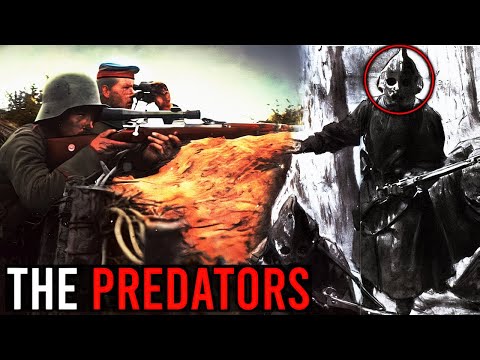
The trenches stretched from the North Sea to the Swiss border, a labyrinth of mud and wire where survival depended on invisibility. Yet the sniper thrived in this environment. He was patient, methodical, and utterly silent. “You never heard the shot that killed your friend,” one British officer recalled. “Only the flat thud downrange, and then the body slumping into the mud.”
At first, these killings were dismissed as stray bullets or chance fire. But the pattern was unmistakable. Officers, runners, observers—anyone who dared show themselves—fell in quick succession. The Germans were not just shooting; they were hunting.
From the Black Forest to the trenches, German hunters brought their skills to the front. The Duke of Ratibor, a nobleman with deep hunting roots, launched a campaign to collect civilian rifles with telescopic sights. Within months, thousands of scoped rifles reached the front, and with them, the best marksmen Europe had ever produced.
“Suddenly, British and French trenches became killing zones,” a German sniper wrote. “We studied them like game—their routines, their careless moments. And then we struck.”
Men like Gerrit Geyorg Hearnwriter, a former poacher, climbed trees overlooking enemy lines and picked off targets with impunity. Wounded twice, he refused to descend until he had over a hundred confirmed kills. His legend spread—the woodsman turned ghost.
The psychological toll was immense. British battalions reported losing ten to eighteen men a day to unseen marksmen. “We stopped showing our heads, even to eat or pass orders,” one soldier confessed. “Fear ruled us.”
But the Allies were not idle. The British, slow to adapt, eventually turned to Vernon Hesketh-Prichard, a relentless officer who argued that sniping was a craft, not an accident. By 1916, the first British sniping school opened its doors, teaching fieldcraft, range estimation, and the cold discipline of the scope.
The school at Linghem became a forge. Officers arrived skeptical, left converted. They learned to read wind from a blade of grass, to judge distance by the blur of a button, to wait for the exact moment a man forgot he was mortal. “It was not about shooting,” one instructor wrote. “It was about seeing first, and being seen never.”
From these classrooms, a new breed of marksman returned to the line. They carried notebooks filled with sketches of enemy parapets, notes on loopholes, timings of reliefs. They moved in pairs—one glass, one trigger—and they hunted the hunters.
But the Germans had not been idle. Their sniper schools, older and better supplied, churned out specialists with Zeiss optics and a doctrine of cold patience. The trench war had become a duel of lenses.
In the spring of 1916, near Ypres, a British sniper named Harold Cottrell spotted a glint in a shattered farmhouse. He waited three hours. At dusk, a German sniper raised his head to scan the British line. Cottrell fired once. The glint vanished. “That was the first time I killed a man who was looking for me,” he later wrote. “It felt less like war and more like murder.”
The kill was confirmed by an observer. But the moral weight lingered. Cottrell’s diary, preserved in the Imperial War Museum, records sleepless nights and a growing detachment. “I no longer see faces,” he confessed. “Only targets.”
This psychological shift was not unique. Snipers on both sides described a strange intimacy with their prey. They learned enemy routines, gave them nicknames, even felt a perverse grief when a familiar figure disappeared. “You watch a man for days,” a German marksman recalled. “You know when he shaves, when he writes letters. Then one morning you shoot him, and the trench feels empty.”
The Allies, meanwhile, began to close the gap. Canadian and Australian units, raised in the wilderness, brought a natural fieldcraft that rivaled the German hunting tradition. Their reputation grew. “The Canadians are devils,” a captured German officer admitted. “They hide in places no man should fit.”
Among them was Francis Pegahmagabow, an Ojibwa soldier whose confirmed kills would reach 378—a record that stood for decades. He worked alone, often ahead of the line, draped in burlap and patience. “I just wait,” he said. “The enemy always moves first.”
His methods were legend. He used a dummy head on a stick to draw fire, then waited for the enemy sniper to reveal himself. He never missed. “He was the most dangerous man in no man’s land,” a comrade remembered. “And the quietest.”
By 1917, the sniper war had reached its zenith. Both sides fielded thousands of trained marksmen, equipped with the finest optics and ammunition. The trenches were no longer just defensive lines; they were arenas of invisible combat, where a single shot could alter the morale of a battalion.
Yet the sniper’s war was not without cost. The constant vigilance, the moral burden, the isolation—it wore men down. “I dream of faces I never met,” one sniper wrote home. “They ask me why.”
And still, the war ground on. The snipers watched, waited, and fired. The front lines shifted, but the silent duel never ended.
The sniper’s war was not confined to the Western Front. In the Alps, where the mountains themselves seemed to conspire with the marksman, the Austro-Hungarian Empire held a natural advantage. Their trenches overlooked Italian lines, and their access to optics was far superior. Italian workshops in Milan and Turin scrambled to copy German designs, and training manuals ordered observers to retrieve a sniper rifle if its owner was killed—so the precious scope wasn’t lost.
“I had him well in my sights,” one Italian marksman recalled. “The boy’s pale face, wide eyes, blonde hair. I fired. He arched back, arms to the sky, and folded among the rocks. A moment of mechanical duty, then silence.”
Even the distant Gallipoli peninsula became a sniper’s paradise. The Ottomans lacked telescopic rifles, but from the ridgelines above the beaches, their sharpshooters looked straight down into Allied trenches, cutting down anyone who moved. It was here that Australian sniper Billy Sing earned his name—credited with up to 300 kills and dueling a mysterious Turkish marksman known as Abdullah the Terrible.
On the Eastern Front, the story was the same. The Russians had good riflemen but few optics. German snipers had the advantage, and men like Wilhelm Ens described it coldly: “I would lie there half an hour with the scope ready until some Siberian came into view. I’d pull the trigger as if on a robe. The thought that he’s a man, that he has a wife and child, always comes too late.”
By late 1915, the sniper had become a fixture of trench life. The novelty was gone. Now every front had its chosen watchers, each lying in wait for a face, a hand, a reflection of sunlight off a scope. For men like Ignaz Haum, life as a sniper felt almost privileged. “I do not need to do any sentry duty,” he wrote home, “and I am allowed to sleep at night while everyone else is on their feet. I feel like I am in heaven.”
His heaven, of course, was built on the quiet business of killing. Once both sides began training specialists, the trenches turned into an invisible battlefield of eyes and triggers. The static lines didn’t mean the war had gone still. Every day and night saw trench raids, artillery registration, and endless harassment fire. Scouts crept through no man’s land at dusk. Working parties built wire entanglements under moonlight. And all of them knew that one careless movement could end in a single whisper of lead from a hidden muzzle.
Most shots were taken between 100 and 400 meters, but the distance was less important than the angle. Each side refined tactics to match their terrain. Teams usually worked in pairs—one observer, one shooter. The observer watched through the scope, logging wind shifts, light changes, or enemy movement, while the shooter conserved strength and stayed ready. The Germans sometimes doubled this formation, fielding two pairs that supported each other: one drawing attention, the other waiting for the counter-sniper’s flash to answer with a kill.
Soon every major army adopted the periscope rifle—a crude but effective contraption of mirrors and wood that let a man shoot without exposing his skull above the parapet. If an enemy marksman caused too many casualties, battalion snipers would be called up to hunt him down. The cat-and-mouse duels began: hours of silence broken by a single shot, sometimes at a dummy helmet, sometimes at a real head.
The hierarchy of targets was coldly logical: enemy snipers first, then officers, artillery observers, machine gunners, and sappers. A sniper’s mission was never to kill indiscriminately. It was to disrupt the enemy’s command and observation. Sometimes shooting at a machine gun’s cooling drum achieved more than shooting the man behind it. The Germans countered with water-jacket armor plates and even issued special helmet shields for their gunners. None of it offered comfort.
To the average trench soldier, snipers were both savior and curse. Relief spread through the ranks when their own sharpshooter arrived to silence a persistent German marksman. Yet resentment followed close behind. The sniper would take his shot, slip away to his hidden post, and the retaliation would fall on the infantry who stayed behind. “I never liked them,” one British soldier put it plainly. “They’d shoot some poor Hun and bugger off, then we’d get it in the neck. Our officer used to chase them out, telling them to ply their murderous bloody trade somewhere else.”
There was no camaraderie between the line troops and the hidden hunter. They fought two entirely different wars.
By 1918, the trenches were breaking open. The sniper, once master of stillness, had to learn movement—advancing with infantry, clearing machine-gun nests, becoming an assault scout. “Two trained snipers will accompany every leading section,” British manuals now ordered. The hunter had become a spearhead.
On the German side, the retreat was bitter. Sniper-and-machine-gun pairs fought for time, not victory. A Canadian regiment at Le Catelet recorded the truth of it: “One Bosch sniper did more damage than four machine guns firing from the same position. The guns were located. The sniper was not.”
When the guns finally fell silent on November 11, the marksmen slipped away—back to farms, forests, and quiet streets. But the silence followed them. “For years after the war, I used to wake in the early hours and go walking to forget some of the things I’d seen and done,” one veteran confessed.
The Great War had birthed a new kind of soldier: patient, surgical, solitary. His lessons—optics, fieldcraft, cold precision—would return twenty years later, deadlier than ever. The modern sniper was no longer an experiment. He was here to stay.
And yet, a century on, one question still lingers in the quiet: when a man kills from a thousand yards, unseen and unseeing—does he carry the weight of that life, or does the distance carry it for him? Tell us what you think.






