They were promised adventure, uniforms, and a future. Instead, they became the fuel for the deadliest war in human history. The story of the Hitler Youth is not just about a paramilitary organization; it is a chilling account of how a regime systematically seduced an entire generation of children, turning them into fanatical soldiers willing to die for a madman. It began in the 1920s, in the shadow of Germany’s humiliating defeat in World War I, with a small group of young militants eager to fight for Adolf Hitler. But the true transformation would come later, when the Nazi Party realized that the key to their future lay in the hearts and minds of the nation’s youth.
In the beginning, the Hitler Youth was just one of many youth movements in Germany, offering camping trips, sports, and a sense of belonging to boys from all walks of life. “For many children, it was more than they could hope for,” recalls one former member. In a country crippled by economic crisis, the promise of free activities and a uniform that hid social differences was irresistible. But behind the façade of fun and games, a darker purpose was brewing. Hitler saw these young people not as children to be nurtured, but as raw material for his empire. “We are old, but my wonderful young people, what an amazing human resource they are. With them, I could build a new world,” he confided to his inner circle after witnessing a massive rally of 70,000 Hitler Youth in 1932.
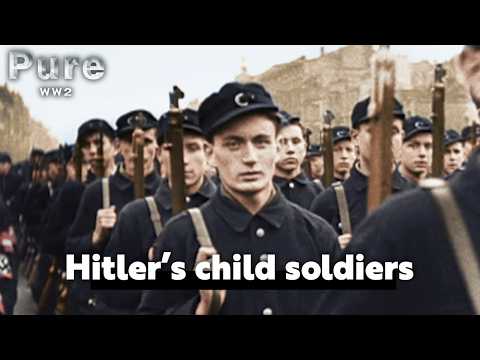
When Hitler seized power in 1933, the seduction became systematic. All rival youth organizations were dissolved or absorbed, and the Hitler Youth gained a monopoly on summer camps—the highlight of the year for many children. “Far from parents, in a setting that appeared adventurous and free, an ideological education was made easier,” explains a historian. Through leisure activities, the Nazi regime carefully cultivated loyalty and obedience. Membership skyrocketed from 100,000 to over 2 million within a year. For those who fit the mold—non-Jewish and politically compliant—life under the Third Reich could seem pleasant. But for the weak, the scrawny, or the nonconformist, the Hitler Youth was a nightmare of humiliation and bullying. “They were battered and bullied by certain Hitler Youth leaders,” remembers one survivor. “Sometimes they were beaten, too. That was also absolutely awful.”
For the boys, however, the organization offered something even more intoxicating: the chance to play soldier. Full-scale war games were organized, and children as young as ten were taught to shoot, camouflage, and navigate enemy territory. “It was a great experience because of course we wanted to play soldier,” admits one former member. “For us it was an adventure.” The regime even produced films glorifying combat and the warrior spirit, with messages like “The young German male must once again become a beast of prey, an attack dog.” By 1936, over 5 million young people were shouting their adoration of the Führer, their minds shaped by a relentless barrage of propaganda. The Hitler salute became as automatic as breathing, and children were taught to recite oaths of loyalty to Hitler, swearing to sacrifice their lives for him.
But the ultimate goal was always military preparation. As war loomed, the Hitler Youth transformed into a pre-military training ground. Boys hiked for miles with heavy backpacks, learned to master their fear, and were introduced to firearms and gliders. “Without our realizing it, we were being prepared militarily for the upcoming war,” one recalls. “Those people were so clever. They made it into something fun, something interesting.” By 1939, 98% of all young Germans were part of the Hitler Youth—over 8 million children and adolescents. When war broke out, they were ready. They cheered the Wehrmacht’s lightning victories and dreamed of joining the fight. “We all thought that these subhumans who wanted to put us under their yoke had to be vanquished,” says one former member. “And that this was just.” The stage was set for a generation to be consumed by the very ideology that had promised them glory.
Solomon Perel, the Jewish boy hiding in plain sight, was perhaps the most unlikely member of all. “Take a good look at Youssef. He’s the classical Aryan type from the Eastern Baltic region,” his race teacher declared, measuring the skull of a boy who had been circumcised in secret. Perel survived by a thread, his mother’s words—“You must live”—echoing in his mind every time a Nazi official examined him. He was not the only one living a lie. Across the Reich, conformity was the price of survival, and the Hitler Youth had become the ultimate instrument of that pressure.
By 1943, the tide had turned. Stalingrad had shattered the myth of Wehrmacht invincibility. “We said to ourselves, ‘Okay, fine. We’ve suffered a few defeats, but when we get there, we who were born in 1928, we’ll straighten things out,’” remembers one former member. The regime, desperate to maintain the illusion of total war, began deploying its youngest soldiers to the front lines. The 12th SS Panzer Division Hitlerjugend was formed, composed largely of teenagers barely old enough to shave. They were given tanks, weapons, and a fanatical belief in their own invincibility. “The SS, which I belonged to, we were the saviors,” one veteran insists, still clinging to the propaganda decades later.
But for those left on the home front, the war had become a daily horror. Allied bombing raids turned German cities into infernos. The Hitler Youth, once the proud showcase of the regime, were now impromptu firefighters and paramedics, pulling corpses from rubble. “When you felt something soft with a spade, you might have heard that person if they were still alive,” recalls one former member, his voice shaking. “The few people we got out of there, they were all dead.” The children who had been promised glory were now burying the dead.
Yet even as the Reich crumbled, the indoctrination held. In the final months of the war, boys as young as twelve were handed Panzerfausts—single-use anti-tank weapons—and ordered to defend Berlin street by street. “The final victory can’t wait for you guys to grow up,” older soldiers had joked. “We’re going to finish the job before.” But the final victory never came. Instead, the Hitler Youth were sacrificed in the ruins of a burning capital, their loyalty repaid with death and destruction.
When the war ended in 1945, the survivors faced a new reality. Many could not comprehend that they had been betrayed. “We believed it,” one former member admits, speaking of the Nazi racial theories. “It’s unimaginable that I could have believed that. It was only later that I realized it was all rubbish.” For others, the shame was too great. Some refused to speak of their past for decades, burying their memories beneath silence and denial. The Hitler Youth had been promised a thousand-year Reich. They had been given twelve years of terror, and a lifetime of reckoning.
The reckoning, when it came, was not a single moment of clarity but a slow, painful unraveling. In the spring of 1945, as Soviet tanks rolled through the streets of Berlin and American soldiers crossed the Rhine, the boys of the Hitler Youth found themselves fighting a war that had already been lost. “We were told to hold the line, to fight to the last man,” one survivor recalls. “But we were not men. We were children.” Many of them died in the rubble of their own cities, clutching weapons they barely knew how to use, their faith in the Führer undiminished until the very end.
For those who survived, the silence that followed was almost as devastating as the war itself. “For years, I told no one,” admits a former member. “Not my wife, not my children. I was ashamed.” The Hitler Youth had been the center of their universe, a place of belonging and purpose. After 1945, that universe collapsed, leaving behind a generation of young adults who had been taught to worship a man who was now dead, to believe in an ideology that was now a crime. They had to rebuild their lives in a country that had been reduced to rubble, both physically and morally.
The process of denazification, imposed by the Allied powers, attempted to strip away the remnants of the regime. Former Hitler Youth members were required to fill out questionnaires detailing their involvement. “I wrote that I had been a member, but that I had not believed in it,” one recalls. “That was a lie. I had believed everything.” Many found it easier to bury their past than to confront it. They threw themselves into the reconstruction of Germany, working long hours in factories and on farms, determined to build a new life and, perhaps, to forget the old one.
But forgetting was not so simple. In the decades that followed, historians and educators began to examine the role of the Hitler Youth with increasing scrutiny. “It was a systematic abuse of an entire generation,” argues one scholar. “The Nazis understood that if you control the children, you control the future.” The organization had been a masterclass in manipulation, combining the allure of adventure and camaraderie with a relentless campaign of indoctrination. It had turned ordinary boys into fanatics, and in doing so, it had destroyed millions of lives—both those it consumed and those it targeted.
For Solomon Perel, the Jewish boy who had hidden in plain sight, the end of the war brought a different kind of reckoning. He had survived by pretending to be someone else, and now he had to decide who he really was. “I had worn the uniform of my enemies,” he later wrote. “I had saluted the man who wanted to kill me. But I had also survived.” His story, like those of so many others, is a testament to the resilience of the human spirit—and to the terrible cost of blind obedience.
Today, the Hitler Youth is remembered as a cautionary tale. It is a reminder of how easily young minds can be shaped, how quickly a society can be led astray, and how the promise of belonging can be twisted into a weapon. “We were not born monsters,” one former member reflects. “We were made into them.” The survivors who chose to speak—often decades later—did so not to excuse themselves, but to warn future generations. Their voices, heavy with regret and sorrow, are a plea for vigilance, a reminder that the price of freedom is eternal watchfulness.
As the last of the Hitler Youth generation passes into history, their stories remain. They are a dark mirror reflecting the potential for evil that lies within us all, and a stark warning about the power of ideology to corrupt the innocent. “I was a child,” one survivor says simply. “And they stole my childhood.” It is a sentence that captures the tragedy of an entire generation—a generation that was promised the world and was given only ashes.
In the end, the Hitler Youth were not the architects of the Reich but its final casualties. “We were the last line of defense,” one survivor remembers, “and we were children.” The ideology that had promised them glory delivered only ruin, and the loyalty they had sworn to the Führer was answered with a bullet or a noose.
Those who lived carried the weight of a double betrayal—by the regime that used them, and by themselves for believing. “I had believed everything,” a former member confesses. “That is the hardest thing to forgive.” Their testimonies, recorded decades later, are not confessions but warnings, offered so that the seduction of belonging might never again be mistaken for virtue.
The Hitler Youth are gone, but the question remains: what would you have done, at ten years old, with a uniform and a promise of purpose? Tell us in the comments.






