The train screeched to a halt, the doors slid open, and the nightmare began. In that instant, families were torn apart, lives were shattered, and the air filled with the acrid smell of burning flesh. This was Auschwitz—the most infamous concentration camp of Nazi Germany, where over a million people were murdered in gas chambers or shot by sadistic guards. The living conditions were horrendous, with prisoners perishing from cold, hunger, and disease. The crematoria operated day and night, filling the killing center with smoke and ash. Life there was short and cruel, and only a few of those who entered were fortunate enough to be free again.
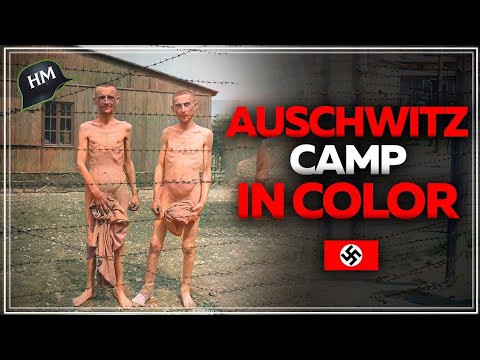
Today, we present full-color images like you have never seen before, reflecting the brutal reality of life in the Auschwitz Concentration Camp. These images bring to light the horrors that unfolded within its walls, offering a chilling glimpse into the past that must never be forgotten.
Poland was invaded by Germany on September 1st, 1939, marking the beginning of World War II. Within a month, the Nazis had swept away the defenders, and by October 6th, the entire country was under their control. Tens of thousands of soldiers were made prisoners of war, and civilians—politicians, intellectuals, journalists, artists, and many others who formed the elite of the nation—were also imprisoned. The Germans needed a place to house them until they decided what to do. Near the town of Oświęcim (Auschwitz in German), there were barracks previously used by Polish forces. The Nazis found the perfect place to establish the infamous concentration camp where millions would be murdered. It was in a sparsely populated area but at the intersection of railroad tracks, which facilitated the transportation of people.
The first center built was called Auschwitz I, which had 22 one- or two-story buildings. Initially, about 700 Polish prisoners were sent there, but as the months passed and the Nazis increased their conquests across Europe, more and more men and women were transferred. The camp was overwhelmed, so the German guards put the new arrivals to work. The number of buildings was expanded, and in those that only had one floor, an additional floor was added. The working conditions were brutal, with little food and almost no time for rest. The German guards, all members of the cruel SS, frequently tortured the weakest, making them work until they fell exhausted. Although the camp had not yet been converted into an extermination center, they did not care if their captives died.
On June 22nd, 1941, Germany invaded the Soviet Union and within a few months conquered hundreds of kilometers of territory along with all the people who lived there. Hitler saw world Jewry as a threat to the German race. He also saw communism as a threat to Western civilization, and from his perspective, Jews were behind the Soviet threat—“Jew equaled Bolshevik.” So, by destroying the Soviet Union, he could kill two birds with one stone. Due to the invasion, the Nazis again had thousands of prisoners, many of whom were sent to Auschwitz. The population of 700 had in just one year grown to approximately 11,000. Not only were there Poles now, but also Jews, Slavs, Roma, Communists, and many others branded by the Nazis as inferior and subhuman.
In October 1941, construction began on Auschwitz II, better known as Birkenau. The Germans intended this new facility to house over 30,000 people. Again, prisoners were used for construction, much of the work done during the harsh Polish winter. Prisoners were forced to sleep in the barracks as they were built, and because the roof was the last thing to be put on, they had no protection from the merciless weather. Weakened by months of terrible conditions, many did not survive. The cold, exhaustion, hunger, and beatings by the Germans killed several others. The German murder machine was beginning to oil its gears. So, in addition to the barracks, four gas chambers were built for a dark purpose. Unlike Auschwitz I, Birkenau had been designed primarily as an extermination center and would soon be operational.
At the beginning of 1942, Adolf Hitler and the Nazi leaders began to discuss the best way to consolidate their macabre plan. The time had come to employ the Final Solution, with which they sought to wipe out the Jewish population housed in the concentration camps. To do so, they would begin using the gas chambers. Auschwitz, due to its large size and number of people held there, became one of the deadliest centers in the entire Third Reich. As soon as they got off the train, the prisoners were separated into two large groups by SS guards. The healthiest-looking were shaved, tattooed with an identification number, and sent to the barracks. The weakest—including the elderly, pregnant women, and children—were almost without exception sent to the gas chambers. The smoke rising from the chimneys was a constant reminder to the other prisoners of the fate that awaited them if their performance began to falter.
One woman, saved from immediate death by a stroke of cruel chance, was forced to remain a prisoner where life was an endless agony. The barracks, designed for 700, soon held nearly twice that number. Some buildings lacked beds entirely, offering only straw mattresses where fleas and other pests abounded. Sometimes even that was missing, and the only option was to sleep on the hard, cold floor. The coal stove was not enough to heat the place, and many died due to these brutal conditions.
Prisoners were awakened before sunrise—by 5:00 a.m. they had to be up for breakfast. This consisted of an infusion of herbs or water boiled with grains as a substitute for coffee. It was so bitter that many could not stomach it, refusing even this meager offering. If they were lucky, they might receive a piece of bread. Then the SS men would take them out of the barracks to form lines for roll call. If someone took longer than allowed or the count did not add up, this procedure could last for hours, regardless of rain or snow. There were times when some, so weakened by their experiences, died during roll call, falling exhausted to the frozen ground. This only made the ordeal last even longer.
When the Germans were finally satisfied, they ordered the prisoners to march to their work detachments. Many worked making war products—vehicle parts or weapons—while others were employed by companies such as Bayer and IG Farben to increase their wealth. In fact, Auschwitz III, also called Monowitz, was built by the latter company to create synthetic rubber. These companies took advantage of slave labor, paying the Nazi government to employ the prisoners. Many were also used to expand the concentration camp, which always needed to house more captives, or in the coal mines outside the camp. Some women were taken to warehouses where they separated the valuable belongings of the captives—clothes and jewelry. Although theoretically sold to provide funds to the government, many of these items were appropriated by the guards as gifts for their wives.
Work days could last 11 hours or more. Any mistakes were often brutally punished—by taking away lunch, beating them, or even summarily executing them. The food given consisted of soup with potatoes, grains, and flour. As with breakfast, many vomited it, leaving them weaker for the rest of the day. Hunger was a constant companion. Malnutrition killed almost as many as the gas chambers. Food was brought in wooden barrels—a thick vegetable concoction. Each prisoner received about a liter, scooped into a bowl. “I remember it was a maroon-colored bowl that we always wore, hanging from the belt together with a spoon,” one survivor recalled. “You didn’t dare lose it, because without that you didn’t eat.” In a place like this, everyone had to think about their own survival.
After the work day was over, the prisoners were escorted back to the barracks, tasked with carrying the bodies of those who had died during the day to be burned. Dinner was not much better than lunch—mostly bread and sometimes a small piece of meat or cheese. By mid-1942, the Germans realized that tens of thousands of prisoners were dying from lack of food and were forced to improve these conditions. This was not due to humanitarian concern but merely practical—they were running out of sources of forced labor. However, this was not the case for the Jews and Soviets, who had been marked for total extermination. They continued to suffer extreme hunger until their captivity ended.
By the end of 1942, the Final Solution was in full operation. Many prisoners from other camps were sent to Birkenau to be killed there, as it had numerous gas chambers built for this macabre purpose. When they arrived, to prevent panic, they were told that the rooms they were sent to were for disinfection. But when the doors were closed, the Germans activated the gas—a pesticide called Zyklon B. Immediately people began banging on the walls and begging for mercy, but it was all in vain. Minutes later, the screams stopped, and certain selected prisoners entered to remove the bodies. By 1944, it is estimated that approximately 20,000 people were killed in this way per day. The incinerators often could not cope with the number of corpses, and they piled up—rotting or freezing depending on the time of year.
Executions, however, did not only occur in the gas chambers. The guards were given explicit permission to unleash their fury on the prisoners. Any slightest infraction was severely punished, and these tortures often ended in the death of the victim. The prisoners barely reacted when a fellow prisoner was shot in the head, as the Germans had accustomed them to such crimes. Within Auschwitz, Block 11 had been designated solely for punishment. According to reports, having one’s hands in one’s pockets or daring to ask for a second ration of food were the most common reasons for being sent there. Within this block, SS men would whip offenders or hang them on metal hooks until they were off the ground. They would even hold their heads inside chimneys, indifferent to their screams of pain. If the prisoner was too weak after his torture, he was sent to the gas chamber without a second thought.
Block 10 was another section designed for sadistic use. This was where German doctors performed their experiments on prisoners used as guinea pigs. As well as eliminating those deemed inferior, they also sought to prohibit them from reproducing. Tests were run to find an effective sterilizer. Many women were exposed to high doses of X-rays to test their effect. Many others were injected with dangerous chemicals that would render them incapable of bearing children. Several died in these trials or were so damaged that they were no longer of any use to the Nazis and were sent straight to the gas chambers.
Outside of sterilization, other experiments were also carried out. Dr. Josef Mengele conducted his dark tests, for which he became infamous. Any prisoner with dwarfism or hereditary diseases was sent to a barracks reserved for him, as were twin brothers. The Nazi scientist was obsessed with these conditions and carried out a large number of tests on these people. When he had obtained the information he sought, he would kill them and then dissect them. Tens of thousands entered his laboratory, but only a few survived. “One day I became extremely ill after a visit to the lab,” one survivor remembered, “and I was taken to a barrack that was filled with practically living dead. So there you are—a living dead person, knowing it well. Mengele came in every morning and every evening, twice a day, with four other doctors, and he declared very sarcastically, laughing, ‘Too bad she’s so young. She has only two weeks to live.’ Right in front of you. Right in front of you.” Of the 3,000 twins Mengele experimented on, only 150 survived until the camp’s liberation. The woman we hear about was one of the lucky few.
The Auschwitz chambers continued to operate until October 1944, murdering tens of thousands every day. But the Soviets were approaching, and the SS, desperate to hide their crimes, demolished the crematoria and destroyed records. Hundreds of thousands of prisoners were forced onto death marches westward. In the freezing winter, those who fell behind were shot.
On January 27, 1945, the Soviets liberated the camp. Only 7,000 prisoners remained alive, most too weak to comprehend their freedom. More than a million had perished. Yet even in such darkness, many never lost their humanity—sharing food, holding secret religious services, and rebelling against their captors.
What impacts you most about the history of Auschwitz? Share your thoughts in the comments below, and subscribe to learn more about the events that shaped our world.






