Hitler called him the man with the iron heart. Himmler said he was irreplaceable. Reinhard Heydrich commanded death squads that murdered two million civilians. He planned the extermination of eleven million Jews in a ninety-minute meeting over coffee and cognac. He was the most dangerous Nazi who ever lived.
But here’s what nobody talks about: the architect of the Holocaust wasn’t killed by the bomb that hit his car. He was killed by the upholstery.
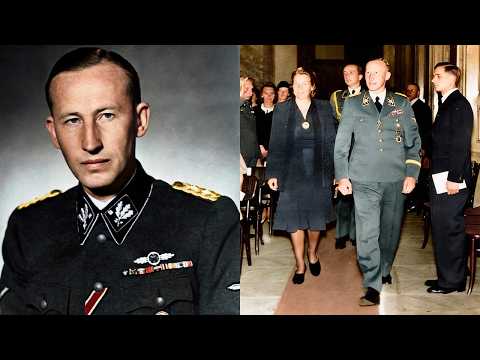
This is the true story of Reinhard Heydrich’s horrifying crimes and the bizarre accident that finally stopped him.
Reinhard Heydrich wasn’t born a monster. He was made into one.
Born in 1904 to a musical family in Halle, young Heydrich was a gifted violinist who seemed destined for a career in the arts. But something darker ran beneath the surface. Throughout his childhood, he was constantly bullied over rumors that his step-grandfather was Jewish. In the paranoid, racist atmosphere of early 20th-century Germany, this accusation followed him everywhere—whispered in schoolyards, scratched into desks, thrown at him by classmates who sensed his vulnerability.
Heydrich escaped into the German Navy, building a promising career as an officer. By his mid-twenties, he seemed to have outrun his past.
Then in 1931, everything collapsed. A naval tribunal publicly discharged him in disgrace for seducing a young woman with false promises of marriage. The details were humiliating. The woman’s family demanded accountability, and the Navy sided with them. Rather than apologize or show remorse, Heydrich blamed the girl entirely. He insisted he had done nothing wrong.
This moment broke something fundamental in him. The man who had spent his life fleeing accusations of weakness now stood publicly shamed, stripped of his career, his reputation destroyed. He would never show vulnerability again.
Within months of his discharge, Heydrich had found something far more powerful than the Navy: the SS.
Heinrich Himmler recognized immediately what others had missed. Heydrich wasn’t just ruthless. He was organized. Himmler needed someone to build an intelligence service for the Nazi party. And Heydrich presented a detailed proposal on the spot.
Within two years, he had constructed the SD—the Sicherheitsdienst—into an empire of informants that spied not only on the party’s enemies, but on Nazi members themselves.
This was Heydrich’s genius. He understood that information was power, and he accumulated it relentlessly. His agents compiled files on everyone: personal indiscretions, financial irregularities, hidden Jewish ancestry, extramarital affairs. No one was safe.
The man who had been destroyed by scandal now held the scandals of thousands in his filing cabinets. He became untouchable. Anyone who threatened him could be destroyed with a single document.
The humiliated naval officer had transformed himself into one of the most feared men in Germany before he had ordered a single execution.
But blackmail files were just practice for what came next.
On June 30, 1934, Heydrich proved he could do far more than collect secrets.
The Night of the Long Knives began as an internal Nazi purge. Ernst Röhm and the SA—the brown-shirted street fighters who had helped Hitler seize power—had become a political liability. Hitler wanted them eliminated.
Heydrich personally compiled the execution lists.
Over three days, SS killing squads murdered between 85 and 200 people across Germany. SA leaders were dragged from their beds and shot. Political rivals disappeared. Old enemies were settled.
The violence appeared chaotic, but behind it was Heydrich’s trademark: meticulous planning in service of mass death. Every name on every list had been researched, verified, and approved. The logistics of simultaneous arrests and executions across multiple cities required coordination that only Heydrich could provide.
When the killing stopped, Hitler praised the operation as necessary surgery to save Germany. Heydrich had proven his value. He could organize murder at scale.
But internal purges were just the beginning.
The Night of the Long Knives was Nazis killing Nazis. On November 9, 1938, Heydrich demonstrated what his organizational genius could accomplish when turned against an entire population.
That night, he sent a single telegram to police commanders across Germany and Austria. The instructions were precise: “Arrest as many Jews, particularly affluent Jews, as can be accommodated in existing detention facilities.”
Within forty-eight hours, more than twenty thousand Jewish men had been seized from their homes and transported to concentration camps. Synagogues burned across the Reich. Jewish businesses were looted and destroyed.
The violence of Kristallnacht appeared spontaneous—ordinary Germans expressing their rage. In reality, it was coordinated persecution at industrial scale, directed by telegram from Heydrich’s desk.
This was something new in the history of state violence. Not a pogrom driven by mob anger, but a systematic operation with arrest quotas, transportation logistics, and detention capacity planning. The organizational genius that had built an informant network was now building something far worse.
And because he delivered results, he was given even more power.
By January 1942, Heydrich controlled the entire security apparatus of Nazi Germany: the Gestapo, the SD, the criminal police. He answered only to Himmler and Hitler.
When the regime decided to implement the complete destruction of European Jewry, there was only one man capable of coordinating such an operation.
On January 20, 1942, fifteen senior Nazi officials gathered at a villa on the shore of Lake Wannsee, just outside Berlin. Heydrich ran the meeting. Coffee was served. Fine cognacs circulated. The atmosphere, according to attendees, was remarkably congenial.
In just ninety minutes, these fifteen men coordinated the bureaucratic machinery to murder eleven million Jews across Europe—including nations Germany hadn’t even conquered yet.
Heydrich presented statistics showing Jewish populations country by country. He outlined the process: Jews would be deported to the east, worked to death on road-building projects, and survivors would be dealt with appropriately. Everyone in the room understood what that phrase meant.
The meeting minutes record that Heydrich’s authority over all Jewish deportations was absolute. No one objected. No one hesitated. No one asked moral questions. They discussed logistics. They resolved jurisdictional disputes. They finished their cognac and returned to their offices.
Ninety minutes to plan the murder of eleven million people. This is what the banality of evil looks like—genocide reduced to a bureaucratic conference scheduled between breakfast and lunch.
But Wannsee was planning. Heydrich had already built the killing apparatus.
The Einsatzgruppen—mobile death squads that followed German armies into conquered territories—had been operating since the invasion of Poland in 1939. By the time of the Wannsee Conference, they had already murdered over two million civilians, including 1.3 million Jews.
These weren’t soldiers dying in combat. They were families rounded up in villages, marched to ravines and forests, and shot in mass executions that sometimes took entire days to complete.
The Einsatzgruppen reported directly to Heydrich. He reviewed their body counts like production reports, noting which units were meeting quotas, which were falling behind, which methods proved most efficient. When bullets became too slow and psychologically damaging to the shooters, his organization developed gas vans—mobile killing chambers that murdered victims with carbon monoxide as they were driven to burial pits.
More than twenty percent of all Holocaust victims died under operations Heydrich personally directed.
He wasn’t a distant bureaucrat signing papers in Berlin. He built the system, staffed it with men he had selected, and monitored its output with the attention of a factory manager tracking production.
When historians debate whether any single individual bears primary responsibility for the Holocaust, Heydrich’s name appears at the top of every list.
His success made him indispensable. When Hitler needed someone to crush Czech resistance in the occupied territories, there was only one choice.
In September 1941, Hitler appointed Heydrich as acting Reichsprotektor of Bohemia and Moravia—essentially the Nazi viceroy of occupied Czechoslovakia. His mandate was clear: break Czech resistance and maximize industrial production for the German war effort.
Heydrich accomplished both with characteristic efficiency. Within weeks of his arrival, he declared martial law across the territory. Thousands were arrested. Hundreds were executed. Resistance networks that had operated for years were rolled up in days. The Czechs gave him a new title: the Butcher of Prague.
But Heydrich’s approach wasn’t pure terror. This is where his intelligence revealed itself. He understood that workers who were merely terrorized produced less than workers who had something to lose. So alongside the executions, he offered modest economic concessions—increased food rations, improved working conditions, small rewards for productivity. The carrot and the stick, applied with precision.
The strategy worked. Industrial production increased. Active resistance decreased. Czech workers kept their heads down and did their jobs.
Heydrich had crushed opposition so thoroughly that he began to believe it no longer existed.
This success led to a fatal miscalculation. He started traveling through Prague in an open Mercedes convertible. No armored car, no escort, no guards. The Butcher of Prague drove to work each morning like a businessman commuting to the office. He believed he had broken the Czech spirit completely.
He was wrong.
Six months before Heydrich arrived in Prague, British intelligence had begun training a team of Czech and Slovak paratroopers for a single mission: kill the Reichsprotektor. The operation was codenamed Anthropoid.
Jozef Gabčík and Jan Kubiš parachuted into occupied Czechoslovakia in December 1941. For five months, they gathered intelligence, mapped Heydrich’s routes, and waited for the right moment. They identified a hairpin turn in the Libeň district, where his car would have to slow almost to a stop.
On the morning of May 27, 1942, they took their positions.
At approximately 10:30 a.m., Heydrich’s open Mercedes approached the turn. No escort, no guards—just Heydrich in the front passenger seat and his driver, Johannes Klein, at the wheel.
Gabčík stepped into the road and raised his Sten submachine gun. He aimed directly at Heydrich’s chest and pulled the trigger.
Nothing happened. The gun had jammed.
For a moment, everything froze. Heydrich saw the attacker. Instead of ordering Klein to speed away, he stood up in the car and reached for his pistol. He was going to shoot back. It was brave. It was also foolish.
Kubiš ran forward and threw a modified British anti-tank grenade at the right rear fender. The explosion tore through the car, sending shrapnel and fragments of the vehicle’s interior into Heydrich’s body. The blast also wounded Kubiš, but he managed to escape on a bicycle. Gabčík fled on foot after a brief chase.
Heydrich, still conscious, climbed out of the destroyed Mercedes and attempted to pursue his attackers. He fired several shots before collapsing. A passing truck driver loaded him into his vehicle and drove to the nearest hospital.
The wounds appeared survivable. Surgeons operated. Heydrich remained conscious and alert for days. Hitler sent his personal physician. Initial reports to Berlin suggested recovery was likely.
But something was already killing him from the inside.
The grenade had done more than drive metal into Heydrich’s body. The blast had forced fragments of the car’s interior deep into his spleen, diaphragm, and lungs—pieces of horsehair stuffing, leather upholstery, and uniform fabric.
This contaminated material carried bacteria that no amount of surgery could remove.
Over eight days, infection spread through Heydrich’s vital organs: his diaphragm, his pericardium, his liver, his kidneys. The best SS physicians in Europe—men who had treated Hitler and Himmler—failed to recognize what was happening. They treated the visible wounds while invisible bacteria multiplied in his bloodstream.
On June 4, 1942, Reinhard Heydrich died of septicemia. Blood poisoning. Not the grenade, not the shrapnel. The upholstery.
The most meticulous mass murderer in Nazi history—the man who had organized genocide with bureaucratic precision, who had built filing systems to track millions of victims, who had coordinated deportations across an entire continent—was killed by the random chance of horsehair and leather contaminating his wounds.
His death was as chaotic as his crimes were systematic. He was thirty-eight years old, and he remains the highest-ranking Nazi official successfully assassinated during the entire war.
But Heydrich’s legacy demanded one final bloodletting.
Hitler was enraged. He demanded reprisal on a scale that would terrorize the Czech population into permanent submission.
On June 9, 1942, German forces surrounded the village of Lidice, chosen essentially at random based on thin intelligence suggesting a possible connection to the assassins. What followed was methodical extermination.
Every man and boy over fifteen was separated from the women and children. 173 males were lined up against a barn wall and shot in groups of ten. The executions took most of the day.
The 184 women of Lidice were transported to Ravensbrück concentration camp, where most would die over the following months. The 82 children underwent racial evaluation. Those who looked sufficiently Aryan were taken for adoption by German families. The rest were transported to Chełmno extermination camp and gassed.
When the killing was finished, German engineers burned every building in Lidice to the ground. They bulldozed the ruins, diverted the stream, and plowed the earth until no trace remained. Lidice was erased from maps entirely.
Approximately 340 people murdered because two men with a grenade killed one man on his way to work.
The assassins themselves died two weeks later, betrayed by a fellow resistance member who broke under Gestapo torture. Gabčík, Kubiš, and five other operatives were cornered in the crypt of a Prague church. They fought for hours against 700 SS soldiers before using their final bullets on themselves rather than face capture.
They had known from the beginning it was a suicide mission. They had known the reprisals would be devastating. But they also understood something essential: Reinhard Heydrich was too dangerous to be allowed to live.
The upholstery finished what their grenade started, and the architect of the Holocaust died—not from precision, but from randomness. A fitting end for a man who had reduced millions of human lives to numbers on a conference room chart.
Was this a case of poetic justice, or simply blind chance?






