On October 16, 1946, at 1:10 in the morning, Joachim von Ribbentrop became the first Nazi war criminal executed at Nuremberg. Hitler’s foreign minister—the man who helped start the deadliest war in human history—was hanged, his body cremated, his ashes scattered in a river. Story over. But here’s what nobody tells you: while his body disappeared, his family kept everything. They kept the champagne fortune, the social standing, and even the freedom to spend 30 years writing books that defended him. The execution was supposed to be justice. What happened to his family tells a very different story.
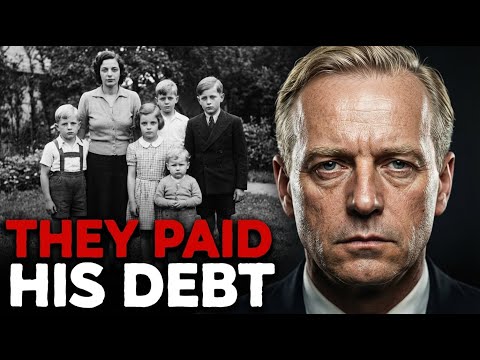
Anneliese von Ribbentrop was not just married to a war criminal. Historians say she was the driving force behind his Nazi involvement. She introduced him to the right people and pushed him toward the party when he was still a champagne salesman with social ambitions. Without Anneliese, there might never have been a foreign minister Ribbentrop at all.
After the war, the Allies detained her at a former concentration camp—Dachau, of all places. For a brief moment, it looked like she might face the same reckoning as other prominent Nazi figures. Denazification tribunals were processing thousands of cases across occupied Germany. Wives of high-ranking officials sat in internment camps, waiting to learn their fates. But Anneliese walked free. No prosecution, no denazification hearing, no stripping of assets. Why? Because her fortune did not come from her husband. It came from her father, Otto Henkell, founder of one of Germany’s oldest and most prestigious champagne empires: Henkell & Co.
Henkell & Co. had been producing sparkling wine since 1832, long before the Nazi party existed. The Allies could execute her husband for crimes against peace. They could hang him in a prison gymnasium and scatter his ashes to prevent any shrine from forming. But they could not touch her inheritance. So while other Nazi families faced tribunals and property seizures, Anneliese von Ribbentrop returned to civilian life with her millions completely intact. The wife of the first man hanged at Nuremberg never spent a single day answering for her role in putting him there.
Freedom wasn’t enough for Anneliese. She had something to prove and three decades to prove it. Starting in 1953, she launched a personal campaign to rehabilitate her husband’s legacy. Not quietly, not privately. She published four books, stretching from the early 1950s to the mid-1970s. Each one defended Nazi foreign policy. Each one portrayed Joachim von Ribbentrop as a misunderstood diplomat who had tried to prevent the very war he was hanged for starting. The first was Between London and Moscow, published in 1953—just seven years after her husband’s execution. She followed it with Conspiracy Against Peace in 1962, German-English Secret Connections in 1967, and finally War Guilt of the Resistance in 1975. That last title is worth pausing on. She wasn’t just defending her husband anymore. She was blaming the German resistance—the people who tried to stop Hitler—for the war’s outcome.
Her work did not go unnoticed by sympathetic audiences. She received the Hutton Medal, an award from an organization founded by Hitler’s former press chief. In the circles of unreconstructed Nazi sympathizers, Anneliese von Ribbentrop had become something of a celebrity: the grieving widow who refused to accept the verdict of history. She died on October 5, 1973, in Wuppertal at age 77. Completely unpunished, completely unrepentant. She had outlived her executed husband by 27 years, spending most of that time arguing he had done nothing wrong.
Rudolph von Ribbentrop could have avoided the war entirely. His father was Hitler’s foreign minister, one of the most powerful men in the Reich. A word in the right ear, and Rudolph could have spent the war in some comfortable diplomatic posting, far from the fighting. Instead, in 1941, at age 20, he volunteered for the Waffen-SS—not the regular army, but the ideological spearhead of Nazi Germany. He did not do it because he was forced. He did it because he wanted to prove he was not riding his father’s coattails. He wanted combat. He wanted to earn whatever honors came his way on his own terms.
He earned them. Rudolph received the Knight’s Cross, one of Nazi Germany’s highest military decorations. He received the German Cross in Gold. He was wounded five times on the Eastern Front—five separate occasions where he could have died in the frozen mud of Russia or the burning ruins of some forgotten village. By any measure, Rudolph had proven himself as a soldier.
But then came 1945 and an accusation that should have ended everything. When Allied forces captured Rudolph, they did not treat him as an ordinary prisoner of war. They held him as a suspected war criminal. The charge was devastating: Allied investigators accused him of shooting two Canadian prisoners of war during an interrogation. Not in the heat of battle, not in self-defense—during an interrogation. If true, Rudolph had committed murder under the laws of war.
For three years, he sat in Allied custody while investigators built their case. Three years of uncertainty. Three years of knowing that conviction could mean the same fate his father had faced: a rope in a prison gymnasium, a body reduced to ashes. But the prosecution never came. The evidence was not strong enough. Witnesses could not agree on what had happened. The fog of war had swallowed whatever truth existed about those two Canadian soldiers. In 1948, Rudolph von Ribbentrop walked free. No trial, no conviction, no punishment.
But freedom brought its own problems. He had no career, no prospects. His military honors meant nothing in a Germany trying desperately to forget the war. And his name—Ribbentrop—was poison. Who would hire the son of a hanged war criminal? Who would associate with a man who had been accused, even if never convicted, of murdering prisoners? Rudolph was free, but he had nowhere to go.
Then, in 1952, a German court in Wuppertal issued a ruling that would have seemed impossible just a few years earlier. The court ordered Henkell & Co. to accept Rudolph von Ribbentrop as a full partner in the business. Not because he had earned it, not because the company wanted him, but because the court decided he had a legal right to the family fortune. Think about what this means: the son of the first Nazi hanged at Nuremberg, a former Waffen-SS officer, a man who had spent three years under investigation for murdering prisoners of war—this man became a champagne executive, not through his own efforts, but by judicial decree.
The Henkell family had built their empire over more than a century. They had survived two world wars, economic collapse, and the Nazi period itself. Now a German court was forcing them to share their business with a man whose very name symbolized everything postwar Germany was trying to forget. Rudolph took his place in the champagne industry. He proved capable enough at business, and unlike his mother, he largely stayed out of the spotlight for decades, building a quiet life far from the controversies that had defined his youth. But he never fully escaped his father’s shadow.
In 2008, at age 87, Rudolph published a memoir. In it, he defended aspects of his father’s legacy—not with the aggressive defiance of his mother, but with the measured justifications of a man who had spent a lifetime processing what his family name meant. He wrote of the diplomatic triumphs, the treaties signed, the war that he insisted his father had tried to prevent. He never apologized. He never condemned. He simply explained, as though explanation itself were a form of absolution.
Rudolph von Ribbentrop died on May 20, 2019, at the age of 98. He had outlived the Third Reich by 74 years. He had outlived his father by 73. He had lived long enough to see the champagne empire pass through yet another generation, long enough to watch his family name fade from headlines into footnotes, long enough that the world had largely forgotten what the name Ribbentrop once meant.
But Rudolph was the most visible of Joachim von Ribbentrop’s children—the one who left the clearest trail through history. He was not the only one. The family had five children in total, and what happened to the others reveals just how thoroughly some Nazi descendants managed to disappear.
Bettina, the eldest daughter, was born in 1922. After the war, she faded almost completely from public records. No memoirs, no interviews, no scandals that drew media attention. She simply vanished into the anonymity that postwar Germany offered to those who wanted it badly enough. Ursula, born in 1932, followed a similar path. She was only 13 when her father was executed—old enough to understand what had happened, young enough that she had her whole life ahead of her. Whatever life she built, she built it in silence.
Adolf von Ribbentrop—and yes, that was his name—was born in 1935. He eventually became an art gallery owner, carving out a respectable career in a field far removed from politics or diplomacy. In 1985, he married into prominent German society. His father’s legacy, apparently, was not enough to bar him from the upper echelons of postwar German life.
And then there is Barthold, the youngest, born December 19, 1940—just six years before his father’s execution. Some sources say Barthold died in 1941, barely a year old. Infant mortality was tragically common during the war years, even among wealthy families. If this is true, he never knew his father as anything but a presence in a nursery. But other sources show photographs of him with his father dated around 1942. If those photographs are accurately dated, then Barthold survived infancy—which raises the question of what happened to him afterward. His fate remains one of the family’s unresolved mysteries. Did he die young? Did he survive the war and disappear into a new identity? Did he simply avoid any public connection to the Ribbentrop name so successfully that historians lost track of him? Nobody seems to know for certain.
The Ribbentrop family mansion in Berlin-Dahlem was more than just a home. It was a symbol—a physical monument to the family’s power during the Nazi years. Lentzeallee 7-9, a prestigious address in one of Berlin’s wealthiest neighborhoods. Hitler himself had visited in the 1930s, walking the same halls where the family lived their private lives. Foreign dignitaries had been entertained there. Nazi foreign policy had been discussed over dinner in its elegant rooms.
After 1945, the Allies confiscated the property. By September 1947, it had become union headquarters for German workers—a deliberate repurposing that erased its Nazi associations. Today, the building houses the Berlin International School. Children learn mathematics and literature in rooms where Nazi diplomacy was once celebrated. The architecture remains, but the meaning has been completely transformed.
There is a certain irony in that transformation. The physical symbol of Ribbentrop power was taken, repurposed, and given to the next generation. But the family wealth—the Henkell fortune that had nothing to do with Nazi politics—survived completely intact. The Allies could seize a mansion. They could hang a foreign minister. But they could not undo an inheritance that predated the crimes.
Nuremberg was supposed to establish a principle that would echo through history: no one is above the law. Not kings, not generals, not foreign ministers. Joachim von Ribbentrop’s execution proved that diplomatic position offered no protection from accountability. But his family’s story reveals the limits of that justice.
The wife who pushed him into Nazism was never prosecuted. The son accused of murdering prisoners of war was never tried—and a court later placed him in control of the family’s champagne fortune. The inherited wealth remained untouched by denazification. The leaders faced consequences—dramatic, public, final. But the structures that supported them proved far harder to address.
Anneliese died wealthy and defiant. Rudolph died wealthy at 98. The Henkell Champagne Empire continued without interruption. The villa became a school, but the money stayed in family hands. The gallows took Joachim von Ribbentrop at 1:10 in the morning—but his legacy lived on for decades. And in some ways, it is still living now.
So here is the question that won’t go away: what does justice actually mean when the leaders hang but their families inherit everything? Was Nuremberg a closing chapter—or did it only open another one? Let us know your thoughts in the comments below.






