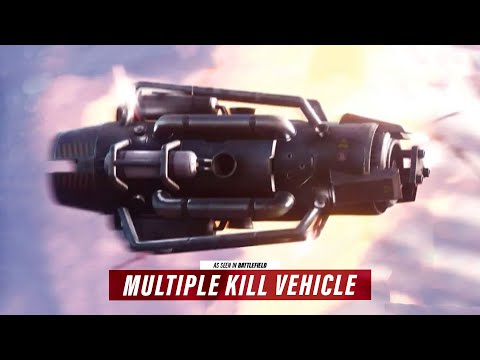
In the shadow of the Cold War, a weapon was born that seemed pulled from the pages of science fiction. A pod-like craft, no larger than a man, designed to hunt and destroy multiple ballistic missiles in the vacuum of space. It was called the Multiple Kill Vehicle, and for decades, its existence was a closely guarded secret. Few knew that the flying gun system in Battlefield 4 was not a work of pure imagination, but a ghost of a real, semi-functioning prototype.
Today, we pull back the curtain on this forgotten marvel of engineering—a story of ambition, innovation, and the fine line between genius and impossibility.
The roots of the MKV stretch back to the earliest days of the missile age. When Nazi V-2 rockets rained down on London, the Allies realized they had no defense against weapons that traveled faster than sound and fell from the edge of space. “No Allied country had the technology to counter the V2,” Bell Labs engineers admitted, igniting a desperate race that would span generations.
Post-war, projects like Nike Zeus and Nike X pushed the boundaries of radar and computing, but they were blunt instruments—nuclear-tipped interceptors that could only handle one target at a time. As ICBMs multiplied and MIRVs (multiple independently targetable reentry vehicles) emerged, the challenge grew exponentially. One missile could now unleash a dozen warheads, each a potential city-killer. The defense needed to be smarter, faster, and lethal without explosives.
Enter the era of hit-to-kill. The idea was simple: ram an incoming warhead at hypersonic speed, and the kinetic energy alone would obliterate it. But hitting a bullet with a bullet in space required accuracy that many deemed impossible. “It was like trying to get a hole in one in New York while hitting the golf ball from Los Angeles,” one engineer recalled.
Yet, against the odds, the technology inched forward. The Lightweight Exo-Atmospheric Projectile (LEAP) proved that a small vehicle could track and intercept a target in the void. Then came the Exo-atmospheric Kill Vehicle (EKV), a larger, more advanced system that successfully destroyed a target on its first real-world test in 1999. Many had doubted it could ever work, but the EKV hit its mark, proving that kinetic interception was not just possible—it was the future.
But the EKV was just the beginning. The Pentagon wanted more: a single vehicle that could take out multiple threats at once. In 2002, the Multiple Kill Vehicle program was born, and two aerospace giants—Raytheon and Lockheed Martin—were pitted against each other in a dual-path race. The goal: create a pod that could carry a swarm of mini-kill vehicles, each capable of independently tracking and destroying a separate warhead.
The engineering hurdles were staggering. The MKV had to operate in the harsh environment of space, communicate with its siblings, and make split-second decisions. Raytheon’s design used a central carrier to guide its kill vehicles, while Lockheed’s version was a decentralized cluster where each vehicle could take the lead if others were lost. Both were tested in hover trials, stunning observers with their ability to stabilize and maneuver in standard gravity.
But as the 2000s wore on, the program’s fate grew uncertain. Budgets tightened, priorities shifted, and in 2009, the MKV was officially canceled. Yet, its legacy lived on—in the classified labs of the defense industry and, surprisingly, in the hands of gamers.
When Battlefield 4 featured a futuristic flying gun system, few players realized it was a nod to a real-world prototype. The MKV had become a ghost, its image surviving only in declassified videos and the imagination of developers.
But the story doesn’t end there. In 2015, whispers emerged that Raytheon, Lockheed Martin, and Boeing were quietly continuing work on multi-target interceptors. The dream of the MKV was not dead—it had simply gone dark.
Today, as the world enters a new era of hypersonic weapons and space-based defenses, the lessons of the MKV are more relevant than ever. The race to build the perfect missile shield never truly stopped; it just evolved.
And somewhere, in a hangar or a computer simulation, the descendants of that pod-like craft are being tested, waiting for the day they might be called upon to defend the skies.
The official cancellation in 2009 was, by most accounts, a bureaucratic death—not a technological one. The Pentagon’s budget hawks had won the argument that the MKV was too expensive, too complex, and too far ahead of its time. But the engineering knowledge didn’t evaporate. It simply migrated.
Raytheon’s engineers, who had spent years coaxing their carrier-vehicle design into stable hover, quietly folded their findings into other programs. Lockheed Martin’s team, which had championed the decentralized swarm concept, did the same. The lessons learned—about miniaturized thrusters, autonomous target discrimination, and inter-vehicle communication—became building blocks for the next generation of interceptors.
By 2015, the three major defense contractors began dropping hints. Public statements were carefully worded, but the message was clear: multi-target interception was still on the table. The concept had been reborn under a new name—the Multi-Object Kill Vehicle, or MOKV. The goal was identical to the original MKV: deploy a single interceptor that could release multiple kill vehicles, each capable of independently striking a different warhead.
The MOKV program, however, faced a new set of challenges. The threat landscape had shifted. North Korea and Iran were developing mobile ICBMs, and both Russia and China were fielding hypersonic glide vehicles that could maneuver unpredictably during reentry. An interceptor that could only hit warheads following predictable ballistic arcs was no longer enough.
The new kill vehicles would need better sensors, faster processors, and the ability to distinguish real warheads from sophisticated decoys. They would also need to operate in a networked environment, sharing data with ground-based radars and space-based sensors in real time.
Raytheon’s engineers, drawing on their MKV experience, proposed a design that used a single carrier vehicle with an onboard radar. Lockheed Martin countered with a swarm architecture, where each kill vehicle carried its own seeker and could operate independently if communications were jammed. Both approaches had merit, and both traced their DNA directly back to the hover tests of 2008.
Meanwhile, the Missile Defense Agency was quietly funding a parallel effort: the Next Generation Interceptor, or NGI. Unlike the MKV and MOKV, the NGI was designed as a direct replacement for the aging EKV and its Ground-Based Interceptor missiles. It would be a single-kill vehicle, but far more capable than anything that had come before.
Lockheed Martin won the NGI contract in 2021, and by early 2024, test variants had already begun flying. Details remain classified, but analysts believe the NGI incorporates advanced discrimination algorithms, a more powerful booster, and a kill vehicle that can adjust its trajectory mid-flight.
The NGI is expected to remain operational until at least 2034, when it will be replaced by an even more advanced system. But the real question is whether the multi-kill concept will ever see the light of day in an operational deployment.
Some defense officials argue that the MKV’s time has finally come. With adversaries deploying larger and more sophisticated missile arsenals, the ability to destroy multiple warheads with a single interceptor is no longer a luxury—it’s a necessity. Others remain skeptical, pointing to the immense cost and complexity of fielding a swarm of autonomous kill vehicles.
What is certain is that the MKV’s legacy is secure. Its hover tests, once dismissed as impractical, are now studied as foundational research. Its decentralized swarm architecture has influenced everything from drone warfare to satellite defense. And its brief appearance in a video game has ensured that, even among civilians, the pod-like craft is remembered.
As the world races toward a new era of space-based weapons and hypersonic threats, the engineers who worked on the MKV are watching closely. They know that the technology they helped create—once deemed impossible—may soon be the only thing standing between a city and a warhead.
The engineers who built the MKV understood something their critics did not: the hardest part was never the rocket science. It was the software. Getting a kill vehicle to hover was one thing; teaching it to think was another entirely.
Each mini-kill vehicle carried a compact infrared seeker, a set of divert thrusters, and a processor that had to make life-or-death decisions in fractions of a second. In the vacuum of space, there was no room for hesitation. The vehicle had to distinguish a real warhead from a decoy, calculate an intercept course, and fire its thrusters—all while traveling at closing speeds measured in kilometers per second.
Raytheon’s approach leaned on the carrier vehicle as a brain. The pod would do the heavy lifting of tracking and discrimination, then dispatch its kill vehicles with precise targeting data. It was centralized, reliable, and vulnerable—if the carrier was blinded or destroyed, the swarm went dumb.
Lockheed’s design was bolder. Each kill vehicle was its own hunter, sharing data through a peer-to-peer network. If one vehicle detected a cluster of warheads, it broadcast the coordinates. If the leader was lost, another instantly assumed command. It was the difference between a general and his soldiers, versus a pack of wolves.
Both concepts were tested extensively in simulation, but the real breakthrough came in the hover facility. Engineers built a test rig that mimicked the weightlessness of space using a combination of air bearings and counterweights. The kill vehicles, suspended on a cushion of air, practiced their dance—stabilizing, translating, and reorienting with millimeter precision.
The videos released in 2008 were carefully edited, but they revealed enough. One clip showed a kill vehicle hovering in place, then darting sideways as if dodging an invisible punch. Another showed two vehicles operating in tandem, one designating a target while the other maneuvered into position. For the first time, the public glimpsed what a real-life swarm of smart interceptors might look like.
What the videos didn’t show was the software development that made it possible. The algorithms that governed target discrimination were among the most complex ever written for a weapon system. They had to account for the fact that a warhead’s infrared signature could be mimicked by a balloon decoy, that a tumbling object might be a spent booster rather than a live threat, and that the environment itself—sun glint, Earth’s albedo, cosmic radiation—could confuse even the best sensors.
One engineer likened the problem to teaching a machine to play chess, except the board was moving at twenty thousand miles per hour and the pieces were trying to kill you.
By the time the MKV program was canceled, the software had reached a remarkable level of maturity. It could handle multiple targets, adapt to unexpected decoys, and even recover from the loss of a kill vehicle mid-engagement. The code didn’t disappear when the program ended. It was archived, studied, and quietly folded into the next generation of interceptors.
Today, the descendants of that software are running on the Next Generation Interceptor and on classified space-based defense platforms. The hardware has changed—smaller thrusters, faster processors, better sensors—but the core logic remains. The ghost of the MKV lives on in every line of code that teaches a machine to hunt.
But the most enduring legacy of the MKV may not be in the Pentagon’s arsenals at all. The very concept of a swarm of autonomous vehicles, each capable of independent decision-making, has migrated far beyond missile defense. Today’s drone swarms, satellite servicing vehicles, and even autonomous mining equipment owe a debt to the hover tests of 2008.
One retired Raytheon engineer, now in his seventies, keeps a small model of the MKV on his desk. “People ask me if I’m bitter that it never got deployed,” he says. “I tell them the idea was never meant to be a single weapon. It was a seed.”
That seed has now grown into something the original designers could barely imagine. The Next Generation Interceptor, the MOKV, and a dozen classified programs all trace their lineage to that pod-like craft. The ghost has become a family tree.
As hypersonic threats multiply and space becomes a contested domain, the question is no longer whether multi-kill vehicles will fly—it’s when. And when they do, the engineers who built the first hovering prototype will finally be vindicated.
So here’s the question for you: if the MKV’s technology is finally ready for primetime, should the Pentagon revive the program—or has the moment already passed? Let us know in the comments below.






