Behind the glittering lights and standing ovations, some of Hollywood’s most beloved stars were fighting a battle far darker than any script. They had fame, fortune, and millions of adoring fans—yet their greatest enemy was waiting at the bottom of a glass. For many, the bottle won.
These are the shocking, tragic, and sometimes unbelievable stories of Hollywood’s most notorious alcoholics—legends whose talents were undeniable, but whose demons were even stronger.
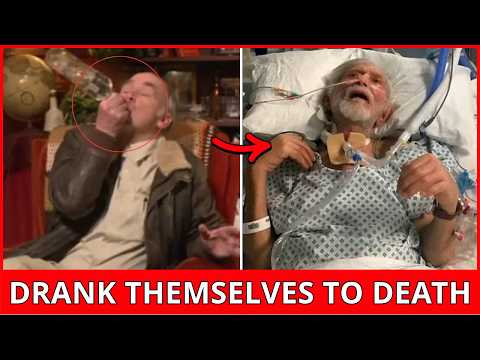
Take William Holden. He was one of the biggest stars in Hollywood, with classic films like Sunset Boulevard and The Bridge on the River Kwai to his name. Audiences saw a confident leading man, but behind closed doors, alcohol slowly tightened its grip. His health declined, his career faded, and in 1981, he was found dead in his Santa Monica apartment, surrounded by empty bottles. A telephone sat just inches away—a cruel irony for a man who once had millions of fans but spent his final moments alone.
Then there’s Gail Russell, a shy introvert who never wanted fame. Hollywood saw beauty and turned it into destiny. The pressure and relentless attention pushed her toward alcohol. Arrests followed, career opportunities vanished, and despite treatment, she died at just 36 from acute and chronic alcoholism. A woman admired by millions spent much of her life wishing she could simply escape attention.
Spencer Tracy was one of Hollywood’s most respected actors, but offscreen he fought a lifelong battle with alcohol. After finishing a film, he would disappear into hotels for days, drinking heavily. He knew exactly what it was doing to him—damaging his health, straining relationships—yet he kept returning. Friends described a man trapped between success and self-destruction, carrying a deep guilt that never left him. Even after years of sobriety, the temptation remained. Imagine staring at a martini and missing it like an old friend who had ruined your life.
Richard Harris, long before he was Dumbledore, was one of Hollywood’s most notorious hell raisers. During the 1970s, he reportedly drank two bottles of vodka a day, then washed it down with brandy and port. Doctors warned him he had 18 months to live, but he kept going. Fights, late-night adventures, and unbelievable drunken stories followed him everywhere. Once, he tried to drive a truck under a bridge that was clearly too low—the bridge won. Yet through all the chaos, he never lost the talent that made him a star.
Montgomery Clift was destined for greatness, but a devastating car accident left him in constant pain. Searching for relief, he turned to alcohol. The man famous for portraying broken, vulnerable characters was quietly becoming one. He once wrestled with a haunting question: “How do you stay vulnerable in a world determined to harden you?” Sadly, he never found the answer. The same sensitivity that made him unforgettable may have also been what destroyed him.
Mary Astor had everything Hollywood promised, but a highly publicized divorce turned her into tabloid gold. As the pressure mounted, she turned to alcohol for comfort. What started as an escape became a 20-year battle. After a suicide attempt and a nervous breakdown, she checked herself into treatment in 1949. Unlike many on this list, she fought her way back, rebuilding her life and continuing to work for decades. Her journey is almost cinematic—a fallen star staring into the darkness and somehow finding her way out.
Larry Hagman, the charming JR Ewing from Dallas, started drinking champagne in the morning and kept going throughout the day—sometimes five bottles. Years of heavy drinking devastated his liver, leading to end-stage cirrhosis. By 1995, he required a liver transplant to survive. It was a life-or-death wake-up call that forced him to confront the addiction that had quietly followed him for decades. What makes his story compelling is that he never hid from the truth, speaking openly about his mistakes and their consequences.
Rita Hayworth was the definition of movie star magic, but behind the spotlight, a different story unfolded. By the late 1970s, reports surfaced that she was struggling with alcoholism. Friends saw a woman who appeared confused, isolated, and increasingly unable to care for herself. A devoted fan from Newport Beach stepped in to help, once finding her barricaded inside, frightened and seeking refuge. The tragedy is that the woman once adored by the world spent her final years struggling to hold on to herself.
Judy Garland was pure magic as Dorothy in The Wizard of Oz, but behind that smile was a childhood few would envy. Introduced to pills as a child to keep up with exhausting work schedules, alcohol later joined the mix. She spent her career helping audiences escape reality, yet she spent much of her own life trying to escape hers. By 1969, the weight of addiction, fame, and emotional turmoil had taken an enormous toll. She died at just 47, leaving behind a legacy that still captivates generations.
These are just the first few chapters of a much larger story—one that reveals how the brightest stars often burn out the fastest, and how the applause of millions can drown out the silence of a personal battle.
Alan Ladd looked like the ultimate success story—from poverty to Hollywood royalty, with that calm confidence and unforgettable role in Shane. But off camera, control was becoming harder to find. Chronic insomnia and worsening health kept him awake night after night, so he turned first to medication, then to alcohol. The combination became a dangerous habit. In January 1964, he was found dead at his Palm Springs home after an overdose involving sedatives and alcohol. He was only 50. The man who spent years portraying fearless heroes was quietly losing a battle no audience could see.
Glenn Ford seemed to have it all—handsome, talented, endlessly charming. On screen, he was always confident and in control. Offscreen, another relationship was quietly taking over his life. His drinking wasn’t immediately destructive, which made it even more dangerous. Like a slow-moving storm, alcohol weakened his body and stole the vitality that had once made him a star. His health deteriorated so severely that he spent the final decade of his life unable to walk. A man who once strode confidently across movie screens around the world was eventually confined by the very addiction he could never fully escape. He lived to 90, but the fall happened slowly, one drink at a time.
Marie Prevost was once a rising star of the silent film era, surrounded by the glamour that defined early Hollywood. But as opportunities faded, alcohol quietly became a constant companion. By the time she reached 40, her struggle had spiraled out of control. After neighbors grew concerned by the non-stop barking of her dog, someone finally checked on her. Inside, Marie was found dead, having been alone for days. Scattered throughout the room were empty liquor bottles—silent witnesses to a battle she had ultimately lost.
Then there’s Broderick Crawford, best known as the tough police chief in Highway Patrol. His drinking became so severe that the set was cleverly adjusted to create the illusion he was standing upright—when in reality, he was sometimes lying on the floor. Offscreen, things weren’t much better. Crawford racked up multiple drunk driving arrests and became so notorious that members of the California Highway Patrol reportedly nicknamed him “Old 502,” a reference to the radio code for drunk driving. Imagine starring as a TV cop while becoming a legend among real cops for all the wrong reasons.
Ava Gardner wasn’t interested in behaving like a proper movie star. Rules bored her, and alcohol became a constant companion in her wild, fast-paced life. During the filming of Night of the Iguana, she reportedly skipped a night shoot in favor of tequila—and instead of stopping her, director John Huston joined in. Before long, both were too drunk to continue working. But beneath the laughter was a woman trying to outrun loneliness, heartbreak, and the pressures of fame. She wasn’t just a star. She was a storm that never learned how to slow down.
For horror fans, Bela Lugosi will forever be Dracula. But behind the cape was a man slowly losing a battle against addiction. Dependent on both morphine and alcohol, the glamorous icon faded into financial troubles, declining health, and overwhelming despair. Then came a moment that sounded more like one of his horror films than real life. While working with director Ed Wood, Lugosi was reportedly found hiding behind a curtain, drunk, emotional, and holding a gun. Through tears, he allegedly told Wood, “I’m going to die tonight. I want to take you with me.” Instead of panic, Wood brought him a drink. The gun was lowered. The crisis passed. For one more night, alcohol became both the poison and the temporary escape.
John Wayne was the definition of strength on screen, but offscreen, there was another side to the Duke that Hollywood insiders knew all too well. He preferred shooting his scenes before noon because as the day wore on and the drinks started flowing, his mood could change dramatically. There was even a running joke on set that production couldn’t really begin until Wayne had completed his morning routine. When you’re John Wayne, apparently even time clocks show respect. But beneath the humor was a serious reality—years of heavy drinking affected his health and made maintaining a consistent work schedule increasingly difficult. Yet because he was the larger-than-life symbol of American masculinity, few people openly challenged him.
Sterling Hayden seemed almost amused by his own drinking. During interviews, he could often be found sipping wine, drifting through long conversations that became increasingly rambling as the alcohol took hold. One of his favorite stories involved a panhandler who looked at the disheveled actor and decided Hayden needed money more than he did.
But beneath the humor was something far more troubling. Hayden openly admitted he couldn’t explain why he drank so much. He wasn’t running from a specific scandal or heartbreak—he simply found himself returning to alcohol again and again, as if searching for an answer that never came. One morning, after nearly drowning in a canal following a drunken fall, he narrowly escaped death. For many, that would have been a wake-up call. For Hayden, it became just another chapter in a life filled with contradictions.
And then there’s Gig Young—perhaps the darkest ending of them all. Charming, talented, and respected by his peers, he built a career that earned him an Academy Award. But behind the scenes, alcohol and prescription pills were slowly taking over. In one infamous incident, Young was fired from the set of Blazing Saddles on his very first day after collapsing due to substance abuse. Imagine losing a major Hollywood role before the cameras even had a chance to roll.
But that embarrassment was only a preview of a far darker ending. In October 1978, just three weeks after marrying his fifth wife, Kim Schmidt, tragedy struck inside their Manhattan apartment. Young fatally shot his wife before turning the gun on himself. He was 64 years old. No note was ever found. No clear explanation was left behind.
Friends remembered his talent. Audiences remembered his performances. Yet addiction had become an invisible co-star in his life, slowly taking over the script. Sometimes the darkest scenes happen after the credits should have rolled.
From William Holden’s lonely final moments to Gig Young’s unspeakable tragedy, these legends shared one cruel truth: fame can fill a room with admirers, but it cannot fill the emptiness inside. The applause fades. The cameras stop. And what remains is the silence—and the choice of what to do with it.
So here’s the question worth asking yourself: if the brightest stars in the world couldn’t escape the bottle’s pull, what does that say about the battles we refuse to see in the people around us—and who might be fighting one right now, waiting for someone to notice?






