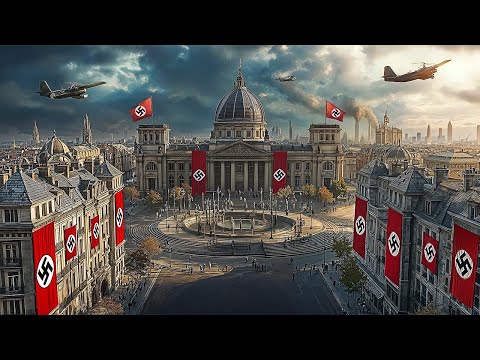
On September 3rd, 1939, France and Great Britain declared war on Germany. That moment forever changed the lives of hundreds of millions. The largest and deadliest conflict in human history had begun. But for the people of Germany, the transformation had started years earlier. Since 1933, the Nazi regime had already reshaped routines, socializing, and culture. Away from the battlefields, the daily life of ordinary Germans under Hitler’s dictatorship is rarely discussed. Yet understanding how millions lived is crucial to comprehending why they were willing to sacrifice everything for the Third Reich.
Before Hitler, Germany was a flawed democracy—the Weimar Republic—marked by economic and social crisis. In 1919, the average income was 25% below pre-war levels. Between 1921 and 1923, brutal hyperinflation hit. At its peak, Germans needed one trillion marks to buy a single dollar. People pushed wheelbarrows full of cash to buy essentials. By the time Hitler became chancellor, the economy was in shambles.
Hitler promised that under his leadership, the economy would thrive—but only for those pure of race. The Nazis skillfully created scapegoats: first communists, then Jews. Hitler also blamed the Weimar Republic for cultural decadence that supposedly tainted German morals. The Nazi project sought not just economic recovery, but a complete dismantling of Weimar society, replaced by one based on race and national tradition.
Daily life changed drastically for 65 million Germans with the inauguration of the Third Reich in 1933. But Hitler’s plans were far-reaching. The Nazi party adopted an old expansionist concept: Lebensraum, or living space. It was the idea that the Aryan race needed more territory to develop fully—land populated by undesirable peoples or controlled by other states. In every speech, Hitler highlighted that Germans had not only the need but the right to take it by force. Most young people sympathized with this aggressive revolutionary ideology, while older citizens welcomed the chance to reclaim territory lost after World War I.
Hitler himself was born in Austria, not Germany. He explained that being German was a matter of blood, not birth. Austrians and Germans were united by Aryan blood. This justified his first expansionist orders: annexing Austria and retaking territories lost in WWI. The Saarland returned in 1935, and the Sudetenland followed in 1938. Eventually, the Third Reich took all of Czechoslovakia and invaded Poland in 1939—sparking World War II.
Back home, most people seemed to approve of these steps toward a Greater German Reich. But if civilians imagined the war would be confined to battlefields and early victories would bring peace and prosperity, they were soon disillusioned. Rationing and shortages became daily inconveniences, imposed mainly on German women in the early months of the war.
Long before the war, the Nazis decided to completely modify the place of women in civil society. According to the party, women in the Weimar Republic had left their natural place as devoted housewives thanks to social democrats, communists, and Jews. They claimed previous governments had masculinized women by giving them the right to vote and voice their concerns—turning them into thinking beings with their own opinions instead of docile wives. Moreover, women who worked aggravated male unemployment and forced salaries to plummet. There was no place in the Third Reich for so-called double earners. A man’s salary was supposed to support any family.
Of course, after the long years of the Weimar Republic, this did not seem like a loss of independence for women, but a welcome respite. Most welcomed the possibility of not having to work long hours and having time for house and children. Hitler promised jobs for every man and competitive salaries. To a degree, these promises became reality. But Hitler also restricted women’s access to universities: since 1933, only 10% of university places could be given to women. Women were excluded from leadership positions and could only aspire to become secretaries. Politics was not a suitable field for women.
The task of Nazi women’s organizations was to lead women back to traditional feminine duties. The first step in creating jobs in 1933 was to ease women out of the labor market and universities. Marriage credits and child bonuses were part of the anti-emancipation campaign. The Nazis implemented the so-called household year: every woman needed to complete at least a year of household work after high school before attempting university. But with growing labor shortages after 1935, the paradoxical nature of these efforts became obvious—especially for unmarried women. They were reabsorbed into the labor process. The number of working women rose from 4.24 million in 1933 to 5.2 million in 1938. Increasing numbers were employed in industry to support the war and replace male combatants. Women’s economic emancipation continued and even gained momentum during the war.
The perfect German woman was a wife and mother. Mother’s Day became a major propaganda event and a national holiday in 1934. Goebbels ordered Nazi organizations to give members the day off to be with families. Theaters staged relevant plays and gave free tickets to mothers. Priests preached sermons on motherhood. On Mother’s Day in May 1939, 3 million women who had given birth to four or more children were awarded the title Mother of the Reich. They received specially minted Mother’s Honor Crosses: bronze for four children, silver for six, gold for eight or more. Wearers could jump queues in food stores, and Hitler Youth members were instructed to salute them in the street. Mothers with ten children had Hitler as godfather of the tenth child—meaning boys were named Adolf.
Listening to Hitler’s speeches was mandatory. Every school stopped classes to tune the radio to the official broadcast, and loudspeakers in factories and offices played the speech. Members of the Hitler Youth and other organizations were forced to learn some of Hitler’s speeches by heart and repeat them frequently. But long before Hitler became dictator, his speeches were wildly popular and attracted crowds without coercion. Hitler did not create the Nazi party from scratch. He joined an existing organization in 1919, the German Workers’ Party (DAP). A month later, he was one of the speakers at a meeting in a Munich beer hall before an audience of 100. Soon he was speaking before nationalist groups outside Munich. The first real mass meeting on February 24th, 1920, at Munich’s beer hall proved a milestone. Hitler announced a new party program of 25 points and the change of name to National Socialist German Workers’ Party. The mass meetings were the true beginnings of Hitler’s popularity and the consolidation of his dictatorial position within the party.
Hitler, Goebbels, Julius Streicher, and other early Nazis toured Germany and Austria holding increasingly popular rallies. At first they booked theaters and halls, but soon they began holding rallies in public squares. Due to large crowds, the Nazis were escorted by large groups of brown shirts—the party’s attack group. Sometimes brown shirts arrived a day earlier and marched through streets chanting anti-Semitic slogans. On August 30, 1935, Julius Streicher held a rally in Hamburg. The day before, two lorry loads of brown shirt stormtroopers drove through streets known to be inhabited by Jews, throwing blazing torches onto the road. Hamburg party members were told attendance was compulsory. A massive advertising campaign offered tickets at 10 Reichsmarks each to the unemployed—one of the main targets for Nazi recruiters, as they had the most to gain and nothing to lose. 20,000 people attended that rally. Many wore SA, SS, Hitler Youth, or Labor Service uniforms, strategically placed to lead applause at pre-ordained points in Streicher’s speech. Riots or violence often erupted before or after rallies.
Without a doubt, the best and most successful speaker was Adolf Hitler himself. He wrote his own speeches and frequently engaged in lengthy tours around Germany, speaking, meeting officials, and carrying out ceremonial functions. His style was assertive and feisty, but flexible enough to gauge the audience and modify his speech accordingly. His rallies were frequently attended by entire families who wanted to be closer to the leader and gain insight into his plans. Hitler Youth and SS members greeted families and gifted small red flags with black swastikas to kids so they could cheer. Official parades and commemorations were massive, and every family was expected to attend wearing their best clothes. Nazi rallies, especially when Hitler was in town, became huge social and familiar events.
Long before the Nazis came to power, Hitler declared education of Germany’s children a priority. But after 1933, when state schools came under Nazi control, it became clear it was not education but indoctrination. Traditional subjects like biology and history were replaced by racial ideology and pseudo-sciences. Even math was used to disseminate propaganda. Pupils were asked, for example, how much money could be saved if the state eliminated 300,000 mentally ill people in care at a cost of four marks a day. Teachers were required to sanction the new curriculum and prove loyalty by joining the Nazi Teachers League. Founded in April 1927 by a schoolteacher named Hans Schemm, the league grew from 12,000 members in January 1933 to 220,000 by year’s end. By 1936, 97% of all schoolteachers—some 300,000—were members. The remainder were forced to leave their posts. One-third of female teachers were compelled to take early retirement in 1933 to fulfill their primary role as homemakers and mothers.
Primary school was mandatory for every child aged 7 to 11. During the Third Reich, a picture of Adolf Hitler hung on the wall in almost every classroom. At the beginning and end of every lesson, teachers and pupils greeted each other with the right hand raised—the official German greeting. Classes were often interrupted to listen to major political speeches on the radio in the school hall. Afterwards, they discussed the speech’s contents. Secondary education was divided into two: grammar school for general education and preparation for higher education, and the Realschule for technical skills. In secondary schools, English was frequently taught as the first foreign language, with French as the second. Boys might also be taught Latin. Girls typically learned secretarial skills, domestic science, needlework, art, and music in addition to basic subjects. History was rewritten to emphasize positive aspects of German nationalism and blame Allied victors and Jews for the defeat of 1918. Racial purity was taught in practically every subject, with emphasis on the need for Lebensraum. The preservation of the superior Aryan bloodline was illustrated with propaganda films comparing Jews to plague-spreading vermin. These were enforced with films and photographs of mentally and physically disabled people to justify forced sterilization and euthanasia. Fanciful racial theories were introduced from age six under a new subject called Race Knowledge, presented as proven fact of Aryan superiority and Jewish and Slavic inferiority. Students had no opportunity to question these theories, as all Jews had been excluded from public schools after 1935 under the Nuremberg Laws.
But there was another type of education enforced by the Nazi Party since 1933, aimed at forming the future elite. The future National Socialist leadership corps was educated in four different institutions according to age and training type. The first, named Order Castles, were founded in 1933 along with the National Political Education Institutes (Napolas). Beginning in 1937, there were also the Adolf Hitler Schools. In 1941, Alfred Rosenberg built his dream institution, the Supreme School, in Frankfurt—short-lived, as it closed after the war. The Napolas were boarding schools for boys aged 10 to 18, continuing the tradition of Prussian cadet training schools. They typified the Nazi reorganization of established institutions. The program concentrated on military spirit, fusion of Prussian and Nazi values, and development of courage, dedication, and simplicity. Administrators, always under a high-ranking SS officer, were members of the SA and SS. The Napolas emphasized competition, military indoctrination, and training with horses, motorcycles, cars, and glider planes. Although intended for a select few, they expanded exponentially after the war began. They combined old and new militarism, conservative nationalist and Nazi military training. In contrast, the Adolf Hitler Schools were geared toward intellectual young Nazis. The 12-to-18-year-olds in these leadership schools were, according to Hitler’s personal orders, meant above all to become Nazi functionaries. Graduates were given preference in non-party posts as well. In the end, the war thwarted Hitler’s dream of a network of specialized schools, and none of the pupils became party leaders.
An interesting cultural phenomenon known as the Swing Movement appeared in nightclubs in the mid-1930s and quickly spread to almost every large and medium-sized German city. Swing clubs, especially in Hamburg in the 1940s, attracted young people from the upper echelons of Nazi society who experienced a romantic desire for adventure and nonconformism toward the rigidity of regime life. Swing was a predominantly upper-class movement influenced above all by English culture. Swing boys and girls gathered in cocktail bars and nightclubs, sometimes organizing parties in their own family homes. They chose pretentious, provocative clothing, flirted openly, and danced wildly. Boys wore tailored suits, sport coats, felt hats, white silk scarves, closed umbrellas, and long hair. Girls wore heavy makeup, painted nails, short skirts, and sexy blouses, and let their hair grow long. Party authorities regarded this youth movement with astonishment but also caution, since it was an upper-class movement. The Nazis disliked its English influences and overly global character. They resented its cult of sexuality and scruffiness, its tolerance or indifference to Jews, and its fondness for American music—which, according to Nazi leadership, was of black and Jewish influence. The first ordinance banning swing dancing was enacted in Düsseldorf in November 1937. Other municipalities followed, and by summer 1939, swing dancing was effectively banned in most German cities. The decision was not easy, as it was one of the few times Aryan Germans from wealthy backgrounds were affected. The authorities commissioned the Hitler Youth and other Nazi organizations to prepare reports on the swing lifestyle. These reports condemned the young swingers for their lack of patriotic sentiment and nonconformism. But above all, they reported details about their sexual practices—polygamy, orgies, sex with or among minors, and tolerance and sex with Jews. Clearly, the swing lifestyle in a context of war against England and the United States went against nationalist sentiment. Despite being a high-class movement not accused of Jewish or communist origin, the main axis of criticism was sexual promiscuity. But the main concern was that the swing movement was tolerant toward Jews. The Gestapo, when it came to adolescent sexuality, was much more concerned about Jewish involvement than promiscuity. The counter to the swing movement was the Hitler Youth, seen as boring kids, too obedient to the rules. Many young people in the swing movement had managed to avoid joining the Hitler Youth thanks to their high societal positions. Their rejection had less to do with extreme right-wing ideology—which they cared little for—and more to do with the dull, stiff lifestyle. The Hitler Youth were not exempt from engaging in sex, but as if it were a political religion. They did it not so much for pleasure but for a higher mission to fill Europe with Aryans. Sex for the Hitler Youth did not mean individual pleasure but fulfillment of duty—an almost military view of sexual practice.
On June 27, 1933, Hitler’s government issued a law authorizing the building of a new type of road: the motorway, or Autobahn. These dual carriageways would link Germany’s major cities, establishing a communications network for unprecedented speed and directness. Hitler was an enthusiast of the automobile, considering travel by car aesthetically superior to train or plane. The motorways were built along scenic routes with laybys for travelers to admire the German countryside. For Hitler, they fulfilled a racial purpose: linking modern Germans to the authentic woods, mountains, and fields of their native land, and expressing the Nordic race’s delight in adventure, speed, and excitement provided by modern technology. By May 1935, the first stretch from Frankfurt to Darmstadt was open. 3,500 km were completed by summer 1938. The motorways were perhaps the most durable propaganda exercise of the Third Reich—they survive to this day. Hitler took close personal interest in the routes, intervening to redirect them when he thought they were not picturesque enough. He insisted on personally approving bridge and service station designs, many bold examples of modernism. However, few people had the means to enjoy the motorways before 1939, as Germany was one of the least motorized societies in Europe. In 1935, only 1.6% of the population owned motor vehicles, compared to 4.9% in France and 20.5% in the United States. This is why, at the Berlin Motor Show, Hitler announced not only the motorway program but also the promotion of motorsports and reduction of taxes on car ownership. The result was a 40% increase in motor vehicle industry workers from March to June 1933 alone. Car production doubled from 1932 to 1933 and again by 1935. Over a quarter of a million cars were produced annually, and prices were much lower than at the end of the 1920s. Cars embodied Hitler’s technological vision of Germany’s future, encompassing car ownership on an almost universal scale. Already in the 1920s, he talked about motorization with visitors at Landsberg prison. By the early 1930s, he was drawing sketches of a small family vehicle selling for less than a thousand Reichsmarks—within reach of the vast majority. Meeting skepticism from mainstream industry, Hitler secured the collaboration of racing car engineer Ferdinand Porsche, whose prototype was ready by the end of 1937. At Hitler’s insistence, production was funded by the German Labor Front, which built a vast new factory. Hitler called the car the Volkswagen—the people’s car. In public speeches, he also called it the Strength Through Joy car, imagining up to a million models a year. A huge advertising campaign urged workers to save part of their wages with the slogan “A car for everyone.” The campaign was a huge success, thanks to publicity and because workers were already enjoying better wages.
Creating a motorized society was not just a technological vision; it was intended to produce immediate benefits. Building the motorways could provide employment for 600,000 men, not just on the roads but in supplying industries. By June 1935, some 125,000 men worked on motorway construction alone. The program did create jobs, though fewer than many supposed. The Nazis had gained electoral success in the early 1930s on the promise to pull Germany out of depression. 6 million people were registered as unemployed in January 1933. By January 1933, the number of employed had fallen to 11.5 million from 20 million in 1929. Getting Germany back to work was the immediate priority of Hitler’s coalition government. On June 1, 1933, the government promulgated the first law on reduction of unemployment, making 1,000 million Reichsmarks available for public works. A second law on September 21, 1933, made 500 million Reichsmarks in credits available for private businesses, particularly construction. By 1934, official statistics showed unemployment had fallen to less than half of 1932 levels. By 1935 it stood at 2.2 million, and by 1937 below one million. Incessant Nazi propaganda boasting that the battle for work was being won gained widespread credence. New regulations cut working hours in some trades, making it necessary to employ more workers but cutting wages substantially. So while these schemes reduced official unemployment, they did not bring a general increase in purchasing power. Along with propaganda trumpeting victories in the struggle for work, the regime sought alternative means of reconciling the working class with the Third Reich. Chief among these was the extraordinary organization known as the National Socialist Community Strength Through Joy. Founded as a subsidiary of the German Labor Front on November 27, 1933, Strength Through Joy aimed to organize workers’ leisure time rather than allow them to organize it themselves—making leisure serve the interests of the racial community and reconciling the worlds of work and free time, factory and home, production line and recreation ground. Workers were to gain strength for work by experiencing joy in leisure. Above all, Strength Through Joy would bridge the class divide by making middle-class leisure activities available to the masses. Its most striking activity was the organization of mass tourism for workers. Already in 1934, some 400,000 people participated in package tours within Germany. By 1937, the number had grown to 1.7 million. In 1939 alone, 175,000 people went to Italy on organized trips, many on cruises. By 1939, the organization owned eight cruise ships, two specially constructed and four rented permanently, carrying members to Libya, Finland, Bulgaria, and Istanbul—celebrating Germany’s solidarity with real or potential allies and advertising a future German-dominated European empire. Millions of workers who took part had never before gone on vacation. Strength Through Joy offered heavily discounted leisure activities within financial reach of many workers. By 1935, over 3 million people took part in physical education and gymnastics evenings, while many others enjoyed cheap access to tennis, sailing, and other sports previously only for the upper classes. But perhaps the department that helped the working class most was called Beauty of Labor. Its basic intention was to compensate for low wages and long hours through improvements in the workplace. Beauty of Labor campaigned for washing facilities, toilets, changing rooms, lockers, showers, and improved hygiene in factories—more air, less noise, proper work clothing, tidiness, and order. They claimed healthy workers in clean workplaces would work better and be happier. To reinforce this, Beauty of Labor arranged concerts on the shop floor, encouraged on-site sports and recreation facilities, and pressured employers to provide decent canteens and clean up debris. By 1938, it claimed nearly 34,000 companies had improved in these respects. Tax incentives encouraged employers, and Beauty of Labor staged competitions and awarded prizes for the most improved firm, issuing winners certificates signed by Hitler declaring them model firms. The benefits to employers and the regime in terms of increased productivity were obvious. But all these improvements were bought at the workers’ own expense, since many firms expected employees to do the painting, cleaning, and building themselves after hours for no extra pay, docked wages to cover costs, and threatened those who did not volunteer with dismissal or even the concentration camp. When World War II erupted in 1939, Germany was a much more industrialized nation than in the 1920s, and workers were happier, even when they still had to work long hours for low wages.
While millions of German workers enjoyed cheap entertainment, cruises, and workplace benefits, the money had to come from somewhere. Benefits for so-called pure Aryan workers were financed thanks to one of Hitler’s most ambitious plans: the Aryanization of the economy. This was nothing more than the full-scale expropriation of the Jews—a vast campaign of plunder with few parallels in modern history. True to Hitler’s ideology, one of the prime targets of Nazi propaganda before 1933 had been the department store, where since the late 19th century people bought cheap mass-produced goods. Many founders of such stores were Jewish, reflecting the concentration of Jews in drapery and retail. What started as criticism of consumerism evolved into hatred for Jews, blaming them for everything wrong with Germany’s economy. Point 16 of the Nazi party program in 1920 demanded immediate nationalization of big department stores and renting them at low prices to small businessmen. In March 1933, Brown Shirt Stormtroopers broke into a Woolworths in Gotha and trashed the store. Violent attacks were launched on department stores irrespective of ownership. In Braunschweig, a restaurant in a department store was shot to pieces by brown shirts armed with pistols. Less dramatically, there were many demands to close department stores or tax them out of existence. But the Ministry of Economics and Nazi leadership quickly realized that closing enterprises employing thousands would seriously damage the battle for work. The boycott of department stores illustrated how Nazi priorities had changed since 1920. Starting with an anti-capitalist message, they abandoned it under economic necessity and substituted a determined drive to remove Jews from the German economy. The department stores did not disappear. Indeed, the campaign against Jewish owners opened new opportunities for non-Jewish companies. If, as the Nazis claimed, Germany’s economic ills originated with the Jews, then they would be solved by getting rid of Jewish economic influence rather than attacking business itself. Since early 1933, local party groups harassed and attacked Jewish shops. Stormtroopers painted slogans on display windows to discourage patronage or pressure authorities to place orders elsewhere. Alarmed at the economic effects, the government and party issued warnings. Hitler himself declared at the beginning of October 1933 that civil servants could buy in Jewish-owned shops. Yet in the 1933 Christmas shopping season, stormtroopers again stood outside Jewish-owned shops with placards proclaiming anyone who went inside a traitor to the German race. Increasing numbers of local markets barred Jewish traders. No Jewish firms were permitted to advertise. Local authorities broke off business relations with Jewish-owned companies. Further widespread boycotts occurred in spring 1934. Violence often accompanied such events, from smashing shop windows to a bomb attack on a synagogue in Hausach. From 1936 onwards, blaming Jews for financial distress gave way to the next part of the plan: dispossessing them of their wealth to fund party activities, keep workers happy, and start the arms race that would allow Hitler to conquer half of Europe. Ministerial discussions on anti-Jewish economic measures continued through 1936, leading to laws making transfer of Jewish-owned funds abroad illegal. Prosecutions followed, with prison sentences. Mere suspicion of intent to transfer funds was enough for confiscation. This provided the legal pretext for growing expropriations. At the same time, sporadic local boycotts and attacks continued, while laws from Berlin made life progressively more difficult for Jewish businesses. Aryanization meant transferring wealth and ownership of shops and firms from Jews to German hands. To expedite matters, Hermann Göring and the Interior Ministry issued a decree on April 26, 1938, forcing every Jew or non-Jewish spouse of a Jew to declare all assets held at home and abroad over 5,000 Reichsmarks. Further orders barred Jews from acting as auctioneers, possessing or selling arms, and signing legal contracts. By this time, pressures on Jewish-owned companies had become irresistible. Many Jews opted to leave the country while they could, taking few things. They might not have known it in 1938, but they saved their lives in the process. There were nearly 800 Aryanizations between January and October 1938, including 340 factories and 22 private banks. The pace increased and eventually gave way to the Final Solution—the extermination of all Jews and expropriation of their belongings. Aryanization offered many opportunities to non-Jewish businesses to enrich themselves, and many eagerly grasped them. At the very least, when Jewish businesses liquidated, non-Jewish competitors congratulated themselves on losing some competition. This was true at all levels.
The imposition of a police state meant every man and woman was under surveillance and could face legal problems depending on what they did and said, in public and in private. The Nazis made a concerted effort to win hearts and minds, ingratiating themselves with every section of society and making promises they had no intention of keeping. They mastered political propaganda by staging mass rallies and marches emphasizing unity and fanaticism, giving a false impression of popularity. While many accepted this as a necessity and a small price for economic stability, others found it hard to stay silent every day. The regime outlawed all other political parties and Catholic youth organizations. All public and private institutions had to conform to Nazi ideology. Young boys and girls in high school had to sign a declaration of allegiance starting in 1933. While this was a formality and even most opponents signed to avoid persecution, others felt they were betraying their ideologies. On May 10, 1933, students in Berlin and other cities organized public burning of books deemed un-German, including titles by Thomas Mann, H.G. Wells, Jack London, Sigmund Freud, Albert Einstein, and Helen Keller. Propaganda Minister Goebbels incited the students with a speech revealing the real reason: the Nazis feared anything that encouraged the masses to think for themselves and question what they were told. This is why they resorted to propaganda and intimidation in all aspects of life. Fortunately, the Nazis did not intimidate everyone. Less fanatical party members might overlook critical remarks by friends, and some even warned communist colleagues of imminent arrests—especially among manual workers in factories, shipyards, and railways, where comradeship often came before party loyalty. The suspect could lie low for a few days, absence blamed on illness. But many political opponents were not so fortunate. Anyone could be sacked without reason, with the official pretext of political unreliability. Manual and white-collar workers were acutely aware that wages declined steadily during the Nazi era. While income from factory ownership and investment rose, workers put in longer hours and worked faster to meet targets, hoping for wage increases. While the Nazi leadership declared solidarity with the people, they enacted laws binding workers to a form of medieval serfdom. Under the Law for the Organization of National Labor from 1934, industry regressed to a feudal system with employees reduced to servants. If an employer didn’t want an employee to leave, they could refuse to hand over required documents for a new job. In general, the Nazis were incredibly efficient in crushing political opposition—less through improving the economy than through non-stop propaganda geared toward suppression and fragmentation of political and organizational life. This effort directed people toward private pleasures and purposes: getting a steady job, marrying, having children, improving living conditions, going on holiday. Economic achievement became the only real meaning in life for many. Politics was an irrelevant irritation. By the end of the 1930s, the great mass of German workers had reconciled themselves, often reluctantly, to the Third Reich. They might be unpersuaded by its core ideology, but most reflected that it had given them a steady job and overcome the hardships of the Weimar years. For that alone, the vast majority seemed to think it was worth tolerating—especially since organized resistance was minimal and the price of dissent so high. There was widespread informal and individual refractory behavior in factories and workplaces on the eve of World War II, but it did not amount to opposition, let alone resistance. Nor did it create any real sense of crisis in the Third Reich’s ruling elite.
By 1939, the German people had traded freedom for stability, and the bill was coming due. When the first bombs fell on German cities, the same workers who had celebrated Strength Through Joy cruises found themselves digging through rubble. The regime that promised a thousand-year Reich would last twelve years, leaving behind ashes and silence.
The daily life of ordinary Germans under Hitler remains a warning: comfort and fear can coexist, and tyranny often arrives not with terror alone, but with jobs, holidays, and a sense of belonging. The question history leaves us is not how a nation could follow such a leader, but how any of us might, given the right promises and the right scapegoats.
What would you have done in their place—and what will you do now, when similar promises are made again?






